 Add to Chrome
 Add to Firefox
 Add to Edge
Bayesian Inference and Decision Audits for Public Archives of Frontier AI Evaluations
Jun 15, 2026
Public AI evaluations are often read as terminal leaderboards, yet the underlying evidence is a selective time series shaped by reporting rules, benchmark revisions, and missingness. Repeated public archives for LiveBench and Open LLM Leaderboard v2 serve as the primary longitudinal record; LMArena provides a preference stress test; and GAIA and tau-bench contribute limited agentic pilots. Together, these archives instantiate a Bayesian inference problem: under a fixed reporting convention, one constructed terminal-only example over $1{,}000$ systems is compatible with two pre-terminal histories, yielding times of $23.03$ or $75.13$ to reach within $0.05$ of the ceiling under the same terminal-tail model. In synthetic posterior comparisons, action-facing diagnostics differ across observation regimes. The candidate selection-aware frontier model fails synthetic recovery, objective-archive prediction, preference transfer, and uncertainty calibration; correspondingly, fixed audit gates reject its stronger claims. An archive-and-adjudication protocol reconstructs public evaluation histories, isolates a verified timing boundary, and falsifies unsupported frontier claims.

Every Eval Ever: A Unifying Schema and Community Repository for AI Evaluation Results
Jun 12, 2026AI evaluations are widely used for testing and understanding progress. However, the diverse evaluators bring with them inconsistencies that challenge analysis and comparison. First, results are saved in incompatible formats, scattered across leaderboards, papers, blog posts, evaluation harness logs, and custom repositories. Second, results are created by different evaluation frameworks, which produce divergent scores for nominally identical evaluations and record metadata inconsistently, hindering comparison, cross-community evaluation science, cost reduction, and reuse. We introduce Every Eval Ever, the first shared schema and community-crowdsourced repository for AI evaluation results. The schema standardizes how evaluations are represented in a unified, single JSON document. It is source-agnostic by design, ingesting results from evaluation harnesses and papers alike, and optionally stores per-instance outputs for fine-grained analysis. We contribute: (i) a community-governed metadata schema with a companion instance-level schema, the first standardization effort of its kind; (ii) automatic converters from popular formats, evaluation harnesses, and leaderboards to the unified schema; and (iii) a crowdsourced community database hosted on Hugging Face, currently spanning to date 22,235 models, 2,273 unique benchmarks, and 31 evaluation formats.
Evaluation Cards: An Interpretive Layer for AI Evaluation Reporting
Jun 09, 2026AI evaluation results are produced at scale but reported inconsistently across leaderboards, model cards, benchmark papers, and company blogs. The cost is interpretive: readers cannot reliably compare results across sources, identify what a report omits, or trace an aggregate claim to its underlying evidence. Recent efforts address isolated components but leave three gaps: they cover only narrow slices of the evaluation lifecycle and do not compose into a single interpretable record; they specify static representations that do not differentiate the questions different stakeholders bring to the same evidence; and they remain proposals on paper, lacking the extraction infrastructure required for adoption at scale. We present \EvalCards{}, an operational reporting layer that composes benchmark metadata, evaluation run data, and model metadata into a unified record. We (1) derive a reporting schema from a structured review of 52 papers and 10 stakeholder interviews, (2) implement four interpretive signals (reproducibility, documentation completeness, provenance and risk, and score comparability), rendered through reader modes calibrated to research and non-research audiences, and (3) deploy a monitoring tool that applies \EvalCards{} across 5,816 models, 635 benchmarks, and 101,843 results, surfacing systematic gaps in current reporting practice.
When AI Benchmarks Plateau: A Systematic Study of Benchmark Saturation
Feb 18, 2026Artificial Intelligence (AI) benchmarks play a central role in measuring progress in model development and guiding deployment decisions. However, many benchmarks quickly become saturated, meaning that they can no longer differentiate between the best-performing models, diminishing their long-term value. In this study, we analyze benchmark saturation across 60 Large Language Model (LLM) benchmarks selected from technical reports by major model developers. To identify factors driving saturation, we characterize benchmarks along 14 properties spanning task design, data construction, and evaluation format. We test five hypotheses examining how each property contributes to saturation rates. Our analysis reveals that nearly half of the benchmarks exhibit saturation, with rates increasing as benchmarks age. Notably, hiding test data (i.e., public vs. private) shows no protective effect, while expert-curated benchmarks resist saturation better than crowdsourced ones. Our findings highlight which design choices extend benchmark longevity and inform strategies for more durable evaluation.
Triangulation as an Acceptance Rule for Multilingual Mechanistic Interpretability
Dec 31, 2025Multilingual language models achieve strong aggregate performance yet often behave unpredictably across languages, scripts, and cultures. We argue that mechanistic explanations for such models should satisfy a \emph{causal} standard: claims must survive causal interventions and must \emph{cross-reference} across environments that perturb surface form while preserving meaning. We formalize \emph{reference families} as predicate-preserving variants and introduce \emph{triangulation}, an acceptance rule requiring necessity (ablating the circuit degrades the target behavior), sufficiency (patching activations transfers the behavior), and invariance (both effects remain directionally stable and of sufficient magnitude across the reference family). To supply candidate subgraphs, we adopt automatic circuit discovery and \emph{accept or reject} those candidates by triangulation. We ground triangulation in causal abstraction by casting it as an approximate transformation score over a distribution of interchange interventions, connect it to the pragmatic interpretability agenda, and present a comparative experimental protocol across multiple model families, language pairs, and tasks. Triangulation provides a falsifiable standard for mechanistic claims that filters spurious circuits passing single-environment tests but failing cross-lingual invariance.
Who Evaluates AI's Social Impacts? Mapping Coverage and Gaps in First and Third Party Evaluations
Nov 06, 2025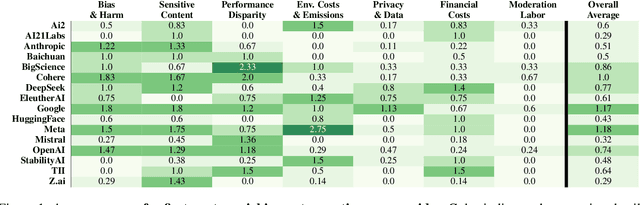
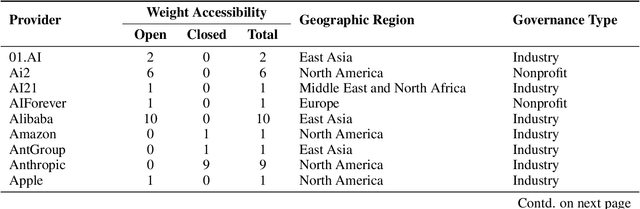
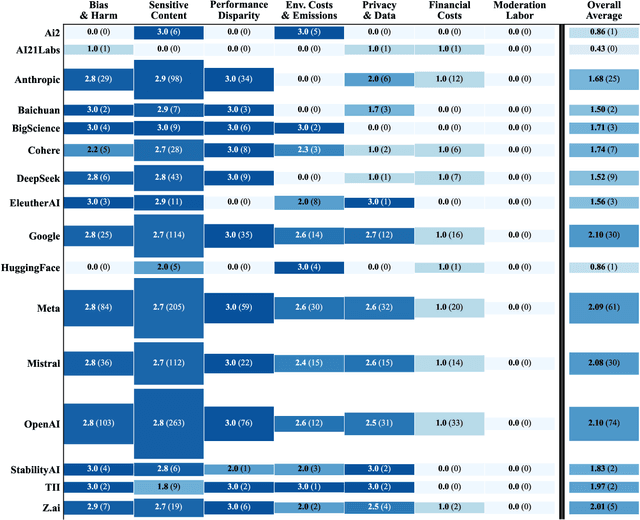
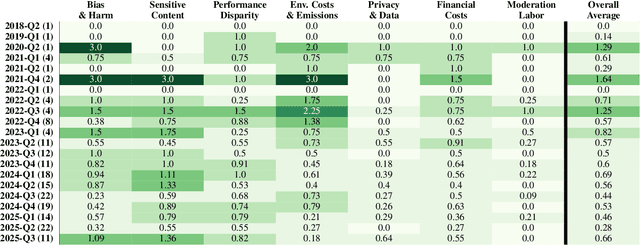
Foundation models are increasingly central to high-stakes AI systems, and governance frameworks now depend on evaluations to assess their risks and capabilities. Although general capability evaluations are widespread, social impact assessments covering bias, fairness, privacy, environmental costs, and labor practices remain uneven across the AI ecosystem. To characterize this landscape, we conduct the first comprehensive analysis of both first-party and third-party social impact evaluation reporting across a wide range of model developers. Our study examines 186 first-party release reports and 183 post-release evaluation sources, and complements this quantitative analysis with interviews of model developers. We find a clear division of evaluation labor: first-party reporting is sparse, often superficial, and has declined over time in key areas such as environmental impact and bias, while third-party evaluators including academic researchers, nonprofits, and independent organizations provide broader and more rigorous coverage of bias, harmful content, and performance disparities. However, this complementarity has limits. Only model developers can authoritatively report on data provenance, content moderation labor, financial costs, and training infrastructure, yet interviews reveal that these disclosures are often deprioritized unless tied to product adoption or regulatory compliance. Our findings indicate that current evaluation practices leave major gaps in assessing AI's societal impacts, highlighting the urgent need for policies that promote developer transparency, strengthen independent evaluation ecosystems, and create shared infrastructure to aggregate and compare third-party evaluations in a consistent and accessible way.
Position: Bayesian Statistics Facilitates Stakeholder Participation in Evaluation of Generative AI
Apr 21, 2025
The evaluation of Generative AI (GenAI) systems plays a critical role in public policy and decision-making, yet existing methods are often limited by reliance on benchmark-driven, point-estimate comparisons that fail to capture uncertainty and broader societal impacts. This paper argues for the use of Bayesian statistics as a principled framework to address these challenges. Bayesian methods enable the integration of domain expertise through prior elicitation, allow for continuous learning from new data, and provide robust uncertainty quantification via posterior inference. We demonstrate how Bayesian inference can be applied to GenAI evaluation, particularly in incorporating stakeholder perspectives to enhance fairness, transparency, and reliability. Furthermore, we discuss Bayesian workflows as an iterative process for model validation and refinement, ensuring robust assessments of GenAI systems in dynamic, real-world contexts.
Queer In AI: A Case Study in Community-Led Participatory AI
Apr 10, 2023We present Queer in AI as a case study for community-led participatory design in AI. We examine how participatory design and intersectional tenets started and shaped this community's programs over the years. We discuss different challenges that emerged in the process, look at ways this organization has fallen short of operationalizing participatory and intersectional principles, and then assess the organization's impact. Queer in AI provides important lessons and insights for practitioners and theorists of participatory methods broadly through its rejection of hierarchy in favor of decentralization, success at building aid and programs by and for the queer community, and effort to change actors and institutions outside of the queer community. Finally, we theorize how communities like Queer in AI contribute to the participatory design in AI more broadly by fostering cultures of participation in AI, welcoming and empowering marginalized participants, critiquing poor or exploitative participatory practices, and bringing participation to institutions outside of individual research projects. Queer in AI's work serves as a case study of grassroots activism and participatory methods within AI, demonstrating the potential of community-led participatory methods and intersectional praxis, while also providing challenges, case studies, and nuanced insights to researchers developing and using participatory methods.