 Add to Chrome
 Add to Firefox
 Add to Edge
DelusionEval: Measuring Delusion-Linked Behaviors in AI Chatbots
Aug 05, 2026
Mental health professionals have raised concerns about risks of psychological harm from interaction with large language models (LLMs), including "delusional spirals" in which concerning human and LLM behaviors reinforce each other over time. With growing public use of LLM-powered chatbots, there is an urgent need to build evaluations grounded in real-world episodes of psychological harm experienced by users. We developed DelusionEval, an evaluation protocol that tests a model's tendencies to exhibit behaviors linked to promoting user delusions. We prompt each model with 589 unique conversation histories from 18 participants, comprising 12,591 messages from users who experienced delusions and psychological harm. We find that the tendency of an evaluated LLM to exhibit delusion-linked behavior does not reliably correlate with model size, release date, or the presence of test-time reasoning. However, extending the context of prior messages substantially increases rates of delusion-linked behaviors, providing evidence for the importance of context in LLM safety evaluation. For example, the rate of failing to discourage self-harm when the user expresses suicidal ideation increases from 30.0% to 41.1% when an additional 350 messages are prepended to the conversation history. All model families (e.g., GPT, Claude) exhibit substantial rates of delusion-linked behaviors. Within families, later, larger, or higher-reasoning models are not uniformly better across all behavior categories. Our results raise concerns regarding the potential psychological impact of LLMs and the need for more rigorous studies of real-world human-AI interaction.

Expert Evaluation of Clinical AI Tools on Real Point-of-Care Clinical Queries
Jun 27, 2026Physicians now pose millions of clinical questions to AI tools each week, yet these tools are evaluated largely on hypothetical or exam-style questions, not those actually asked in practice. We report a blinded evaluation built on 620 Real-world Point-Of-Care Queries (Real-POCQi) submitted to the OpenEvidence (OE) platform by physicians spanning 30 specialties, as well as 187 questions from HealthBench. 149 practicing physicians across 36 states made head-to-head comparisons between answers from three frontier general-purpose models (Claude Opus 4.8, Gemini 3.1 Pro, and GPT-5.5) and a specialized clinical tool (OE), with graders matched to each question's specialty. When comparing answers along five dimensions relevant to clinical decision support -- accuracy, clinical utility, source quality, verifiability, & completeness -- physicians scored the specialized tool highest on all axes; in the primary analysis on Real-POCQi, win differences (margins between win and loss rates) ranged from 25 to 39 percentage points (p<0.001). Results remained consistent in sensitivity analyses stratifying by citation display, answer length, OE-user status, and Real-POCQi versus HealthBench. In parallel, LLM judges were found to systematically differ from expert judges, though both generally agreed on the best model. These findings underscore two conclusions: (i) AI tool evaluations should reflect real-world query distributions and use expert judges that mirror the specialization defining modern medicine and (ii) the consistent advantage of the specialized tool over general-purpose models does not necessarily mean that the latter cannot serve similar purposes, but that targeted engineering and customization can yield meaningful gains in performance for its users. We release Real-POCQi as a public benchmark, as well as the prespecified statistical analysis for reproducing results of this study.
Every Eval Ever: A Unifying Schema and Community Repository for AI Evaluation Results
Jun 12, 2026AI evaluations are widely used for testing and understanding progress. However, the diverse evaluators bring with them inconsistencies that challenge analysis and comparison. First, results are saved in incompatible formats, scattered across leaderboards, papers, blog posts, evaluation harness logs, and custom repositories. Second, results are created by different evaluation frameworks, which produce divergent scores for nominally identical evaluations and record metadata inconsistently, hindering comparison, cross-community evaluation science, cost reduction, and reuse. We introduce Every Eval Ever, the first shared schema and community-crowdsourced repository for AI evaluation results. The schema standardizes how evaluations are represented in a unified, single JSON document. It is source-agnostic by design, ingesting results from evaluation harnesses and papers alike, and optionally stores per-instance outputs for fine-grained analysis. We contribute: (i) a community-governed metadata schema with a companion instance-level schema, the first standardization effort of its kind; (ii) automatic converters from popular formats, evaluation harnesses, and leaderboards to the unified schema; and (iii) a crowdsourced community database hosted on Hugging Face, currently spanning to date 22,235 models, 2,273 unique benchmarks, and 31 evaluation formats.
Characterizing Delusional Spirals through Human-LLM Chat Logs
Mar 17, 2026As large language models (LLMs) have proliferated, disturbing anecdotal reports of negative psychological effects, such as delusions, self-harm, and ``AI psychosis,'' have emerged in global media and legal discourse. However, it remains unclear how users and chatbots interact over the course of lengthy delusional ``spirals,'' limiting our ability to understand and mitigate the harm. In our work, we analyze logs of conversations with LLM chatbots from 19 users who report having experienced psychological harms from chatbot use. Many of our participants come from a support group for such chatbot users. We also include chat logs from participants covered by media outlets in widely-distributed stories about chatbot-reinforced delusions. In contrast to prior work that speculates on potential AI harms to mental health, to our knowledge we present the first in-depth study of such high-profile and veridically harmful cases. We develop an inventory of 28 codes and apply it to the $391,562$ messages in the logs. Codes include whether a user demonstrates delusional thinking (15.5% of user messages), a user expresses suicidal thoughts (69 validated user messages), or a chatbot misrepresents itself as sentient (21.2% of chatbot messages). We analyze the co-occurrence of message codes. We find, for example, that messages that declare romantic interest and messages where the chatbot describes itself as sentient occur much more often in longer conversations, suggesting that these topics could promote or result from user over-engagement and that safeguards in these areas may degrade in multi-turn settings. We conclude with concrete recommendations for how policymakers, LLM chatbot developers, and users can use our inventory and conversation analysis tool to understand and mitigate harm from LLM chatbots. Warning: This paper discusses self-harm, trauma, and violence.
Talk, Evaluate, Diagnose: User-aware Agent Evaluation with Automated Error Analysis
Mar 16, 2026Agent applications are increasingly adopted to automate workflows across diverse tasks. However, due to the heterogeneous domains they operate in, it is challenging to create a scalable evaluation framework. Prior works each employ their own methods to determine task success, such as database lookups, regex match, etc., adding complexity to the development of a unified agent evaluation approach. Moreover, they do not systematically account for the user's role nor expertise in the interaction, providing incomplete insights into the agent's performance. We argue that effective agent evaluation goes beyond correctness alone, incorporating conversation quality, efficiency and systematic diagnosis of agent errors. To address this, we introduce the TED framework (Talk, Evaluate, Diagnose). (1) Talk: We leverage reusable, generic expert and non-expert user persona templates for user-agent interaction. (2) Evaluate: We adapt existing datasets by representing subgoals-such as tool signatures, and responses-as natural language grading notes, evaluated automatically with LLM-as-a-judge. We propose new metrics that capture both turn efficiency and intermediate progress of the agent complementing the user-aware setup. (3) Diagnose: We introduce an automated error analysis tool that analyzes the inconsistencies of the judge and agents, uncovering common errors, and providing actionable feedback for agent improvement. We show that our TED framework reveals new insights regarding agent performance across models and user expertise levels. We also demonstrate potential gains in agent performance with peaks of 8-10% on our proposed metrics after incorporating the identified error remedies into the agent's design.
OCR or Not? Rethinking Document Information Extraction in the MLLMs Era with Real-World Large-Scale Datasets
Mar 03, 2026Multimodal Large Language Models (MLLMs) enhance the potential of natural language processing. However, their actual impact on document information extraction remains unclear. In particular, it is unclear whether an MLLM-only pipeline--while simpler--can truly match the performance of traditional OCR+MLLM setups. In this paper, we conduct a large-scale benchmarking study that evaluates various out-of-the-box MLLMs on business-document information extraction. To examine and explore failure modes, we propose an automated hierarchical error analysis framework that leverages large language models (LLMs) to diagnose error patterns systematically. Our findings suggest that OCR may not be necessary for powerful MLLMs, as image-only input can achieve comparable performance to OCR-enhanced approaches. Moreover, we demonstrate that carefully designed schema, exemplars, and instructions can further enhance MLLMs performance. We hope this work can offer practical guidance and valuable insight for advancing document information extraction.
ErrorMap and ErrorAtlas: Charting the Failure Landscape of Large Language Models
Jan 22, 2026Large Language Models (LLM) benchmarks tell us when models fail, but not why they fail. A wrong answer on a reasoning dataset may stem from formatting issues, calculation errors, or dataset noise rather than weak reasoning. Without disentangling such causes, benchmarks remain incomplete and cannot reliably guide model improvement. We introduce ErrorMap, the first method to chart the sources of LLM failure. It extracts a model's unique "failure signature", clarifies what benchmarks measure, and broadens error identification to reduce blind spots. This helps developers debug models, aligns benchmark goals with outcomes, and supports informed model selection. ErrorMap works on any model or dataset with the same logic. Applying our method to 35 datasets and 83 models we generate ErrorAtlas, a taxonomy of model errors, revealing recurring failure patterns. ErrorAtlas highlights error types that are currently underexplored in LLM research, such as omissions of required details in the output and question misinterpretation. By shifting focus from where models succeed to why they fail, ErrorMap and ErrorAtlas enable advanced evaluation - one that exposes hidden weaknesses and directs progress. Unlike success, typically measured by task-level metrics, our approach introduces a deeper evaluation layer that can be applied globally across models and tasks, offering richer insights into model behavior and limitations. We make the taxonomy and code publicly available with plans to periodically update ErrorAtlas as new benchmarks and models emerge.
The Singapore Consensus on Global AI Safety Research Priorities
Jun 25, 2025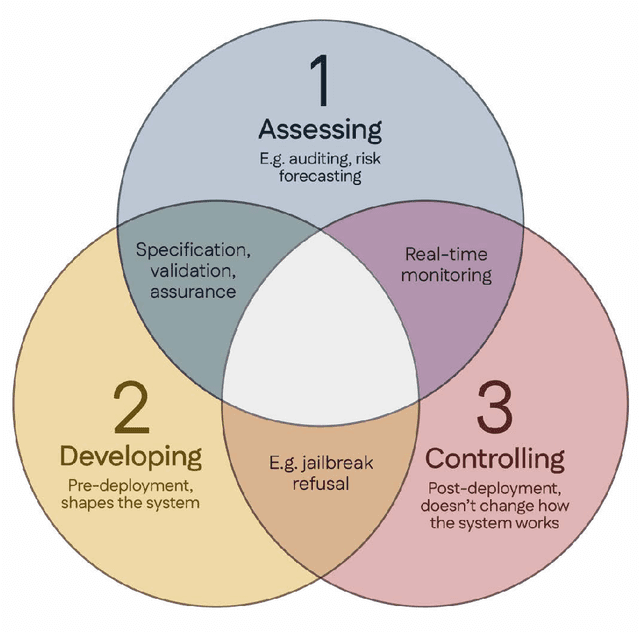
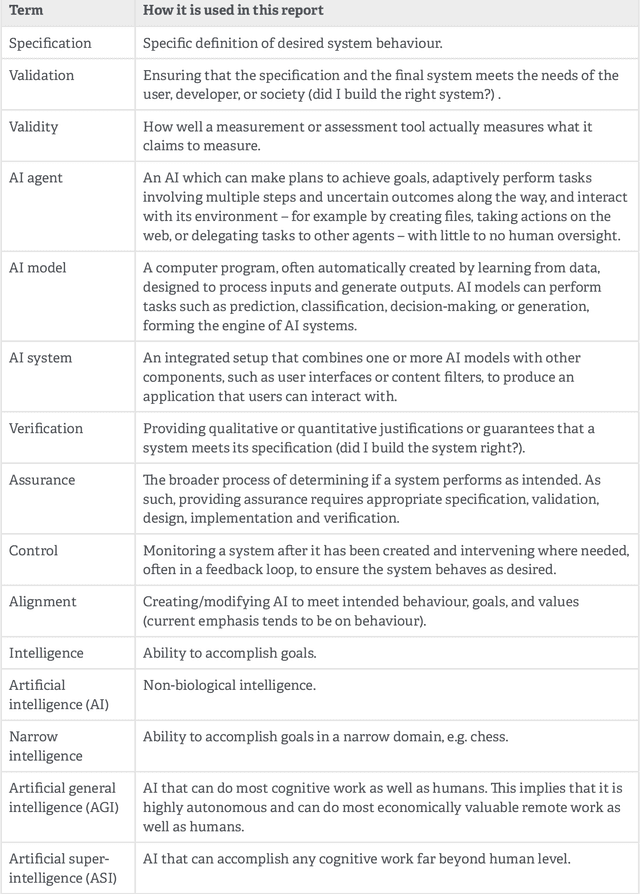
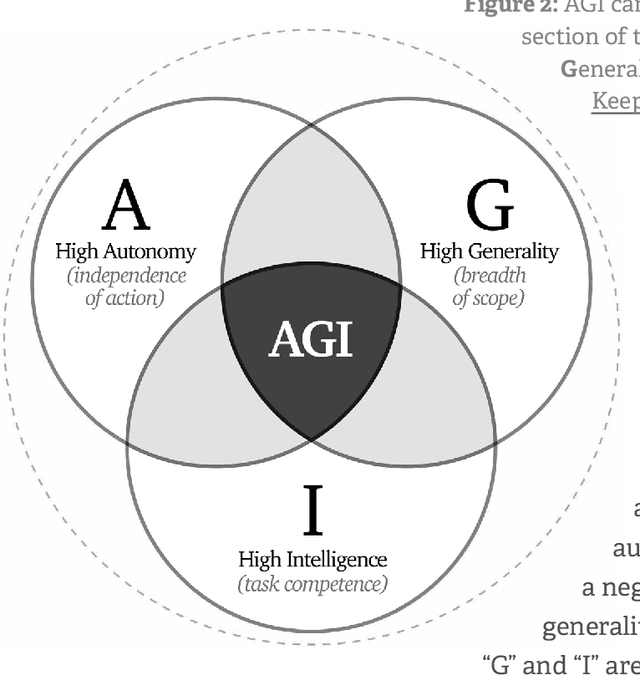
Rapidly improving AI capabilities and autonomy hold significant promise of transformation, but are also driving vigorous debate on how to ensure that AI is safe, i.e., trustworthy, reliable, and secure. Building a trusted ecosystem is therefore essential -- it helps people embrace AI with confidence and gives maximal space for innovation while avoiding backlash. The "2025 Singapore Conference on AI (SCAI): International Scientific Exchange on AI Safety" aimed to support research in this space by bringing together AI scientists across geographies to identify and synthesise research priorities in AI safety. This resulting report builds on the International AI Safety Report chaired by Yoshua Bengio and backed by 33 governments. By adopting a defence-in-depth model, this report organises AI safety research domains into three types: challenges with creating trustworthy AI systems (Development), challenges with evaluating their risks (Assessment), and challenges with monitoring and intervening after deployment (Control).
Judging LLMs on a Simplex
May 28, 2025Automated evaluation of free-form outputs from large language models (LLMs) is challenging because many distinct answers can be equally valid. A common practice is to use LLMs themselves as judges, but the theoretical properties of this approach are not yet well understood. We show that a geometric framework that represents both judges and candidates as points on a probability simplex can provide helpful insight on what is or is not identifiable using LLM judges. Our theoretical analysis uncovers a "phase transition" in ranking identifiability: for binary scoring systems, true rankings are identifiable even with weak judges under mild assumptions, while rankings become non-identifiable for three or more scoring levels even with infinite data, absent additional prior knowledge. This non-identifiability highlights how uncertainty in rankings stems from not only aleatoric uncertainty (i.e., inherent stochasticity in the data) but also epistemic uncertainty regarding which assumptions hold, an aspect that has received limited attention until now. To integrate both types of uncertainty, we use Bayesian inference to encode assumptions as priors and conduct sensitivity analysis of ranking estimates and credible intervals. Empirical evaluations across multiple benchmarks demonstrate that Bayesian inference yields more accurate rankings and substantially improves coverage rates. These results underscore the importance of taking a more holistic approach to uncertainty quantification when using LLMs as judges.
MedHELM: Holistic Evaluation of Large Language Models for Medical Tasks
May 26, 2025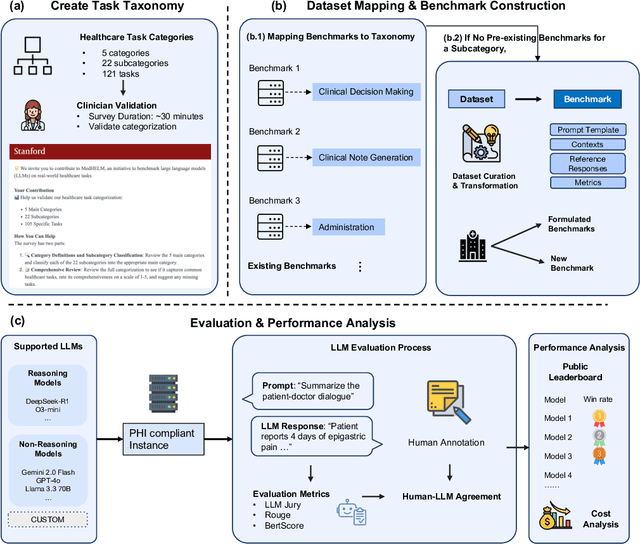
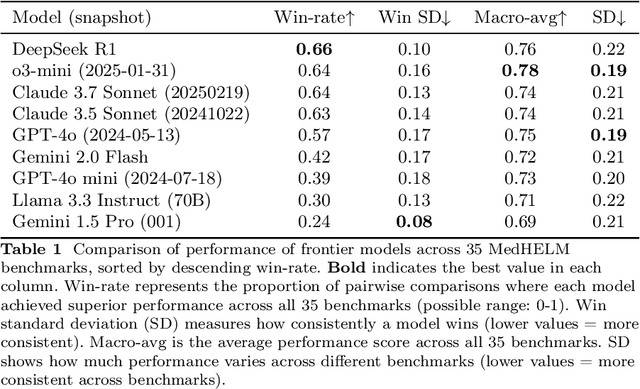
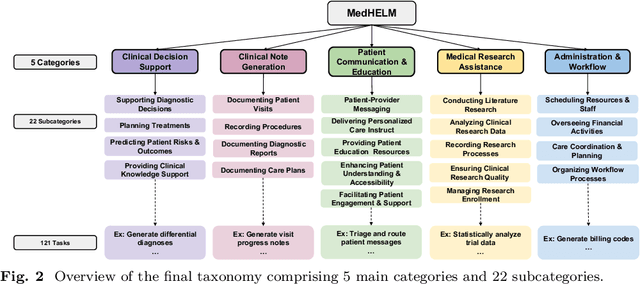

While large language models (LLMs) achieve near-perfect scores on medical licensing exams, these evaluations inadequately reflect the complexity and diversity of real-world clinical practice. We introduce MedHELM, an extensible evaluation framework for assessing LLM performance for medical tasks with three key contributions. First, a clinician-validated taxonomy spanning 5 categories, 22 subcategories, and 121 tasks developed with 29 clinicians. Second, a comprehensive benchmark suite comprising 35 benchmarks (17 existing, 18 newly formulated) providing complete coverage of all categories and subcategories in the taxonomy. Third, a systematic comparison of LLMs with improved evaluation methods (using an LLM-jury) and a cost-performance analysis. Evaluation of 9 frontier LLMs, using the 35 benchmarks, revealed significant performance variation. Advanced reasoning models (DeepSeek R1: 66% win-rate; o3-mini: 64% win-rate) demonstrated superior performance, though Claude 3.5 Sonnet achieved comparable results at 40% lower estimated computational cost. On a normalized accuracy scale (0-1), most models performed strongly in Clinical Note Generation (0.73-0.85) and Patient Communication & Education (0.78-0.83), moderately in Medical Research Assistance (0.65-0.75), and generally lower in Clinical Decision Support (0.56-0.72) and Administration & Workflow (0.53-0.63). Our LLM-jury evaluation method achieved good agreement with clinician ratings (ICC = 0.47), surpassing both average clinician-clinician agreement (ICC = 0.43) and automated baselines including ROUGE-L (0.36) and BERTScore-F1 (0.44). Claude 3.5 Sonnet achieved comparable performance to top models at lower estimated cost. These findings highlight the importance of real-world, task-specific evaluation for medical use of LLMs and provides an open source framework to enable this.