 Add to Chrome
 Add to Firefox
 Add to Edge
DeepResearch Agent System
Jul 30, 2026
The DeepResearch Agent System is a large language model system engineered for deep information retrieval, multi-step reasoning, and autonomous research tasks. Built upon a sparse activation architecture with 30 billion total parameters of which only 3 billion are activated per token, the system achieves state-of-the-art performance on multiple agent search benchmarks while delivering 3.2 times faster inference compared to dense counterparts of equivalent scale. The system supports a 128K-token context window with hierarchical attention mechanisms that yield 18.7% accuracy and 23.4% recall improvements over standard long-context approaches. A dual-mode reasoning engine provides both a ReAct paradigm for basic multi-step problem solving and an IterResearch mode for high-performance iterative research with up to 20 reasoning steps, collectively delivering a 31.2% accuracy improvement over single-pass baselines. Multi-tool coordination integrates retrieval, computation, web search, and file parsing modules to achieve 92.1% tool-use accuracy. A reinforcement learning optimization framework based on the GRPO algorithm provides token-level policy gradients that improve training stability by 35% and accelerate convergence by 42%. An automated data synthesis pipeline with seed-based expansion achieves a 92.5% usability rate. Benchmark results include 87.3% on Humanity's Last Exam, 85.3% on BrowserComp Chinese, and 91.2% on WebWalkerQA. The system is fully open-sourced, including data synthesis, training, and inference code, and supports applications in academic research, business analysis, R&D support, and education.

SugarTextNet: A Transformer-Based Framework for Detecting Sugar Dating-Related Content on Social Media with Context-Aware Focal Loss
Nov 11, 2025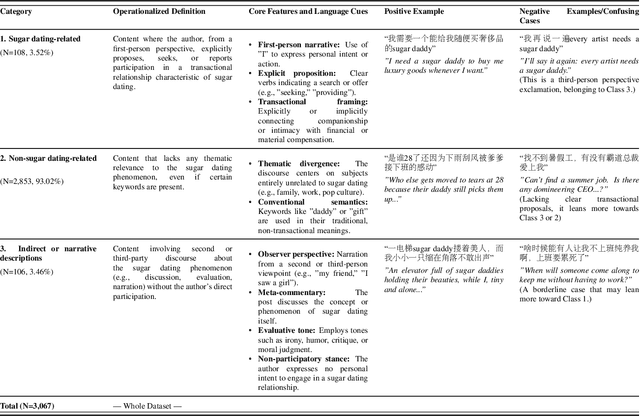
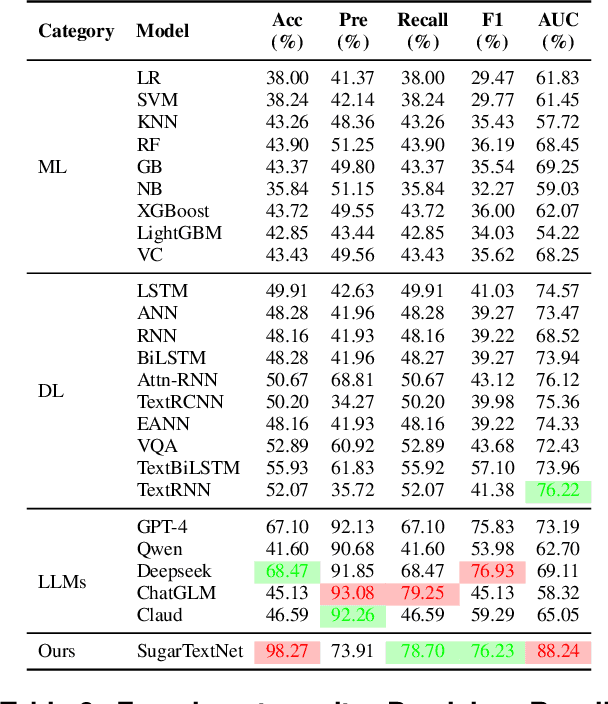
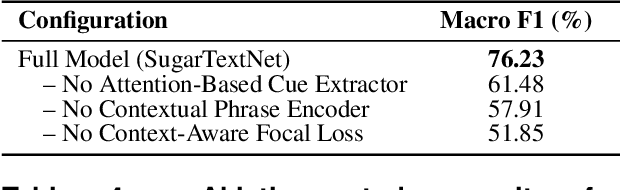
Sugar dating-related content has rapidly proliferated on mainstream social media platforms, giving rise to serious societal and regulatory concerns, including commercialization of intimate relationships and the normalization of transactional relationships.~Detecting such content is highly challenging due to the prevalence of subtle euphemisms, ambiguous linguistic cues, and extreme class imbalance in real-world data.~In this work, we present SugarTextNet, a novel transformer-based framework specifically designed to identify sugar dating-related posts on social media.~SugarTextNet integrates a pretrained transformer encoder, an attention-based cue extractor, and a contextual phrase encoder to capture both salient and nuanced features in user-generated text.~To address class imbalance and enhance minority-class detection, we introduce Context-Aware Focal Loss, a tailored loss function that combines focal loss scaling with contextual weighting.~We evaluate SugarTextNet on a newly curated, manually annotated dataset of 3,067 Chinese social media posts from Sina Weibo, demonstrating that our approach substantially outperforms traditional machine learning models, deep learning baselines, and large language models across multiple metrics.~Comprehensive ablation studies confirm the indispensable role of each component.~Our findings highlight the importance of domain-specific, context-aware modeling for sensitive content detection, and provide a robust solution for content moderation in complex, real-world scenarios.