 Add to Chrome
 Add to Firefox
 Add to Edge
Generalizable Dense Reward for Long-Horizon Robotic Tasks
Mar 31, 2026
Existing robotic foundation policies are trained primarily via large-scale imitation learning. While such models demonstrate strong capabilities, they often struggle with long-horizon tasks due to distribution shift and error accumulation. While reinforcement learning (RL) can finetune these models, it cannot work well across diverse tasks without manual reward engineering. We propose VLLR, a dense reward framework combining (1) an extrinsic reward from Large Language Models (LLMs) and Vision-Language Models (VLMs) for task progress recognition, and (2) an intrinsic reward based on policy self-certainty. VLLR uses LLMs to decompose tasks into verifiable subtasks and then VLMs to estimate progress to initialize the value function for a brief warm-up phase, avoiding prohibitive inference cost during full training; and self-certainty provides per-step intrinsic guidance throughout PPO finetuning. Ablation studies reveal complementary benefits: VLM-based value initialization primarily improves task completion efficiency, while self-certainty primarily enhances success rates, particularly on out-of-distribution tasks. On the CHORES benchmark covering mobile manipulation and navigation, VLLR achieves up to 56% absolute success rate gains over the pretrained policy, up to 5% gains over state-of-the-art RL finetuning methods on in-distribution tasks, and up to $10\%$ gains on out-of-distribution tasks, all without manual reward engineering. Additional visualizations can be found in https://silongyong.github.io/vllr_project_page/

pySpatial: Generating 3D Visual Programs for Zero-Shot Spatial Reasoning
Mar 01, 2026Multi-modal Large Language Models (MLLMs) have demonstrated strong capabilities in general-purpose perception and reasoning, but they still struggle with tasks that require spatial understanding of the 3D world. To address this, we introduce pySpatial, a visual programming framework that equips MLLMs with the ability to interface with spatial tools via Python code generation. Given an image sequence and a natural-language query, the model composes function calls to spatial tools including 3D reconstruction, camera-pose recovery, novel-view rendering, etc. These operations convert raw 2D inputs into an explorable 3D scene, enabling MLLMs to reason explicitly over structured spatial representations. Notably, pySpatial requires no gradient-based fine-tuning and operates in a fully zero-shot setting. Experimental evaluations on the challenging MindCube and Omni3D-Bench benchmarks demonstrate that our framework pySpatial consistently surpasses strong MLLM baselines; for instance, it outperforms GPT-4.1-mini by 12.94% on MindCube. Furthermore, we conduct real-world indoor navigation experiments where the robot can successfully traverse complex environments using route plans generated by pySpatial, highlighting the practical effectiveness of our approach.
Self-Refining Vision Language Model for Robotic Failure Detection and Reasoning
Feb 12, 2026Reasoning about failures is crucial for building reliable and trustworthy robotic systems. Prior approaches either treat failure reasoning as a closed-set classification problem or assume access to ample human annotations. Failures in the real world are typically subtle, combinatorial, and difficult to enumerate, whereas rich reasoning labels are expensive to acquire. We address this problem by introducing ARMOR: Adaptive Round-based Multi-task mOdel for Robotic failure detection and reasoning. We formulate detection and reasoning as a multi-task self-refinement process, where the model iteratively predicts detection outcomes and natural language reasoning conditioned on past outputs. During training, ARMOR learns from heterogeneous supervision - large-scale sparse binary labels and small-scale rich reasoning annotations - optimized via a combination of offline and online imitation learning. At inference time, ARMOR generates multiple refinement trajectories and selects the most confident prediction via a self-certainty metric. Experiments across diverse environments show that ARMOR achieves state-of-the-art performance by improving over the previous approaches by up to 30% on failure detection rate and up to 100% in reasoning measured through LLM fuzzy match score, demonstrating robustness to heterogeneous supervision and open-ended reasoning beyond predefined failure modes. We provide dditional visualizations on our website: https://sites.google.com/utexas.edu/armor
ONLY: One-Layer Intervention Sufficiently Mitigates Hallucinations in Large Vision-Language Models
Jul 01, 2025Recent Large Vision-Language Models (LVLMs) have introduced a new paradigm for understanding and reasoning about image input through textual responses. Although they have achieved remarkable performance across a range of multi-modal tasks, they face the persistent challenge of hallucination, which introduces practical weaknesses and raises concerns about their reliable deployment in real-world applications. Existing work has explored contrastive decoding approaches to mitigate this issue, where the output of the original LVLM is compared and contrasted with that of a perturbed version. However, these methods require two or more queries that slow down LVLM response generation, making them less suitable for real-time applications. To overcome this limitation, we propose ONLY, a training-free decoding approach that requires only a single query and a one-layer intervention during decoding, enabling efficient real-time deployment. Specifically, we enhance textual outputs by selectively amplifying crucial textual information using a text-to-visual entropy ratio for each token. Extensive experimental results demonstrate that our proposed ONLY consistently outperforms state-of-the-art methods across various benchmarks while requiring minimal implementation effort and computational cost. Code is available at https://github.com/zifuwan/ONLY.
Aug3D: Augmenting large scale outdoor datasets for Generalizable Novel View Synthesis
Jan 11, 2025Recent photorealistic Novel View Synthesis (NVS) advances have increasingly gained attention. However, these approaches remain constrained to small indoor scenes. While optimization-based NVS models have attempted to address this, generalizable feed-forward methods, offering significant advantages, remain underexplored. In this work, we train PixelNeRF, a feed-forward NVS model, on the large-scale UrbanScene3D dataset. We propose four training strategies to cluster and train on this dataset, highlighting that performance is hindered by limited view overlap. To address this, we introduce Aug3D, an augmentation technique that leverages reconstructed scenes using traditional Structure-from-Motion (SfM). Aug3D generates well-conditioned novel views through grid and semantic sampling to enhance feed-forward NVS model learning. Our experiments reveal that reducing the number of views per cluster from 20 to 10 improves PSNR by 10%, but the performance remains suboptimal. Aug3D further addresses this by combining the newly generated novel views with the original dataset, demonstrating its effectiveness in improving the model's ability to predict novel views.
Sigma: Siamese Mamba Network for Multi-Modal Semantic Segmentation
Apr 05, 2024Multi-modal semantic segmentation significantly enhances AI agents' perception and scene understanding, especially under adverse conditions like low-light or overexposed environments. Leveraging additional modalities (X-modality) like thermal and depth alongside traditional RGB provides complementary information, enabling more robust and reliable segmentation. In this work, we introduce Sigma, a Siamese Mamba network for multi-modal semantic segmentation, utilizing the Selective Structured State Space Model, Mamba. Unlike conventional methods that rely on CNNs, with their limited local receptive fields, or Vision Transformers (ViTs), which offer global receptive fields at the cost of quadratic complexity, our model achieves global receptive fields coverage with linear complexity. By employing a Siamese encoder and innovating a Mamba fusion mechanism, we effectively select essential information from different modalities. A decoder is then developed to enhance the channel-wise modeling ability of the model. Our method, Sigma, is rigorously evaluated on both RGB-Thermal and RGB-Depth segmentation tasks, demonstrating its superiority and marking the first successful application of State Space Models (SSMs) in multi-modal perception tasks. Code is available at https://github.com/zifuwan/Sigma.
An Embodied Generalist Agent in 3D World
Nov 18, 2023Leveraging massive knowledge and learning schemes from large language models (LLMs), recent machine learning models show notable successes in building generalist agents that exhibit the capability of general-purpose task solving in diverse domains, including natural language processing, computer vision, and robotics. However, a significant challenge remains as these models exhibit limited ability in understanding and interacting with the 3D world. We argue this limitation significantly hinders the current models from performing real-world tasks and further achieving general intelligence. To this end, we introduce an embodied multi-modal and multi-task generalist agent that excels in perceiving, grounding, reasoning, planning, and acting in the 3D world. Our proposed agent, referred to as LEO, is trained with shared LLM-based model architectures, objectives, and weights in two stages: (i) 3D vision-language alignment and (ii) 3D vision-language-action instruction tuning. To facilitate the training, we meticulously curate and generate an extensive dataset comprising object-level and scene-level multi-modal tasks with exceeding scale and complexity, necessitating a deep understanding of and interaction with the 3D world. Through rigorous experiments, we demonstrate LEO's remarkable proficiency across a wide spectrum of tasks, including 3D captioning, question answering, embodied reasoning, embodied navigation, and robotic manipulation. Our ablation results further provide valuable insights for the development of future embodied generalist agents.
SQA3D: Situated Question Answering in 3D Scenes
Oct 14, 2022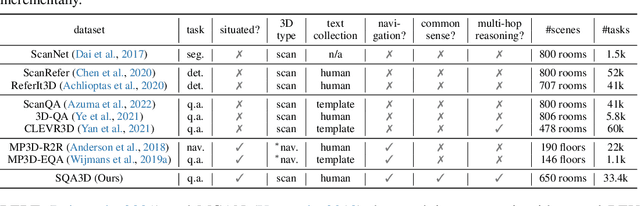
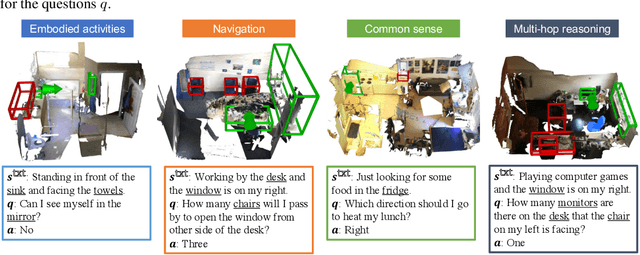
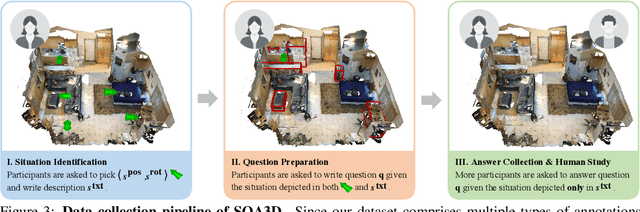
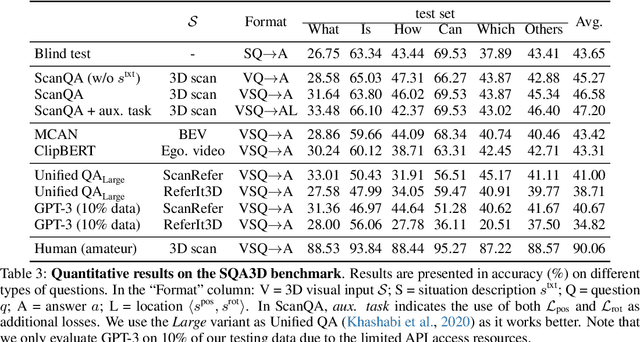
We propose a new task to benchmark scene understanding of embodied agents: Situated Question Answering in 3D Scenes (SQA3D). Given a scene context (e.g., 3D scan), SQA3D requires the tested agent to first understand its situation (position, orientation, etc.) in the 3D scene as described by text, then reason about its surrounding environment and answer a question under that situation. Based upon 650 scenes from ScanNet, we provide a dataset centered around 6.8k unique situations, along with 20.4k descriptions and 33.4k diverse reasoning questions for these situations. These questions examine a wide spectrum of reasoning capabilities for an intelligent agent, ranging from spatial relation comprehension to commonsense understanding, navigation, and multi-hop reasoning. SQA3D imposes a significant challenge to current multi-modal especially 3D reasoning models. We evaluate various state-of-the-art approaches and find that the best one only achieves an overall score of 47.20%, while amateur human participants can reach 90.06%. We believe SQA3D could facilitate future embodied AI research with stronger situation understanding and reasoning capability.