 Add to Chrome
 Add to Firefox
 Add to Edge
pySpatial: Generating 3D Visual Programs for Zero-Shot Spatial Reasoning
Mar 01, 2026
Multi-modal Large Language Models (MLLMs) have demonstrated strong capabilities in general-purpose perception and reasoning, but they still struggle with tasks that require spatial understanding of the 3D world. To address this, we introduce pySpatial, a visual programming framework that equips MLLMs with the ability to interface with spatial tools via Python code generation. Given an image sequence and a natural-language query, the model composes function calls to spatial tools including 3D reconstruction, camera-pose recovery, novel-view rendering, etc. These operations convert raw 2D inputs into an explorable 3D scene, enabling MLLMs to reason explicitly over structured spatial representations. Notably, pySpatial requires no gradient-based fine-tuning and operates in a fully zero-shot setting. Experimental evaluations on the challenging MindCube and Omni3D-Bench benchmarks demonstrate that our framework pySpatial consistently surpasses strong MLLM baselines; for instance, it outperforms GPT-4.1-mini by 12.94% on MindCube. Furthermore, we conduct real-world indoor navigation experiments where the robot can successfully traverse complex environments using route plans generated by pySpatial, highlighting the practical effectiveness of our approach.

Unifying Deep Predicate Invention with Pre-trained Foundation Models
Dec 19, 2025Long-horizon robotic tasks are hard due to continuous state-action spaces and sparse feedback. Symbolic world models help by decomposing tasks into discrete predicates that capture object properties and relations. Existing methods learn predicates either top-down, by prompting foundation models without data grounding, or bottom-up, from demonstrations without high-level priors. We introduce UniPred, a bilevel learning framework that unifies both. UniPred uses large language models (LLMs) to propose predicate effect distributions that supervise neural predicate learning from low-level data, while learned feedback iteratively refines the LLM hypotheses. Leveraging strong visual foundation model features, UniPred learns robust predicate classifiers in cluttered scenes. We further propose a predicate evaluation method that supports symbolic models beyond STRIPS assumptions. Across five simulated and one real-robot domains, UniPred achieves 2-4 times higher success rates than top-down methods and 3-4 times faster learning than bottom-up approaches, advancing scalable and flexible symbolic world modeling for robotics.
Diffusion-Based Restoration for Multi-Modal 3D Object Detection in Adverse Weather
Dec 18, 2025Multi-modal 3D object detection is important for reliable perception in robotics and autonomous driving. However, its effectiveness remains limited under adverse weather conditions due to weather-induced distortions and misalignment between different data modalities. In this work, we propose DiffFusion, a novel framework designed to enhance robustness in challenging weather through diffusion-based restoration and adaptive cross-modal fusion. Our key insight is that diffusion models possess strong capabilities for denoising and generating data that can adapt to various weather conditions. Building on this, DiffFusion introduces Diffusion-IR restoring images degraded by weather effects and Point Cloud Restoration (PCR) compensating for corrupted LiDAR data using image object cues. To tackle misalignments between two modalities, we develop Bidirectional Adaptive Fusion and Alignment Module (BAFAM). It enables dynamic multi-modal fusion and bidirectional bird's-eye view (BEV) alignment to maintain consistent spatial correspondence. Extensive experiments on three public datasets show that DiffFusion achieves state-of-the-art robustness under adverse weather while preserving strong clean-data performance. Zero-shot results on the real-world DENSE dataset further validate its generalization. The implementation of our DiffFusion will be released as open-source.
Imagine with the Teacher: Complete Shape in a Multi-View Distillation Way
Jan 31, 2025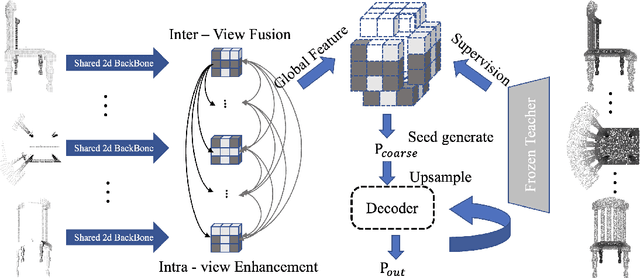
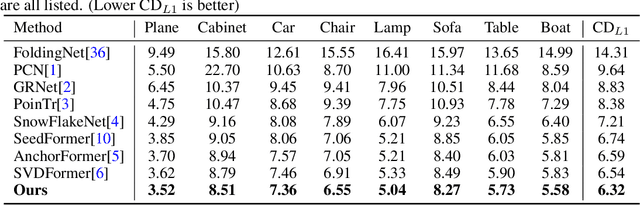
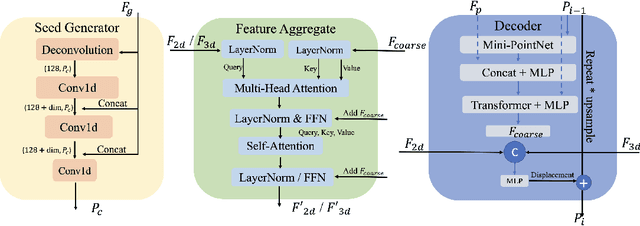
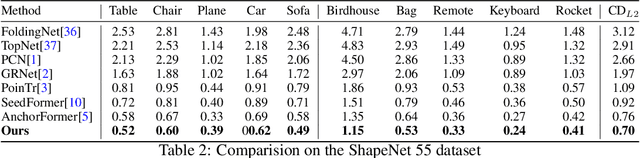
Point cloud completion aims to recover the completed 3D shape of an object from its partial observation caused by occlusion, sensor's limitation, noise, etc. When some key semantic information is lost in the incomplete point cloud, the neural network needs to infer the missing part based on the input information. Intuitively we would apply an autoencoder architecture to solve this kind of problem, which take the incomplete point cloud as input and is supervised by the ground truth. This process that develops model's imagination from incomplete shape to complete shape is done automatically in the latent space. But the knowledge for mapping from incomplete to complete still remains dark and could be further explored. Motivated by the knowledge distillation's teacher-student learning strategy, we design a knowledge transfer way for completing 3d shape. In this work, we propose a novel View Distillation Point Completion Network (VD-PCN), which solve the completion problem by a multi-view distillation way. The design methodology fully leverages the orderliness of 2d pixels, flexibleness of 2d processing and powerfulness of 2d network. Extensive evaluations on PCN, ShapeNet55/34, and MVP datasets confirm the effectiveness of our design and knowledge transfer strategy, both quantitatively and qualitatively. Committed to facilitate ongoing research, we will make our code publicly available.