 Add to Chrome
 Add to Firefox
 Add to Edge
Data Augmentation of Multi-turn Psychological Dialogue via Knowledge-driven Progressive Thought Prompting
Jun 24, 2024
Existing dialogue data augmentation (DA) techniques predominantly focus on augmenting utterance-level dialogues, which makes it difficult to take dialogue contextual information into account. The advent of large language models (LLMs) has simplified the implementation of multi-turn dialogues. Due to absence of professional understanding and knowledge, it remains challenging to deliver satisfactory performance in low-resource domain, like psychological dialogue dialogue. DA involves creating new training or prompting data based on the existing data, which help the model better understand and generate psychology-related responses. In this paper, we aim to address the issue of multi-turn dialogue data augmentation for boosted performance in the psychology domain. We propose a knowledge-driven progressive thought prompting method to guide LLM to generate multi-turn psychology-related dialogue. This method integrates a progressive thought generator, a psychology knowledge generator, and a multi-turn dialogue generator. The thought generated by the progressive thought generator serves as a prompt to prevent the generated dialogue from having significant semantic deviations, while the psychology knowledge generator produces psychological knowledge to serve as the dialogue history for the LLM, guiding the dialogue generator to create multi-turn psychological dialogue. To ensure the precision of multi-turn psychological dialogue generation by LLM, a meticulous professional evaluation is required. Extensive experiments conducted on three datasets related to psychological dialogue verify the effectiveness of the proposed method.

A Comprehensive Survey of Scientific Large Language Models and Their Applications in Scientific Discovery
Jun 16, 2024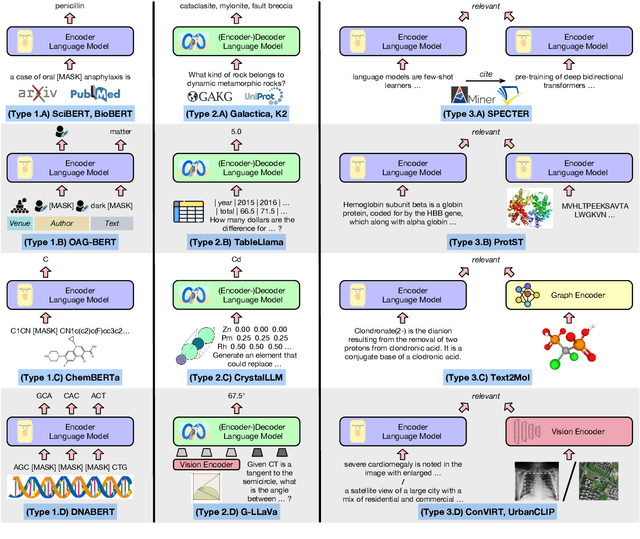
In many scientific fields, large language models (LLMs) have revolutionized the way with which text and other modalities of data (e.g., molecules and proteins) are dealt, achieving superior performance in various applications and augmenting the scientific discovery process. Nevertheless, previous surveys on scientific LLMs often concentrate on one to two fields or a single modality. In this paper, we aim to provide a more holistic view of the research landscape by unveiling cross-field and cross-modal connections between scientific LLMs regarding their architectures and pre-training techniques. To this end, we comprehensively survey over 250 scientific LLMs, discuss their commonalities and differences, as well as summarize pre-training datasets and evaluation tasks for each field and modality. Moreover, we investigate how LLMs have been deployed to benefit scientific discovery. Resources related to this survey are available at https://github.com/yuzhimanhua/Awesome-Scientific-Language-Models.
Inter-slice Super-resolution of Magnetic Resonance Images by Pre-training and Self-supervised Fine-tuning
Jun 10, 2024In clinical practice, 2D magnetic resonance (MR) sequences are widely adopted. While individual 2D slices can be stacked to form a 3D volume, the relatively large slice spacing can pose challenges for both image visualization and subsequent analysis tasks, which often require isotropic voxel spacing. To reduce slice spacing, deep-learning-based super-resolution techniques are widely investigated. However, most current solutions require a substantial number of paired high-resolution and low-resolution images for supervised training, which are typically unavailable in real-world scenarios. In this work, we propose a self-supervised super-resolution framework for inter-slice super-resolution of MR images. Our framework is first featured by pre-training on video dataset, as temporal correlation of videos is found beneficial for modeling the spatial relation among MR slices. Then, we use public high-quality MR dataset to fine-tune our pre-trained model, for enhancing awareness of our model to medical data. Finally, given a target dataset at hand, we utilize self-supervised fine-tuning to further ensure our model works well with user-specific super-resolution tasks. The proposed method demonstrates superior performance compared to other self-supervised methods and also holds the potential to benefit various downstream applications.
RiskMap: A Unified Driving Context Representation for Autonomous Motion Planning in Urban Driving Environment
Jun 06, 2024Planning is complicated by the combination of perception and map information, particularly when driving in heavy traffic. Developing an extendable and efficient representation that visualizes sensor noise and provides constraints to real-time planning tasks is desirable. We aim to develop an extendable map representation offering prior to cost in planning tasks to simplify the planning process of dealing with complex driving scenarios and visualize sensor noise. In this paper, we illustrate a unified context representation empowered by a modern deep learning motion prediction model, representing statistical cognition of motion prediction for human beings. A sampling-based planner is adopted to train and compare the difference in risk map generation methods. The training tools and model structures are investigated illustrating their efficiency in this task.
HetHub: A Heterogeneous distributed hybrid training system for large-scale models
May 25, 2024The development of large-scale models relies on a vast number of computing resources. For example, the GPT-4 model (1.8 trillion parameters) requires 25000 A100 GPUs for its training. It is a challenge to build a large-scale cluster with a type of GPU-accelerator. Using multiple types of GPU-accelerators to construct a cluster is an effective way to solve the problem of insufficient homogeneous GPU-accelerators. However, the existing distributed training systems for large-scale models only support homogeneous GPU-accelerators, not heterogeneous GPU-accelerators. To address the problem, this paper proposes a distributed training system with hybrid parallelism support on heterogeneous GPU-accelerators for large-scale models. It introduces a distributed unified communicator to realize the communication between heterogeneous GPU-accelerators, a distributed performance predictor, and an automatic hybrid parallel module to develop and train models efficiently with heterogeneous GPU-accelerators. Compared to the distributed training system with homogeneous GPU-accelerators, our system can support six different combinations of heterogeneous GPU-accelerators and the optimal performance of heterogeneous GPU-accelerators has achieved at least 90% of the theoretical upper bound performance of homogeneous GPU-accelerators.
BiomedParse: a biomedical foundation model for image parsing of everything everywhere all at once
May 21, 2024


Biomedical image analysis is fundamental for biomedical discovery in cell biology, pathology, radiology, and many other biomedical domains. Holistic image analysis comprises interdependent subtasks such as segmentation, detection, and recognition of relevant objects. Here, we propose BiomedParse, a biomedical foundation model for imaging parsing that can jointly conduct segmentation, detection, and recognition for 82 object types across 9 imaging modalities. Through joint learning, we can improve accuracy for individual tasks and enable novel applications such as segmenting all relevant objects in an image through a text prompt, rather than requiring users to laboriously specify the bounding box for each object. We leveraged readily available natural-language labels or descriptions accompanying those datasets and use GPT-4 to harmonize the noisy, unstructured text information with established biomedical object ontologies. We created a large dataset comprising over six million triples of image, segmentation mask, and textual description. On image segmentation, we showed that BiomedParse is broadly applicable, outperforming state-of-the-art methods on 102,855 test image-mask-label triples across 9 imaging modalities (everything). On object detection, which aims to locate a specific object of interest, BiomedParse again attained state-of-the-art performance, especially on objects with irregular shapes (everywhere). On object recognition, which aims to identify all objects in a given image along with their semantic types, we showed that BiomedParse can simultaneously segment and label all biomedical objects in an image (all at once). In summary, BiomedParse is an all-in-one tool for biomedical image analysis by jointly solving segmentation, detection, and recognition for all major biomedical image modalities, paving the path for efficient and accurate image-based biomedical discovery.
Gaze-DETR: Using Expert Gaze to Reduce False Positives in Vulvovaginal Candidiasis Screening
May 15, 2024Accurate detection of vulvovaginal candidiasis is critical for women's health, yet its sparse distribution and visually ambiguous characteristics pose significant challenges for accurate identification by pathologists and neural networks alike. Our eye-tracking data reveals that areas garnering sustained attention - yet not marked by experts after deliberation - are often aligned with false positives of neural networks. Leveraging this finding, we introduce Gaze-DETR, a pioneering method that integrates gaze data to enhance neural network precision by diminishing false positives. Gaze-DETR incorporates a universal gaze-guided warm-up protocol applicable across various detection methods and a gaze-guided rectification strategy specifically designed for DETR-based models. Our comprehensive tests confirm that Gaze-DETR surpasses existing leading methods, showcasing remarkable improvements in detection accuracy and generalizability.
Dragtraffic: A Non-Expert Interactive and Point-Based Controllable Traffic Scene Generation Framework
Apr 19, 2024
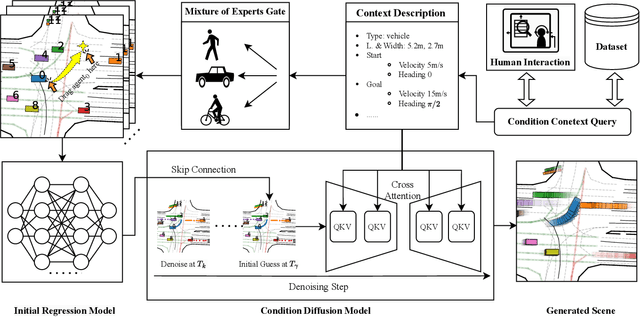
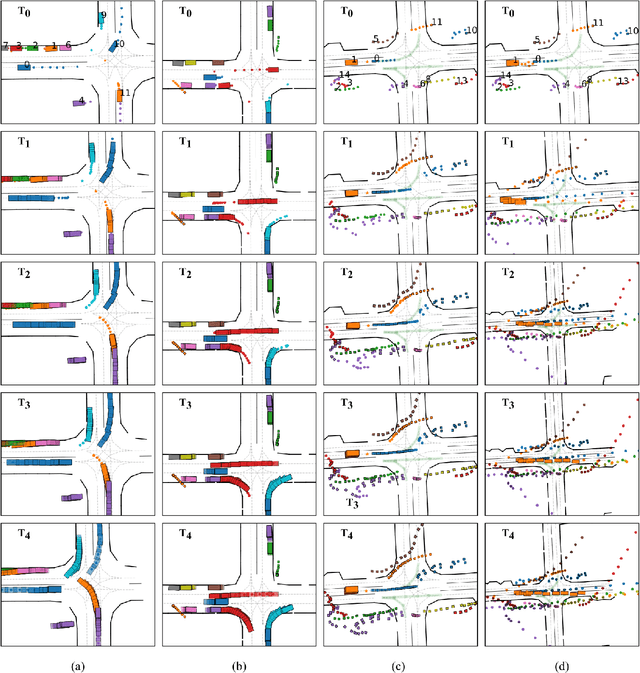
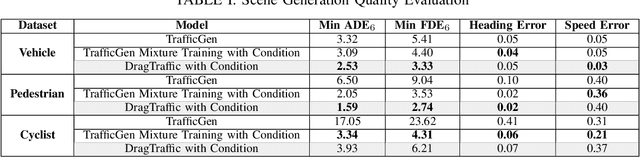
The evaluation and training of autonomous driving systems require diverse and scalable corner cases. However, most existing scene generation methods lack controllability, accuracy, and versatility, resulting in unsatisfactory generation results. To address this problem, we propose Dragtraffic, a generalized, point-based, and controllable traffic scene generation framework based on conditional diffusion. Dragtraffic enables non-experts to generate a variety of realistic driving scenarios for different types of traffic agents through an adaptive mixture expert architecture. We use a regression model to provide a general initial solution and a refinement process based on the conditional diffusion model to ensure diversity. User-customized context is introduced through cross-attention to ensure high controllability. Experiments on a real-world driving dataset show that Dragtraffic outperforms existing methods in terms of authenticity, diversity, and freedom.
A Generic Trajectory Planning Method for Constrained All-Wheel-Steering Robots
Apr 15, 2024This paper presents a trajectory planning method for wheeled robots with fixed steering axes while the steering angle of each wheel is constrained. In the past, All-Wheel-Steering(AWS) robots, incorporating modes such as rotation-free translation maneuvers, in-situ rotational maneuvers, and proportional steering, exhibited inefficient performance due to time-consuming mode switches. This inefficiency arises from wheel rotation constraints and inter-wheel cooperation requirements. The direct application of a holonomic moving strategy can lead to significant slip angles or even structural failure. Additionally, the limited steering range of AWS wheeled robots exacerbates nonlinearity issues, thereby complicating control processes. To address these challenges, we developed a novel planning method termed Constrained AWS(C-AWS), which integrates second-order discrete search with predictive control techniques. Experimental results demonstrate that our method adeptly generates feasible and smooth trajectories for C-AWS while adhering to steering angle constraints.
CopilotCAD: Empowering Radiologists with Report Completion Models and Quantitative Evidence from Medical Image Foundation Models
Apr 11, 2024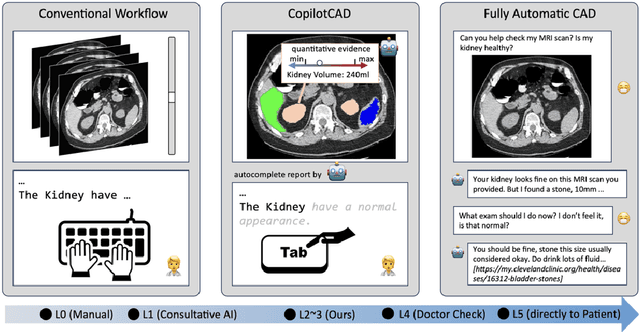
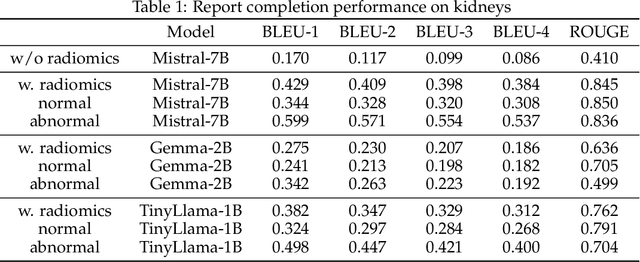
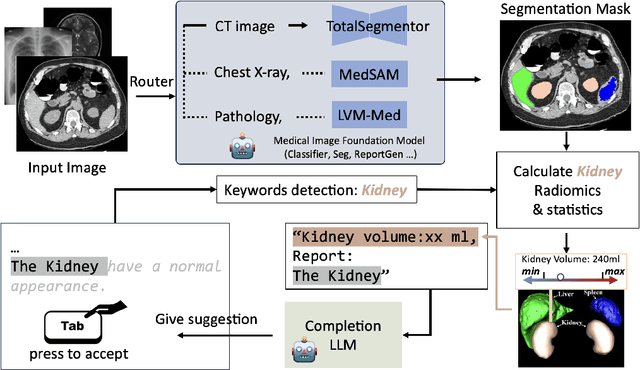

Computer-aided diagnosis systems hold great promise to aid radiologists and clinicians in radiological clinical practice and enhance diagnostic accuracy and efficiency. However, the conventional systems primarily focus on delivering diagnostic results through text report generation or medical image classification, positioning them as standalone decision-makers rather than helpers and ignoring radiologists' expertise. This study introduces an innovative paradigm to create an assistive co-pilot system for empowering radiologists by leveraging Large Language Models (LLMs) and medical image analysis tools. Specifically, we develop a collaborative framework to integrate LLMs and quantitative medical image analysis results generated by foundation models with radiologists in the loop, achieving efficient and safe generation of radiology reports and effective utilization of computational power of AI and the expertise of medical professionals. This approach empowers radiologists to generate more precise and detailed diagnostic reports, enhancing patient outcomes while reducing the burnout of clinicians. Our methodology underscores the potential of AI as a supportive tool in medical diagnostics, promoting a harmonious integration of technology and human expertise to advance the field of radiology.