 Add to Chrome
 Add to Firefox
 Add to Edge
SpotlessGS: Relightable 3D Gaussian Splatting under Dynamic Illumination for Robotic Perception
Aug 11, 2026
Robots operating in dark or poorly lit environments rely on onboard lights, which often produce uneven illumination that degrades downstream perception tasks. Prior approaches based on 2D image enhancement lack reliable supervision and fail to preserve multi-view geometric consistency. To address these limitations, we extend Dark Gaussian Splatting (DarkGS) toward a more accurate and flexible relightable 3D reconstruction framework. First, we eliminate the need for explicit light parameter calibration by jointly optimizing lighting parameters within the Gaussian Splatting framework. Second, we introduce a low-frequency illumination model based on spherical harmonics (SH) to capture spatially varying residual and ambient lighting effects. Third, we incorporate an MLP-based Bidirectional Reflectance Distribution Function (BRDF) to model non-Lambertian reflectance. Experiments on synthetic and real-world datasets demonstrate that our method effectively mitigates illumination artifacts while improving rendering quality and quantitative performance over prior approaches. We further validate its benefits for robotic perception through a downstream task.

WARA: A Closed-Loop Multi-Agent Framework for Wireless Optimization Autoresearch
Jul 22, 2026Large language model (LLM) agents have shown growing capabilities in tool use, code execution, artifact inspection, and iterative revision, creating new opportunities for automating scientific research. To the best of our knowledge, this paper presents the first end-to-end autoresearch framework for the wireless domain, with a particular focus on wireless resource allocation optimization, an essential area for characterizing the fundamental performance limits of wireless systems and enhancing their practical performance under dynamic channel and network conditions. Specifically, we propose the Wireless AutoResearch Agent (WARA), a closed-loop multi-agent system that transforms an initial research topic into a complete research package. WARA organizes the research workflow into three phases: 1) research gap identification and problem proposal, 2) optimization modeling, algorithm design, and experimentation, and 3) research deliverable construction. Each phase follows an artifact-mediated process, in which structured upstream artifacts are consumed to generate downstream outputs. Controller-managed gates validate these artifacts and maintain consistency among problem formulations, algorithms, experiments, and research claims. When validation fails, WARA repairs only the affected artifact instead of restarting the entire workflow. We further design an LLM-based ScoringAgent to evaluate manuscript-level research validity. Comparative results show that WARA substantially outperforms one-shot LLM generation and approaches the quality profile of recently accepted peer-reviewed papers. These results demonstrate the potential of closed-loop artifact control for end-to-end LLM-assisted wireless optimization research. The source code is available at https://github.com/guoyuan-dotcom/WARA_CUHKSZ
Accurate, Interdisciplinary and Transparent Structure-property Understanding with Deep Native Structural Reasoning
Jul 08, 2026Structure-property relationships are foundational to biology, chemistry and materials science, where function, reactivity and physical response emerge from spatial, chemical and periodic organization. Mechanistically explaining these relationships requires interpreting structural evidence through scientific principles and physical constraints, from stereochemistry and bonding to symmetry, energetics and periodic order. However, applying artificial intelligence to this process presents a joint challenge of representation and reasoning: models must preserve domain-native structural information while showing how specific evidence supports predictions under these constraints. Here we introduce SciReasoner, a multimodal scientific foundation model for native structural reasoning across proteins, small molecules and inorganic crystals. SciReasoner discretizes coordinates, topologies and periodic connectivities into a unified structure-aware vocabulary, treating structural tokens as addressable evidence units during reasoning. In homology-controlled Gene Ontology prediction, SciReasoner improves Cellular Component annotation for low-homology and orphan-like proteins, increasing $F_{\max}$ from 0.42 to 0.55. In chemistry, it raises single-step retrosynthesis accuracy from 0.63 to 0.72 while generating fragment-level disconnection and precursor-verification traces. In materials science, its representations separate elemental and compound phases and resolve high- and low-band-gap regimes. Across 86 benchmarks, SciReasoner achieves state-of-the-art performance on 67 tasks. Double-blind expert evaluation rates its reasoning traces as preferred or at least comparable to those of a frontier large language model in 98% of cases. By making structure an inspectable substrate for reasoning under scientific constraints, SciReasoner connects accurate prediction with interpretable scientific inference.
Retrieval-Augmented Multimodal Learning for Enzyme-Substrate Interaction Prediction Under Low-Homology Shift
Jun 22, 2026Enzyme substrate interaction (ESI) prediction is a fundamental computational task for biocatalyst discovery and reaction screening in large biochemical spaces. In practical settings, ESI prediction is challenged by sparse positive supervision and low-homology distribution shift, where test enzymes share limited sequence identity with those observed during training. To address these challenges, we propose RAMMESI, a retrieval-augmented multimodal framework for robust ESI prediction. RAMMESI learns explicit pairwise enzyme-substrate representations through directional cross-modal interaction modeling and adaptive fusion. To enhance robustness, RAMMESI retrieves neighboring enzymes at inference time, recombines them with the query substrate, and aggregates the resulting pairwise predictions as contextual evidence. To improve learning under sparse positive supervision, we further adopt an imbalance-aware weighted-BCE objective. Experiments on two ESI benchmarks under sequence-identity-aware splits demonstrate that RAMMESI achieves consistently strong performance, with particular advantages in more challenging low-identity regimes. In addition, the retrieval module improves multiple ESI backbones in a plug-and-play manner, suggesting that retrieval provides a general mechanism for improving robustness under homology shift.
Hierarchical Flow Decomposition for Turning Movement Prediction at Signalized Intersections
Apr 10, 2026Accurate prediction of intersection turning movements is essential for adaptive signal control but remains difficult due to the high volatility of directional flows. This study proposes HFD-TM (Hierarchical Flow-Decomposition for Turning Movement Prediction), a hierarchical deep learning framework that predicts turning movements by first forecasting corridor through-movements and then expanding these predictions to individual turning streams. This design is motivated by empirical traffic structure, where corridor flows account for 65.1% of total volume, exhibit lower volatility than turning movements, and explain 35.5% of turning-movement variance. A physics-informed loss function enforces flow conservation to maintain structural consistency. Evaluated on six months of 15-minute interval LiDAR (Light Detection and Ranging) data from a six-intersection corridor in Nashville, Tennessee, HFD-TM achieves a mean absolute error of 2.49 vehicles per interval, reducing MAE by 5.7% compared to a Transformer and by 27.0% compared to a GRU (Gated Recurrent Unit). Ablation results show that hierarchical decomposition provides the largest performance gain, while training time is 12.8 times lower than DCRNN (Diffusion Convolutional Recurrent Neural Network), demonstrating suitability for real-time traffic applications.
Physics-Embedded Feature Learning for AI in Medical Imaging
Mar 30, 2026Deep learning (DL) models have achieved strong performance in an intelligence healthcare setting, yet most existing approaches operate as black boxes and ignore the physical processes that govern tumor growth, limiting interpretability, robustness, and clinical trust. To address this limitation, we propose PhysNet, a physics-embedded DL framework that integrates tumor growth dynamics directly into the feature learning process of a convolutional neural network (CNN). Unlike conventional physics-informed methods that impose physical constraints only at the output level, PhysNet embeds a reaction diffusion model of tumor growth within intermediate feature representations of a ResNet backbone. The architecture jointly performs multi-class tumor classification while learning a latent tumor density field, its temporal evolution, and biologically meaningful physical parameters, including tumor diffusion and growth rates, through end-to-end training. This design is necessary because purely data-driven models, even when highly accurate or ensemble-based, cannot guarantee physically consistent predictions or provide insight into tumor behavior. Experimental results on a large brain MRI dataset demonstrate that PhysNet outperforms multiple state-of-the-art DL baselines, including MobileNetV2, VGG16, VGG19, and ensemble models, achieving superior classification accuracy and F1-score. In addition to improved performance, PhysNet produces interpretable latent representations and learned bio-physical parameters that align with established medical knowledge, highlighting physics-embedded representation learning as a practical pathway toward more trustworthy and clinically meaningful medical AI systems.
Self-evolving AI agents for protein discovery and directed evolution
Mar 28, 2026Protein scientific discovery is bottlenecked by the manual orchestration of information and algorithms, while general agents are insufficient in complex domain projects. VenusFactory2 provides an autonomous framework that shifts from static tool usage to dynamic workflow synthesis via a self-evolving multi-agent infrastructure to address protein-related demands. It outperforms a set of well-known agents on the VenusAgentEval benchmark, and autonomously organizes the discovery and optimization of proteins from a single natural language prompt.
Rank-and-Reason: Multi-Agent Collaboration Accelerates Zero-Shot Protein Mutation Prediction
Feb 03, 2026Zero-shot mutation prediction is vital for low-resource protein engineering, yet existing protein language models (PLMs) often yield statistically confident results that ignore fundamental biophysical constraints. Currently, selecting candidates for wet-lab validation relies on manual expert auditing of PLM outputs, a process that is inefficient, subjective, and highly dependent on domain expertise. To address this, we propose Rank-and-Reason (VenusRAR), a two-stage agentic framework to automate this workflow and maximize expected wet-lab fitness. In the Rank-Stage, a Computational Expert and Virtual Biologist aggregate a context-aware multi-modal ensemble, establishing a new Spearman correlation record of 0.551 (vs. 0.518) on ProteinGym. In the Reason-Stage, an agentic Expert Panel employs chain-of-thought reasoning to audit candidates against geometric and structural constraints, improving the Top-5 Hit Rate by up to 367% on ProteinGym-DMS99. The wet-lab validation on Cas12i3 nuclease further confirms the framework's efficacy, achieving a 46.7% positive rate and identifying two novel mutants with 4.23-fold and 5.05-fold activity improvements. Code and datasets are released on GitHub (https://github.com/ai4protein/VenusRAR/).
A new strategy for finite-sample valid prediction of future insurance claims in the regression setting
Jan 29, 2026The extant insurance literature demonstrates a paucity of finite-sample valid prediction intervals of future insurance claims in the regression setting. To address this challenge, this article proposes a new strategy that converts a predictive method in the unsupervised iid (independent identically distributed) setting to a predictive method in the regression setting. In particular, it enables an actuary to obtain infinitely many finite-sample valid prediction intervals in the regression setting.
VenusX: Unlocking Fine-Grained Functional Understanding of Proteins
May 17, 2025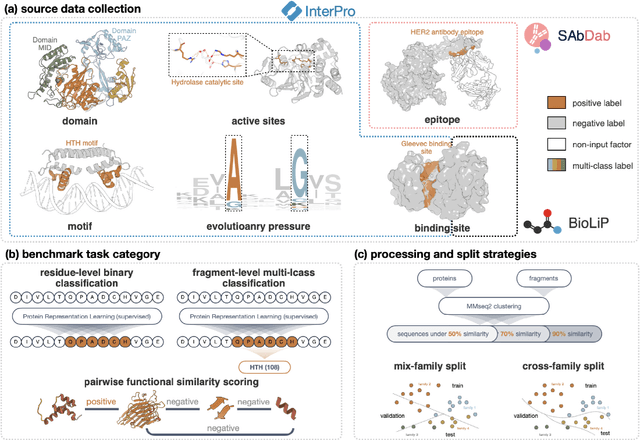
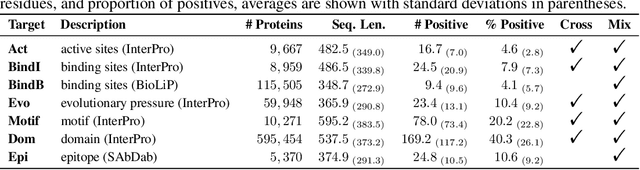

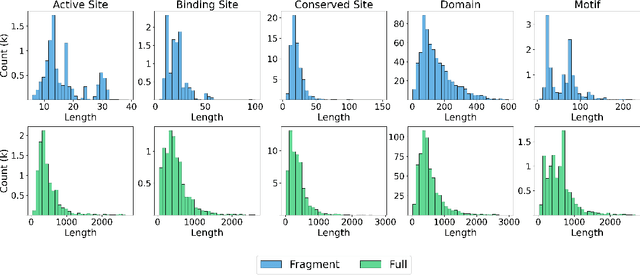
Deep learning models have driven significant progress in predicting protein function and interactions at the protein level. While these advancements have been invaluable for many biological applications such as enzyme engineering and function annotation, a more detailed perspective is essential for understanding protein functional mechanisms and evaluating the biological knowledge captured by models. To address this demand, we introduce VenusX, the first large-scale benchmark for fine-grained functional annotation and function-based protein pairing at the residue, fragment, and domain levels. VenusX comprises three major task categories across six types of annotations, including residue-level binary classification, fragment-level multi-class classification, and pairwise functional similarity scoring for identifying critical active sites, binding sites, conserved sites, motifs, domains, and epitopes. The benchmark features over 878,000 samples curated from major open-source databases such as InterPro, BioLiP, and SAbDab. By providing mixed-family and cross-family splits at three sequence identity thresholds, our benchmark enables a comprehensive assessment of model performance on both in-distribution and out-of-distribution scenarios. For baseline evaluation, we assess a diverse set of popular and open-source models, including pre-trained protein language models, sequence-structure hybrids, structure-based methods, and alignment-based techniques. Their performance is reported across all benchmark datasets and evaluation settings using multiple metrics, offering a thorough comparison and a strong foundation for future research. Code and data are publicly available at https://github.com/ai4protein/VenusX.