 Add to Chrome
 Add to Firefox
 Add to Edge
Game Plan: What AI can do for Football, and What Football can do for AI
Nov 18, 2020
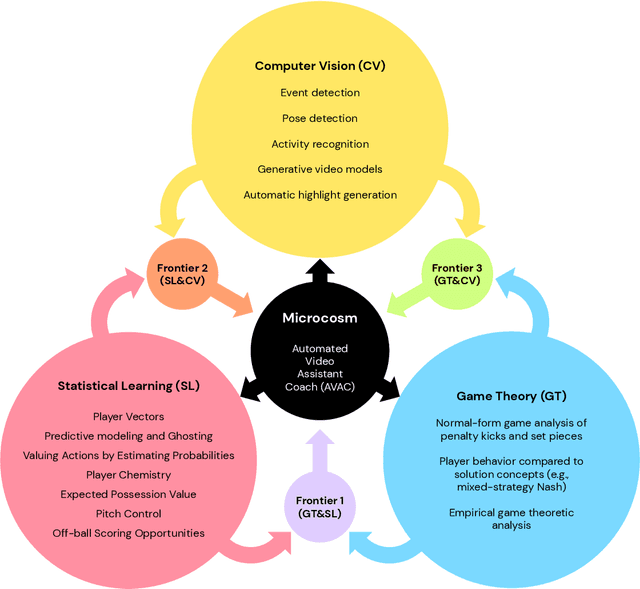
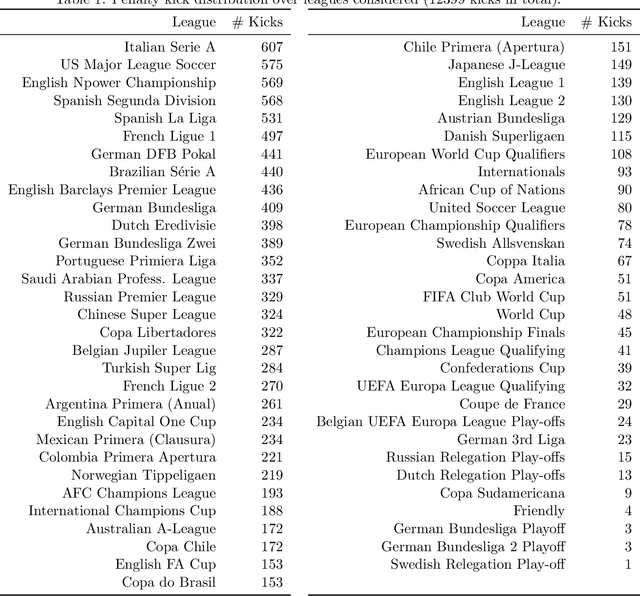

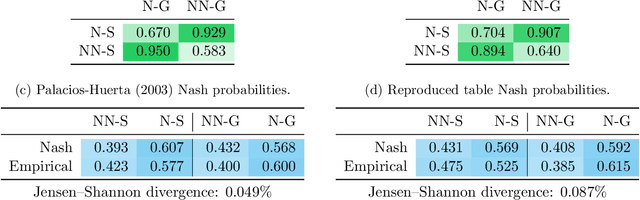
The rapid progress in artificial intelligence (AI) and machine learning has opened unprecedented analytics possibilities in various team and individual sports, including baseball, basketball, and tennis. More recently, AI techniques have been applied to football, due to a huge increase in data collection by professional teams, increased computational power, and advances in machine learning, with the goal of better addressing new scientific challenges involved in the analysis of both individual players' and coordinated teams' behaviors. The research challenges associated with predictive and prescriptive football analytics require new developments and progress at the intersection of statistical learning, game theory, and computer vision. In this paper, we provide an overarching perspective highlighting how the combination of these fields, in particular, forms a unique microcosm for AI research, while offering mutual benefits for professional teams, spectators, and broadcasters in the years to come. We illustrate that this duality makes football analytics a game changer of tremendous value, in terms of not only changing the game of football itself, but also in terms of what this domain can mean for the field of AI. We review the state-of-the-art and exemplify the types of analysis enabled by combining the aforementioned fields, including illustrative examples of counterfactual analysis using predictive models, and the combination of game-theoretic analysis of penalty kicks with statistical learning of player attributes. We conclude by highlighting envisioned downstream impacts, including possibilities for extensions to other sports (real and virtual).

Navigating the Landscape of Games
May 04, 2020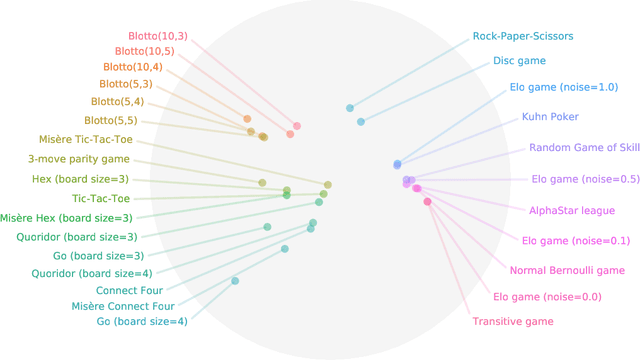
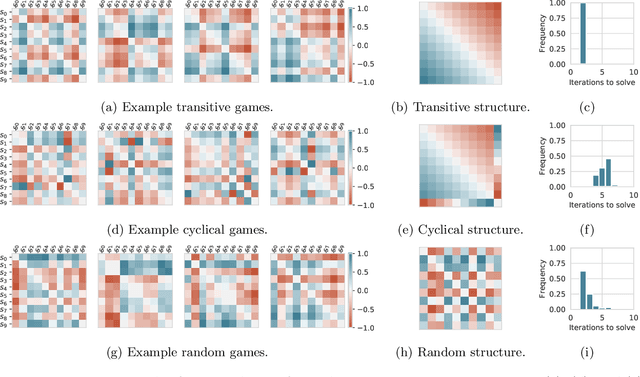
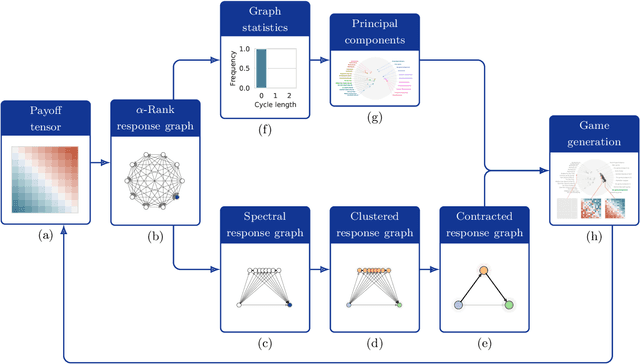

Games are traditionally recognized as one of the key testbeds underlying progress in artificial intelligence (AI), aptly referred to as the "Drosophila of AI". Traditionally, researchers have focused on using games to build strong AI agents that, e.g., achieve human-level performance. This progress, however, also requires a classification of how 'interesting' a game is for an artificial agent. Tackling this latter question not only facilitates an understanding of the characteristics of learnt AI agents in games, but also helps to determine what game an AI should address next as part of its training. Here, we show how network measures applied to so-called response graphs of large-scale games enable the creation of a useful landscape of games, quantifying the relationships between games of widely varying sizes, characteristics, and complexities. We illustrate our findings in various domains, ranging from well-studied canonical games to significantly more complex empirical games capturing the performance of trained AI agents pitted against one another. Our results culminate in a demonstration of how one can leverage this information to automatically generate new and interesting games, including mixtures of empirical games synthesized from real world games.
Real World Games Look Like Spinning Tops
Apr 20, 2020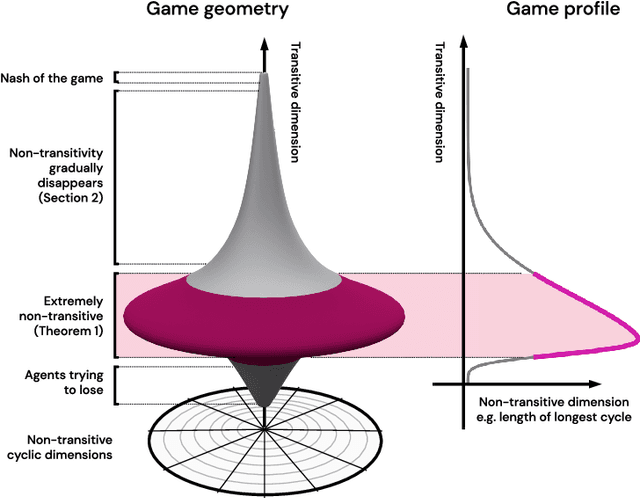
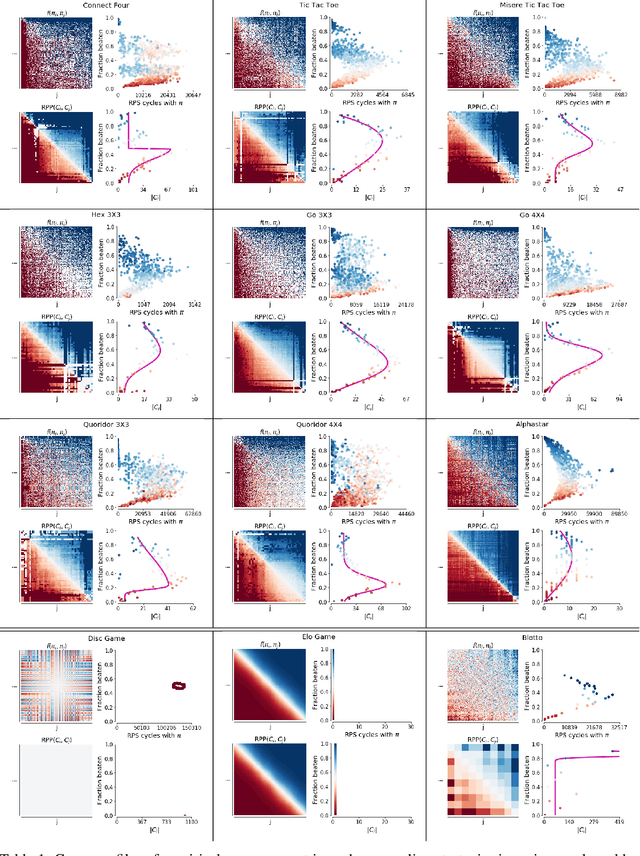
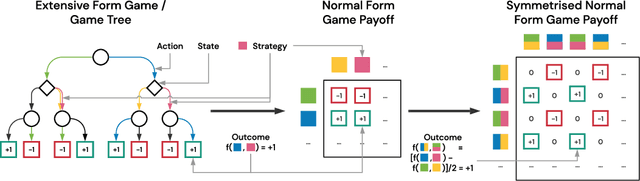
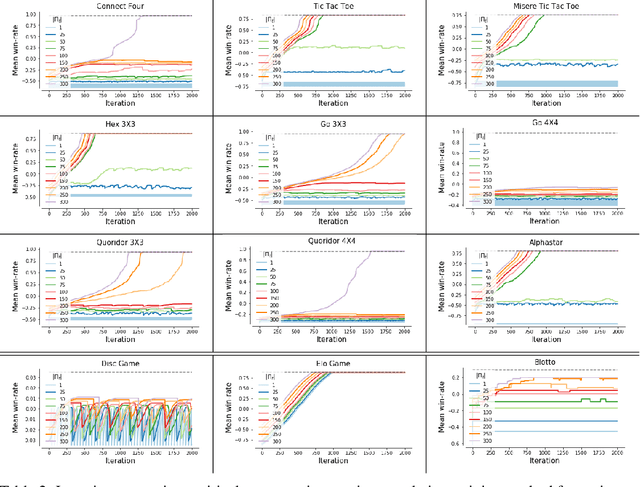
This paper investigates the geometrical properties of real world games (e.g. Tic-Tac-Toe, Go, StarCraft II). We hypothesise that their geometrical structure resemble a spinning top, with the upright axis representing transitive strength, and the radial axis, which corresponds to the number of cycles that exist at a particular transitive strength, representing the non-transitive dimension. We prove the existence of this geometry for a wide class of real world games, exposing their temporal nature. Additionally, we show that this unique structure also has consequences for learning - it clarifies why populations of strategies are necessary for training of agents, and how population size relates to the structure of the game. Finally, we empirically validate these claims by using a selection of nine real world two-player zero-sum symmetric games, showing 1) the spinning top structure is revealed and can be easily re-constructed by using a new method of Nash clustering to measure the interaction between transitive and cyclical strategy behaviour, and 2) the effect that population size has on the convergence in these games.
From Poincaré Recurrence to Convergence in Imperfect Information Games: Finding Equilibrium via Regularization
Feb 19, 2020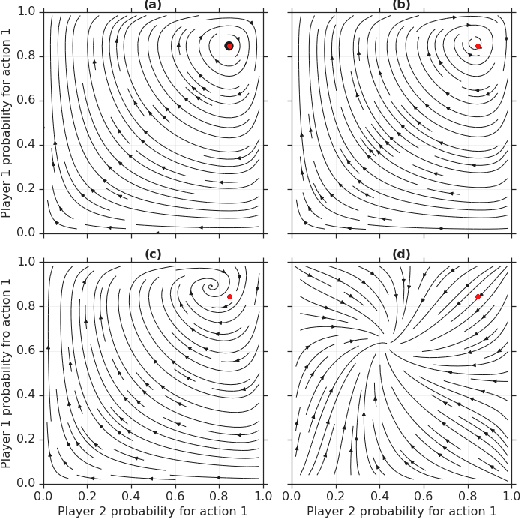
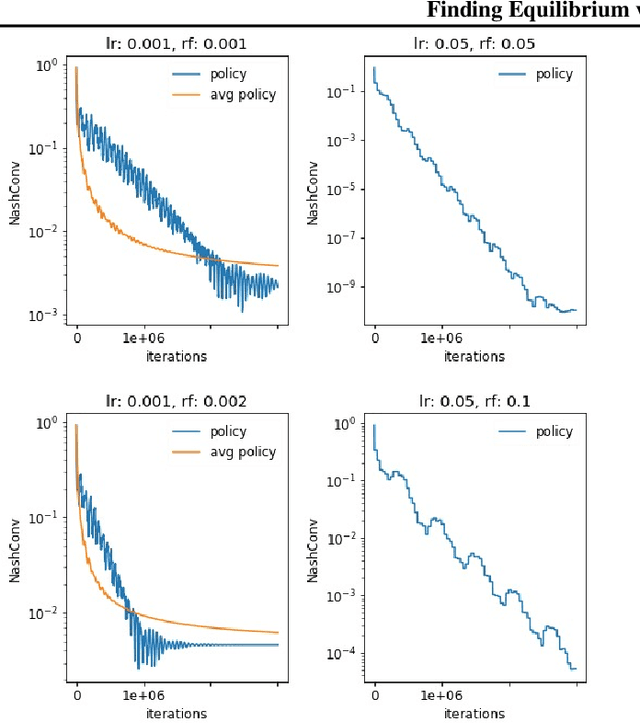
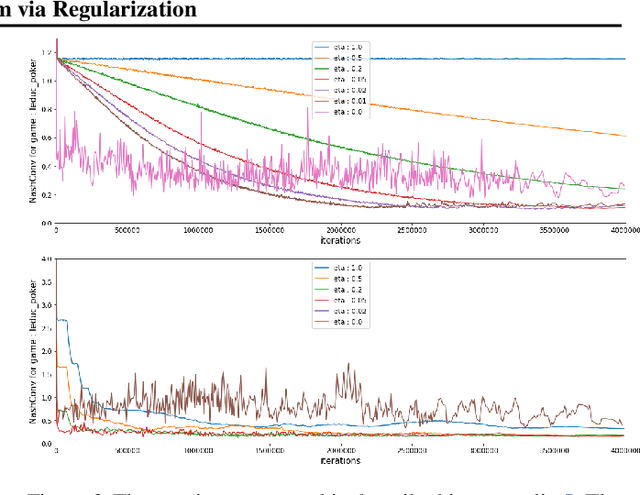
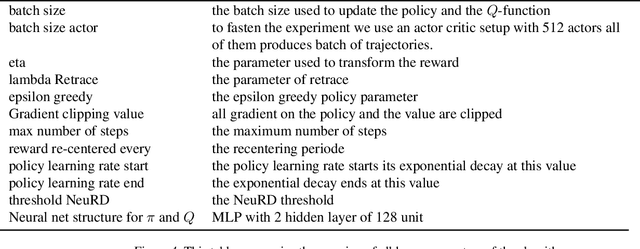
In this paper we investigate the Follow the Regularized Leader dynamics in sequential imperfect information games (IIG). We generalize existing results of Poincar\'e recurrence from normal-form games to zero-sum two-player imperfect information games and other sequential game settings. We then investigate how adapting the reward (by adding a regularization term) of the game can give strong convergence guarantees in monotone games. We continue by showing how this reward adaptation technique can be leveraged to build algorithms that converge exactly to the Nash equilibrium. Finally, we show how these insights can be directly used to build state-of-the-art model-free algorithms for zero-sum two-player Imperfect Information Games (IIG).
Multiagent Evaluation under Incomplete Information
Oct 30, 2019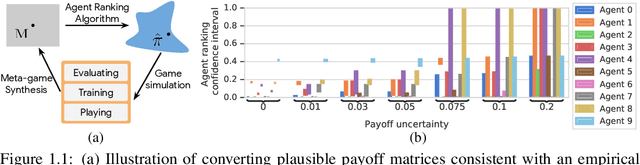
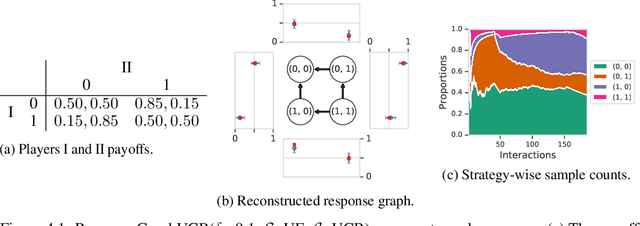
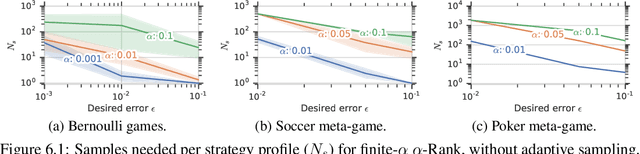
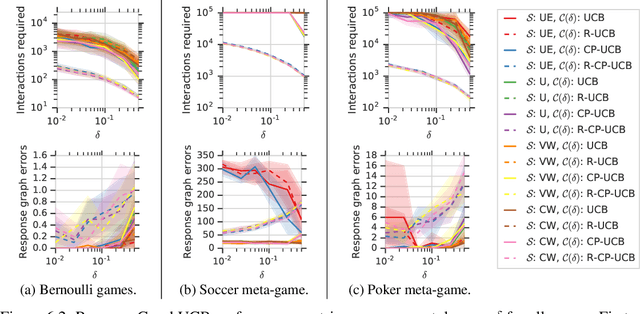
This paper investigates the evaluation of learned multiagent strategies in the incomplete information setting, which plays a critical role in ranking and training of agents. Traditionally, researchers have relied on Elo ratings for this purpose, with recent works also using methods based on Nash equilibria. Unfortunately, Elo is unable to handle intransitive agent interactions, and other techniques are restricted to zero-sum, two-player settings or are limited by the fact that the Nash equilibrium is intractable to compute. Recently, a ranking method called {\alpha}-Rank, relying on a new graph-based game-theoretic solution concept, was shown to tractably apply to general games. However, evaluations based on Elo or {\alpha}-Rank typically assume noise-free game outcomes, despite the data often being collected from noisy simulations, making this assumption unrealistic in practice. This paper investigates multiagent evaluation in the incomplete information regime, involving general-sum many-player games with noisy outcomes. We derive sample complexity guarantees required to confidently rank agents in this setting. We propose adaptive algorithms for accurate ranking, provide correctness and sample complexity guarantees, then introduce a means of connecting uncertainties in noisy match outcomes to uncertainties in rankings. We evaluate the performance of these approaches in several domains, including Bernoulli games, a soccer meta-game, and Kuhn poker.
OpenSpiel: A Framework for Reinforcement Learning in Games
Oct 10, 2019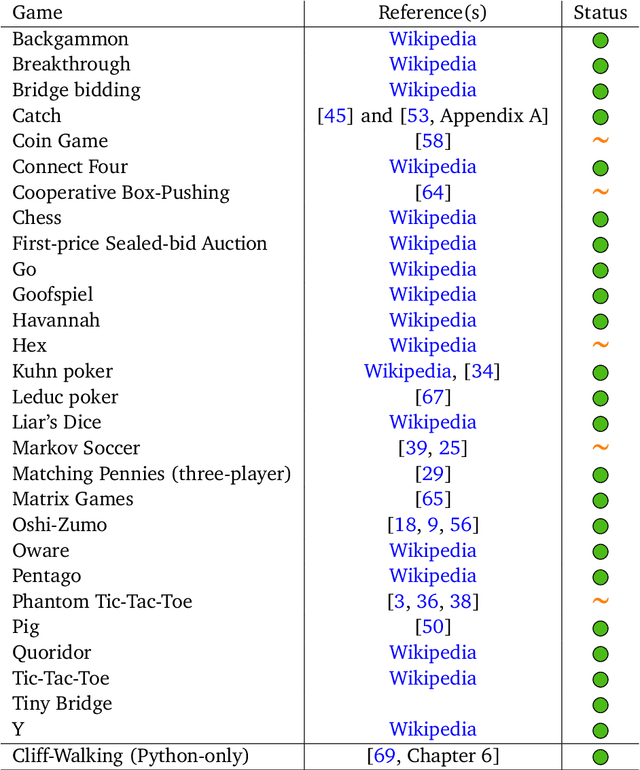
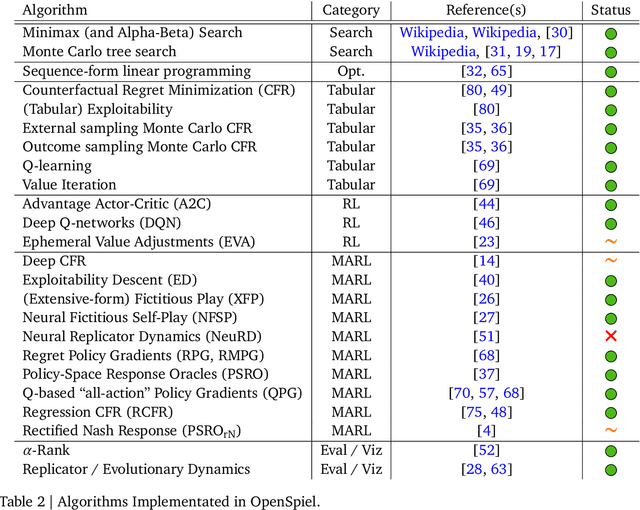
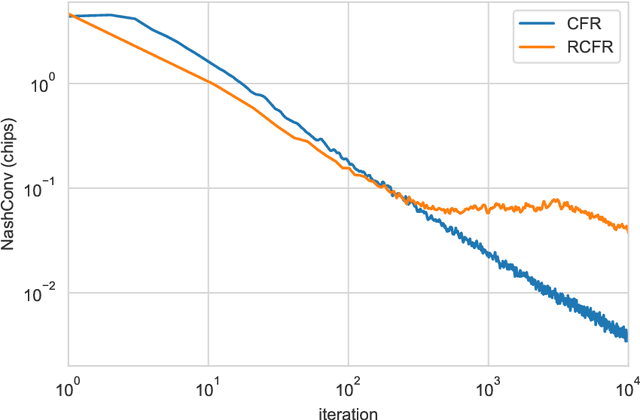
OpenSpiel is a collection of environments and algorithms for research in general reinforcement learning and search/planning in games. OpenSpiel supports n-player (single- and multi- agent) zero-sum, cooperative and general-sum, one-shot and sequential, strictly turn-taking and simultaneous-move, perfect and imperfect information games, as well as traditional multiagent environments such as (partially- and fully- observable) grid worlds and social dilemmas. OpenSpiel also includes tools to analyze learning dynamics and other common evaluation metrics. This document serves both as an overview of the code base and an introduction to the terminology, core concepts, and algorithms across the fields of reinforcement learning, computational game theory, and search.
A Generalized Training Approach for Multiagent Learning
Sep 27, 2019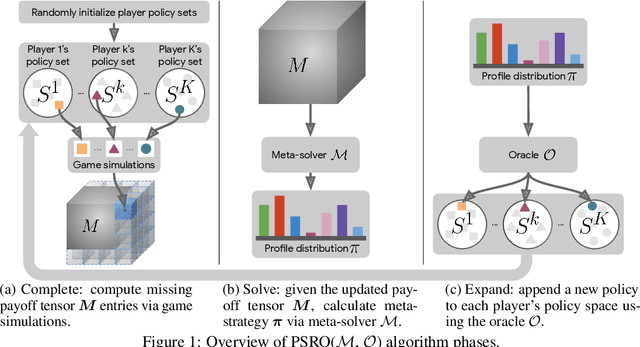
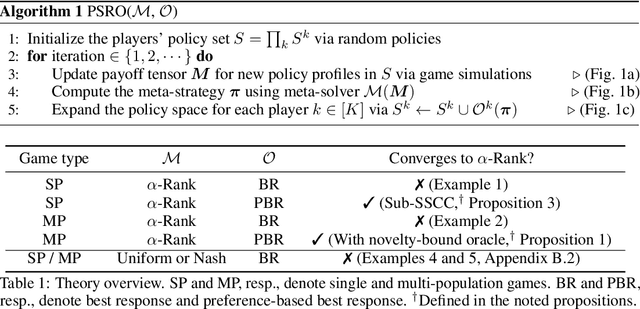
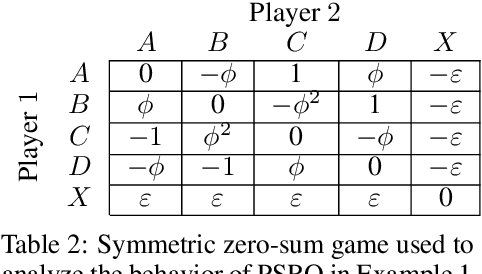
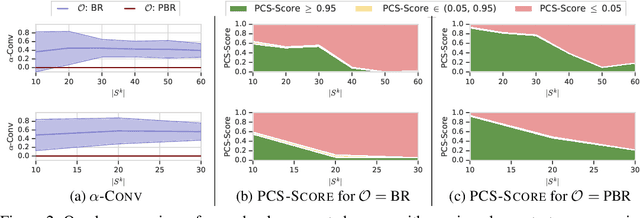
This paper investigates a population-based training regime based on game-theoretic principles called Policy-Spaced Response Oracles (PSRO). PSRO is general in the sense that it (1) encompasses well-known algorithms such as fictitious play and double oracle as special cases, and (2) in principle applies to general-sum, many-player games. Despite this, prior studies of PSRO have been focused on two-player zero-sum games, a regime wherein Nash equilibria are tractably computable. In moving from two-player zero-sum games to more general settings, computation of Nash equilibria quickly becomes infeasible. Here, we extend the theoretical underpinnings of PSRO by considering an alternative solution concept, {\alpha}-Rank, which is unique (thus faces no equilibrium selection issues, unlike Nash) and tractable to compute in general-sum, many-player settings. We establish convergence guarantees in several games classes, and identify links between Nash equilibria and {\alpha}-Rank. We demonstrate the competitive performance of {\alpha}-Rank-based PSRO against an exact Nash solver-based PSRO in 2-player Kuhn and Leduc Poker. We then go beyond the reach of prior PSRO applications by considering 3- to 5-player poker games, yielding instances where {\alpha}-Rank achieves faster convergence than approximate Nash solvers, thus establishing it as a favorable general games solver. We also carry out an initial empirical validation in MuJoCo soccer, illustrating the feasibility of the proposed approach in another complex domain.
Neural Replicator Dynamics
Jun 01, 2019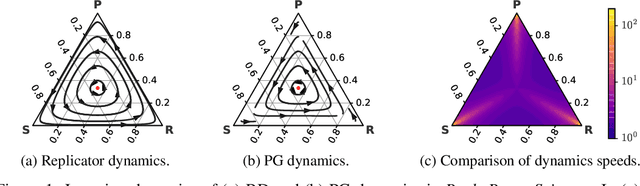
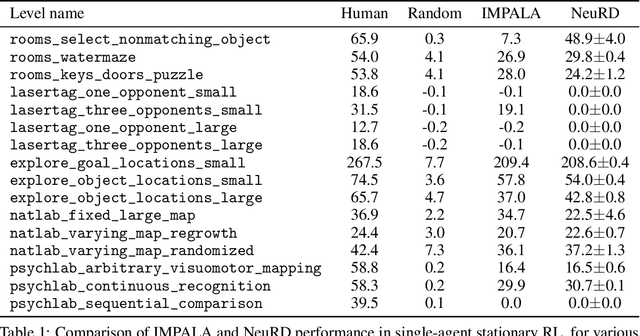
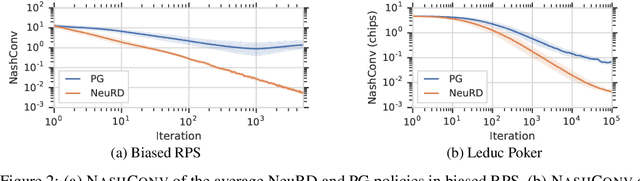
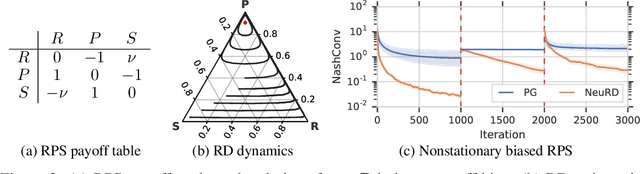
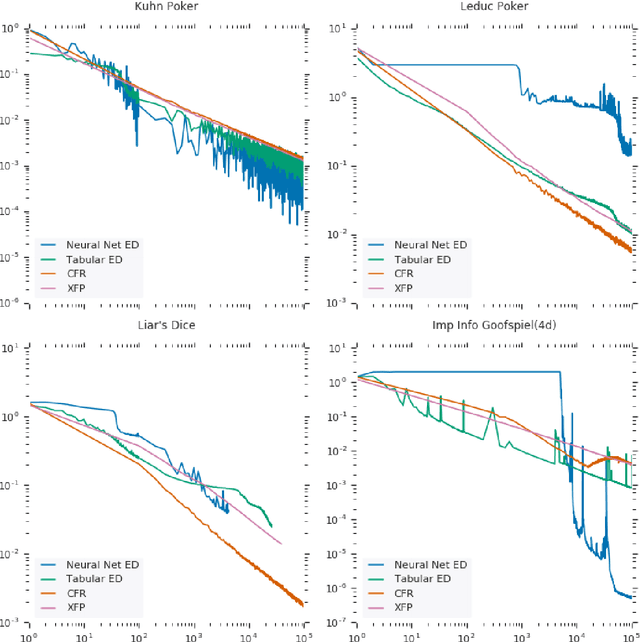
In multiagent learning, agents interact in inherently nonstationary environments due to their concurrent policy updates. It is, therefore, paramount to develop and analyze algorithms that learn effectively despite these nonstationarities. A number of works have successfully conducted this analysis under the lens of evolutionary game theory (EGT), wherein a population of individuals interact and evolve based on biologically-inspired operators. These studies have mainly focused on establishing connections to value-iteration based approaches in stateless or tabular games. We extend this line of inquiry to formally establish links between EGT and policy gradient (PG) methods, which have been extensively applied in single and multiagent learning. We pinpoint weaknesses of the commonly-used softmax PG algorithm in adversarial and nonstationary settings and contrast PG's behavior to that predicted by replicator dynamics (RD), a central model in EGT. We consequently provide theoretical results that establish links between EGT and PG methods, then derive Neural Replicator Dynamics (NeuRD), a parameterized version of RD that constitutes a novel method with several advantages. First, as NeuRD reduces to the well-studied no-regret Hedge algorithm in the tabular setting, it inherits no-regret guarantees that enable convergence to equilibria in games. Second, NeuRD is shown to be more adaptive to nonstationarity, in comparison to PG, when learning in canonical games and imperfect information benchmarks including Poker. Thirdly, modifying any PG-based algorithm to use the NeuRD update rule is straightforward and incurs no added computational costs. Finally, while single-agent learning is not the main focus of the paper, we verify empirically that NeuRD is competitive in these settings with a recent baseline algorithm.
Policy Distillation and Value Matching in Multiagent Reinforcement Learning
Mar 15, 2019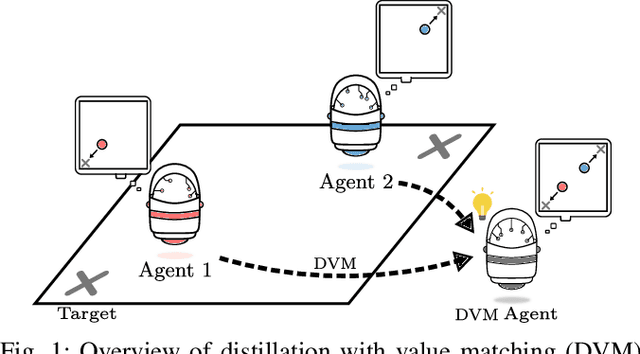
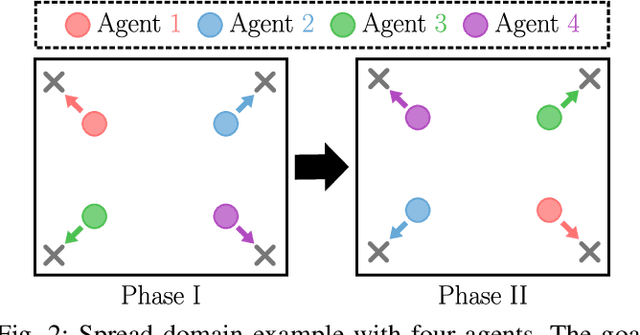
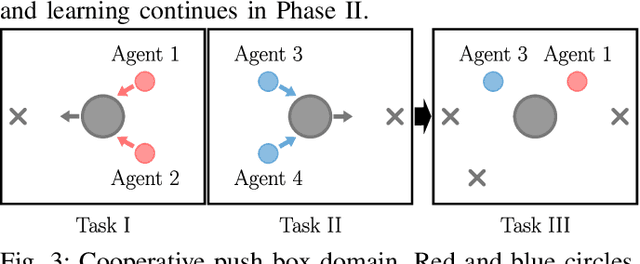
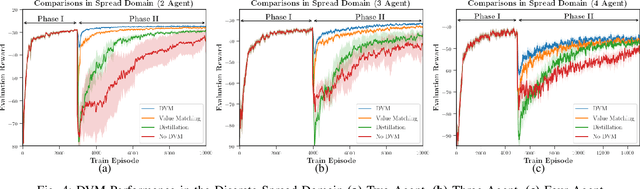
Multiagent reinforcement learning algorithms (MARL) have been demonstrated on complex tasks that require the coordination of a team of multiple agents to complete. Existing works have focused on sharing information between agents via centralized critics to stabilize learning or through communication to increase performance, but do not generally look at how information can be shared between agents to address the curse of dimensionality in MARL. We posit that a multiagent problem can be decomposed into a multi-task problem where each agent explores a subset of the state space instead of exploring the entire state space. This paper introduces a multiagent actor-critic algorithm and method for combining knowledge from homogeneous agents through distillation and value-matching that outperforms policy distillation alone and allows further learning in both discrete and continuous action spaces.
Learning Hierarchical Teaching in Cooperative Multiagent Reinforcement Learning
Mar 07, 2019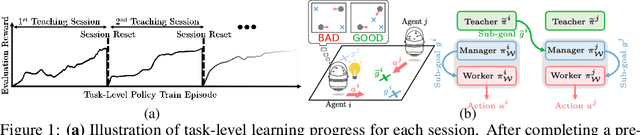
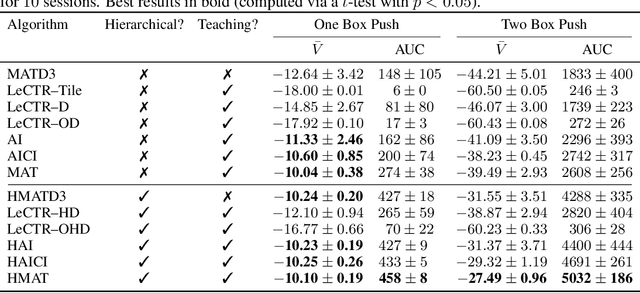
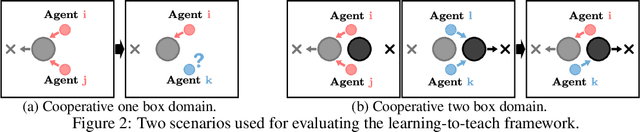

Heterogeneous knowledge naturally arises among different agents in cooperative multiagent reinforcement learning. As such, learning can be greatly improved if agents can effectively pass their knowledge on to other agents. Existing work has demonstrated that peer-to-peer knowledge transfer, a process referred to as action advising, improves team-wide learning. In contrast to previous frameworks that advise at the level of primitive actions, we aim to learn high-level teaching policies that decide when and what high-level action (e.g., sub-goal) to advise a teammate. We introduce a new learning to teach framework, called hierarchical multiagent teaching (HMAT). The proposed framework solves difficulties faced by prior work on multiagent teaching when operating in domains with long horizons, delayed rewards, and continuous states/actions by leveraging temporal abstraction and deep function approximation. Our empirical evaluations show that HMAT accelerates team-wide learning progress in difficult environments that are more complex than those explored in previous work. HMAT also learns teaching policies that can be transferred to different teammates/tasks and can even teach teammates with heterogeneous action spaces.