 Add to Chrome
 Add to Firefox
 Add to Edge
Efficient learning by implicit exploration in bandit problems with side observations
Apr 27, 2026
We consider online learning problems under a partial observability model capturing situations where the information conveyed to the learner is between full information and bandit feedback. In the simplest variant, we assume that in addition to its own loss, the learner also gets to observe losses of some other actions. The revealed losses depend on the learner's action and a directed observation system chosen by the environment. For this setting, we propose the first algorithm that enjoys near-optimal regret guarantees without having to know the observation system before selecting its actions. Along similar lines, we also define a new partial information setting that models online combinatorial optimization problems where the feedback received by the learner is between semi-bandit and full feedback. As the predictions of our first algorithm cannot be always computed efficiently in this setting, we propose another algorithm with similar properties and with the benefit of always being computationally efficient, at the price of a slightly more complicated tuning mechanism. Both algorithms rely on a novel exploration strategy called implicit exploration, which is shown to be more efficient both computationally and information-theoretically than previously studied exploration strategies for the problem.

Spectral Thompson sampling
Apr 15, 2026Thompson Sampling (TS) has attracted a lot of interest due to its good empirical performance, in particular in the computational advertising. Though successful, the tools for its performance analysis appeared only recently. In this paper, we describe and analyze SpectralTS algorithm for a bandit problem, where the payoffs of the choices are smooth given an underlying graph. In this setting, each choice is a node of a graph and the expected payoffs of the neighboring nodes are assumed to be similar. Although the setting has application both in recommender systems and advertising, the traditional algorithms would scale poorly with the number of choices. For that purpose we consider an effective dimension d, which is small in real-world graphs. We deliver the analysis showing that the regret of SpectralTS scales as d*sqrt(T ln N) with high probability, where T is the time horizon and N is the number of choices. Since a d*sqrt(T ln N) regret is comparable to the known results, SpectralTS offers a computationally more efficient alternative. We also show that our algorithm is competitive on both synthetic and real-world data.
Efficient RL Training for LLMs with Experience Replay
Apr 09, 2026While Experience Replay - the practice of storing rollouts and reusing them multiple times during training - is a foundational technique in general RL, it remains largely unexplored in LLM post-training due to the prevailing belief that fresh, on-policy data is essential for high performance. In this work, we challenge this assumption. We present a systematic study of replay buffers for LLM post-training, formalizing the optimal design as a trade-off between staleness-induced variance, sample diversity and the high computational cost of generation. We show that strict on-policy sampling is suboptimal when generation is expensive. Empirically, we show that a well-designed replay buffer can drastically reduce inference compute without degrading - and in some cases even improving - final model performance, while preserving policy entropy.
Automatic Textbook Formalization
Apr 03, 2026We present a case study where an automatic AI system formalizes a textbook with more than 500 pages of graduate-level algebraic combinatorics to Lean. The resulting formalization represents a new milestone in textbook formalization scale and proficiency, moving from early results in undergraduate topology and restructuring of existing library content to a full standalone formalization of a graduate textbook. The formalization comprises 130K lines of code and 5900 Lean declarations and was conducted within one week by a total of 30K Claude 4.5 Opus agents collaborating in parallel on a shared code base via version control, simultaneously setting a record in multi-agent software engineering with usable results. The inference cost matches or undercuts what we estimate as the salaries required for a team of human experts, and we expect there is still the potential for large efficiencies to be made without the need for better models. We make our code, the resulting Lean code base and a side-by-side blueprint website available open-source.
Expanding the Capabilities of Reinforcement Learning via Text Feedback
Feb 02, 2026The success of RL for LLM post-training stems from an unreasonably uninformative source: a single bit of information per rollout as binary reward or preference label. At the other extreme, distillation offers dense supervision but requires demonstrations, which are costly and difficult to scale. We study text feedback as an intermediate signal: richer than scalar rewards, yet cheaper than complete demonstrations. Textual feedback is a natural mode of human interaction and is already abundant in many real-world settings, where users, annotators, and automated judges routinely critique LLM outputs. Towards leveraging text feedback at scale, we formalize a multi-turn RL setup, RL from Text Feedback (RLTF), where text feedback is available during training but not at inference. Therefore, models must learn to internalize the feedback in order to improve their test-time single-turn performance. To do this, we propose two methods: Self Distillation (RLTF-SD), which trains the single-turn policy to match its own feedback-conditioned second-turn generations; and Feedback Modeling (RLTF-FM), which predicts the feedback as an auxiliary objective. We provide theoretical analysis on both methods, and empirically evaluate on reasoning puzzles, competition math, and creative writing tasks. Our results show that both methods consistently outperform strong baselines across benchmarks, highlighting the potential of RL with an additional source of rich supervision at scale.
Outcome-based Exploration for LLM Reasoning
Sep 08, 2025Reinforcement learning (RL) has emerged as a powerful method for improving the reasoning abilities of large language models (LLMs). Outcome-based RL, which rewards policies solely for the correctness of the final answer, yields substantial accuracy gains but also induces a systematic loss in generation diversity. This collapse undermines real-world performance, where diversity is critical for test-time scaling. We analyze this phenomenon by viewing RL post-training as a sampling process and show that, strikingly, RL can reduce effective diversity even on the training set relative to the base model. Our study highlights two central findings: (i) a transfer of diversity degradation, where reduced diversity on solved problems propagates to unsolved ones, and (ii) the tractability of the outcome space, since reasoning tasks admit only a limited set of distinct answers. Motivated by these insights, we propose outcome-based exploration, which assigns exploration bonuses according to final outcomes. We introduce two complementary algorithms: historical exploration, which encourages rarely observed answers via UCB-style bonuses, and batch exploration, which penalizes within-batch repetition to promote test-time diversity. Experiments on standard competition math with Llama and Qwen models demonstrate that both methods improve accuracy while mitigating diversity collapse. On the theoretical side, we formalize the benefit of outcome-based exploration through a new model of outcome-based bandits. Together, these contributions chart a practical path toward RL methods that enhance reasoning without sacrificing the diversity essential for scalable deployment.
Soft Policy Optimization: Online Off-Policy RL for Sequence Models
Mar 07, 2025
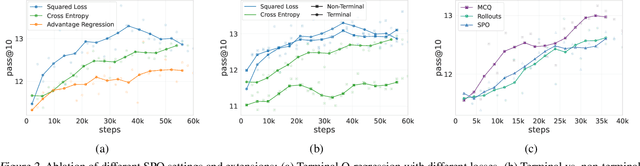
RL-based post-training of language models is almost exclusively done using on-policy methods such as PPO. These methods cannot learn from arbitrary sequences such as those produced earlier in training, in earlier runs, by human experts or other policies, or by decoding and exploration methods. This results in severe sample inefficiency and exploration difficulties, as well as a potential loss of diversity in the policy responses. Moreover, asynchronous PPO implementations require frequent and costly model transfers, and typically use value models which require a large amount of memory. In this paper we introduce Soft Policy Optimization (SPO), a simple, scalable and principled Soft RL method for sequence model policies that can learn from arbitrary online and offline trajectories and does not require a separate value model. In experiments on code contests, we shows that SPO outperforms PPO on pass@10, is significantly faster and more memory efficient, is able to benefit from off-policy data, enjoys improved stability, and learns more diverse (i.e. soft) policies.
Offline Regularised Reinforcement Learning for Large Language Models Alignment
May 29, 2024The dominant framework for alignment of large language models (LLM), whether through reinforcement learning from human feedback or direct preference optimisation, is to learn from preference data. This involves building datasets where each element is a quadruplet composed of a prompt, two independent responses (completions of the prompt) and a human preference between the two independent responses, yielding a preferred and a dis-preferred response. Such data is typically scarce and expensive to collect. On the other hand, \emph{single-trajectory} datasets where each element is a triplet composed of a prompt, a response and a human feedback is naturally more abundant. The canonical element of such datasets is for instance an LLM's response to a user's prompt followed by a user's feedback such as a thumbs-up/down. Consequently, in this work, we propose DRO, or \emph{Direct Reward Optimisation}, as a framework and associated algorithms that do not require pairwise preferences. DRO uses a simple mean-squared objective that can be implemented in various ways. We validate our findings empirically, using T5 encoder-decoder language models, and show DRO's performance over selected baselines such as Kahneman-Tversky Optimization (KTO). Thus, we confirm that DRO is a simple and empirically compelling method for single-trajectory policy optimisation.
Super-Exponential Regret for UCT, AlphaGo and Variants
May 07, 2024We improve the proofs of the lower bounds of Coquelin and Munos (2007) that demonstrate that UCT can have $\exp(\dots\exp(1)\dots)$ regret (with $\Omega(D)$ exp terms) on the $D$-chain environment, and that a `polynomial' UCT variant has $\exp_2(\exp_2(D - O(\log D)))$ regret on the same environment -- the original proofs contain an oversight for rewards bounded in $[0, 1]$, which we fix in the present draft. We also adapt the proofs to AlphaGo's MCTS and its descendants (e.g., AlphaZero, Leela Zero) to also show $\exp_2(\exp_2(D - O(\log D)))$ regret.
Human Alignment of Large Language Models through Online Preference Optimisation
Mar 13, 2024
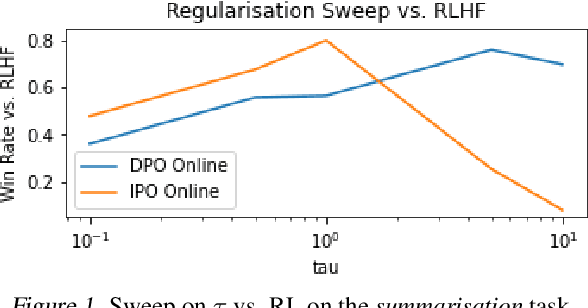

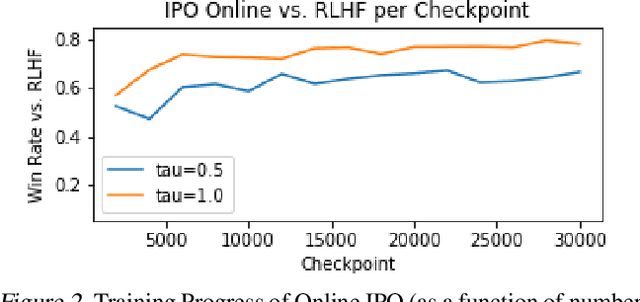
Ensuring alignment of language models' outputs with human preferences is critical to guarantee a useful, safe, and pleasant user experience. Thus, human alignment has been extensively studied recently and several methods such as Reinforcement Learning from Human Feedback (RLHF), Direct Policy Optimisation (DPO) and Sequence Likelihood Calibration (SLiC) have emerged. In this paper, our contribution is two-fold. First, we show the equivalence between two recent alignment methods, namely Identity Policy Optimisation (IPO) and Nash Mirror Descent (Nash-MD). Second, we introduce a generalisation of IPO, named IPO-MD, that leverages the regularised sampling approach proposed by Nash-MD. This equivalence may seem surprising at first sight, since IPO is an offline method whereas Nash-MD is an online method using a preference model. However, this equivalence can be proven when we consider the online version of IPO, that is when both generations are sampled by the online policy and annotated by a trained preference model. Optimising the IPO loss with such a stream of data becomes then equivalent to finding the Nash equilibrium of the preference model through self-play. Building on this equivalence, we introduce the IPO-MD algorithm that generates data with a mixture policy (between the online and reference policy) similarly as the general Nash-MD algorithm. We compare online-IPO and IPO-MD to different online versions of existing losses on preference data such as DPO and SLiC on a summarisation task.