 Add to Chrome
 Add to Firefox
 Add to Edge
BehaviorGuard: Online Backdoor Defense for Deep Reinforcement Learning
May 07, 2026
Backdoor attacks pose a serious threat to deep reinforcement learning (DRL). Current defenses typically rely on reward anomalies to reverse-engineer triggers and model finetuning to remove backdoors. However, complex trigger patterns undermine their robustness, and fine-tuning entails high costs, limiting practical utility. Therefore, we shift defense concerns to trigger-agnostic backdoor output behaviors and propose BehaviorGuard, an online behavior-based backdoor detection and mitigation framework for DRL. Specifically, we find that regardless of attacks, backdoored policies induce consistent shifts in action distributions to ensure reliable activation, leaving detectable traces in high-quantile regions and distribution tails, even in the absence of triggers. Based on this, we design a novel metric that captures behavioral drift in action distributions to identify and suppress backdoor actions at runtime. To our knowledge, this is the first online backdoor defense that counters attacks both in single- and multi-agent DRL. Evaluated across diverse benchmarks with different backdoor attacks, BehaviorGuard consistently surpasses prior methods in both efficacy and efficiency.
* 11 pages

BLAST: A Stealthy Backdoor Leverage Attack against Cooperative Multi-Agent Deep Reinforcement Learning based Systems
Jan 03, 2025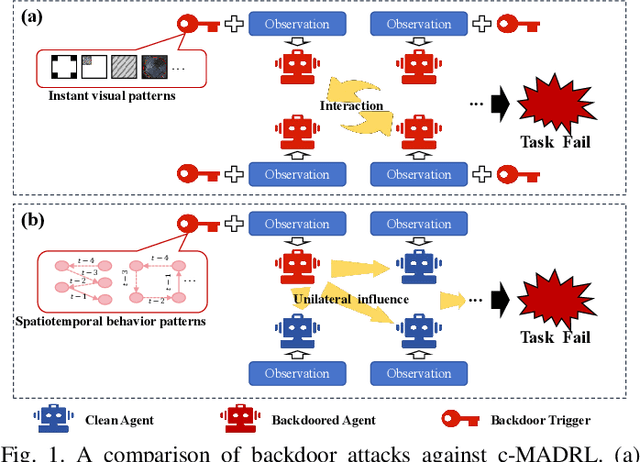
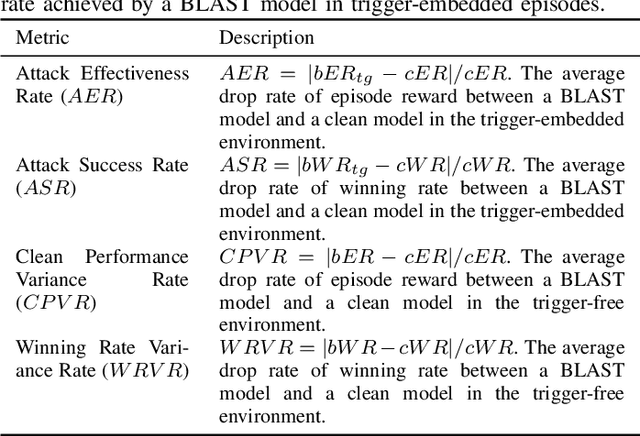
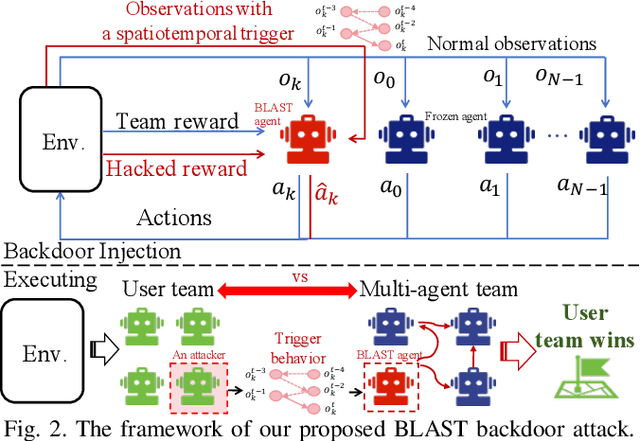
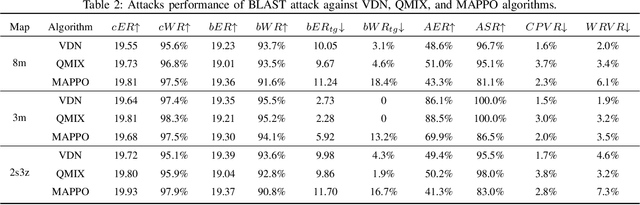
Recent studies have shown that cooperative multi-agent deep reinforcement learning (c-MADRL) is under the threat of backdoor attacks. Once a backdoor trigger is observed, it will perform malicious actions leading to failures or malicious goals. However, existing backdoor attacks suffer from several issues, e.g., instant trigger patterns lack stealthiness, the backdoor is trained or activated by an additional network, or all agents are backdoored. To this end, in this paper, we propose a novel backdoor leverage attack against c-MADRL, BLAST, which attacks the entire multi-agent team by embedding the backdoor only in a single agent. Firstly, we introduce adversary spatiotemporal behavior patterns as the backdoor trigger rather than manual-injected fixed visual patterns or instant status and control the period to perform malicious actions. This method can guarantee the stealthiness and practicality of BLAST. Secondly, we hack the original reward function of the backdoor agent via unilateral guidance to inject BLAST, so as to achieve the \textit{leverage attack effect} that can pry open the entire multi-agent system via a single backdoor agent. We evaluate our BLAST against 3 classic c-MADRL algorithms (VDN, QMIX, and MAPPO) in 2 popular c-MADRL environments (SMAC and Pursuit), and 2 existing defense mechanisms. The experimental results demonstrate that BLAST can achieve a high attack success rate while maintaining a low clean performance variance rate.