 Add to Chrome
 Add to Firefox
 Add to Edge
Cosmos 3: Omnimodal World Models for Physical AI
Jun 01, 2026
We introduce Cosmos 3, a family of omnimodal world models designed to jointly process and generate language, image, video, audio, and action sequences within a unified mixture-of-transformers architecture. By supporting highly flexible input-output configurations, Cosmos 3 seamlessly unifies critical modalities for Physical AI -- effectively subsuming vision-language models, video generators, world simulators, and world-action models into a single framework. Our evaluation demonstrates that Cosmos 3 establishes a new state-of-the-art across a diverse suite of understanding and generation tasks, demonstrating omnimodal world models as scalable, general-purpose backbones for embodied agents. Our post-trained Cosmos 3 models were ranked as the best open-source Text-to-Image and Image-to-Video models by Artificial Analysis, and the best policy model by RoboArena at the time the technical report was written. To accelerate open research and deployment in Physical AI, we make our code, model checkpoints, curated synthetic datasets, and evaluation benchmark available under the Linux Foundation's OpenMDW-1.1 https://openmdw.ai/license/1-1/ License at https://github.com/nvidia/cosmos}{github.com/nvidia/cosmos and https://huggingface.co/collections/nvidia/cosmos3 . The project website is available at https://research.nvidia.com/labs/cosmos-lab/cosmos3 .

Autocorrelation Reintroduces Spectral Bias in KANs for Time Series Forecasting
Apr 26, 2026Existing theory suggests that Kolmogorov-Arnold Networks (KANs) can overcome the spectral bias commonly observed in neural networks under the assumption that inputs are statistically independent. However, this assumption does not hold in time series forecasting (TSF), where inputs are lagged observations with strong temporal autocorrelation. Through theoretical analysis and empirical validation, we obtain an unexpected finding: temporal autocorrelation reintroduces spectral bias in KANs, and the bias becomes increasingly pronounced as the degree of autocorrelation increases. This suggests that standard KANs may face substantial difficulties in TSF with strongly autocorrelated inputs. To address this problem, we introduce the Discrete Cosine Transform (DCT) to reduce the correlations among the network inputs. As expected, experimental results reveal that DCT preprocessing substantially reduces the observed low-frequency preference in TSF. This result also corroborates that the spectral bias of KANs in TSF tasks is indeed induced by the autocorrelation among input variables.
GeoNDC: A Queryable Neural Data Cube for Planetary-Scale Earth Observation
Mar 27, 2026Satellite Earth observation has accumulated massive spatiotemporal archives essential for monitoring environmental change, yet these remain organized as discrete raster files, making them costly to store, transmit, and query. We present GeoNDC, a queryable neural data cube that encodes planetary-scale Earth observation data as a continuous spatiotemporal implicit neural field, enabling on-demand queries and continuous-time reconstruction without full decompression. Experiments on a 20-year global MODIS MCD43A4 reflectance record ($8016 \times 4008$ pixels, 7 bands, 915 temporal frames) show that the learned representation supports direct spatiotemporal queries on consumer hardware. On Sentinel-2 imagery (10 m), continuous temporal parameterization recovers cloud-free dynamics with high fidelity ($R^2 > 0.85$) under simulated 2-km cloud occlusion. On HiGLASS biophysical products (LAI and FPAR), GeoNDC attains near-perfect accuracy ($R^2 > 0.98$). The representation compresses the 20-year MODIS archive to 0.44\,GB -- approximately 95:1 relative to an optimized Int16 baseline -- with high spectral fidelity (mean $R^2 > 0.98$, mean RMSE $= 0.021$). These results suggest GeoNDC offers a unified AI-native representation for planetary-scale Earth observation, complementing raw archives with a compact, analysis-ready data layer integrating query, reconstruction, and compression in a single framework.
SOMA: Unifying Parametric Human Body Models
Mar 17, 2026Parametric human body models are foundational to human reconstruction, animation, and simulation, yet they remain mutually incompatible: SMPL, SMPL-X, MHR, Anny, and related models each diverge in mesh topology, skeletal structure, shape parameterization, and unit convention, making it impractical to exploit their complementary strengths within a single pipeline. We present SOMA, a unified body layer that bridges these heterogeneous representations through three abstraction layers. Mesh topology abstraction maps any source model's identity to a shared canonical mesh in constant time per vertex. Skeletal abstraction recovers a full set of identity-adapted joint transforms from any body shape, whether in rest pose or an arbitrary posed configuration, in a single closed-form pass, with no iterative optimization or per-model training. Pose abstraction inverts the skinning pipeline to recover unified skeleton rotations directly from posed vertices of any supported model, enabling heterogeneous motion datasets to be consumed without custom retargeting. Together, these layers reduce the $O(M^2)$ per-pair adapter problem to $O(M)$ single-backend connectors, letting practitioners freely mix identity sources and pose data at inference time. The entire pipeline is fully differentiable end-to-end and GPU-accelerated via NVIDIA-Warp.
The PokeAgent Challenge: Competitive and Long-Context Learning at Scale
Mar 17, 2026We present the PokeAgent Challenge, a large-scale benchmark for decision-making research built on Pokemon's multi-agent battle system and expansive role-playing game (RPG) environment. Partial observability, game-theoretic reasoning, and long-horizon planning remain open problems for frontier AI, yet few benchmarks stress all three simultaneously under realistic conditions. PokeAgent targets these limitations at scale through two complementary tracks: our Battling Track, which calls for strategic reasoning and generalization under partial observability in competitive Pokemon battles, and our Speedrunning Track, which requires long-horizon planning and sequential decision-making in the Pokemon RPG. Our Battling Track supplies a dataset of 20M+ battle trajectories alongside a suite of heuristic, RL, and LLM-based baselines capable of high-level competitive play. Our Speedrunning Track provides the first standardized evaluation framework for RPG speedrunning, including an open-source multi-agent orchestration system for modular, reproducible comparisons of harness-based LLM approaches. Our NeurIPS 2025 competition validates both the quality of our resources and the research community's interest in Pokemon, with over 100 teams competing across both tracks and winning solutions detailed in our paper. Participant submissions and our baselines reveal considerable gaps between generalist (LLM), specialist (RL), and elite human performance. Analysis against the BenchPress evaluation matrix shows that Pokemon battling is nearly orthogonal to standard LLM benchmarks, measuring capabilities not captured by existing suites and positioning Pokemon as an unsolved benchmark that can drive RL and LLM research forward. We transition to a living benchmark with a live leaderboard for Battling and self-contained evaluation for Speedrunning at https://pokeagentchallenge.com.
Step-GUI Technical Report
Dec 19, 2025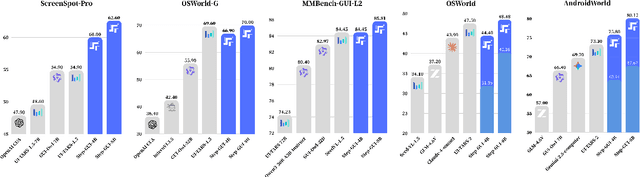
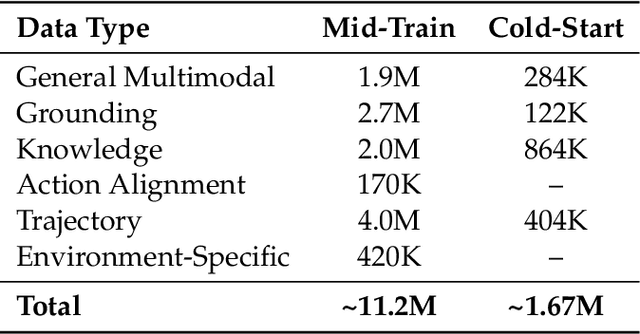
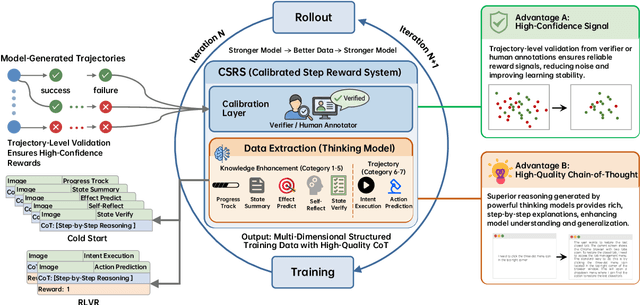
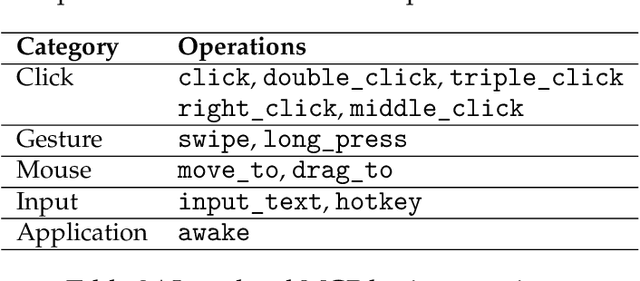
Recent advances in multimodal large language models unlock unprecedented opportunities for GUI automation. However, a fundamental challenge remains: how to efficiently acquire high-quality training data while maintaining annotation reliability? We introduce a self-evolving training pipeline powered by the Calibrated Step Reward System, which converts model-generated trajectories into reliable training signals through trajectory-level calibration, achieving >90% annotation accuracy with 10-100x lower cost. Leveraging this pipeline, we introduce Step-GUI, a family of models (4B/8B) that achieves state-of-the-art GUI performance (8B: 80.2% AndroidWorld, 48.5% OSWorld, 62.6% ScreenShot-Pro) while maintaining robust general capabilities. As GUI agent capabilities improve, practical deployment demands standardized interfaces across heterogeneous devices while protecting user privacy. To this end, we propose GUI-MCP, the first Model Context Protocol for GUI automation with hierarchical architecture that combines low-level atomic operations and high-level task delegation to local specialist models, enabling high-privacy execution where sensitive data stays on-device. Finally, to assess whether agents can handle authentic everyday usage, we introduce AndroidDaily, a benchmark grounded in real-world mobile usage patterns with 3146 static actions and 235 end-to-end tasks across high-frequency daily scenarios (8B: static 89.91%, end-to-end 52.50%). Our work advances the development of practical GUI agents and demonstrates strong potential for real-world deployment in everyday digital interactions.
Predicting Household Water Consumption Using Satellite and Street View Images in Two Indian Cities
Oct 30, 2025Monitoring household water use in rapidly urbanizing regions is hampered by costly, time-intensive enumeration methods and surveys. We investigate whether publicly available imagery-satellite tiles, Google Street View (GSV) segmentation-and simple geospatial covariates (nightlight intensity, population density) can be utilized to predict household water consumption in Hubballi-Dharwad, India. We compare four approaches: survey features (benchmark), CNN embeddings (satellite, GSV, combined), and GSV semantic maps with auxiliary data. Under an ordinal classification framework, GSV segmentation plus remote-sensing covariates achieves 0.55 accuracy for water use, approaching survey-based models (0.59 accuracy). Error analysis shows high precision at extremes of the household water consumption distribution, but confusion among middle classes is due to overlapping visual proxies. We also compare and contrast our estimates for household water consumption to that of household subjective income. Our findings demonstrate that open-access imagery, coupled with minimal geospatial data, offers a promising alternative to obtaining reliable household water consumption estimates using surveys in urban analytics.
GenQuest: An LLM-based Text Adventure Game for Language Learners
Oct 06, 2025GenQuest is a generative text adventure game that leverages Large Language Models (LLMs) to facilitate second language learning through immersive, interactive storytelling. The system engages English as a Foreign Language (EFL) learners in a collaborative "choose-your-own-adventure" style narrative, dynamically generated in response to learner choices. Game mechanics such as branching decision points and story milestones are incorporated to maintain narrative coherence while allowing learner-driven plot development. Key pedagogical features include content generation tailored to each learner's proficiency level, and a vocabulary assistant that provides in-context explanations of learner-queried text strings, ranging from words and phrases to sentences. Findings from a pilot study with university EFL students in China indicate promising vocabulary gains and positive user perceptions. Also discussed are suggestions from participants regarding the narrative length and quality, and the request for multi-modal content such as illustrations.
Beyond the Score: Uncertainty-Calibrated LLMs for Automated Essay Assessment
Sep 19, 2025
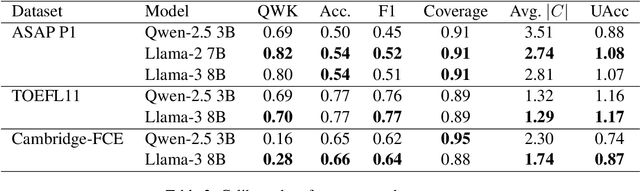
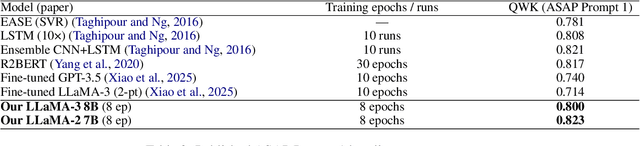
Automated Essay Scoring (AES) systems now reach near human agreement on some public benchmarks, yet real-world adoption, especially in high-stakes examinations, remains limited. A principal obstacle is that most models output a single score without any accompanying measure of confidence or explanation. We address this gap with conformal prediction, a distribution-free wrapper that equips any classifier with set-valued outputs and formal coverage guarantees. Two open-source large language models (Llama-3 8B and Qwen-2.5 3B) are fine-tuned on three diverse corpora (ASAP, TOEFL11, Cambridge-FCE) and calibrated at a 90 percent risk level. Reliability is assessed with UAcc, an uncertainty-aware accuracy that rewards models for being both correct and concise. To our knowledge, this is the first work to combine conformal prediction and UAcc for essay scoring. The calibrated models consistently meet the coverage target while keeping prediction sets compact, indicating that open-source, mid-sized LLMs can already support teacher-in-the-loop AES; we discuss scaling and broader user studies as future work.
GeoTexBuild: 3D Building Model Generation from Map Footprints
Apr 11, 2025We introduce GeoTexBuild, a modular generative framework for creating 3D building models from map footprints. The proposed framework employs a three-stage process comprising height map generation, geometry reconstruction, and appearance stylization, culminating in building models with intricate geometry and appearance attributes. By integrating customized ControlNet and Text2Mesh models, we explore effective methods for controlling both geometric and visual attributes during the generation process. By this, we eliminate the problem of structural variations behind a single facade photo of the existing 3D generation techniques. Experimental results at each stage validate the capability of GeoTexBuild to generate detailed and accurate building models from footprints derived from site planning or map designs. Our framework significantly reduces manual labor in modeling buildings and can offer inspiration for designers.