 Add to Chrome
 Add to Firefox
 Add to Edge
FemWear: A Specialized Wearable Foundation Model for Women's Health
Aug 08, 2026
General wearable foundation models are pretrained across broad sensor streams and populations, but are not designed around women's-health tasks. We introduce FemWear, a specialized wearable foundation model that parameter-efficiently repurposes a pretrained multimodal wearable backbone. FemWear retains the patch projection and Transformer encoder, training 239,236 parameters (1.11% of a 21.54M-parameter encoder) through low-rank residual adapters and causal task-family heads. It learns one shared longitudinal representation for menstrual, symptom, affective, sleep/recovery, autonomic, activity, and pregnancy-related outcomes. We evaluate six cohorts with 63 comparable primary metrics, including 33 from women's-health cohorts, while retaining the 32-task OpenMHC ability-retention benchmark. On a fixed participant split over three seeds, FemWear improved cycle-phase macro-F1 by 8.15% and reduced mean absolute error for cramps, mood symptoms, and sleep problems by 9.32%, 5.80%, and 9.43%, respectively. In a stricter 42-participant nested leave-one-participant-out audit, 24-hour onset, 72-hour onset, and cramps retained positive changes of 2.87%, 6.35%, and 2.19%; phase, mood, and sleep were neutral or negative, and no endpoint had a strictly positive corrected confidence interval. Capacity-matched experiments outperformed a latest-day multilayer perceptron but not shared-GRU or multi-gate mixture-of-experts baselines. Train-only calibration reduced onset expected calibration error by 84.2--88.2% with zero temporal-nesting violations. FemWear enables targeted transfer and coherent probability outputs for women's-health research, but does not establish universal performance dominance or clinical validity.

A Learnable Multi-views Contrastive Framework with Reconstruction Discrepancy for Medical Time-Series
Jan 30, 2025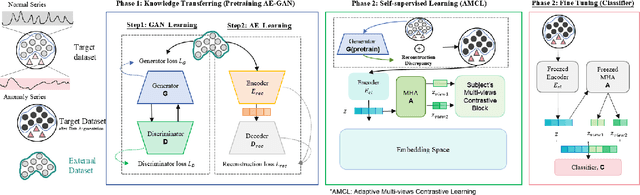


In medical time series disease diagnosis, two key challenges are identified.First, the high annotation cost of medical data leads to overfitting in models trained on label-limited, single-center datasets. To address this, we propose incorporating external data from related tasks and leveraging AE-GAN to extract prior knowledge,providing valuable references for downstream tasks. Second, many existing studies employ contrastive learning to derive more generalized medical sequence representations for diagnostic tasks, usually relying on manually designed diverse positive and negative sample pairs.However, these approaches are complex, lack generalizability, and fail to adaptively capture disease-specific features across different conditions.To overcome this, we introduce LMCF (Learnable Multi-views Contrastive Framework), a framework that integrates a multi-head attention mechanism and adaptively learns representations from different views through inter-view and intra-view contrastive learning strategies.Additionally, the pre-trained AE-GAN is used to reconstruct discrepancies in the target data as disease probabilities, which are then integrated into the contrastive learning process.Experiments on three target datasets demonstrate that our method consistently outperforms seven other baselines, highlighting its significant impact on healthcare applications such as the diagnosis of myocardial infarction, Alzheimer's disease, and Parkinson's disease.