 Add to Chrome
 Add to Firefox
 Add to Edge
Few-Shot Open-Set Audio Classification via Transductive Prototype Refinement and Class Logit Enhancement
Jul 29, 2026
Few-shot Open-set audio classification requires classifying query samples from known classes with a few labeled support samples while rejecting query samples from unknown classes. Transductive inference jointly observes the full unlabeled query set to improve prototype estimation, yet standard transductive updates do not distinguish known from unknown query samples, leaving prototypes vulnerable to open-set contamination. Drawing on latent-inlierness weighting and decoupled scoring for unknown-class samples, we propose a two-phase transductive method operating over a frozen audio encoder. First, each query sample is assigned a latent inlierness score that down-weights likely unknown-class samples, so that prototype refinement is driven primarily by known-class evidence. The refined prototypes are then directly optimized on a transductive loss combining support cross-entropy, inlierness-weighted conditional entropy minimization, and inlierness-weighted marginal entropy maximization, while open-set rejection uses a prior-adaptive free-energy score that adjusts its threshold with the prior proportion of unknown-class samples, decoupling detection from classification. Experiments on three audio datasets show our method achieves state-of-the-art results for few-shot open-set audio classification under multiple experimental conditions.

SymStep: Symbolic Step Verification for Logical Reasoning
Jul 25, 2026Chain-of-thought (CoT) prompting can fail severely on constraint-dense logical reasoning tasks, where unverified errors accumulate silently across steps. We introduce SymStep: an LLM makes one atomic claim at a time (DEDUCE: Alice, pet, Cat), then a lightweight constraint propagator checks the claim for consistency with prior accepted deductions, rejects contradictions, and cascades implied facts automatically. SymStep+G additionally provides MRV guidance after each accepted step, directing the LLM toward the most constrained unresolved variable. On a 35-puzzle retained subset of ZebraLogicBench, a benchmark of 1,000 Einstein-style logic puzzles, Direct and CoT both achieve 0%, while SymStep+G reaches 97%. On AR-LSAT analytical reasoning problems, SymStep achieves 100% vs. CoT's 87%. On LGP-14, SymStep+G achieves 100% vs. 0% for CoT and Logic-LM, the strongest prior symbolic+LLM baseline we compare against. Ablation studies reveal that MRV guidance is a key mechanism for reducing directionless cycling, while consistency checking provides a safety net against explicit contradictions. Across six benchmarks spanning five task domains, SymStep variants match or exceed every baseline on constraint-dense and arithmetic tasks. Experiments on AQUA-RAT algebra confirm the advantage is constraint-density-specific.
Handwritten and Printed Text Segmentation via Region-Aware Human-Writing Descriptor Engineering
Jul 17, 2026With the increasing demand for reusing paper documents in educational and office settings, accurate segmentation of handwritten and printed text has become a crucial step in document digitization. Although numerous deep learning models have been developed for this task, their high computational cost limits deployment on resource-constrained edge devices. To address this challenge, we present a lightweight framework optimized for efficient performance on devices with severely limited computational capacity. Our approach begins with the Sentence-level Connected Component Segmentation algorithm, aimed at extracting coherent sentence-level segments from document images. We then design a novel Region-aware Handwriting Descriptor (RHD) to capture the intrinsic variability of human handwriting at the sentence level. A simple conventional classifier can then be seamlessly integrated with our designed descriptor, demonstrating strong classification performance for distinguishing handwritten and printed sentence-level text images, highlighting that the proposed descriptor is agnostic to the choice of classifier. Extensive experiments are performed on our self-constructed Multilingual High-Quality Annotated Dataset for Handwritten and Printed Text Segmentation (MAD-HPTS) and a public benchmark PHD-AS, and the experimental results demonstrate that the proposed framework outperforms current state-of-the-art methods in both accuracy and computational efficiency. On MAD-HPTS, our method sacrifices only 1.4% accuracy compared to the leading deep neural network baseline, yet achieves more than 8 times speedup in inference, making it well-suited for lightweight deployment.
IR-SIM: A Lightweight Skill-Native Simulator for Navigation, Learning, and Benchmarking
Jun 07, 2026Simulation plays a key role in automated robotics research supported by large language models (LLMs). However, existing simulators often require custom code or complex interfaces, creating a barrier to rapid prototyping and automated algorithm development. To this end, we propose the Intelligent Robot Simulator (IR-SIM), a lightweight skill-native navigation simulator designed for rapid scenario construction, benchmarking, and robot learning. In IR-SIM, scenarios are entirely defined by YAML configuration files that specify mobile robot kinematics, geometric collision checking, LiDAR sensing, visualization, and behavior modules. This design makes robotic simulation fully describable and reproducible, allowing scenarios to be generated and modified from text prompts through the proposed IR-SIM agent skills. The resulting scenarios can be used for automated benchmarking of navigation algorithms and for automated generation of training data for learning methods. Furthermore, IR-SIM provides bridges to high fidelity simulators and real world deployment, allowing users to validate their algorithms in more realistic settings after prototyping without extra coding. The experiments showcase the convenience and versatility of IR-SIM in multiple tasks: constructing navigation scenarios from natural language, training a collision avoidance policy, benchmarking social navigation policies, and bridging to high fidelity simulators and real world deployment. The project website is available at https://github.com/hanruihua/ir-sim.
Global Convergence of Wasserstein Policy Gradient for Entropy-Regularized Reinforcement Learning
May 26, 2026Wasserstein policy gradient (WPG) is a policy optimization method for reinforcement learning (RL) that exploits the optimal-transport geometry of action distributions. For the entropy-regularized RL objective, WPG evolves each state-conditional policy by transporting it along the action gradient of the soft Q-function together with a Langevin-type diffusion. Despite its appeal for continuous-control problems, its global convergence properties remain poorly understood. Standard Langevin analyses do not directly apply, because the RL objective depends on the policy through the Bellman recursion rather than through a static convex functional, and the Langevin drift is determined by the soft Q-function, whose regularity must be controlled along the policy iterates. In this paper, we develop a global convergence theory for WPG by exploiting the Bellman structure of entropy-regularized RL. We show that the role usually played by convexity can be replaced by a Bellman-based argument: the soft Bellman residual admits a statewise KL representation with respect to a Gibbs policy; Bellman contraction relates this residual to the global optimality gap; and a Bellman resolvent identity connects value improvement to relative Fisher information. Combined with a uniform log-Sobolev inequality (LSI) for the evolving Gibbs family, these ingredients yield a distributional Polyak--Łojasiewicz condition. We further establish the regularity and uniform bounds needed to control the discretization error, thereby obtaining geometric contraction up to a discretization bias. Conceptually, our analysis shows that although entropy-regularized RL is not convex in the usual flat sense, the Bellman recursion induces a favorable Polyak--Lojasiewicz-type (PL) geometry that supports global convergence of WPG.
C-MORAL: Controllable Multi-Objective Molecular Optimization with Reinforcement Alignment for LLMs
Apr 24, 2026Large language models (LLMs) show promise for molecular optimization, but aligning them with selective and competing drug-design constraints remains challenging. We propose C-Moral, a reinforcement learning post-training framework for controllable multi-objective molecular optimization. C-Moral combines group-based relative optimization, property score alignment for heterogeneous objectives, and continuous non-linear reward aggregation to improve stability across competing properties. Experiments on the C-MuMOInstruct benchmark show that C-Moral consistently outperforms state-of-the-art models across both in-domain and out-of-domain settings, achieving the best Success Optimized Rate (SOR) of 48.9% on IND tasks and 39.5% on OOD tasks, while largely preserving scaffold similarity. These results suggest that RL post-training is an effective way to align molecular language models with continuous molecular design objectives. Our code and models are publicly available at https://github.com/Rwigie/C-MORAL.
Wasserstein Proximal Policy Gradient
Mar 03, 2026We study policy gradient methods for continuous-action, entropy-regularized reinforcement learning through the lens of Wasserstein geometry. Starting from a Wasserstein proximal update, we derive Wasserstein Proximal Policy Gradient (WPPG) via an operator-splitting scheme that alternates an optimal transport update with a heat step implemented by Gaussian convolution. This formulation avoids evaluating the policy's log density or its gradient, making the method directly applicable to expressive implicit stochastic policies specified as pushforward maps. We establish a global linear convergence rate for WPPG, covering both exact policy evaluation and actor-critic implementations with controlled approximation error. Empirically, WPPG is simple to implement and attains competitive performance on standard continuous-control benchmarks.
LLM-Driven Scenario-Aware Planning for Autonomous Driving
Jan 29, 2026Hybrid planner switching framework (HPSF) for autonomous driving needs to reconcile high-speed driving efficiency with safe maneuvering in dense traffic. Existing HPSF methods often fail to make reliable mode transitions or sustain efficient driving in congested environments, owing to heuristic scene recognition and low-frequency control updates. To address the limitation, this paper proposes LAP, a large language model (LLM) driven, adaptive planning method, which switches between high-speed driving in low-complexity scenes and precise driving in high-complexity scenes, enabling high qualities of trajectory generation through confined gaps. This is achieved by leveraging LLM for scene understanding and integrating its inference into the joint optimization of mode configuration and motion planning. The joint optimization is solved using tree-search model predictive control and alternating minimization. We implement LAP by Python in Robot Operating System (ROS). High-fidelity simulation results show that the proposed LAP outperforms other benchmarks in terms of both driving time and success rate.
DeepHalo: A Neural Choice Model with Controllable Context Effects
Jan 08, 2026Modeling human decision-making is central to applications such as recommendation, preference learning, and human-AI alignment. While many classic models assume context-independent choice behavior, a large body of behavioral research shows that preferences are often influenced by the composition of the choice set itself -- a phenomenon known as the context effect or Halo effect. These effects can manifest as pairwise (first-order) or even higher-order interactions among the available alternatives. Recent models that attempt to capture such effects either focus on the featureless setting or, in the feature-based setting, rely on restrictive interaction structures or entangle interactions across all orders, which limits interpretability. In this work, we propose DeepHalo, a neural modeling framework that incorporates features while enabling explicit control over interaction order and principled interpretation of context effects. Our model enables systematic identification of interaction effects by order and serves as a universal approximator of context-dependent choice functions when specialized to a featureless setting. Experiments on synthetic and real-world datasets demonstrate strong predictive performance while providing greater transparency into the drivers of choice.
Sigma-MoE-Tiny Technical Report
Dec 19, 2025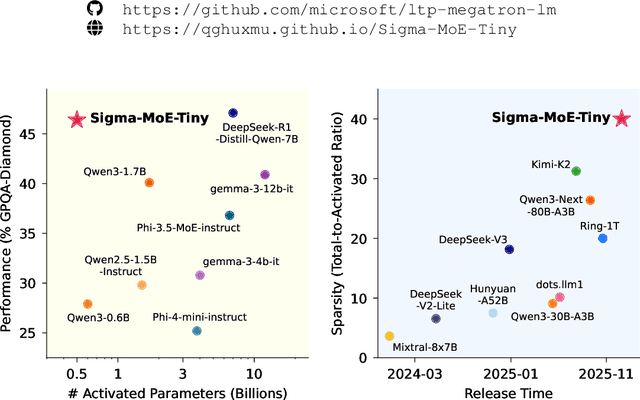
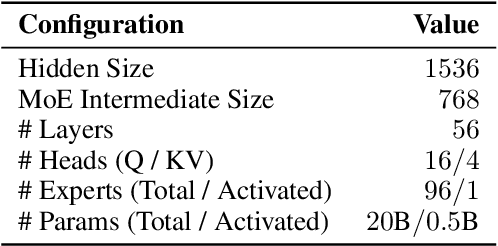
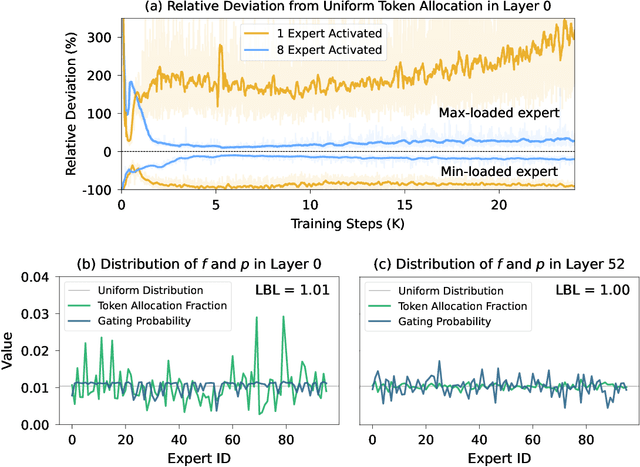
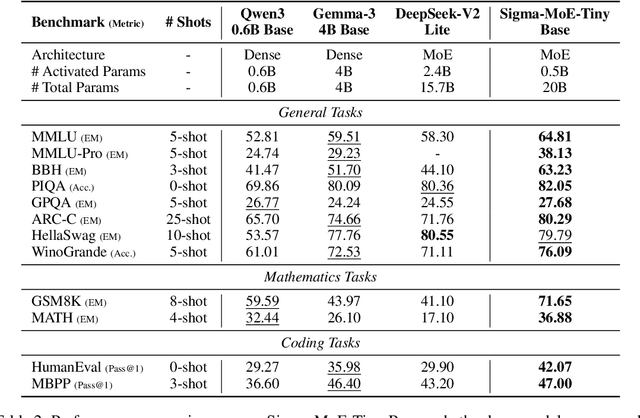
Mixture-of-Experts (MoE) has emerged as a promising paradigm for foundation models due to its efficient and powerful scalability. In this work, we present Sigma-MoE-Tiny, an MoE language model that achieves the highest sparsity compared to existing open-source models. Sigma-MoE-Tiny employs fine-grained expert segmentation with up to 96 experts per layer, while activating only one expert for each token, resulting in 20B total parameters with just 0.5B activated. The major challenge introduced by such extreme sparsity lies in expert load balancing. We find that the widely-used load balancing loss tends to become ineffective in the lower layers under this setting. To address this issue, we propose a progressive sparsification schedule aiming to balance expert utilization and training stability. Sigma-MoE-Tiny is pre-trained on a diverse and high-quality corpus, followed by post-training to further unlock its capabilities. The entire training process remains remarkably stable, with no occurrence of irrecoverable loss spikes. Comprehensive evaluations reveal that, despite activating only 0.5B parameters, Sigma-MoE-Tiny achieves top-tier performance among counterparts of comparable or significantly larger scale. In addition, we provide an in-depth discussion of load balancing in highly sparse MoE models, offering insights for advancing sparsity in future MoE architectures. Project page: https://qghuxmu.github.io/Sigma-MoE-Tiny Code: https://github.com/microsoft/ltp-megatron-lm