 Add to Chrome
 Add to Firefox
 Add to Edge
Knowledge Distillation based Degradation Estimation for Blind Super-Resolution
Nov 30, 2022
Blind image super-resolution (Blind-SR) aims to recover a high-resolution (HR) image from its corresponding low-resolution (LR) input image with unknown degradations. Most of the existing works design an explicit degradation estimator for each degradation to guide SR. However, it is infeasible to provide concrete labels of multiple degradation combinations (\eg, blur, noise, jpeg compression) to supervise the degradation estimator training. In addition, these special designs for certain degradation, such as blur, impedes the models from being generalized to handle different degradations. To this end, it is necessary to design an implicit degradation estimator that can extract discriminative degradation representation for all degradations without relying on the supervision of degradation ground-truth. In this paper, we propose a Knowledge Distillation based Blind-SR network (KDSR). It consists of a knowledge distillation based implicit degradation estimator network (KD-IDE) and an efficient SR network. To learn the KDSR model, we first train a teacher network: KD-IDE$_{T}$. It takes paired HR and LR patches as inputs and is optimized with the SR network jointly. Then, we further train a student network KD-IDE$_{S}$, which only takes LR images as input and learns to extract the same implicit degradation representation (IDR) as KD-IDE$_{T}$. In addition, to fully use extracted IDR, we design a simple, strong, and efficient IDR based dynamic convolution residual block (IDR-DCRB) to build an SR network. We conduct extensive experiments under classic and real-world degradation settings. The results show that KDSR achieves SOTA performance and can generalize to various degradation processes. The source codes and pre-trained models will be released.

CDDFuse: Correlation-Driven Dual-Branch Feature Decomposition for Multi-Modality Image Fusion
Nov 26, 2022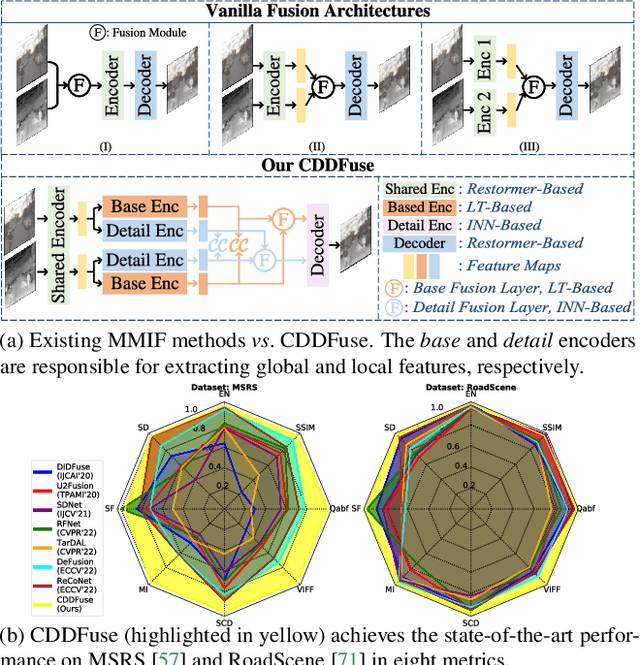
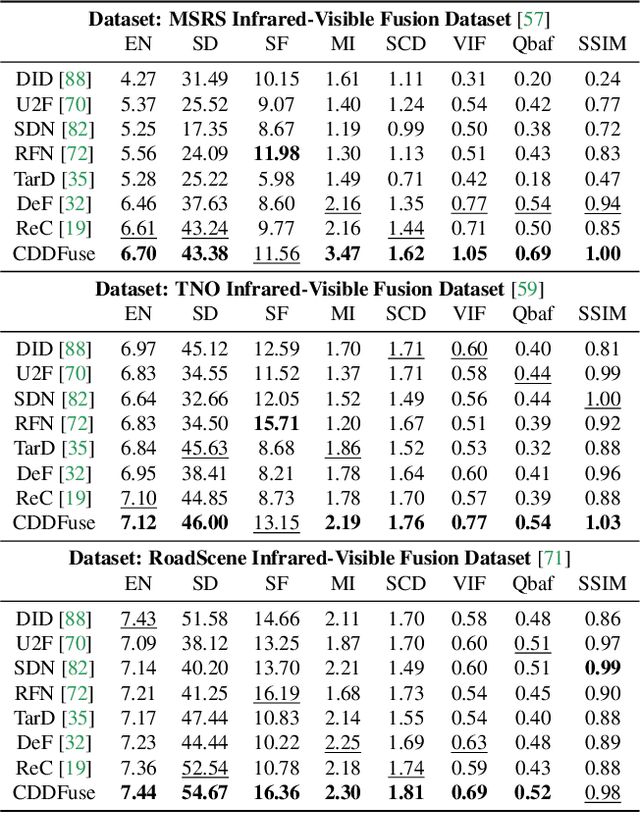
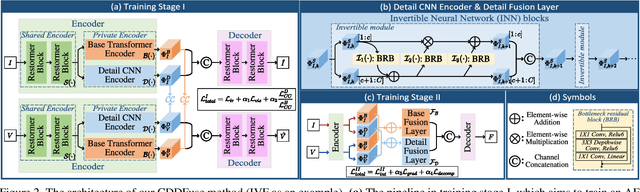
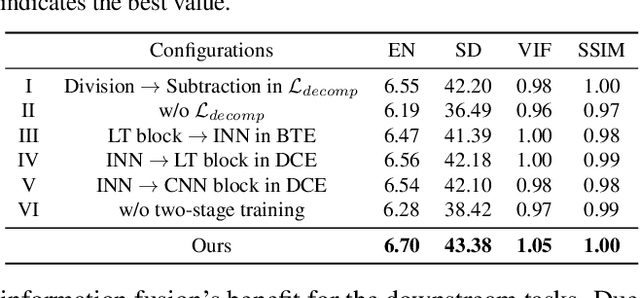
Multi-modality (MM) image fusion aims to render fused images that maintain the merits of different modalities, e.g., functional highlight and detailed textures. To tackle the challenge in modeling cross-modality features and decomposing desirable modality-specific and modality-shared features, we propose a novel Correlation-Driven feature Decomposition Fusion (CDDFuse) network for end-to-end MM feature decomposition and image fusion. In the first stage of the two-stage architectures, CDDFuse uses Restormer blocks to extract cross-modality shallow features. We then introduce a dual-branch Transformer-CNN feature extractor with Lite Transformer (LT) blocks leveraging long-range attention to handle low-frequency global features and Invertible Neural Networks (INN) blocks focusing on extracting high-frequency local information. Upon the embedded semantic information, the low-frequency features should be correlated while the high-frequency features should be uncorrelated. Thus, we propose a correlation-driven loss for better feature decomposition. In the second stage, the LT-based global fusion and INN-based local fusion layers output the fused image. Extensive experiments demonstrate that our CDDFuse achieves promising results in multiple fusion tasks, including infrared-visible image fusion and medical image fusion. We also show that CDDFuse can boost the performance in downstream infrared-visible semantic segmentation and object detection in a unified benchmark.
Real-Time Under-Display Cameras Image Restoration and HDR on Mobile Devices
Nov 25, 2022The new trend of full-screen devices implies positioning the camera behind the screen to bring a larger display-to-body ratio, enhance eye contact, and provide a notch-free viewing experience on smartphones, TV or tablets. On the other hand, the images captured by under-display cameras (UDCs) are degraded by the screen in front of them. Deep learning methods for image restoration can significantly reduce the degradation of captured images, providing satisfying results for the human eyes. However, most proposed solutions are unreliable or efficient enough to be used in real-time on mobile devices. In this paper, we aim to solve this image restoration problem using efficient deep learning methods capable of processing FHD images in real-time on commercial smartphones while providing high-quality results. We propose a lightweight model for blind UDC Image Restoration and HDR, and we also provide a benchmark comparing the performance and runtime of different methods on smartphones. Our models are competitive on UDC benchmarks while using x4 less operations than others. To the best of our knowledge, we are the first work to approach and analyze this real-world single image restoration problem from the efficiency and production point of view.
Advancing Learned Video Compression with In-loop Frame Prediction
Nov 18, 2022Recent years have witnessed an increasing interest in end-to-end learned video compression. Most previous works explore temporal redundancy by detecting and compressing a motion map to warp the reference frame towards the target frame. Yet, it failed to adequately take advantage of the historical priors in the sequential reference frames. In this paper, we propose an Advanced Learned Video Compression (ALVC) approach with the in-loop frame prediction module, which is able to effectively predict the target frame from the previously compressed frames, without consuming any bit-rate. The predicted frame can serve as a better reference than the previously compressed frame, and therefore it benefits the compression performance. The proposed in-loop prediction module is a part of the end-to-end video compression and is jointly optimized in the whole framework. We propose the recurrent and the bi-directional in-loop prediction modules for compressing P-frames and B-frames, respectively. The experiments show the state-of-the-art performance of our ALVC approach in learned video compression. We also outperform the default hierarchical B mode of x265 in terms of PSNR and beat the slowest mode of the SSIM-tuned x265 on MS-SSIM. The project page: https://github.com/RenYang-home/ALVC.
PyNet-V2 Mobile: Efficient On-Device Photo Processing With Neural Networks
Nov 08, 2022The increased importance of mobile photography created a need for fast and performant RAW image processing pipelines capable of producing good visual results in spite of the mobile camera sensor limitations. While deep learning-based approaches can efficiently solve this problem, their computational requirements usually remain too large for high-resolution on-device image processing. To address this limitation, we propose a novel PyNET-V2 Mobile CNN architecture designed specifically for edge devices, being able to process RAW 12MP photos directly on mobile phones under 1.5 second and producing high perceptual photo quality. To train and to evaluate the performance of the proposed solution, we use the real-world Fujifilm UltraISP dataset consisting on thousands of RAW-RGB image pairs captured with a professional medium-format 102MP Fujifilm camera and a popular Sony mobile camera sensor. The results demonstrate that the PyNET-V2 Mobile model can substantially surpass the quality of tradition ISP pipelines, while outperforming the previously introduced neural network-based solutions designed for fast image processing. Furthermore, we show that the proposed architecture is also compatible with the latest mobile AI accelerators such as NPUs or APUs that can be used to further reduce the latency of the model to as little as 0.5 second. The dataset, code and pre-trained models used in this paper are available on the project website: https://github.com/gmalivenko/PyNET-v2
MicroISP: Processing 32MP Photos on Mobile Devices with Deep Learning
Nov 08, 2022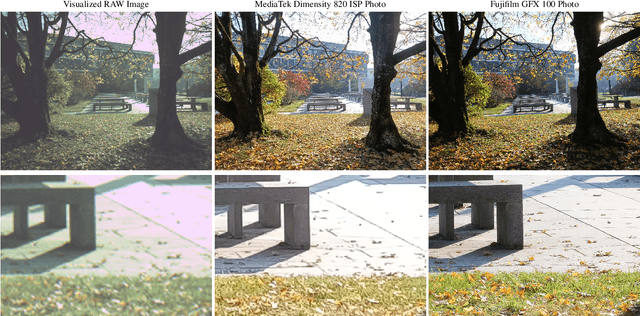
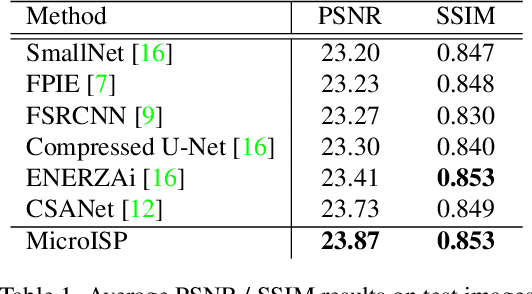

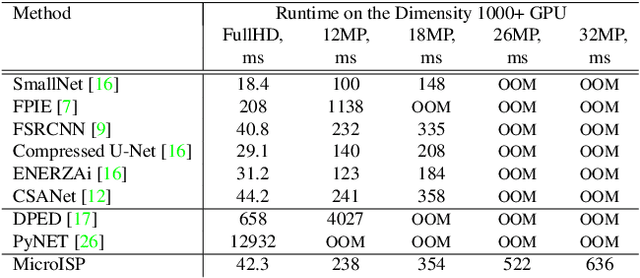
While neural networks-based photo processing solutions can provide a better image quality compared to the traditional ISP systems, their application to mobile devices is still very limited due to their very high computational complexity. In this paper, we present a novel MicroISP model designed specifically for edge devices, taking into account their computational and memory limitations. The proposed solution is capable of processing up to 32MP photos on recent smartphones using the standard mobile ML libraries and requiring less than 1 second to perform the inference, while for FullHD images it achieves real-time performance. The architecture of the model is flexible, allowing to adjust its complexity to devices of different computational power. To evaluate the performance of the model, we collected a novel Fujifilm UltraISP dataset consisting of thousands of paired photos captured with a normal mobile camera sensor and a professional 102MP medium-format FujiFilm GFX100 camera. The experiments demonstrated that, despite its compact size, the MicroISP model is able to provide comparable or better visual results than the traditional mobile ISP systems, while outperforming the previously proposed efficient deep learning based solutions. Finally, this model is also compatible with the latest mobile AI accelerators, achieving good runtime and low power consumption on smartphone NPUs and APUs. The code, dataset and pre-trained models are available on the project website: https://people.ee.ethz.ch/~ihnatova/microisp.html
Realistic Bokeh Effect Rendering on Mobile GPUs, Mobile AI & AIM 2022 challenge: Report
Nov 07, 2022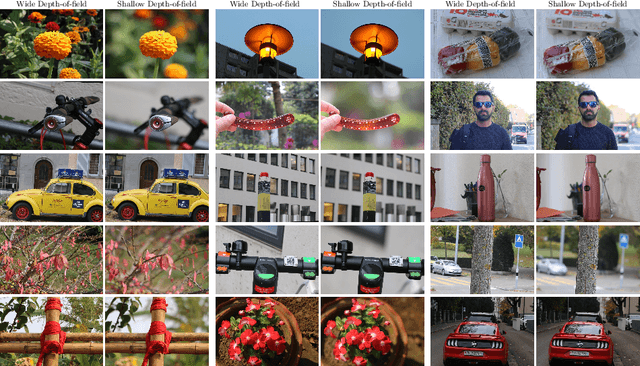

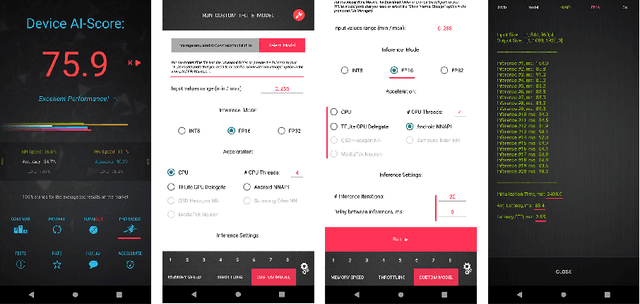

As mobile cameras with compact optics are unable to produce a strong bokeh effect, lots of interest is now devoted to deep learning-based solutions for this task. In this Mobile AI challenge, the target was to develop an efficient end-to-end AI-based bokeh effect rendering approach that can run on modern smartphone GPUs using TensorFlow Lite. The participants were provided with a large-scale EBB! bokeh dataset consisting of 5K shallow / wide depth-of-field image pairs captured using the Canon 7D DSLR camera. The runtime of the resulting models was evaluated on the Kirin 9000's Mali GPU that provides excellent acceleration results for the majority of common deep learning ops. A detailed description of all models developed in this challenge is provided in this paper.
Efficient and Accurate Quantized Image Super-Resolution on Mobile NPUs, Mobile AI & AIM 2022 challenge: Report
Nov 07, 2022

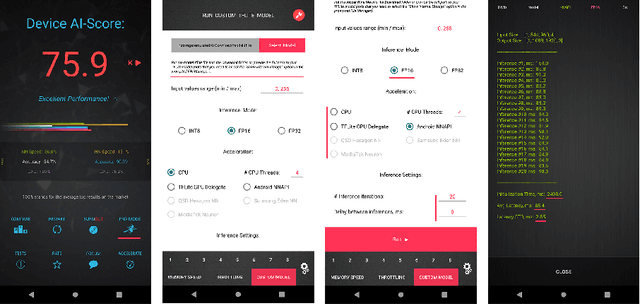
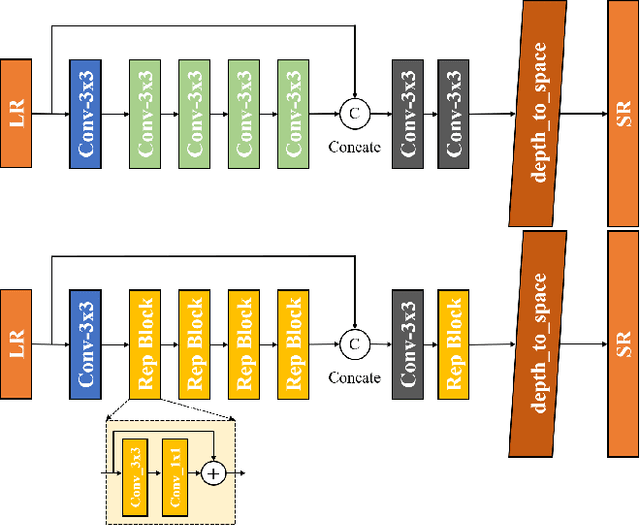
Image super-resolution is a common task on mobile and IoT devices, where one often needs to upscale and enhance low-resolution images and video frames. While numerous solutions have been proposed for this problem in the past, they are usually not compatible with low-power mobile NPUs having many computational and memory constraints. In this Mobile AI challenge, we address this problem and propose the participants to design an efficient quantized image super-resolution solution that can demonstrate a real-time performance on mobile NPUs. The participants were provided with the DIV2K dataset and trained INT8 models to do a high-quality 3X image upscaling. The runtime of all models was evaluated on the Synaptics VS680 Smart Home board with a dedicated edge NPU capable of accelerating quantized neural networks. All proposed solutions are fully compatible with the above NPU, demonstrating an up to 60 FPS rate when reconstructing Full HD resolution images. A detailed description of all models developed in the challenge is provided in this paper.
Efficient Single-Image Depth Estimation on Mobile Devices, Mobile AI & AIM 2022 Challenge: Report
Nov 07, 2022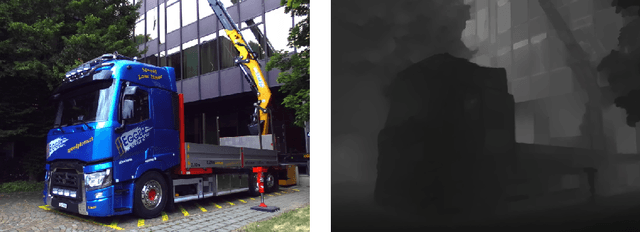


Various depth estimation models are now widely used on many mobile and IoT devices for image segmentation, bokeh effect rendering, object tracking and many other mobile tasks. Thus, it is very crucial to have efficient and accurate depth estimation models that can run fast on low-power mobile chipsets. In this Mobile AI challenge, the target was to develop deep learning-based single image depth estimation solutions that can show a real-time performance on IoT platforms and smartphones. For this, the participants used a large-scale RGB-to-depth dataset that was collected with the ZED stereo camera capable to generated depth maps for objects located at up to 50 meters. The runtime of all models was evaluated on the Raspberry Pi 4 platform, where the developed solutions were able to generate VGA resolution depth maps at up to 27 FPS while achieving high fidelity results. All models developed in the challenge are also compatible with any Android or Linux-based mobile devices, their detailed description is provided in this paper.
Learned Smartphone ISP on Mobile GPUs with Deep Learning, Mobile AI & AIM 2022 Challenge: Report
Nov 07, 2022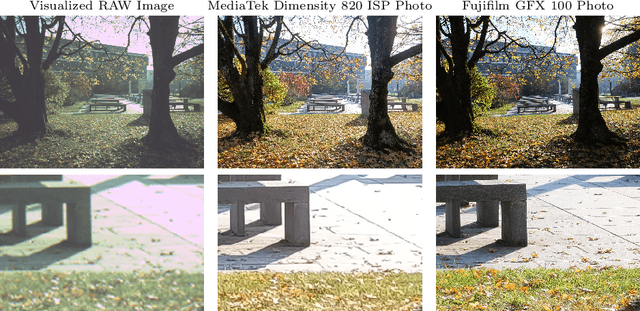
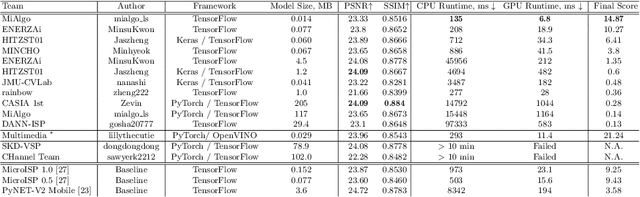
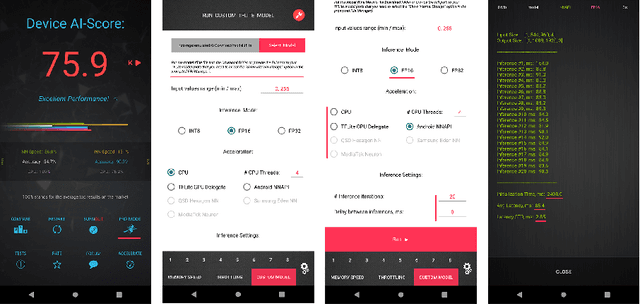
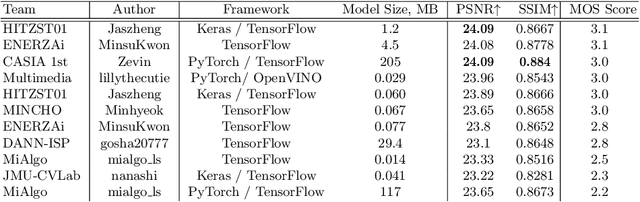
The role of mobile cameras increased dramatically over the past few years, leading to more and more research in automatic image quality enhancement and RAW photo processing. In this Mobile AI challenge, the target was to develop an efficient end-to-end AI-based image signal processing (ISP) pipeline replacing the standard mobile ISPs that can run on modern smartphone GPUs using TensorFlow Lite. The participants were provided with a large-scale Fujifilm UltraISP dataset consisting of thousands of paired photos captured with a normal mobile camera sensor and a professional 102MP medium-format FujiFilm GFX100 camera. The runtime of the resulting models was evaluated on the Snapdragon's 8 Gen 1 GPU that provides excellent acceleration results for the majority of common deep learning ops. The proposed solutions are compatible with all recent mobile GPUs, being able to process Full HD photos in less than 20-50 milliseconds while achieving high fidelity results. A detailed description of all models developed in this challenge is provided in this paper.