 Add to Chrome
 Add to Firefox
 Add to Edge
Frequency Matching in Spiking Neural Networks for mmWave Sensing
May 11, 2026
Millimeter-wave (mmWave) sensing enables privacy-preserving, always-on edge perception, but its measurements are often sparse, temporally irregular, and corrupted by high-frequency noise. Existing mmWave pipelines predominantly rely on artificial neural networks (ANNs), which achieve robustness through extensive preprocessing or deep architectures, thereby limiting their efficiency on edge devices. In this work, we study spiking neural networks (SNNs) for mmWave sensing from a mechanism-data alignment perspective. By leveraging the low-pass filtering behavior of leaky integrate-and-fire (LIF) dynamics, we analyze how their implicit temporal filtering interacts with the frequency structure of mmWave signals. Our analysis shows that when discriminative information resides in low-to-mid frequencies, LIF dynamics can inherently suppress high-frequency noise, clarifying when and why SNNs outperform ANNs. Based on this insight, we derive a principled criterion for configuring the membrane decay factor by matching the effective bandwidth of LIF dynamics to the data's discriminative spectral content. Experimental results across four widely used mmWave datasets validate the proposed frequency-matching hypothesis, yielding an average test-accuracy improvement of 6.22% and a 3.64$\times$ reduction in theoretical energy consumption relative to ANN baselines, under a unified evaluation protocol.

Edge Intelligence with Spiking Neural Networks
Jul 18, 2025The convergence of artificial intelligence and edge computing has spurred growing interest in enabling intelligent services directly on resource-constrained devices. While traditional deep learning models require significant computational resources and centralized data management, the resulting latency, bandwidth consumption, and privacy concerns have exposed critical limitations in cloud-centric paradigms. Brain-inspired computing, particularly Spiking Neural Networks (SNNs), offers a promising alternative by emulating biological neuronal dynamics to achieve low-power, event-driven computation. This survey provides a comprehensive overview of Edge Intelligence based on SNNs (EdgeSNNs), examining their potential to address the challenges of on-device learning, inference, and security in edge scenarios. We present a systematic taxonomy of EdgeSNN foundations, encompassing neuron models, learning algorithms, and supporting hardware platforms. Three representative practical considerations of EdgeSNN are discussed in depth: on-device inference using lightweight SNN models, resource-aware training and updating under non-stationary data conditions, and secure and privacy-preserving issues. Furthermore, we highlight the limitations of evaluating EdgeSNNs on conventional hardware and introduce a dual-track benchmarking strategy to support fair comparisons and hardware-aware optimization. Through this study, we aim to bridge the gap between brain-inspired learning and practical edge deployment, offering insights into current advancements, open challenges, and future research directions. To the best of our knowledge, this is the first dedicated and comprehensive survey on EdgeSNNs, providing an essential reference for researchers and practitioners working at the intersection of neuromorphic computing and edge intelligence.
FedLEC: Effective Federated Learning Algorithm with Spiking Neural Networks Under Label Skews
Dec 23, 2024With the advancement of neuromorphic chips, implementing Federated Learning (FL) with Spiking Neural Networks (SNNs) potentially offers a more energy-efficient schema for collaborative learning across various resource-constrained edge devices. However, one significant challenge in the FL systems is that the data from different clients are often non-independently and identically distributed (non-IID), with label skews presenting substantial difficulties in various federated SNN learning tasks. In this study, we propose a practical post-hoc framework named FedLEC to address the challenge. This framework penalizes the corresponding local logits for locally missing labels to enhance each local model's generalization ability. Additionally, it leverages the pertinent label distribution information distilled from the global model to mitigate label bias. Extensive experiments with three different structured SNNs across five datasets (i.e., three non-neuromorphic and two neuromorphic datasets) demonstrate the efficiency of FedLEC. Compared to seven state-of-the-art FL algorithms, FedLEC achieves an average accuracy improvement of approximately 11.59\% under various label skew distribution settings.
Realistic Bokeh Effect Rendering on Mobile GPUs, Mobile AI & AIM 2022 challenge: Report
Nov 07, 2022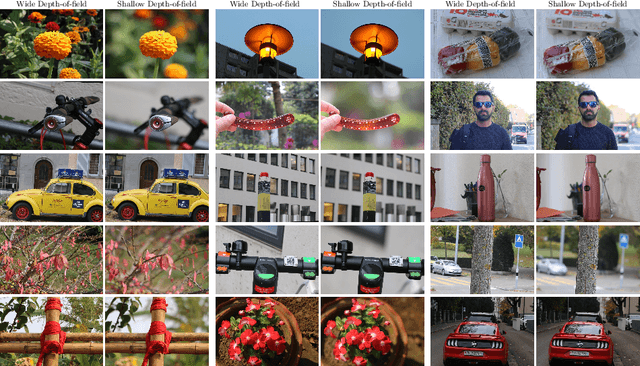

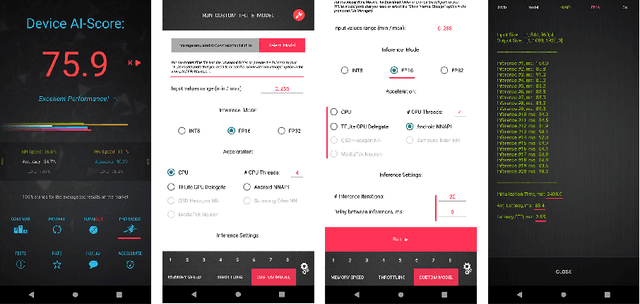

As mobile cameras with compact optics are unable to produce a strong bokeh effect, lots of interest is now devoted to deep learning-based solutions for this task. In this Mobile AI challenge, the target was to develop an efficient end-to-end AI-based bokeh effect rendering approach that can run on modern smartphone GPUs using TensorFlow Lite. The participants were provided with a large-scale EBB! bokeh dataset consisting of 5K shallow / wide depth-of-field image pairs captured using the Canon 7D DSLR camera. The runtime of the resulting models was evaluated on the Kirin 9000's Mali GPU that provides excellent acceleration results for the majority of common deep learning ops. A detailed description of all models developed in this challenge is provided in this paper.