 Add to Chrome
 Add to Firefox
 Add to Edge
GeoGuide: Hierarchical Geometric Guidance for Open-Vocabulary 3D Semantic Segmentation
Mar 27, 2026
Open-vocabulary 3D semantic segmentation aims to segment arbitrary categories beyond the training set. Existing methods predominantly rely on distilling knowledge from 2D open-vocabulary models. However, aligning 3D features to the 2D representation space restricts intrinsic 3D geometric learning and inherits errors from 2D predictions. To address these limitations, we propose GeoGuide, a novel framework that leverages pretrained 3D models to integrate hierarchical geometry-semantic consistency for open-vocabulary 3D segmentation. Specifically, we introduce an Uncertainty-based Superpoint Distillation module to fuse geometric and semantic features for estimating per-point uncertainty, adaptively weighting 2D features within superpoints to suppress noise while preserving discriminative information to enhance local semantic consistency. Furthermore, our Instance-level Mask Reconstruction module leverages geometric priors to enforce semantic consistency within instances by reconstructing complete instance masks. Additionally, our Inter-Instance Relation Consistency module aligns geometric and semantic similarity matrices to calibrate cross-instance consistency for same-category objects, mitigating viewpoint-induced semantic drift. Extensive experiments on ScanNet v2, Matterport3D, and nuScenes demonstrate the superior performance of GeoGuide.

SkeletonGaussian: Editable 4D Generation through Gaussian Skeletonization
Feb 04, 20264D generation has made remarkable progress in synthesizing dynamic 3D objects from input text, images, or videos. However, existing methods often represent motion as an implicit deformation field, which limits direct control and editability. To address this issue, we propose SkeletonGaussian, a novel framework for generating editable dynamic 3D Gaussians from monocular video input. Our approach introduces a hierarchical articulated representation that decomposes motion into sparse rigid motion explicitly driven by a skeleton and fine-grained non-rigid motion. Concretely, we extract a robust skeleton and drive rigid motion via linear blend skinning, followed by a hexplane-based refinement for non-rigid deformations, enhancing interpretability and editability. Experimental results demonstrate that SkeletonGaussian surpasses existing methods in generation quality while enabling intuitive motion editing, establishing a new paradigm for editable 4D generation. Project page: https://wusar.github.io/projects/skeletongaussian/
Mamba24/8D: Enhancing Global Interaction in Point Clouds via State Space Model
Jun 25, 2024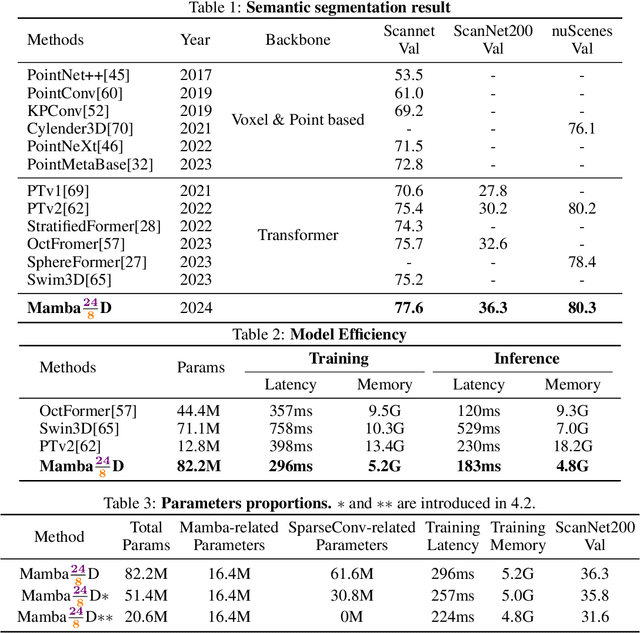
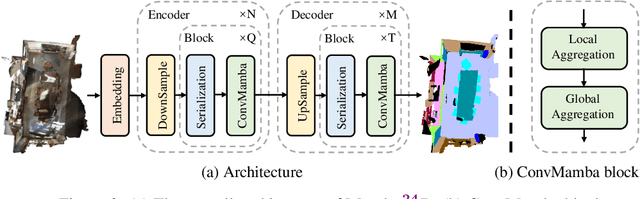
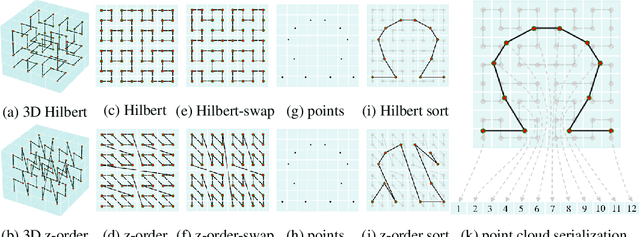
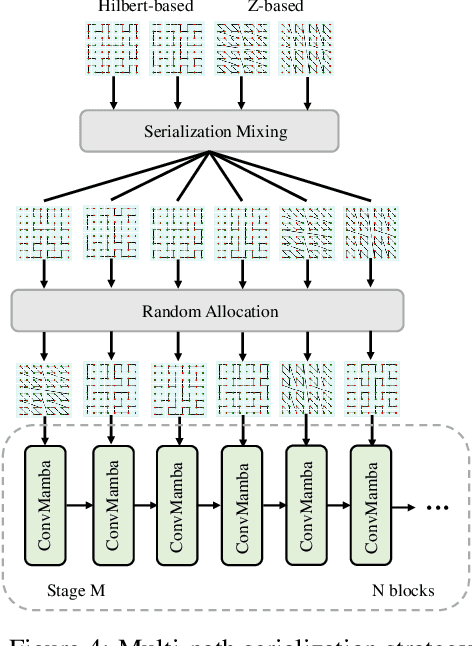
Transformers have demonstrated impressive results for 3D point cloud semantic segmentation. However, the quadratic complexity of transformer makes computation cost high, limiting the number of points that can be processed simultaneously and impeding the modeling of long-range dependencies. Drawing inspiration from the great potential of recent state space models (SSM) for long sequence modeling, we introduce Mamba, a SSM-based architecture, to the point cloud domain and propose Mamba24/8D, which has strong global modeling capability under linear complexity. Specifically, to make disorderness of point clouds fit in with the causal nature of Mamba, we propose a multi-path serialization strategy applicable to point clouds. Besides, we propose the ConvMamba block to compensate for the shortcomings of Mamba in modeling local geometries and in unidirectional modeling. Mamba24/8D obtains state of the art results on several 3D point cloud segmentation tasks, including ScanNet v2, ScanNet200 and nuScenes, while its effectiveness is validated by extensive experiments.