 Add to Chrome
 Add to Firefox
 Add to Edge
Real-Time Interactive Music Generation via Data-Free Streaming Consistency Distillation
Jun 23, 2026
Interactive music and live performance relies on real-time human expression, but modern generative music AI remains largely absent from this domain due to its prohibitive inference latency and offline rendering paradigm. To provide pioneer musicians with a novel medium for interactive composition, we should fundamentally change these static models into dynamic, playable instruments. In this paper, we propose a framework that bridges this gap. To achieve the low latency required for live interaction without sacrificing structural coherence, we formulate distillation within a streaming autoregressive latent space. Our approach gets rid of the need for expensive paired audio-latent datasets by utilizing prompt-only inputs to synthesize teacher-guided, chunk-wise trajectories on the fly. Because live instruments require high acoustic fidelity, we introduce music-aware consistency objectives, which combine latent, spectral, and temporal-difference losses, to preserve crucial qualities like timbre, transients, and rhythmic stability during accelerated single-step streaming generation. Implemented via parameter-efficient adaptation, our distillation reduces generation steps to achieve a low real-time factor. Crucially, by operating as a continuous autoregressive stream, the system can seamlessly assimilate dynamic human inputs on the fly, allowing users to instantly steer the musical trajectory without interrupting the audio flow. Ultimately, this work recontextualizes generative text-to-music models not as passive prompt-and-wait systems, but as responsive instruments, opening new frontiers for live human-AI musical co-creation.

Z-Erase: Enabling Concept Erasure in Single-Stream Diffusion Transformers
Mar 26, 2026Concept erasure serves as a vital safety mechanism for removing unwanted concepts from text-to-image (T2I) models. While extensively studied in U-Net and dual-stream architectures (e.g., Flux), this task remains under-explored in the recent emerging paradigm of single-stream diffusion transformers (e.g., Z-Image). In this new paradigm, text and image tokens are processed as a single unified sequence via shared parameters. Consequently, directly applying prior erasure methods typically leads to generation collapse. To bridge this gap, we introduce Z-Erase, the first concept erasure method tailored for single-stream T2I models. To guarantee stable image generation, Z-Erase first proposes a Stream Disentangled Concept Erasure Framework that decouples updates and enables existing methods on single-stream models. Subsequently, within this framework, we introduce Lagrangian-Guided Adaptive Erasure Modulation, a constrained algorithm that further balances the sensitive erasure-preservation trade-off. Moreover, we provide a rigorous convergence analysis proving that Z-Erase can converge to a Pareto stationary point. Experiments demonstrate that Z-Erase successfully overcomes the generation collapse issue, achieving state-of-the-art performance across a wide range of tasks.
SPIRAL: A Closed-Loop Framework for Self-Improving Action World Models via Reflective Planning Agents
Mar 11, 2026We introduce SPIRAL, a self-improving planning and iterative reflective action world modeling closed-loop framework that enables controllable long-horizon video generation conditioned on high-level semantic actions. Existing one-shot video generation models operate in open-loop, often resulting in incomplete action execution, weak semantic grounding, and temporal drift. SPIRAL formulates ActWM as a closed-loop think-act-reflect process, where generation proceeds step by step under explicit planning and feedback. A PlanAgent decomposes abstract actions into object-centric sub-actions, while a CriticAgent evaluates intermediate results and guides iterative refinement with long-horizon memory. This closed-loop design naturally supports RL evolving optimization, improving semantic alignment and temporal consistency over extended horizons. We further introduce the ActWM-Dataset and ActWM-Bench for training and evaluation. Experiments across multiple TI2V backbones demonstrate consistent gains on ActWM-Bench and mainstream video generation benchmarks, validating SPIRAL's effectiveness.
Multimodal Music Generation with Explicit Bridges and Retrieval Augmentation
Dec 12, 2024Multimodal music generation aims to produce music from diverse input modalities, including text, videos, and images. Existing methods use a common embedding space for multimodal fusion. Despite their effectiveness in other modalities, their application in multimodal music generation faces challenges of data scarcity, weak cross-modal alignment, and limited controllability. This paper addresses these issues by using explicit bridges of text and music for multimodal alignment. We introduce a novel method named Visuals Music Bridge (VMB). Specifically, a Multimodal Music Description Model converts visual inputs into detailed textual descriptions to provide the text bridge; a Dual-track Music Retrieval module that combines broad and targeted retrieval strategies to provide the music bridge and enable user control. Finally, we design an Explicitly Conditioned Music Generation framework to generate music based on the two bridges. We conduct experiments on video-to-music, image-to-music, text-to-music, and controllable music generation tasks, along with experiments on controllability. The results demonstrate that VMB significantly enhances music quality, modality, and customization alignment compared to previous methods. VMB sets a new standard for interpretable and expressive multimodal music generation with applications in various multimedia fields. Demos and code are available at https://github.com/wbs2788/VMB.
Video Background Music Generation: Dataset, Method and Evaluation
Nov 21, 2022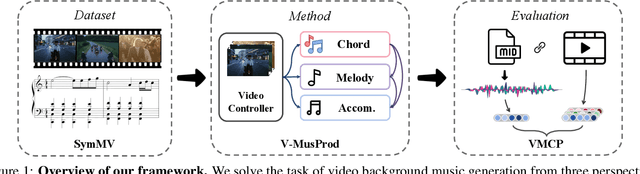
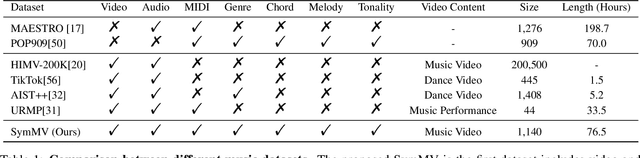


Music is essential when editing videos, but selecting music manually is difficult and time-consuming. Thus, we seek to automatically generate background music tracks given video input. This is a challenging task since it requires plenty of paired videos and music to learn their correspondence. Unfortunately, there exist no such datasets. To close this gap, we introduce a dataset, benchmark model, and evaluation metric for video background music generation. We introduce SymMV, a video and symbolic music dataset, along with chord, rhythm, melody, and accompaniment annotations. To the best of our knowledge, it is the first video-music dataset with high-quality symbolic music and detailed annotations. We also propose a benchmark video background music generation framework named V-MusProd, which utilizes music priors of chords, melody, and accompaniment along with video-music relations of semantic, color, and motion features. To address the lack of objective metrics for video-music correspondence, we propose a retrieval-based metric VMCP built upon a powerful video-music representation learning model. Experiments show that with our dataset, V-MusProd outperforms the state-of-the-art method in both music quality and correspondence with videos. We believe our dataset, benchmark model, and evaluation metric will boost the development of video background music generation.