 Add to Chrome
 Add to Firefox
 Add to Edge
Tensor Train Decomposition Based Noise Reduction and Enhanced Parameter Estimation for FMCW MIMO Radar Systems
May 27, 2026
Frequency modulated continuous wave (FMCW) radar is widely used in autonomous driving and industrial inspection due to its high-resolution target location and velocity estimation capability. However, the plethora of connected devices in automotive applications introduces electromagnetic interference and brings challenges to location-aware services, primarily due to the issue of low signal-to-noise ratio (SNR) caused by mixed noise contamination. Conventional matrix-based signal processing methods exhibit performance deterioration when handling higher-order signals under low SNR conditions. To address this challenge, this paper proposes a tensor decomposition-based framework that jointly performs noise reduction and parameter estimation for four-dimensional signals in FMCW multiple-input multiple-output (MIMO) radar systems. Specifically, the framework exploits the inherent low-rank structure and multidimensional correlations of the received signals through tensor train decomposition to effectively separate noise subspace. A data smoothing processor then reconstructs an augmented signal tensor to resolve rank deficiency caused by coherent signals. Finally, an enhanced rotational subspace algorithm is employed to jointly decouple the distance, velocity, and angle parameters by exploiting the structural fitting to the restored signal. Both simulation and field experiments under real-world noise demonstrate that our proposed framework achieves significant noise reduction while improving target SNR and parameter estimation accuracy. These advancements make the proposed framework a robust solution for high-precision MIMO FMCW radar applications in dynamic, noise-polluted environments.

Artificial Intelligence Empowered Channel Prediction: A New Paradigm for Propagation Channel Modeling
Jan 14, 2026This paper proposes a novel paradigm centered on Artificial Intelligence (AI)-empowered propagation channel prediction to address the limitations of traditional channel modeling. We present a comprehensive framework that deeply integrates heterogeneous environmental data and physical propagation knowledge into AI models for site-specific channel prediction, which referred to as channel inference. By leveraging AI to infer site-specific wireless channel states, the proposed paradigm enables accurate prediction of channel characteristics at both link and area levels, capturing spatio-temporal evolution of radio propagation. Some novel strategies to realize the paradigm are introduced and discussed, including AI-native and AI-hybrid inference approaches. This paper also investigates how to enhance model generalization through transfer learning and improve interpretability via explainable AI techniques. Our approach demonstrates significant practical efficacy, achieving an average path loss prediction root mean square error (RMSE) of $\sim$ 4 dB and reducing training time by 60\%-75\%. This new modeling paradigm provides a foundational pathway toward high-fidelity, generalizable, and physically consistent propagation channel prediction for future communication networks.
Terahertz Signal Coverage Enhancement in Hall Scenarios Based on Single-Hop and Dual-Hop Reconfigurable Intelligent Surfaces
Dec 16, 2025Terahertz (THz) communication offers ultra-high data rates and has emerged as a promising technology for future wireless networks. However, the inherently high free-space path loss of THz waves significantly limits the coverage range of THz communication systems. Therefore, extending the effective coverage area is a key challenge for the practical deployment of THz networks. Reconfigurable intelligent surfaces (RIS), which can dynamically manipulate electromagnetic wave propagation, provide a solution to enhance THz coverage. To investigate multi-RIS deployment scenarios, this work integrates an antenna array-based RIS model into the ray-tracing simulation platform. Using an indoor hall as a representative case study, the enhancement effects of single-hop and dual-hop RIS configurations on indoor signal coverage are evaluated under various deployment schemes. The developed framework offers valuable insights and design references for optimizing RIS-assisted indoor THz communication and coverage estimation.
Channel Semantic Characterization for Integrated Sensing and Communication Scenarios: From Measurements to Modeling
Mar 03, 2025With the advancement of sixth-generation (6G) wireless communication systems, integrated sensing and communication (ISAC) is crucial for perceiving and interacting with the environment via electromagnetic propagation, termed channel semantics, to support tasks like decision-making. However, channel models focusing on physical characteristics face challenges in representing semantics embedded in the channel, thereby limiting the evaluation of ISAC systems. To tackle this, we present a novel framework for channel modeling from the conceptual event perspective. By leveraging a multi-level semantic structure and characterized knowledge libraries, the framework decomposes complex channel characteristics into extensible semantic characterization, thereby better capturing the relationship between environment and channel, and enabling more flexible adjustments of channel models for different events without requiring a complete reset. Specifically, we define channel semantics on three levels: status semantics, behavior semantics, and event semantics, corresponding to channel multipaths, channel time-varying trajectories, and channel topology, respectively. Taking realistic vehicular ISAC scenarios as an example, we perform semantic clustering, characterizing status semantics via multipath statistical distributions, modeling behavior semantics using Markov chains for time variation, and representing event semantics through a co-occurrence matrix. Results show the model accurately generates channels while capturing rich semantic information. Moreover, its generalization supports customized semantics.
Measurement-Based Modeling and Analysis of UAV Air-Ground Channels at 1 and 4 GHz
Jan 28, 2025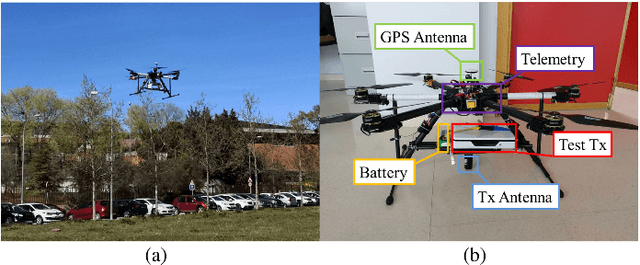
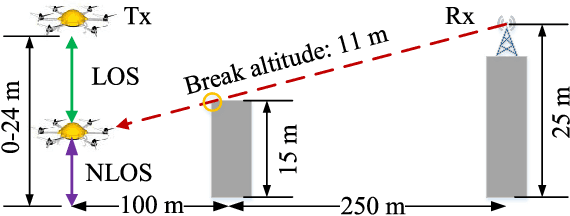
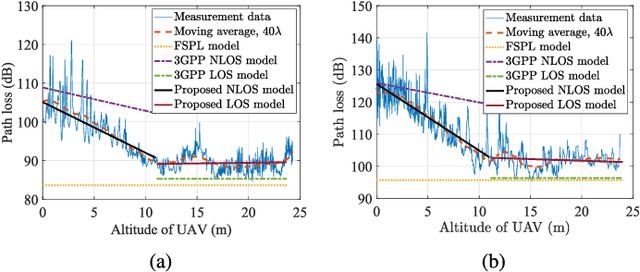
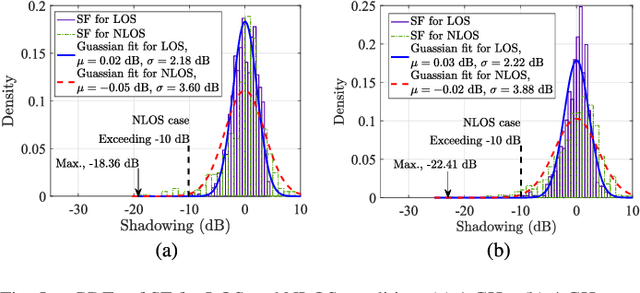
In the design of unmanned aerial vehicle (UAV) wireless communications, a better understanding of propagation characteristics and an accurate channel model are required. Measurements and comprehensive analysis for the UAV-based air-ground (AG) propagation channel in the vertical dimension are presented in this letter. Based on the measurement data at 1 and 4 GHz, the large-scale and small-scale channel parameters are extracted in the line-of-sight (LOS) and nonLOS case, respectively. The altitude-dependent path loss model is proposed herein. Furthermore, shadow fading and fast fading are statistically analyzed for comprehensively describing the fading behavior. Our results will be useful in the modeling of AG channels and the performance analysis for UAV-enabled wireless communication systems.
5G Channel Models for Railway Use Cases at mmWave Band and the Path Towards Terahertz
Jan 28, 2025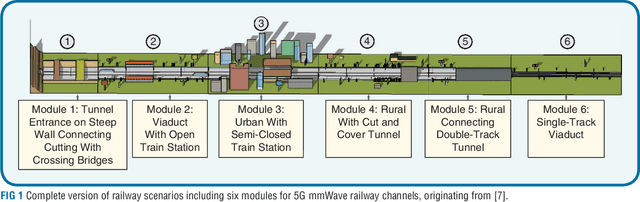
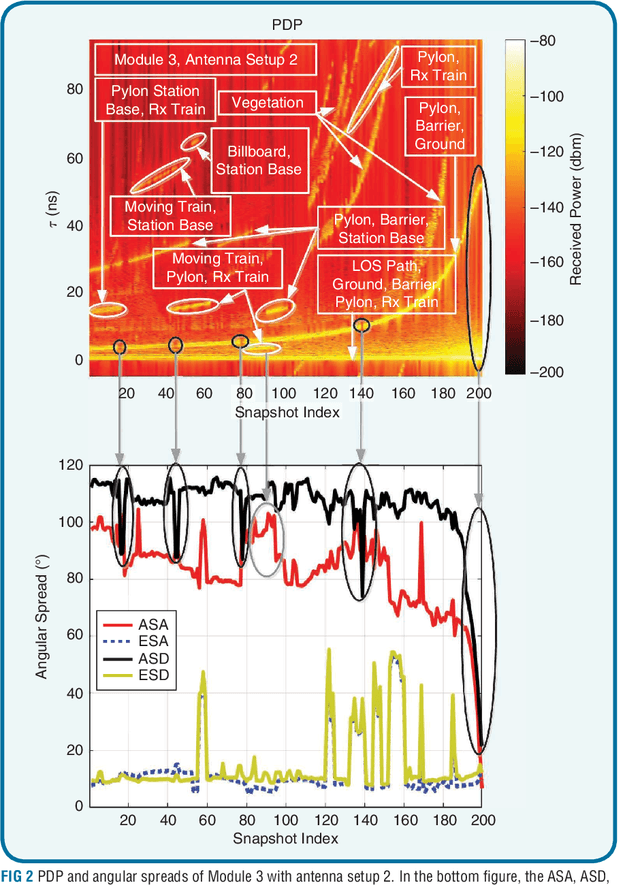
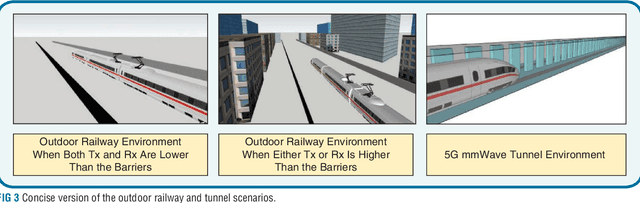
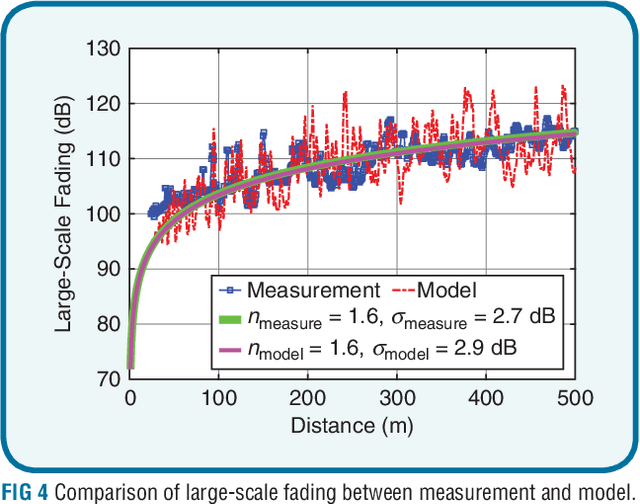
High-speed trains are one of the most relevant scenarios for the fifth-generation (5G) mobile communications and the "smart rail mobility" vision, where a high-data-rate wireless connectivity with up to several GHz bandwidths will be required. This is a strong motivation for the exploration of millimeter wave (mmWave) band. In this article, we identify the main challenges and make progress towards realistic 5G mmWave channel models for railway use cases. In order to cope with the challenge of including the railway features in the channel models, we define reference scenarios to help the parameterization of channel models for railway use at mmWave band. Simulations and the subsequent measurements used to validate the model reflect the detailed influence of railway objects and the accuracy of the simulations. Finally, we point out the future directions towards the full version of the smart rail mobility which will be powered by terahertz (THz) communications.
Vision-Aided Channel Prediction Based on Image Segmentation at Street Intersection Scenarios
Jan 27, 2025Intelligent vehicular communication with vehicle road collaboration capability is a key technology enabled by 6G, and the integration of various visual sensors on vehicles and infrastructures plays a crucial role. Moreover, accurate channel prediction is foundational to realizing intelligent vehicular communication. Traditional methods are still limited by the inability to balance accuracy and operability based on substantial spectrum resource consumption and highly refined description of environment. Therefore, leveraging out-of-band information introduced by visual sensors provides a new solution and is increasingly applied across various communication tasks. In this paper, we propose a computer vision (CV)-based prediction model for vehicular communications, realizing accurate channel characterization prediction including path loss, Rice K-factor and delay spread based on image segmentation. First, we conduct extensive vehicle-to-infrastructure measurement campaigns, collecting channel and visual data from various street intersection scenarios. The image-channel dataset is generated after a series of data post-processing steps. Image data consists of individual segmentation of target user using YOLOv8 network. Subsequently, established dataset is used to train and test prediction network ResNet-32, where segmented images serve as input of network, and various channel characteristics are treated as labels or target outputs of network. Finally, self-validation and cross-validation experiments are performed. The results indicate that models trained with segmented images achieve high prediction accuracy and remarkable generalization performance across different streets and target users. The model proposed in this paper offers novel solutions for achieving intelligent channel prediction in vehicular communications.
Channel Spreading Function-Inspired Channel Transfer Function Estimation for OFDM Systems with High-Mobility
Dec 10, 2024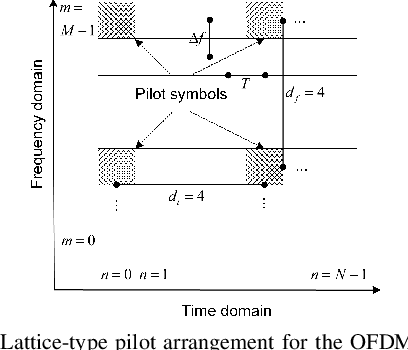
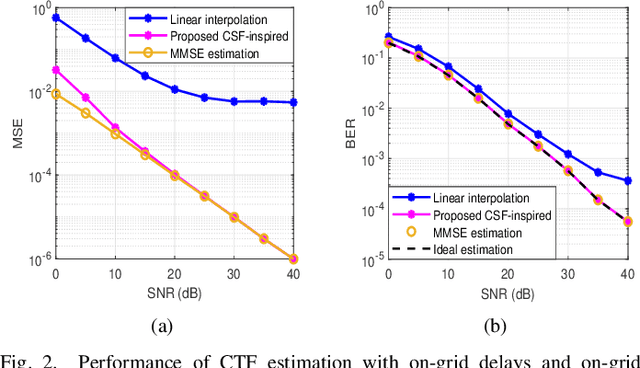
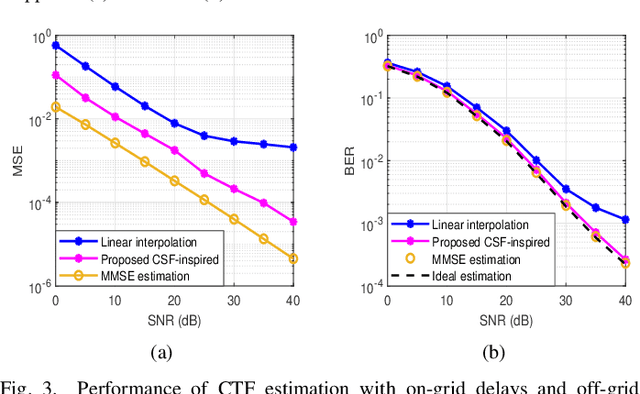
In this letter, we propose a novel channel transfer function (CTF) estimation approach for orthogonal frequency division multiplexing (OFDM) systems in high-mobility scenarios, that leverages the stationary properties of the delay-Doppler domain channel spreading function (CSF). First, we develop a CSF estimation model for OFDM systems that relies solely on discrete pilot symbols in the time-frequency (TF) domain, positioned at predefined resource elements. We then present theorems to elucidate the relationship between CSF compactness and pilot spacing in the TF domain for accurate CSF acquisition. Based on the estimated CSF, we finally estimate the CTF for data symbols. Numerical results show that, in high-mobility scenarios, the proposed approach outperforms traditional interpolation-based methods and closely matches the optimal estimator in terms of estimation accuracy. This work may pave the way for CSF estimation in commercial OFDM systems, benefiting high-mobility communications, integrated sensing and communications, and related applications.
GNN-Enabled Optimization of Placement and Transmission Design for UAV Communications
Oct 03, 2024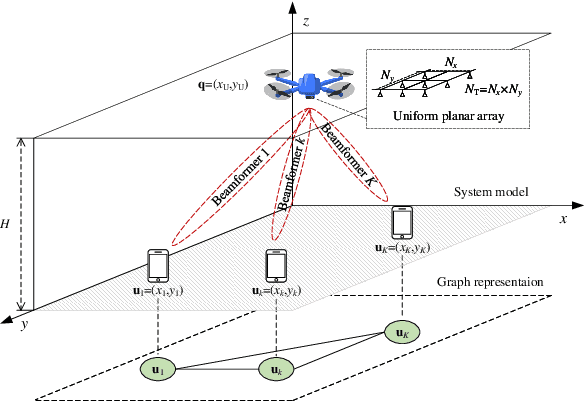
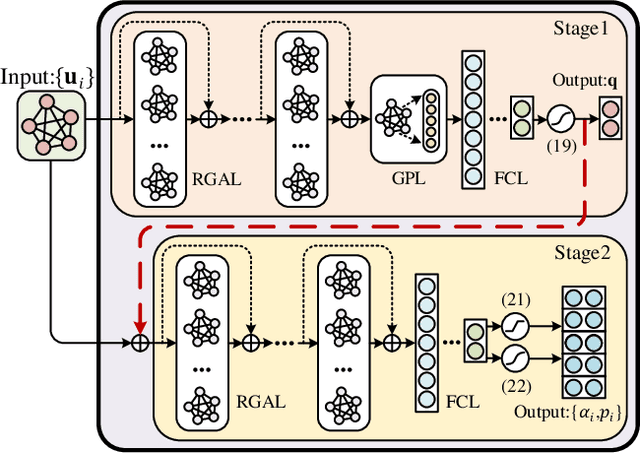
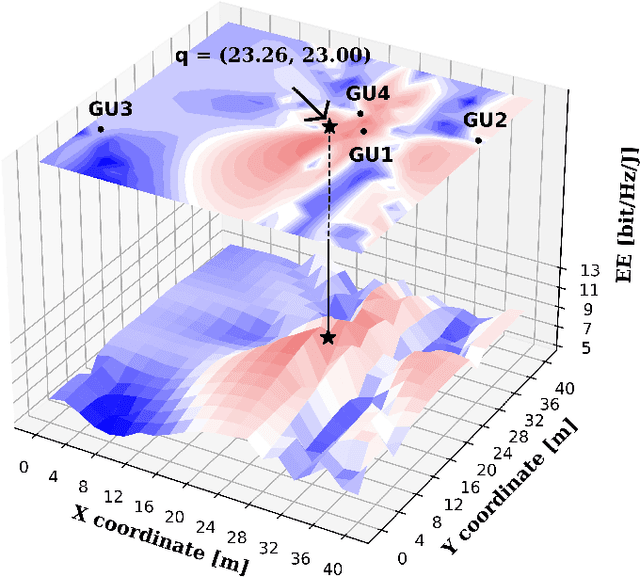
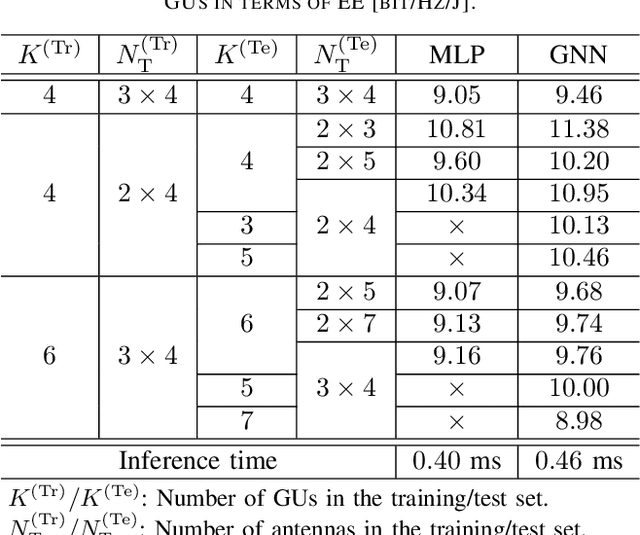
This paper applies graph neural networks (GNN) in UAV communications to optimize the placement and transmission design. We consider a multiple-user multiple-input-single-output UAV communication system where a UAV intends to find a placement to hover and serve users with maximum energy efficiency (EE). To facilitate the GNN-based learning, we adopt the hybrid maximum ratio transmission and zero forcing scheme to design the beamforming vectors and a feature augment is implemented by manually setting edge features. Furthermore, we propose a two-stage GNN-based model where the first stage and the second stage yield the placement and the transmission design, respectively. The two stages are connected via a residual and their learnable weights are jointly optimized by via unsupervised learning. Numerical results illustrate the effectiveness and validate the scalability to both UAV antennas and users of the proposed model.
A Cluster-Based Statistical Channel Model for Integrated Sensing and Communication Channels
Mar 01, 2024


The emerging 6G network envisions integrated sensing and communication (ISAC) as a promising solution to meet growing demand for native perception ability. To optimize and evaluate ISAC systems and techniques, it is crucial to have an accurate and realistic wireless channel model. However, some important features of ISAC channels have not been well characterized, for example, most existing ISAC channel models consider communication channels and sensing channels independently, whereas ignoring correlation under the consistent environment. Moreover, sensing channels have not been well modeled in the existing standard-level channel models. Therefore, in order to better model ISAC channel, a cluster-based statistical channel model is proposed in this paper, which is based on measurements conducted at 28 GHz. In the proposed model, a new framework based on 3GPP standard is proposed, which includes communication clusters and sensing clusters. Clustering and tracking algorithms are used to extract and analyze ISAC channel characteristics. Furthermore, some special sensing cluster structures such as shared sensing cluster, newborn sensing cluster, etc., are defined to model correlation and difference between communication and sensing channels. Finally, accuracy of the proposed model is validated based on measurements and simulations.