 Add to Chrome
 Add to Firefox
 Add to Edge
Graph-DPEP: Decomposed Plug and Ensemble Play for Few-Shot Document Relation Extraction with Graph-of-Thoughts Reasoning
Nov 05, 2024
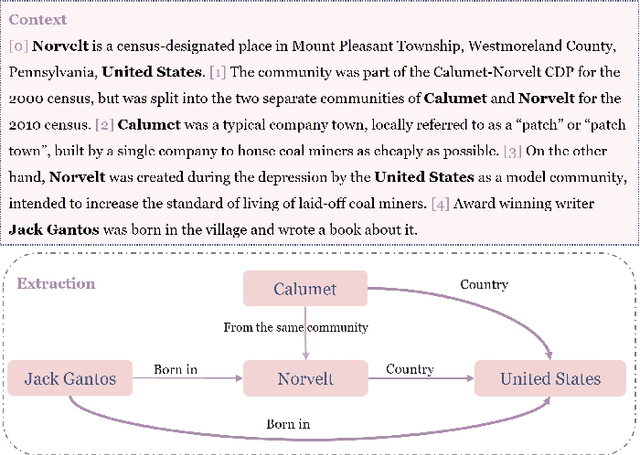

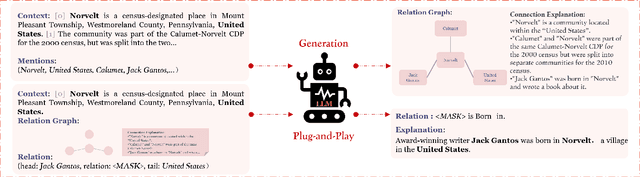

Large language models (LLMs) pre-trained on massive corpora have demonstrated impressive few-shot learning capability on many NLP tasks. Recasting an NLP task into a text-to-text generation task is a common practice so that generative LLMs can be prompted to resolve it. However, performing document-level relation extraction (DocRE) tasks with generative LLM models is still challenging due to the structured output format of DocRE, which complicates the conversion to plain text. Limited information available in few-shot samples and prompt instructions induce further difficulties and challenges in relation extraction for mentioned entities in a document. In this paper, we represent the structured output as a graph-style triplet rather than natural language expressions and leverage generative LLMs for the DocRE task. Our approach, the Graph-DPEP framework is grounded in the reasoning behind triplet explanation thoughts presented in natural language. In this framework, we first introduce a ``decomposed-plug" method for performing the generation from LLMs over prompts with type-space decomposition to alleviate the burden of distinguishing all relation types. Second, we employ a verifier for calibrating the generation and identifying overlooked query entity pairs. Third, we develop "ensemble-play", reapplying generation on the entire type list by leveraging the reasoning thoughts embedded in a sub-graph associated with the missing query pair to address the missingness issue. Through extensive comparisons with existing prompt techniques and alternative Language Models (LLMs), our framework demonstrates superior performance on publicly available benchmarks in experiments.

Prompting with Phonemes: Enhancing LLM Multilinguality for non-Latin Script Languages
Nov 04, 2024


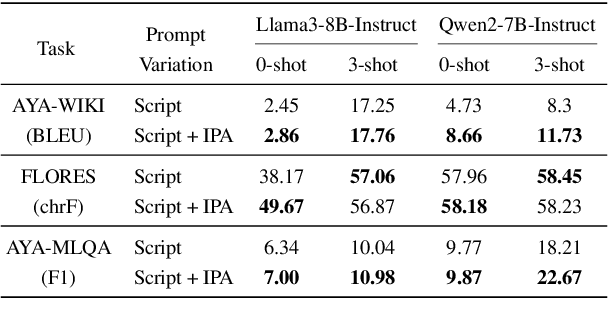
Multilingual LLMs have achieved remarkable benchmark performance, but we find they continue to underperform on non-Latin script languages across contemporary LLM families. This discrepancy arises from the fact that LLMs are pretrained with orthographic scripts, which are dominated by Latin characters that obscure their shared phonology with non-Latin scripts. We propose leveraging phonemic transcriptions as complementary signals to induce script-invariant representations. Our study demonstrates that integrating phonemic signals improves performance across both non-Latin and Latin languages, with a particularly significant impact on closing the performance gap between the two. Through detailed experiments, we show that phonemic and orthographic scripts retrieve distinct examples for in-context learning (ICL). This motivates our proposed Mixed-ICL retrieval strategy, where further aggregation leads to our significant performance improvements for both Latin script languages (up to 12.6%) and non-Latin script languages (up to 15.1%) compared to randomized ICL retrieval.
Diffusion-nested Auto-Regressive Synthesis of Heterogeneous Tabular Data
Oct 28, 2024Autoregressive models are predominant in natural language generation, while their application in tabular data remains underexplored. We posit that this can be attributed to two factors: 1) tabular data contains heterogeneous data type, while the autoregressive model is primarily designed to model discrete-valued data; 2) tabular data is column permutation-invariant, requiring a generation model to generate columns in arbitrary order. This paper proposes a Diffusion-nested Autoregressive model (TabDAR) to address these issues. To enable autoregressive methods for continuous columns, TabDAR employs a diffusion model to parameterize the conditional distribution of continuous features. To ensure arbitrary generation order, TabDAR resorts to masked transformers with bi-directional attention, which simulate various permutations of column order, hence enabling it to learn the conditional distribution of a target column given an arbitrary combination of other columns. These designs enable TabDAR to not only freely handle heterogeneous tabular data but also support convenient and flexible unconditional/conditional sampling. We conduct extensive experiments on ten datasets with distinct properties, and the proposed TabDAR outperforms previous state-of-the-art methods by 18% to 45% on eight metrics across three distinct aspects.
Spiking Graph Neural Network on Riemannian Manifolds
Oct 23, 2024


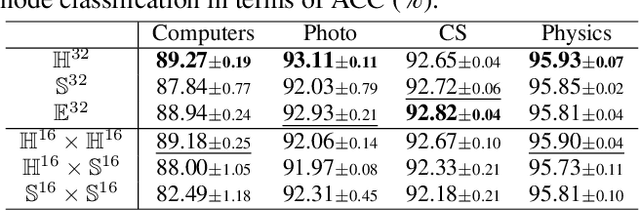
Graph neural networks (GNNs) have become the dominant solution for learning on graphs, the typical non-Euclidean structures. Conventional GNNs, constructed with the Artificial Neuron Network (ANN), have achieved impressive performance at the cost of high computation and energy consumption. In parallel, spiking GNNs with brain-like spiking neurons are drawing increasing research attention owing to the energy efficiency. So far, existing spiking GNNs consider graphs in Euclidean space, ignoring the structural geometry, and suffer from the high latency issue due to Back-Propagation-Through-Time (BPTT) with the surrogate gradient. In light of the aforementioned issues, we are devoted to exploring spiking GNN on Riemannian manifolds, and present a Manifold-valued Spiking GNN (MSG). In particular, we design a new spiking neuron on geodesically complete manifolds with the diffeomorphism, so that BPTT regarding the spikes is replaced by the proposed differentiation via manifold. Theoretically, we show that MSG approximates a solver of the manifold ordinary differential equation. Extensive experiments on common graphs show the proposed MSG achieves superior performance to previous spiking GNNs and energy efficiency to conventional GNNs.
LEGO-Learn: Label-Efficient Graph Open-Set Learning
Oct 21, 2024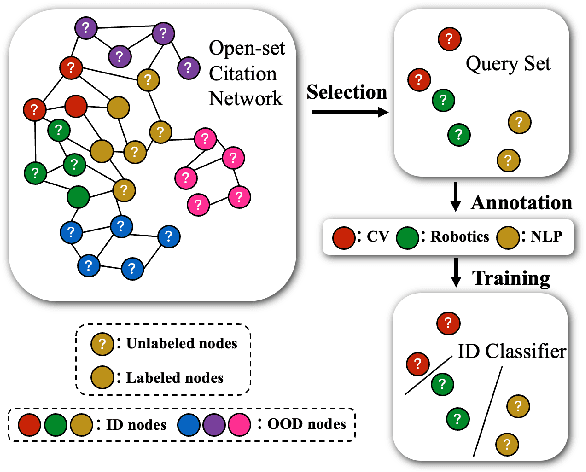
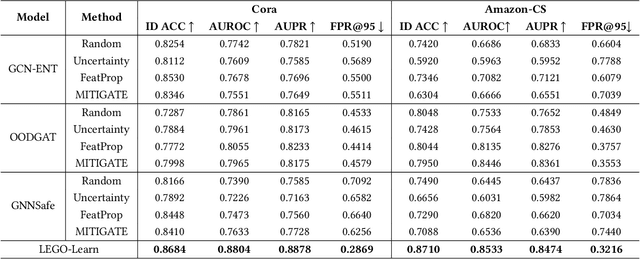
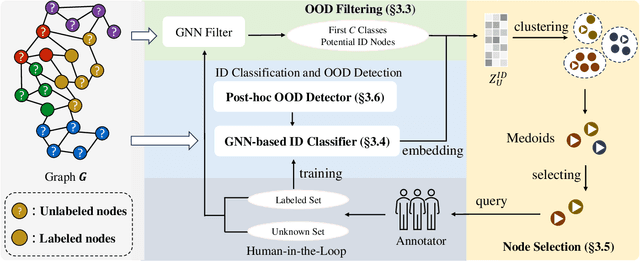
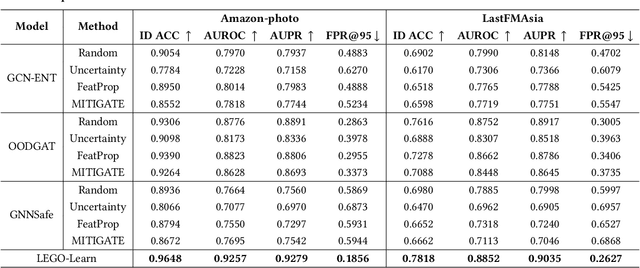
How can we train graph-based models to recognize unseen classes while keeping labeling costs low? Graph open-set learning (GOL) and out-of-distribution (OOD) detection aim to address this challenge by training models that can accurately classify known, in-distribution (ID) classes while identifying and handling previously unseen classes during inference. It is critical for high-stakes, real-world applications where models frequently encounter unexpected data, including finance, security, and healthcare. However, current GOL methods assume access to many labeled ID samples, which is unrealistic for large-scale graphs due to high annotation costs. In this paper, we propose LEGO-Learn (Label-Efficient Graph Open-set Learning), a novel framework that tackles open-set node classification on graphs within a given label budget by selecting the most informative ID nodes. LEGO-Learn employs a GNN-based filter to identify and exclude potential OOD nodes and then select highly informative ID nodes for labeling using the K-Medoids algorithm. To prevent the filter from discarding valuable ID examples, we introduce a classifier that differentiates between the C known ID classes and an additional class representing OOD nodes (hence, a C+1 classifier). This classifier uses a weighted cross-entropy loss to balance the removal of OOD nodes while retaining informative ID nodes. Experimental results on four real-world datasets demonstrate that LEGO-Learn significantly outperforms leading methods, with up to a 6.62% improvement in ID classification accuracy and a 7.49% increase in AUROC for OOD detection.
BANGS: Game-Theoretic Node Selection for Graph Self-Training
Oct 12, 2024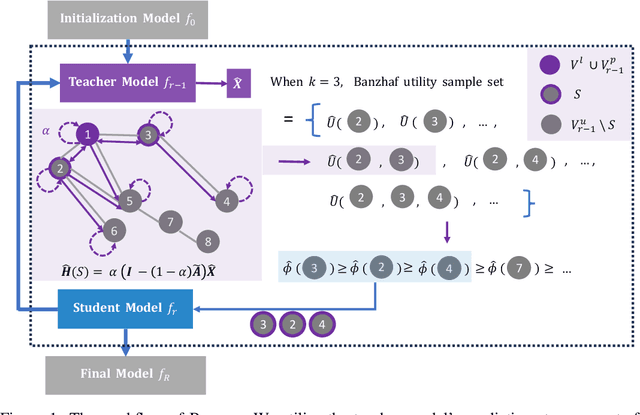
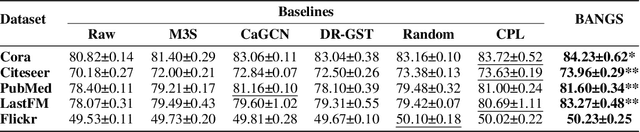

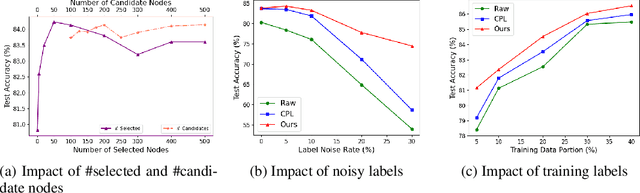
Graph self-training is a semi-supervised learning method that iteratively selects a set of unlabeled data to retrain the underlying graph neural network (GNN) model and improve its prediction performance. While selecting highly confident nodes has proven effective for self-training, this pseudo-labeling strategy ignores the combinatorial dependencies between nodes and suffers from a local view of the distribution. To overcome these issues, we propose BANGS, a novel framework that unifies the labeling strategy with conditional mutual information as the objective of node selection. Our approach -- grounded in game theory -- selects nodes in a combinatorial fashion and provides theoretical guarantees for robustness under noisy objective. More specifically, unlike traditional methods that rank and select nodes independently, BANGS considers nodes as a collective set in the self-training process. Our method demonstrates superior performance and robustness across various datasets, base models, and hyperparameter settings, outperforming existing techniques. The codebase is available on https://github.com/fangxin-wang/BANGS .
FedGraph: A Research Library and Benchmark for Federated Graph Learning
Oct 08, 2024


Federated graph learning is an emerging field with significant practical challenges. While many algorithms have been proposed to enhance model accuracy, their system performance, crucial for real-world deployment, is often overlooked. To address this gap, we present FedGraph, a research library designed for practical distributed deployment and benchmarking in federated graph learning. FedGraph supports a range of state-of-the-art methods and includes profiling tools for system performance evaluation, focusing on communication and computation costs during training. FedGraph can then facilitate the development of practical applications and guide the design of future algorithms.
Recent Advances of Multimodal Continual Learning: A Comprehensive Survey
Oct 07, 2024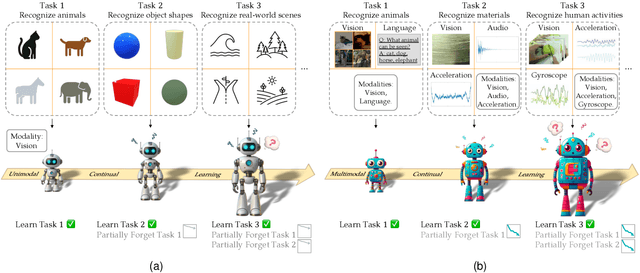
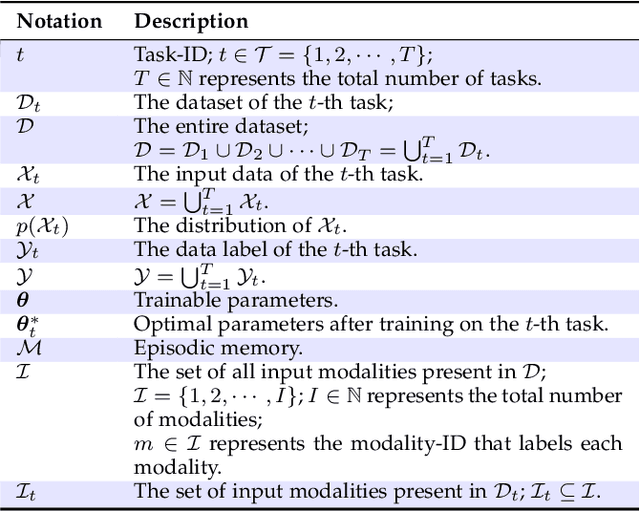
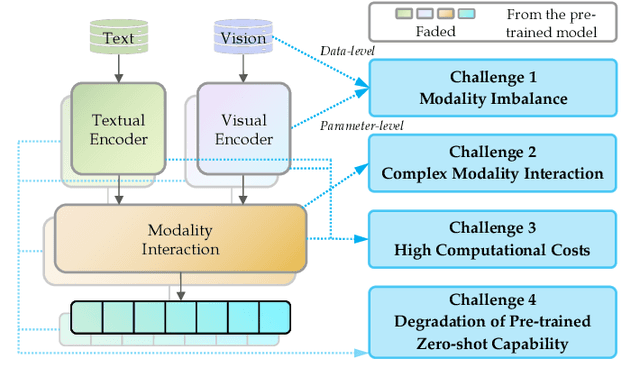
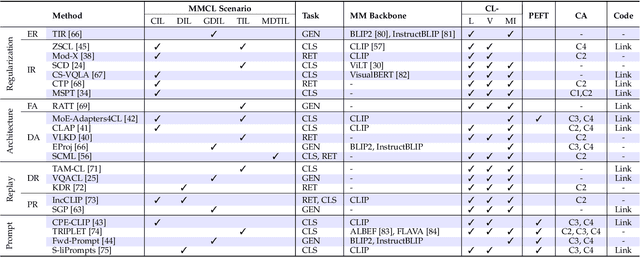
Continual learning (CL) aims to empower machine learning models to learn continually from new data, while building upon previously acquired knowledge without forgetting. As machine learning models have evolved from small to large pre-trained architectures, and from supporting unimodal to multimodal data, multimodal continual learning (MMCL) methods have recently emerged. The primary challenge of MMCL is that it goes beyond a simple stacking of unimodal CL methods, as such straightforward approaches often yield unsatisfactory performance. In this work, we present the first comprehensive survey on MMCL. We provide essential background knowledge and MMCL settings, as well as a structured taxonomy of MMCL methods. We categorize existing MMCL methods into four categories, i.e., regularization-based, architecture-based, replay-based, and prompt-based methods, explaining their methodologies and highlighting their key innovations. Additionally, to prompt further research in this field, we summarize open MMCL datasets and benchmarks, and discuss several promising future directions for investigation and development. We have also created a GitHub repository for indexing relevant MMCL papers and open resources available at https://github.com/LucyDYu/Awesome-Multimodal-Continual-Learning.
Item Cluster-aware Prompt Learning for Session-based Recommendation
Oct 07, 2024
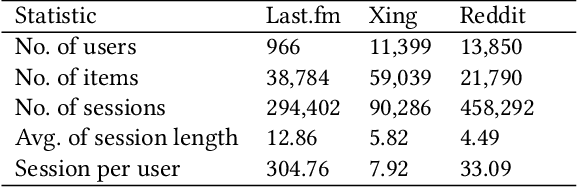
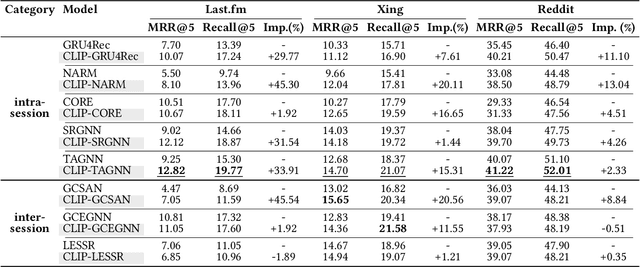
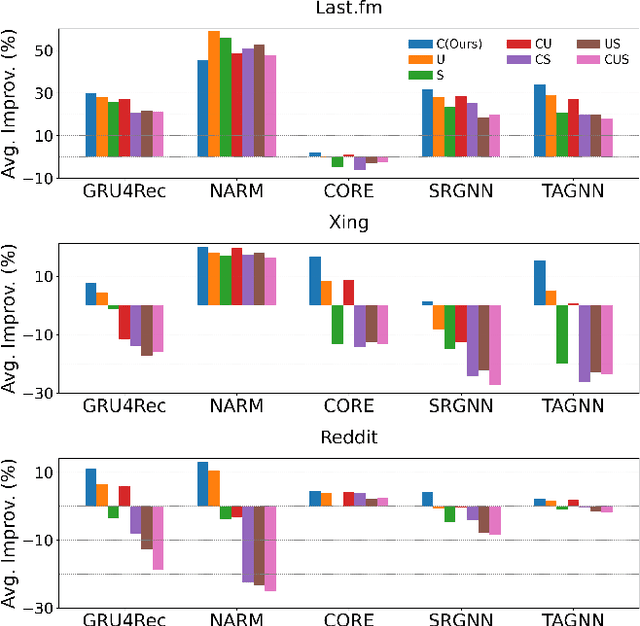
Session-based recommendation (SBR) aims to capture dynamic user preferences by analyzing item sequences within individual sessions. However, most existing approaches focus mainly on intra-session item relationships, neglecting the connections between items across different sessions (inter-session relationships), which limits their ability to fully capture complex item interactions. While some methods incorporate inter-session information, they often suffer from high computational costs, leading to longer training times and reduced efficiency. To address these challenges, we propose the CLIP-SBR (Cluster-aware Item Prompt learning for Session-Based Recommendation) framework. CLIP-SBR is composed of two modules: 1) an item relationship mining module that builds a global graph to effectively model both intra- and inter-session relationships, and 2) an item cluster-aware prompt learning module that uses soft prompts to integrate these relationships into SBR models efficiently. We evaluate CLIP-SBR across eight SBR models and three benchmark datasets, consistently demonstrating improved recommendation performance and establishing CLIP-SBR as a robust solution for session-based recommendation tasks.
TIS-DPO: Token-level Importance Sampling for Direct Preference Optimization With Estimated Weights
Oct 06, 2024
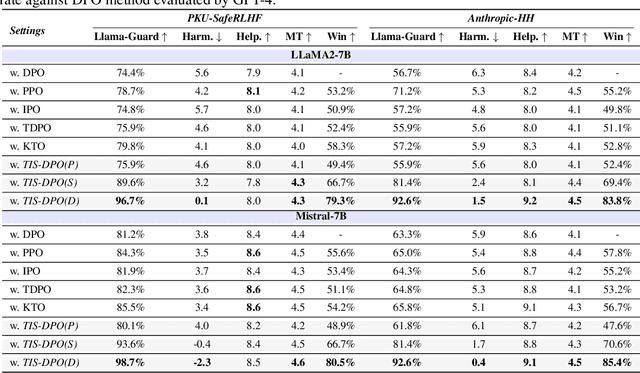


Direct Preference Optimization (DPO) has been widely adopted for preference alignment of Large Language Models (LLMs) due to its simplicity and effectiveness. However, DPO is derived as a bandit problem in which the whole response is treated as a single arm, ignoring the importance differences between tokens, which may affect optimization efficiency and make it difficult to achieve optimal results. In this work, we propose that the optimal data for DPO has equal expected rewards for each token in winning and losing responses, as there is no difference in token importance. However, since the optimal dataset is unavailable in practice, we propose using the original dataset for importance sampling to achieve unbiased optimization. Accordingly, we propose a token-level importance sampling DPO objective named TIS-DPO that assigns importance weights to each token based on its reward. Inspired by previous works, we estimate the token importance weights using the difference in prediction probabilities from a pair of contrastive LLMs. We explore three methods to construct these contrastive LLMs: (1) guiding the original LLM with contrastive prompts, (2) training two separate LLMs using winning and losing responses, and (3) performing forward and reverse DPO training with winning and losing responses. Experiments show that TIS-DPO significantly outperforms various baseline methods on harmlessness and helpfulness alignment and summarization tasks. We also visualize the estimated weights, demonstrating their ability to identify key token positions.