 Add to Chrome
 Add to Firefox
 Add to Edge
PRISA: Proactive Infrastructure LiDAR Framework for Intersection Safety Assessment
Jul 17, 2026
Urban intersections are among the most hazardous locations in road networks, posing significant risks to vehicles and vulnerable road users (VRUs) such as pedestrians and cyclists. The complexity of multi-agent interactions demands continuous, real-time monitoring systems capable of anticipating conflicts before they escalate into crashes. We present PRISA, a modular infrastructure LiDAR framework leveraging privacy-preserving, low-light-robust roadside sensors for long-term traffic observation and real-time risk detection at the edge. The framework comprises two core components: a sensing and perception layer and a plug-and-play risk assessment module. The latter automatically curates site-specific training data from accumulated perception outputs to train a trajectory prediction model without manual annotation. It then deploys the trained model for continuous motion forecasting and dual surrogate safety evaluation, using Time-to-Collision (TTC) for longitudinal conflicts and Predicted Post-Encroachment Time (PPET) for crossing and VRU-involved interactions. PRISA is evaluated on the public R-LiViT dataset and deployed on an NVIDIA Jetson AGX Thor at a live signalized intersection in Chattanooga, Tennessee. PPET-based assessment operates at 194~ms end-to-end latency over a 2.4-second predictive horizon, with TTC-based detection and perception remaining within real-time constraints, demonstrating practical feasibility for proactive multi-agent intersection safety monitoring.

CLIFE: Camera-LiDAR Fusion Framework for Edge-Deployable Roadside VRU Perception
Jul 17, 2026Reliable roadside perception of vulnerable road users (VRUs) remains challenging under occlusions, variable lighting, and diverse weather conditions, particularly under strict edge-computing and latency constraints. Existing multi-sensor fusion systems rely on cloud or server-grade infrastructure, creating a deployment gap at real-world intersections. We present CLIFE, an edge-native camera-LiDAR fusion framework that integrates targetless online calibration and lightweight late-fusion tracking entirely on a single embedded device, without cloud offloading. CLIFE adaptively refines camera-LiDAR alignment on demand and performs multi-sensor fusion and track association with O(N log N) per-frame cost. We deploy CLIFE across 12 signalized intersections in Chattanooga and conduct an in-depth evaluation at a representative intersection using synchronized camera-LiDAR data that spans diverse daytime, nighttime, and weather conditions. Our experiments demonstrate that the fusion architecture substantially enhances the perceptual range and robustness of the individual sensors under varied environmental and traffic conditions. The late-fusion core operates at 53.2 FPS on the Jetson AGX Thor, ensuring high throughput for real-time intersection-scale applications. By centering perception at the edge, CLIFE provides a deployable foundation for downstream safety applications, while reducing bandwidth and calibration overhead for agencies operating multi-intersection corridors.
hia-gat: A Heterogeneous Interaction-Aware Graph Attention Network For Frame-Level Traffic Conflict Risk Prediction On Freeways
Jun 25, 2026This paper formulates frame-level freeway risk assessment as a multi-agent scene graph-level binary classification problem, where each video or trajectory frame is labeled risky if any TTC- or PET-based conflict violates a specified severity threshold. We construct a relation-aware graph per frame with vehicles as nodes and two interaction types as edges: same-lane (longitudinal) and adjacent-lane (lateral), augmented with physics-informed edge features aligned to rear-end and lane-change conflict mechanisms. Building on a structured benchmarking suite of non-graph models and graph baselines, we propose HIA-GAT, a dual-stream heterogeneous graph attention network that processes longitudinal and lateral interactions through dedicated attention pathways and fuses them via a conflict-type-aware gating mechanism with event-level gate supervision derived from SSM conflict attribution. Experiments on the NGSIM I-80 and US-101 freeway datasets across nine TTC and PET threshold configurations show that HIA-GAT achieves the best average risk-ranking performance (AUC 0.835 on I-80 and 0.867 on US-101), with the largest gains on PET-only (lane-change) settings where relational structure is essential. Beyond accuracy, the learned gate provides interpretable per-vehicle attribution of dominant conflict type, supporting actionable, real-time freeway safety monitoring. We show that graph structure is critical for modeling lateral conflict risk, while longitudinal risk can often be captured by non-relational aggregation.
EVA-Bench: A New End-to-end Framework for Evaluating Voice Agents
May 13, 2026Voice agents, artificial intelligence systems that conduct spoken conversations to complete tasks, are increasingly deployed across enterprise applications. However, no existing benchmark jointly addresses two core evaluation challenges: generating realistic simulated conversations, and measuring quality across the full scope of voice-specific failure modes. We present EVA-Bench, an end-to-end evaluation framework that addresses both. On the simulation side, EVA-Bench orchestrates bot-to-bot audio conversations over dynamic multi-turn dialogues, with automatic simulation validation that detects user simulator error and appropriately regenerates conversations before scoring. On the measurement side, EVA-Bench introduces two composite metrics: EVA-A (Accuracy), capturing task completion, faithfulness, and audio-level speech fidelity; and EVA-X (Experience), capturing conversation progression, spoken conciseness, and turn-taking timing. Both metrics apply to different agent architectures, enabling direct cross-architecture comparison. EVA-Bench includes 213 scenarios across three enterprise domains, a controlled perturbation suite for accent and noise robustness, and pass@1, pass@k, pass^k measurements that distinguish peak from reliable capability. Across 12 systems spanning all three architectures, we find: (1) no system simultaneously exceeds 0.5 on both EVA-A pass@1 and EVA-X pass@1; (2) peak and reliable performance diverge substantially (median pass@k - pass^k gap of 0.44 on EVA-A); and (3) accent and noise perturbations expose substantial robustness gaps, with effects varying across architectures, systems, and metrics (mean up to 0.314). We release the full framework, evaluation suite, and benchmark data under an open-source license.
Pedestrian Crossing Intent Prediction via Psychological Features and Transformer Fusion
Mar 20, 2026Pedestrian intention prediction needs to be accurate for autonomous vehicles to navigate safely in urban environments. We present a lightweight, socially informed architecture for pedestrian intention prediction. It fuses four behavioral streams (attention, position, situation, and interaction) using highway encoders, a compact 4-token Transformer, and global self-attention pooling. To quantify uncertainty, we incorporate two complementary heads: a variational bottleneck whose KL divergence captures epistemic uncertainty, and a Mahalanobis distance detector that identifies distributional shift. Together, these components yield calibrated probabilities and actionable risk scores without compromising efficiency. On the PSI 1.0 benchmark, our model outperforms recent vision language models by achieving 0.9 F1, 0.94 AUC-ROC, and 0.78 MCC by using only structured, interpretable features. On the more diverse PSI 2.0 dataset, where, to the best of our knowledge, no prior results exist, we establish a strong initial baseline of 0.78 F1 and 0.79 AUC-ROC. Selective prediction based on Mahalanobis scores increases test accuracy by up to 0.4 percentage points at 80% coverage. Qualitative attention heatmaps further show how the model shifts its cross-stream focus under ambiguity. The proposed approach is modality-agnostic, easy to integrate with vision language pipelines, and suitable for risk-aware intent prediction on resource-constrained platforms.
Graph-DPEP: Decomposed Plug and Ensemble Play for Few-Shot Document Relation Extraction with Graph-of-Thoughts Reasoning
Nov 05, 2024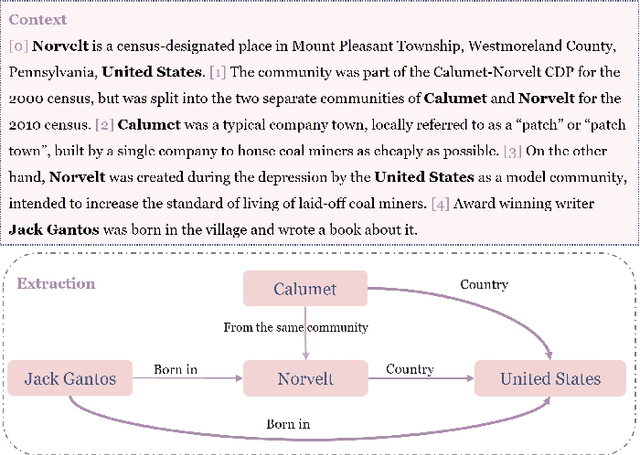

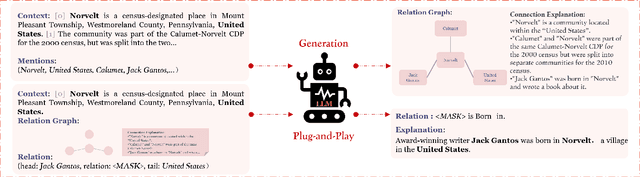

Large language models (LLMs) pre-trained on massive corpora have demonstrated impressive few-shot learning capability on many NLP tasks. Recasting an NLP task into a text-to-text generation task is a common practice so that generative LLMs can be prompted to resolve it. However, performing document-level relation extraction (DocRE) tasks with generative LLM models is still challenging due to the structured output format of DocRE, which complicates the conversion to plain text. Limited information available in few-shot samples and prompt instructions induce further difficulties and challenges in relation extraction for mentioned entities in a document. In this paper, we represent the structured output as a graph-style triplet rather than natural language expressions and leverage generative LLMs for the DocRE task. Our approach, the Graph-DPEP framework is grounded in the reasoning behind triplet explanation thoughts presented in natural language. In this framework, we first introduce a ``decomposed-plug" method for performing the generation from LLMs over prompts with type-space decomposition to alleviate the burden of distinguishing all relation types. Second, we employ a verifier for calibrating the generation and identifying overlooked query entity pairs. Third, we develop "ensemble-play", reapplying generation on the entire type list by leveraging the reasoning thoughts embedded in a sub-graph associated with the missing query pair to address the missingness issue. Through extensive comparisons with existing prompt techniques and alternative Language Models (LLMs), our framework demonstrates superior performance on publicly available benchmarks in experiments.
CORI: CJKV Benchmark with Romanization Integration -- A step towards Cross-lingual Transfer Beyond Textual Scripts
Apr 19, 2024Naively assuming English as a source language may hinder cross-lingual transfer for many languages by failing to consider the importance of language contact. Some languages are more well-connected than others, and target languages can benefit from transferring from closely related languages; for many languages, the set of closely related languages does not include English. In this work, we study the impact of source language for cross-lingual transfer, demonstrating the importance of selecting source languages that have high contact with the target language. We also construct a novel benchmark dataset for close contact Chinese-Japanese-Korean-Vietnamese (CJKV) languages to further encourage in-depth studies of language contact. To comprehensively capture contact between these languages, we propose to integrate Romanized transcription beyond textual scripts via Contrastive Learning objectives, leading to enhanced cross-lingual representations and effective zero-shot cross-lingual transfer.
On Partial Optimal Transport: Revising the Infeasibility of Sinkhorn and Efficient Gradient Methods
Dec 22, 2023

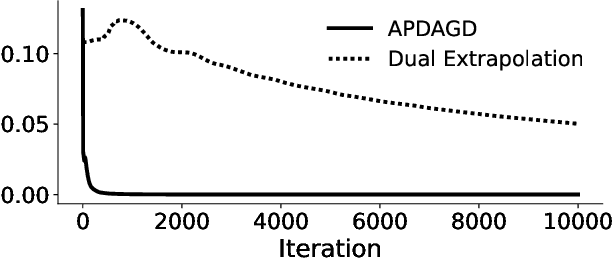

This paper studies the Partial Optimal Transport (POT) problem between two unbalanced measures with at most $n$ supports and its applications in various AI tasks such as color transfer or domain adaptation. There is hence the need for fast approximations of POT with increasingly large problem sizes in arising applications. We first theoretically and experimentally investigate the infeasibility of the state-of-the-art Sinkhorn algorithm for POT due to its incompatible rounding procedure, which consequently degrades its qualitative performance in real world applications like point-cloud registration. To this end, we propose a novel rounding algorithm for POT, and then provide a feasible Sinkhorn procedure with a revised computation complexity of $\mathcal{\widetilde O}(n^2/\varepsilon^4)$. Our rounding algorithm also permits the development of two first-order methods to approximate the POT problem. The first algorithm, Adaptive Primal-Dual Accelerated Gradient Descent (APDAGD), finds an $\varepsilon$-approximate solution to the POT problem in $\mathcal{\widetilde O}(n^{2.5}/\varepsilon)$, which is better in $\varepsilon$ than revised Sinkhorn. The second method, Dual Extrapolation, achieves the computation complexity of $\mathcal{\widetilde O}(n^2/\varepsilon)$, thereby being the best in the literature. We further demonstrate the flexibility of POT compared to standard OT as well as the practicality of our algorithms on real applications where two marginal distributions are unbalanced.
CoF-CoT: Enhancing Large Language Models with Coarse-to-Fine Chain-of-Thought Prompting for Multi-domain NLU Tasks
Oct 23, 2023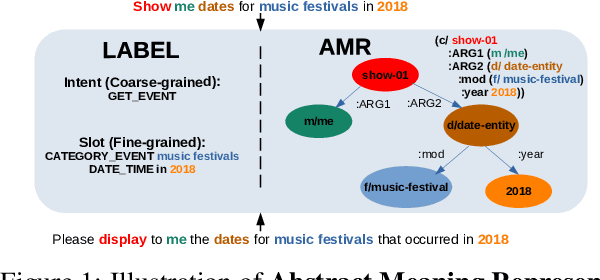
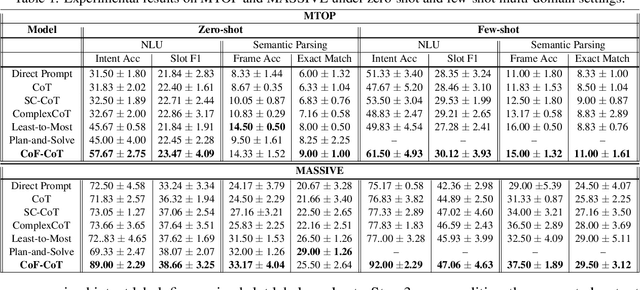

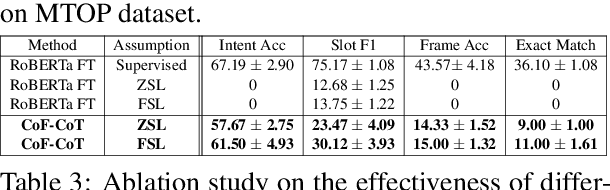
While Chain-of-Thought prompting is popular in reasoning tasks, its application to Large Language Models (LLMs) in Natural Language Understanding (NLU) is under-explored. Motivated by multi-step reasoning of LLMs, we propose Coarse-to-Fine Chain-of-Thought (CoF-CoT) approach that breaks down NLU tasks into multiple reasoning steps where LLMs can learn to acquire and leverage essential concepts to solve tasks from different granularities. Moreover, we propose leveraging semantic-based Abstract Meaning Representation (AMR) structured knowledge as an intermediate step to capture the nuances and diverse structures of utterances, and to understand connections between their varying levels of granularity. Our proposed approach is demonstrated effective in assisting the LLMs adapt to the multi-grained NLU tasks under both zero-shot and few-shot multi-domain settings.
Slot Induction via Pre-trained Language Model Probing and Multi-level Contrastive Learning
Aug 09, 2023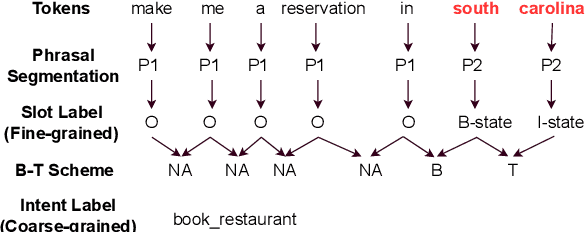

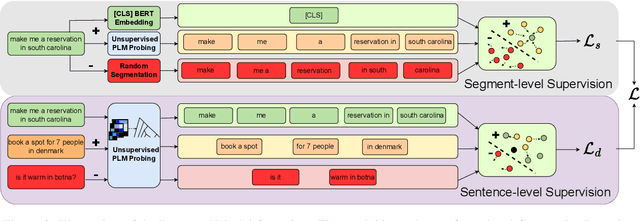

Recent advanced methods in Natural Language Understanding for Task-oriented Dialogue (TOD) Systems (e.g., intent detection and slot filling) require a large amount of annotated data to achieve competitive performance. In reality, token-level annotations (slot labels) are time-consuming and difficult to acquire. In this work, we study the Slot Induction (SI) task whose objective is to induce slot boundaries without explicit knowledge of token-level slot annotations. We propose leveraging Unsupervised Pre-trained Language Model (PLM) Probing and Contrastive Learning mechanism to exploit (1) unsupervised semantic knowledge extracted from PLM, and (2) additional sentence-level intent label signals available from TOD. Our approach is shown to be effective in SI task and capable of bridging the gaps with token-level supervised models on two NLU benchmark datasets. When generalized to emerging intents, our SI objectives also provide enhanced slot label representations, leading to improved performance on the Slot Filling tasks.