 Add to Chrome
 Add to Firefox
 Add to Edge
Harness the Memory: A Holistic Evaluation of Memory Substrates in Memory Agents
Aug 15, 2026
Memory is becoming core infrastructure for long-horizon LLM agents, yet existing evaluations offer limited guidance on which memory substrate, namely the underlying medium in which memory is represented and stored, should be used under different operating regimes. We present a controlled harness evaluation of memory substrates for memory-augmented agents, covering dense and sparse indices, text records, structural stores, hierarchical stores, refinement-based memories, parametric updates, and activation-compatible context mechanisms. Across three backbone models and four benchmark suites spanning user-centric question answering and agent-centric decision-making, we instrument 26 performance and efficiency metrics under a unified harness. Our results show that no single substrate consistently dominates: broad retrieval benefits long-context factual QA, while excessive retrieval can harm sequential decision-making by shifting attention away from action-critical context. Scalability introduces a further routing axis, as substrates that perform well at moderate history lengths can become costly or brittle at longer horizons. These findings motivate substrate routing as a necessary component of adaptive agent memory systems and provide empirical guidance for designing efficient, reliable, and regime-aware long-term memory for LLM agents. Code will be made available upon acceptance.

XBridge: Entity-Grounded Latent Bridge for Heterogeneous LLM Communication
Aug 12, 2026Heterogeneous multi-agent LLM systems, where agents are powered by different model families, can outperform homogeneous configurations by reducing redundant reasoning patterns. Yet existing communication protocols either operate through text, discarding the sender's internal representations, or require architectural homogeneity for latent-level transfer. We identify the entity grounding problem in cross-architecture communication: cross-attention bridges that transfer continuous representations across different LLM families suffer from rare-token compression collapse, where entity identity is lost in the continuous bottleneck (bridge-only F1 ~30%). We propose XBRIDGE, a decode-free communication protocol that addresses this through two mechanisms. Lexical Anchor Mapping (LAM) maps the sender's original context tokens to the receiver's vocabulary, providing discrete entity anchors. A Latent Enrichment Bridge (LEB) lets the receiver query the sender's hidden states for contextual enrichment. The entity anchors ground the bridge's contextual signals to specific entities through the receiver's own self-attention. Across three model families (Llama, Qwen, and Mistral), seven benchmarks, and both communication directions, XBRIDGE outperforms text-based communication on all seven tasks for each model pair while achieving 11x lower latency, and in a same-architecture setting it also exceeds a KV-sharing baseline on six of seven tasks. LEB requires only 264M trainable parameters (3.8% of the receiver), is trained on a small balanced sample set, and adds negligible inference overhead.
Toward User Preference Alignment in LLM Recommendation via Explicit Context Feedback
May 27, 2026Traditional recommender systems (RecSys) primarily infer user preferences from implicit signals (such as clicks, watches, and purchases), often neglecting the rich explicit contextual feedback users provide through verbal text, like comments and reviews. This explicit context feedback captures the nuanced reasons behind user decisions regarding their preferences. In addition, it offers critical heterogeneous information for user preference alignment and more explainable recommendations. Overlooking such signals can lead to misaligned user preferences and further reinforce filter bubbles, as algorithms fail to understand the "semantic context" behind user choices. Recent advances in Large Language Models (LLMs) present new opportunities to harness user-generated content for more accurate and diverse recommendations, yet current LLM-based recommendations still focus on using item meta-data and underutilize this resource. In this paper, we advocate for prioritizing explicit context feedback in the next generation of LLM-based RecSys. We review the evolution of recommendation paradigms, highlight the value of context-rich feedback, call for new benchmarks and metrics, and introduce frameworks for integrating explicit user signals into scalable LLM-driven RecSys. Centering on user-preference modeling, we aim to foster more personalized, transparent, and explainable RecSys online platforms.
Geometrically-Constrained Radar-Inertial Odometry via Continuous Point-Pose Uncertainty Modeling
Apr 03, 2026Radar odometry is crucial for robust localization in challenging environments; however, the sparsity of reliable returns and distinctive noise characteristics impede its performance. This paper introduces geometrically-constrained radar-inertial odometry and mapping that jointly consolidates point and pose uncertainty. We employ the continuous trajectory model to estimate the pose uncertainty at any arbitrary timestamp by propagating uncertainties of the control points. These pose uncertainties are continuously integrated with heteroscedastic measurement uncertainty during point projection, thereby enabling dynamic evaluation of observation confidence and adaptive down-weighting of uninformative radar points. By leveraging quantified uncertainties in radar mapping, we construct a high-fidelity map that improves odometry accuracy under imprecise radar measurements. Moreover, we reveal the effectiveness of explicit geometrical constraints in radar-inertial odometry when incorporated with the proposed uncertainty-aware mapping framework. Extensive experiments on diverse real-world datasets demonstrate the superiority of our method, yielding substantial performance improvements in both accuracy and efficiency compared to existing baselines.
XPRESS: X-Band Radar Place Recognition via Elliptical Scan Shaping
Nov 12, 2025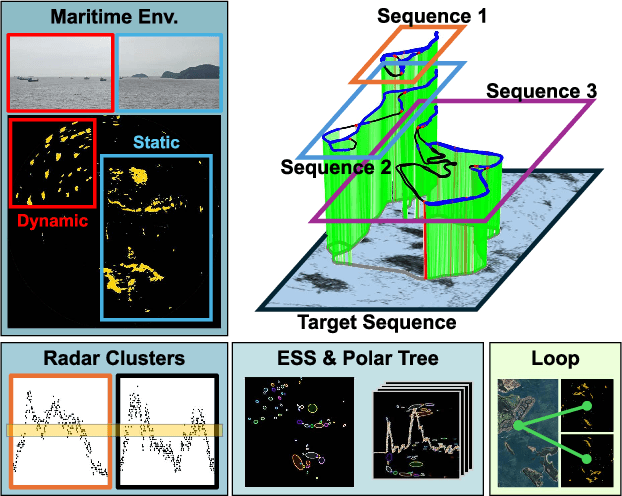
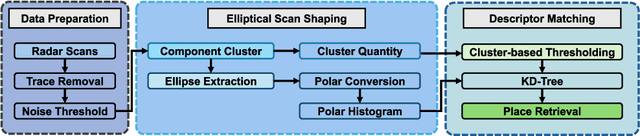
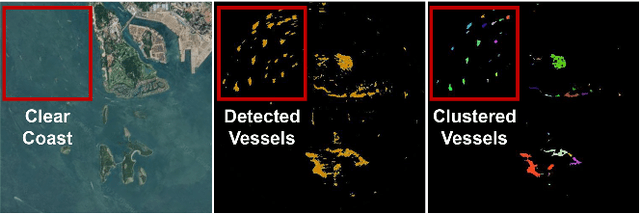
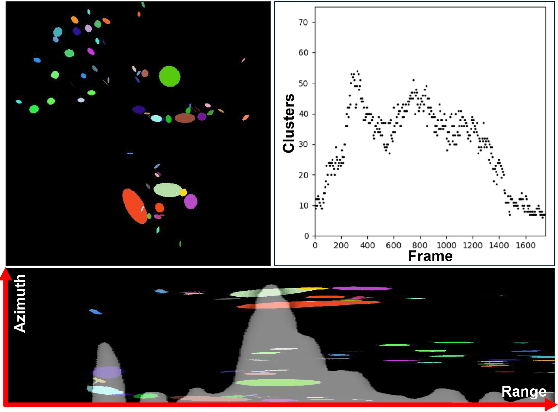
X-band radar serves as the primary sensor on maritime vessels, however, its application in autonomous navigation has been limited due to low sensor resolution and insufficient information content. To enable X-band radar-only autonomous navigation in maritime environments, this paper proposes a place recognition algorithm specifically tailored for X-band radar, incorporating an object density-based rule for efficient candidate selection and intentional degradation of radar detections to achieve robust retrieval performance. The proposed algorithm was evaluated on both public maritime radar datasets and our own collected dataset, and its performance was compared against state-of-the-art radar place recognition methods. An ablation study was conducted to assess the algorithm's performance sensitivity with respect to key parameters.
* 9 pages, 9 figures, Published in IEEE RA-L
SHeRLoc: Synchronized Heterogeneous Radar Place Recognition for Cross-Modal Localization
Jun 18, 2025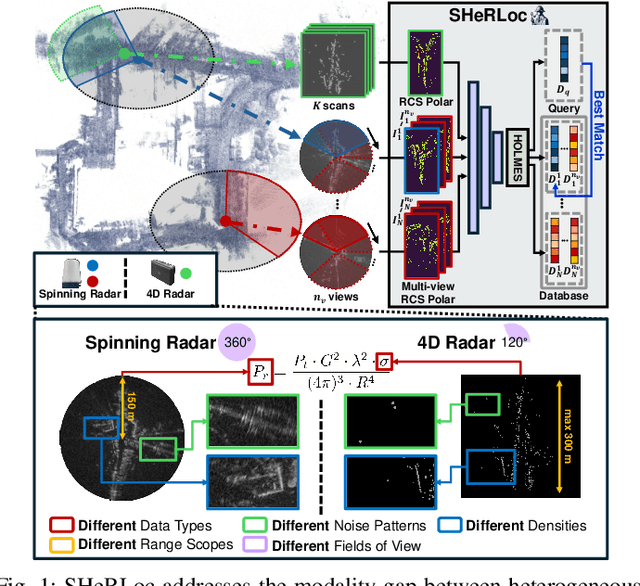
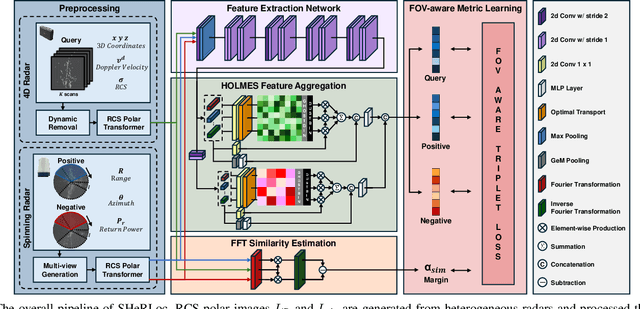
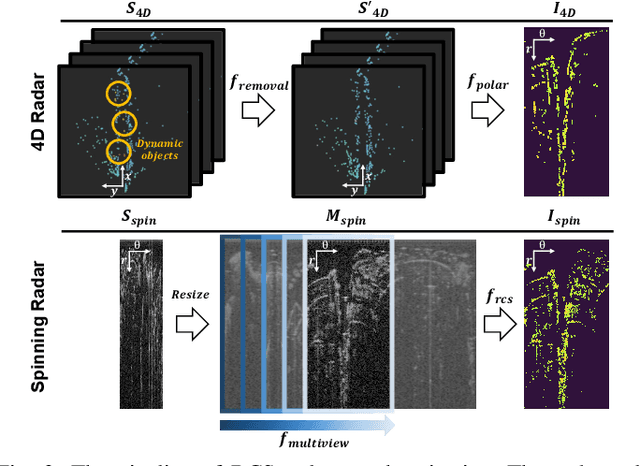
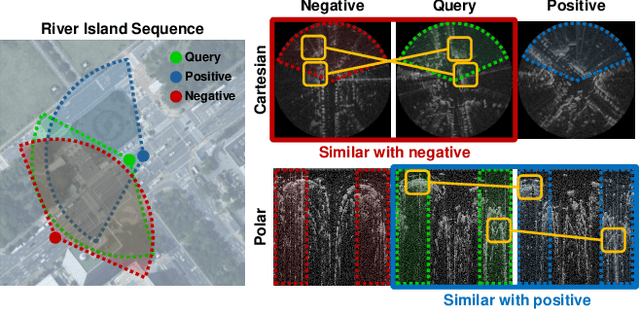
Despite the growing adoption of radar in robotics, the majority of research has been confined to homogeneous sensor types, overlooking the integration and cross-modality challenges inherent in heterogeneous radar technologies. This leads to significant difficulties in generalizing across diverse radar data types, with modality-aware approaches that could leverage the complementary strengths of heterogeneous radar remaining unexplored. To bridge these gaps, we propose SHeRLoc, the first deep network tailored for heterogeneous radar, which utilizes RCS polar matching to align multimodal radar data. Our hierarchical optimal transport-based feature aggregation method generates rotationally robust multi-scale descriptors. By employing FFT-similarity-based data mining and adaptive margin-based triplet loss, SHeRLoc enables FOV-aware metric learning. SHeRLoc achieves an order of magnitude improvement in heterogeneous radar place recognition, increasing recall@1 from below 0.1 to 0.9 on a public dataset and outperforming state of-the-art methods. Also applicable to LiDAR, SHeRLoc paves the way for cross-modal place recognition and heterogeneous sensor SLAM. The source code will be available upon acceptance.
Cold-Start Recommendation with Knowledge-Guided Retrieval-Augmented Generation
May 27, 2025Cold-start items remain a persistent challenge in recommender systems due to their lack of historical user interactions, which collaborative models rely on. While recent zero-shot methods leverage large language models (LLMs) to address this, they often struggle with sparse metadata and hallucinated or incomplete knowledge. We propose ColdRAG, a retrieval-augmented generation approach that builds a domain-specific knowledge graph dynamically to enhance LLM-based recommendation in cold-start scenarios, without requiring task-specific fine-tuning. ColdRAG begins by converting structured item attributes into rich natural-language profiles, from which it extracts entities and relationships to construct a unified knowledge graph capturing item semantics. Given a user's interaction history, it scores edges in the graph using an LLM, retrieves candidate items with supporting evidence, and prompts the LLM to rank them. By enabling multi-hop reasoning over this graph, ColdRAG grounds recommendations in verifiable evidence, reducing hallucinations and strengthening semantic connections. Experiments on three public benchmarks demonstrate that ColdRAG surpasses existing zero-shot baselines in both Recall and NDCG. This framework offers a practical solution to cold-start recommendation by combining knowledge-graph reasoning with retrieval-augmented LLM generation.
LLMInit: A Free Lunch from Large Language Models for Selective Initialization of Recommendation
Mar 03, 2025Collaborative filtering models, particularly graph-based approaches, have demonstrated strong performance in capturing user-item interactions for recommendation systems. However, they continue to struggle in cold-start and data-sparse scenarios. The emergence of large language models (LLMs) like GPT and LLaMA presents new possibilities for enhancing recommendation performance, especially in cold-start settings. Despite their promise, LLMs pose challenges related to scalability and efficiency due to their high computational demands and limited ability to model complex user-item relationships effectively. In this work, we introduce a novel perspective on leveraging LLMs for CF model initialization. Through experiments, we uncover an embedding collapse issue when scaling CF models to larger embedding dimensions. To effectively harness large-scale LLM embeddings, we propose innovative selective initialization strategies utilizing random, uniform, and variance-based index sampling. Our comprehensive evaluation on multiple real-world datasets demonstrates significant performance gains across various CF models while maintaining a lower computational cost compared to existing LLM-based recommendation approaches.
Ground-Optimized 4D Radar-Inertial Odometry via Continuous Velocity Integration using Gaussian Process
Feb 12, 2025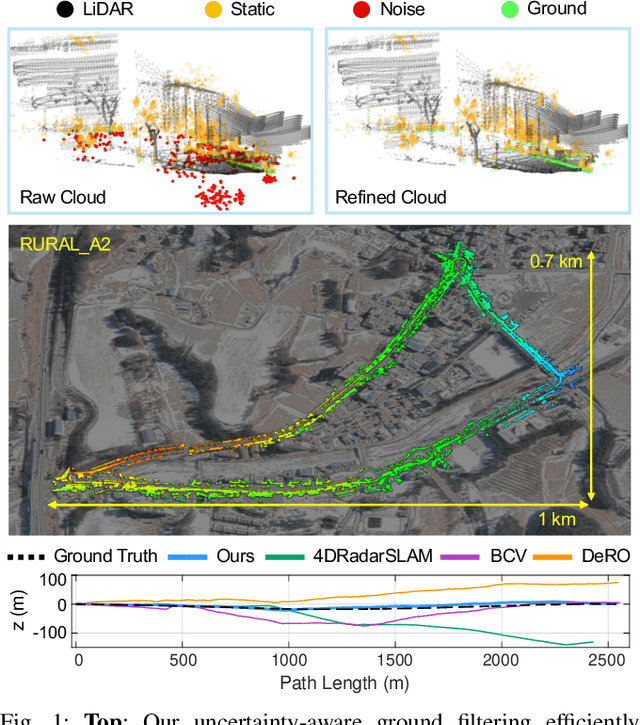
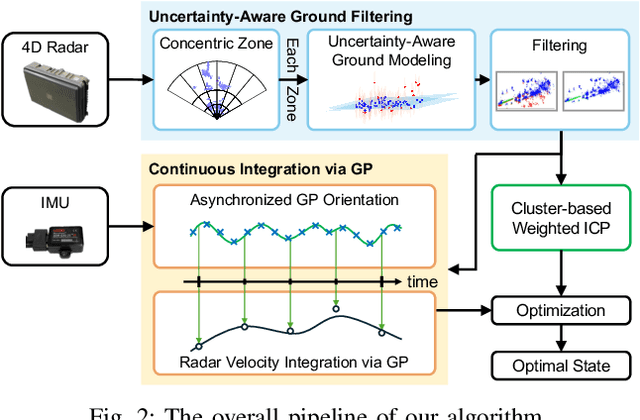
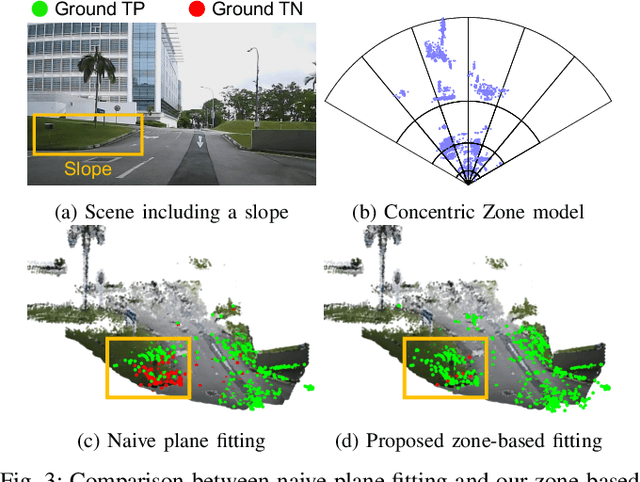
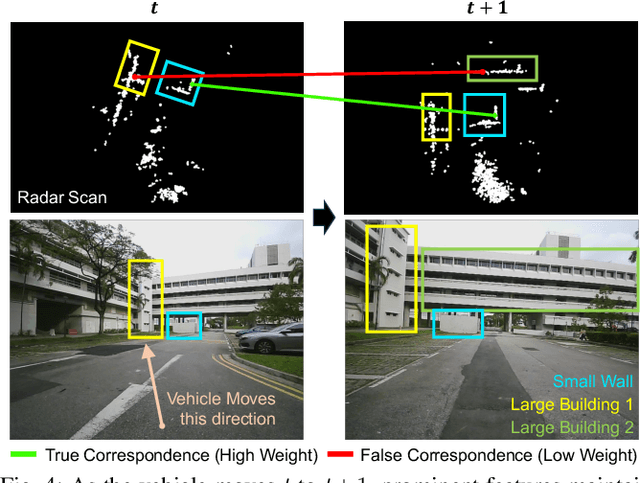
Radar ensures robust sensing capabilities in adverse weather conditions, yet challenges remain due to its high inherent noise level. Existing radar odometry has overcome these challenges with strategies such as filtering spurious points, exploiting Doppler velocity, or integrating with inertial measurements. This paper presents two novel improvements beyond the existing radar-inertial odometry: ground-optimized noise filtering and continuous velocity preintegration. Despite the widespread use of ground planes in LiDAR odometry, imprecise ground point distributions of radar measurements cause naive plane fitting to fail. Unlike plane fitting in LiDAR, we introduce a zone-based uncertainty-aware ground modeling specifically designed for radar. Secondly, we note that radar velocity measurements can be better combined with IMU for a more accurate preintegration in radar-inertial odometry. Existing methods often ignore temporal discrepancies between radar and IMU by simplifying the complexities of asynchronous data streams with discretized propagation models. Tackling this issue, we leverage GP and formulate a continuous preintegration method for tightly integrating 3-DOF linear velocity with IMU, facilitating full 6-DOF motion directly from the raw measurements. Our approach demonstrates remarkable performance (less than 1% vertical drift) in public datasets with meticulous conditions, illustrating substantial improvement in elevation accuracy. The code will be released as open source for the community: https://github.com/wooseongY/Go-RIO.
GaRLIO: Gravity enhanced Radar-LiDAR-Inertial Odometry
Feb 11, 2025Recently, gravity has been highlighted as a crucial constraint for state estimation to alleviate potential vertical drift. Existing online gravity estimation methods rely on pose estimation combined with IMU measurements, which is considered best practice when direct velocity measurements are unavailable. However, with radar sensors providing direct velocity data-a measurement not yet utilized for gravity estimation-we found a significant opportunity to improve gravity estimation accuracy substantially. GaRLIO, the proposed gravity-enhanced Radar-LiDAR-Inertial Odometry, can robustly predict gravity to reduce vertical drift while simultaneously enhancing state estimation performance using pointwise velocity measurements. Furthermore, GaRLIO ensures robustness in dynamic environments by utilizing radar to remove dynamic objects from LiDAR point clouds. Our method is validated through experiments in various environments prone to vertical drift, demonstrating superior performance compared to traditional LiDAR-Inertial Odometry methods. We make our source code publicly available to encourage further research and development. https://github.com/ChiyunNoh/GaRLIO