 Add to Chrome
 Add to Firefox
 Add to Edge
MUSE: A Full-Text Cross-Domain Knowledge Base of Scientific Problems, Solutions, and Rationales
Aug 11, 2026
Scientific papers contain fine-grained records of problem solving: authors mention technical obstacles and methods that were used to address them, often along with reasoning on why those methods were chosen. We introduce MUSE (Mining Underlying Scientific Explanations), a full-text, multi-domain resource of scientific Problem-Solution-Rationale (P-S-R) triplets. We curate 579 expert-annotated full-text paragraphs, with a rich annotation schema covering salient problem, solution, and rationale spans, solves and rationale_of links and conceptual coreference. A modular extraction pipeline scales this annotation to build a high-quality knowledge base of 37K source-grounded P-S-R triplets. We evaluate the extraction components and include a preliminary experiment training a rationale-supervised LLM for scientific problem solving. Interestingly, we find that rationale supervision improves performance on complex, multi-constraint problems but can harm performance on simpler ones.

Consistency-Driven Co-Evolution for Self-Supervised Cross-Representation Learning
Aug 05, 2026As chart images, tabular data, and visualization code play increasingly important roles across diverse domains, cross-representation understanding across these modalities poses fundamental challenges for AI systems: the relationships across representations are inherently \textit{one-to-many}, supervision is ambiguous and costly, and model optimization lacks a principled signal that is both direction-adaptive and representation-generalizable beyond task-specific objectives. We introduce CoCoEvolve to improve consistency across chart, table, and code representations. Instead of treating cross-representation mapping as a one-to-many problem, we define explicit one-to-one correspondences and optimize models using agreement between representations, without additional annotations. During training, CoCoEvolve@Train performs co-evolution across the chart-table-code cycle, while CoCoEvolve@Test applies the same consistency objective at inference time for test-time co-optimization. We also present CoCoEvolve@Eval, an evaluation suite covering all six cross-representation tasks. Across four benchmarks, CoCoEvolve improves performance in both training-time and test-time settings. Our project page: https://xhguo7.github.io/CoCoEvolve/.
WikiSTAR: A System for Shedding Light on the Hidden History of Scientific Wikipedia Articles
Jul 14, 2026Wikipedia plays a key role in shaping public understanding of science, and its openly accessible revision history is a unique record of how scientific knowledge evolves over time. Yet scientifically meaningful revisions are obscured by the sheer volume of routine edits, leaving each article's scientific history hidden. We present WikiSTAR (Scientific Tracking of Article Revisions), an interactive system for exploring scientifically meaningful changes across an article's revision history. Using an LLM classifier with an expert-designed multi-label taxonomy, WikiSTAR first tags edit types such as the addition of technical terms, new research findings, and changes in scientific narrative. Then, through interactive views, an article's full revision history can be traced at any granularity - from aggregate trends that reveal when and in which sections scientific content was added or refined, down to individual edits - showing how scientific knowledge develops at a scale previously impossible. In a user study, experts from three domains found that WikiSTAR surfaced new patterns and research questions and enabled previously impractical analyses. We release our system, code and a human-annotated benchmark.
Iterate Until Retrieved: Factual Nugget Optimization for Discoverable Continual Corrections in Agentic RAG
May 25, 2026Agentic retrieval-augmented generation (RAG) systems in complex B2B (business-to-business) settings may often receive free-form response feedback. Rather than generic feedback signals such as style, preference, or overall response quality, we focus on actionable factual corrections. We identify these instances and convert them into compact knowledge-base entries, which we call factual nuggets. We introduce Iterative Nugget Optimization (INO), an index-time optimization method that uses the production agentic RAG as a test harness: it creates an initial nugget, probes it with the triggering query and paraphrases, reflects over failed retrieval and answer traces, and revises the nugget until it is discoverable. We evaluate INO with two production B2B knowledge-assistance agents across multiple companies that use our system: a product support agent that answers questions over company-specific knowledge bases, and a support ticket agent that assists support engineers. INO consistently improves results over baselines in terms of discoverability and usage of factual corrections, in automated and human evaluations.
PreScience: A Benchmark for Forecasting Scientific Contributions
Feb 24, 2026Can AI systems trained on the scientific record up to a fixed point in time forecast the scientific advances that follow? Such a capability could help researchers identify collaborators and impactful research directions, and anticipate which problems and methods will become central next. We introduce PreScience -- a scientific forecasting benchmark that decomposes the research process into four interdependent generative tasks: collaborator prediction, prior work selection, contribution generation, and impact prediction. PreScience is a carefully curated dataset of 98K recent AI-related research papers, featuring disambiguated author identities, temporally aligned scholarly metadata, and a structured graph of companion author publication histories and citations spanning 502K total papers. We develop baselines and evaluations for each task, including LACERScore, a novel LLM-based measure of contribution similarity that outperforms previous metrics and approximates inter-annotator agreement. We find substantial headroom remains in each task -- e.g. in contribution generation, frontier LLMs achieve only moderate similarity to the ground-truth (GPT-5, averages 5.6 on a 1-10 scale). When composed into a 12-month end-to-end simulation of scientific production, the resulting synthetic corpus is systematically less diverse and less novel than human-authored research from the same period.
Anagent For Enhancing Scientific Table & Figure Analysis
Feb 12, 2026In scientific research, analysis requires accurately interpreting complex multimodal knowledge, integrating evidence from different sources, and drawing inferences grounded in domain-specific knowledge. However, current artificial intelligence (AI) systems struggle to consistently demonstrate such capabilities. The complexity and variability of scientific tables and figures, combined with heterogeneous structures and long-context requirements, pose fundamental obstacles to scientific table \& figure analysis. To quantify these challenges, we introduce AnaBench, a large-scale benchmark featuring $63,178$ instances from nine scientific domains, systematically categorized along seven complexity dimensions. To tackle these challenges, we propose Anagent, a multi-agent framework for enhanced scientific table \& figure analysis through four specialized agents: Planner decomposes tasks into actionable subtasks, Expert retrieves task-specific information through targeted tool execution, Solver synthesizes information to generate coherent analysis, and Critic performs iterative refinement through five-dimensional quality assessment. We further develop modular training strategies that leverage supervised finetuning and specialized reinforcement learning to optimize individual capabilities while maintaining effective collaboration. Comprehensive evaluation across 9 broad domains with 170 subdomains demonstrates that Anagent achieves substantial improvements, up to $\uparrow 13.43\%$ in training-free settings and $\uparrow 42.12\%$ with finetuning, while revealing that task-oriented reasoning and context-aware problem-solving are essential for high-quality scientific table \& figure analysis. Our project page: https://xhguo7.github.io/Anagent/.
Lightweight Joint Optimization of General-Purpose Vision-Language Models and Retrievers for Medical Diagnosis
Aug 24, 2025Clinical decision-making often involves interpreting images (e.g., radiology) for making diagnoses. Retrieving relevant visual information from medical literature and hospital records could enhance diagnostic accuracy. In this paper, we develop a model in which a multimodal retriever is jointly optimized with an LVLM for medical diagnosis, unlike standard RAG where LVLM error signal is not propagated down to the retriever. We show that using only general-purpose backbones, with only lightweight fine-tuning, our model is able to achieve competitive results with medically-pretrained models across clinical multi-label classification and visual question answering tasks. In a novel analysis, we additionally find that in many cases different top retrieved images each lead to different predictions for a given target, and that these cases are empirically challenging for all models, even for non-retrieval models. Our joint retrieval optimization significantly improves these challenging cases over standard RAG. However, oracle analysis reveals that while the correct diagnosis is frequently achievable using one of the top retrieved images, in practice there is a large performance gap from the oracle, and rerankers using frontier LVLMs do not close this gap -- leaving ample room for improvement by future methods. Code will be made publicly available.
Debatable Intelligence: Benchmarking LLM Judges via Debate Speech Evaluation
Jun 05, 2025We introduce Debate Speech Evaluation as a novel and challenging benchmark for assessing LLM judges. Evaluating debate speeches requires a deep understanding of the speech at multiple levels, including argument strength and relevance, the coherence and organization of the speech, the appropriateness of its style and tone, and so on. This task involves a unique set of cognitive abilities that have previously received limited attention in systematic LLM benchmarking. To explore such skills, we leverage a dataset of over 600 meticulously annotated debate speeches and present the first in-depth analysis of how state-of-the-art LLMs compare to human judges on this task. Our findings reveal a nuanced picture: while larger models can approximate individual human judgments in some respects, they differ substantially in their overall judgment behavior. We also investigate the ability of frontier LLMs to generate persuasive, opinionated speeches, showing that models may perform at a human level on this task.
CHIMERA: A Knowledge Base of Idea Recombination in Scientific Literature
May 28, 2025
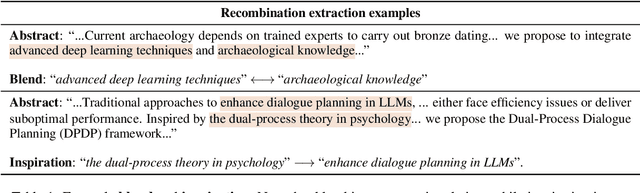
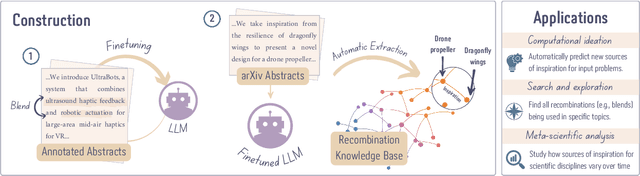
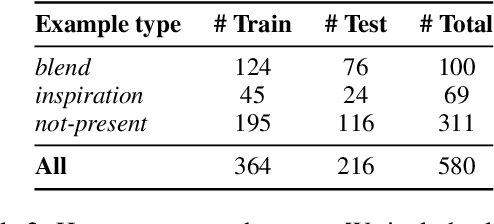
A hallmark of human innovation is the process of recombination -- creating original ideas by integrating elements of existing mechanisms and concepts. In this work, we automatically mine the scientific literature and build CHIMERA: a large-scale knowledge base (KB) of recombination examples. CHIMERA can be used to empirically explore at scale how scientists recombine concepts and take inspiration from different areas, or to train supervised machine learning models that learn to predict new creative cross-domain directions. To build this KB, we present a novel information extraction task of extracting recombination from scientific paper abstracts, collect a high-quality corpus of hundreds of manually annotated abstracts, and use it to train an LLM-based extraction model. The model is applied to a large corpus of papers in the AI domain, yielding a KB of over 28K recombination examples. We analyze CHIMERA to explore the properties of recombination in different subareas of AI. Finally, we train a scientific hypothesis generation model using the KB, which predicts new recombination directions that real-world researchers find inspiring. Our data and code are available at https://github.com/noy-sternlicht/CHIMERA-KB
In-depth Research Impact Summarization through Fine-Grained Temporal Citation Analysis
May 20, 2025Understanding the impact of scientific publications is crucial for identifying breakthroughs and guiding future research. Traditional metrics based on citation counts often miss the nuanced ways a paper contributes to its field. In this work, we propose a new task: generating nuanced, expressive, and time-aware impact summaries that capture both praise (confirmation citations) and critique (correction citations) through the evolution of fine-grained citation intents. We introduce an evaluation framework tailored to this task, showing moderate to strong human correlation on subjective metrics such as insightfulness. Expert feedback from professors reveals a strong interest in these summaries and suggests future improvements.