 Add to Chrome
 Add to Firefox
 Add to Edge
Learning User Simulators with Turing Rewards
Jun 17, 2026
Learning to simulate human users in interactive settings could advance the training of agent assistants, evaluation of personalization systems, research in the social sciences, and more. Existing approaches generally do so by training a large language model (LLM) to match a single ground truth response, either by maximizing the log probability or by using a similarity reward. We instead propose {Turing-RL}: a Turing-Test-based reinforcement learning approach for training user simulator models. {Turing-RL} uses a discriminative Turing reward with an LLM judge to score how indistinguishable a generated response is from the real user's given the user's history, and the user simulator LLM learns to produce responses indistinguishable from what the user could have said with such rewards. Across two different domains--conversational chat and Reddit forum discussion--we find that {Turing-RL} consistently outperforms baseline methods on both LLM and human evaluation metrics. Our study suggests that optimizing for indistinguishability, rather than response matching, is effective for learning user simulators.

ELF: Embedded Language Flows
May 11, 2026Diffusion and flow-based models have become the de facto approaches for generating continuous data, e.g., in domains such as images and videos. Their success has attracted growing interest in applying them to language modeling. Unlike their image-domain counterparts, today's leading diffusion language models (DLMs) primarily operate over discrete tokens. In this paper, we show that continuous DLMs can be made effective with minimal adaptation to the discrete domain. We propose Embedded Language Flows (ELF), a class of diffusion models in continuous embedding space based on continuous-time Flow Matching. Unlike existing DLMs, ELF predominantly stays within the continuous embedding space until the final time step, where it maps to discrete tokens using a shared-weight network. This formulation makes it straightforward to adapt established techniques from image-domain diffusion models, e.g., classifier-free guidance (CFG). Experiments show that ELF substantially outperforms leading discrete and continuous DLMs, achieving better generation quality with fewer sampling steps. These results suggest that ELF offers a promising path toward effective continuous DLMs.
Implicit Representations of Grammaticality in Language Models
May 06, 2026Grammaticality and likelihood are distinct notions in human language. Pretrained language models (LMs), which are probabilistic models of language fitted to maximize corpus likelihood, generate grammatically well-formed text and discriminate well between grammatical and ungrammatical sentences in tightly controlled minimal pairs. However, their string probabilities do not sharply discriminate between grammatical and ungrammatical sentences overall. But do LMs implicitly acquire a grammaticality distinction distinct from string probability? We explore this question through studying internal representations of LMs, by training a linear probe on a dataset of grammatical and (synthetic) ungrammatical sentences obtained by applying perturbations to a naturalistic text corpus. We find that this simple grammaticality probe generalizes to human-curated grammaticality judgment benchmarks and outperforms LM probability-based grammaticality judgments. When applied to semantic plausibility benchmarks, in which both members of a minimal pair are grammatical and differ in only plausibility, the probe however performs worse than string probability. The English-trained probe also exhibits nontrivial cross-lingual generalization, outperforming string probabilities on grammaticality benchmarks in numerous other languages. Additionally, probe scores correlate only weakly with string probabilities. These results collectively suggest that LMs acquire to some extent an implicit grammaticality distinction within their hidden layers.
ARC Is a Vision Problem!
Nov 18, 2025The Abstraction and Reasoning Corpus (ARC) is designed to promote research on abstract reasoning, a fundamental aspect of human intelligence. Common approaches to ARC treat it as a language-oriented problem, addressed by large language models (LLMs) or recurrent reasoning models. However, although the puzzle-like tasks in ARC are inherently visual, existing research has rarely approached the problem from a vision-centric perspective. In this work, we formulate ARC within a vision paradigm, framing it as an image-to-image translation problem. To incorporate visual priors, we represent the inputs on a "canvas" that can be processed like natural images. It is then natural for us to apply standard vision architectures, such as a vanilla Vision Transformer (ViT), to perform image-to-image mapping. Our model is trained from scratch solely on ARC data and generalizes to unseen tasks through test-time training. Our framework, termed Vision ARC (VARC), achieves 60.4% accuracy on the ARC-1 benchmark, substantially outperforming existing methods that are also trained from scratch. Our results are competitive with those of leading LLMs and close the gap to average human performance.
On the Same Wavelength? Evaluating Pragmatic Reasoning in Language Models across Broad Concepts
Sep 08, 2025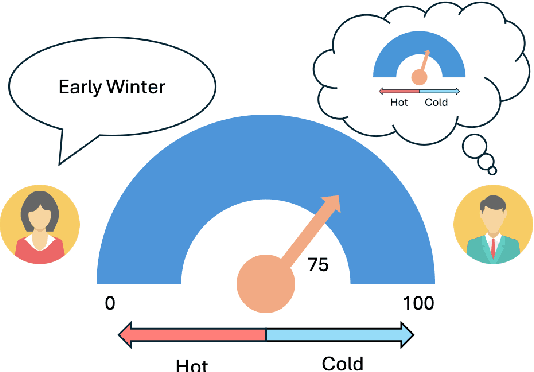
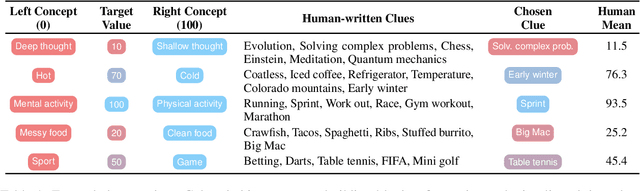
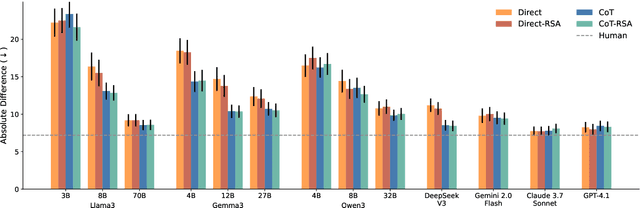
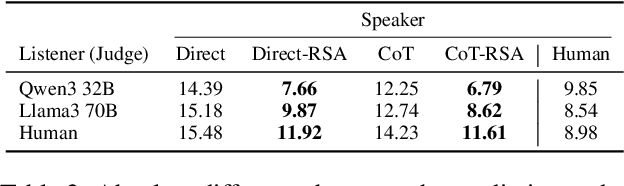
Language use is shaped by pragmatics -- i.e., reasoning about communicative goals and norms in context. As language models (LMs) are increasingly used as conversational agents, it becomes ever more important to understand their pragmatic reasoning abilities. We propose an evaluation framework derived from Wavelength, a popular communication game where a speaker and a listener communicate about a broad range of concepts in a granular manner. We study a range of LMs on both language comprehension and language production using direct and Chain-of-Thought (CoT) prompting, and further explore a Rational Speech Act (RSA) approach to incorporating Bayesian pragmatic reasoning into LM inference. We find that state-of-the-art LMs, but not smaller ones, achieve strong performance on language comprehension, obtaining similar-to-human accuracy and exhibiting high correlations with human judgments even without CoT prompting or RSA. On language production, CoT can outperform direct prompting, and using RSA provides significant improvements over both approaches. Our study helps identify the strengths and limitations in LMs' pragmatic reasoning abilities and demonstrates the potential for improving them with RSA, opening up future avenues for understanding conceptual representation, language understanding, and social reasoning in LMs and humans.
The Surprising Effectiveness of Test-Time Training for Abstract Reasoning
Nov 11, 2024
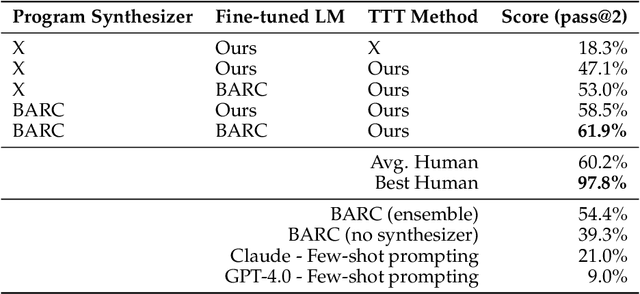


Language models have shown impressive performance on tasks within their training distribution, but often struggle with novel problems requiring complex reasoning. We investigate the effectiveness of test-time training (TTT) -- updating model parameters temporarily during inference using a loss derived from input data -- as a mechanism for improving models' reasoning capabilities, using the Abstraction and Reasoning Corpus (ARC) as a benchmark. Through systematic experimentation, we identify three crucial components for successful TTT: (1) initial finetuning on similar tasks (2) auxiliary task format and augmentations (3) per-instance training. TTT significantly improves performance on ARC tasks, achieving up to 6x improvement in accuracy compared to base fine-tuned models; applying TTT to an 8B-parameter language model, we achieve 53% accuracy on the ARC's public validation set, improving the state-of-the-art by nearly 25% for public and purely neural approaches. By ensembling our method with recent program generation approaches, we get SoTA public validation accuracy of 61.9%, matching the average human score. Our findings suggest that explicit symbolic search is not the only path to improved abstract reasoning in neural language models; additional test-time applied to continued training on few-shot examples can also be extremely effective.
Lookback Lens: Detecting and Mitigating Contextual Hallucinations in Large Language Models Using Only Attention Maps
Jul 09, 2024When asked to summarize articles or answer questions given a passage, large language models (LLMs) can hallucinate details and respond with unsubstantiated answers that are inaccurate with respect to the input context. This paper describes a simple approach for detecting such contextual hallucinations. We hypothesize that contextual hallucinations are related to the extent to which an LLM attends to information in the provided context versus its own generations. Based on this intuition, we propose a simple hallucination detection model whose input features are given by the ratio of attention weights on the context versus newly generated tokens (for each attention head). We find that a linear classifier based on these lookback ratio features is as effective as a richer detector that utilizes the entire hidden states of an LLM or a text-based entailment model. The lookback ratio-based detector -- Lookback Lens -- is found to transfer across tasks and even models, allowing a detector that is trained on a 7B model to be applied (without retraining) to a larger 13B model. We further apply this detector to mitigate contextual hallucinations, and find that a simple classifier-guided decoding approach is able to reduce the amount of hallucination, for example by 9.6% in the XSum summarization task.
Learning to Reason via Program Generation, Emulation, and Search
May 28, 2024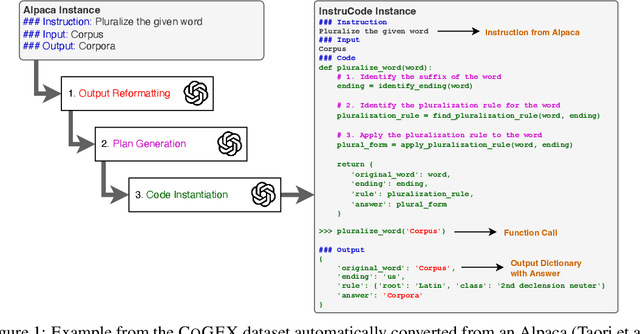
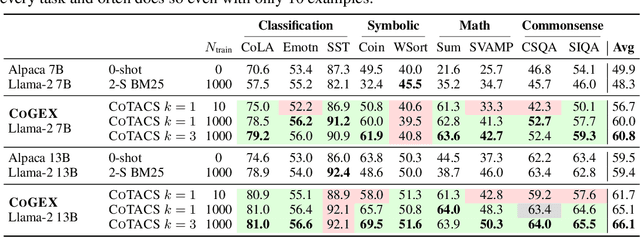

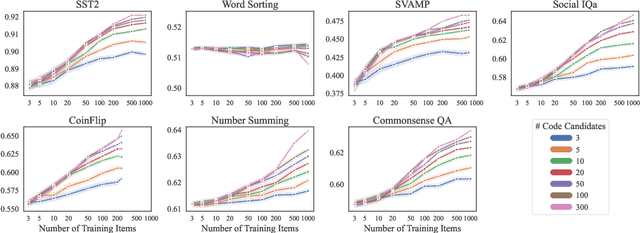
Program synthesis with language models (LMs) has unlocked a large set of reasoning abilities; code-tuned LMs have proven adept at generating programs that solve a wide variety of algorithmic symbolic manipulation tasks (e.g. word concatenation). However, not all reasoning tasks are easily expressible as code, e.g. tasks involving commonsense reasoning, moral decision-making, and sarcasm understanding. Our goal is to extend an LM's program synthesis skills to such tasks and evaluate the results via pseudo-programs, namely Python programs where some leaf function calls are left undefined. To that end, we propose, Code Generation and Emulated EXecution (CoGEX). CoGEX works by (1) training LMs to generate their own pseudo-programs, (2) teaching them to emulate their generated program's execution, including those leaf functions, allowing the LM's knowledge to fill in the execution gaps; and (3) using them to search over many programs to find an optimal one. To adapt the CoGEX model to a new task, we introduce a method for performing program search to find a single program whose pseudo-execution yields optimal performance when applied to all the instances of a given dataset. We show that our approach yields large improvements compared to standard in-context learning approaches on a battery of tasks, both algorithmic and soft reasoning. This result thus demonstrates that code synthesis can be applied to a much broader class of problems than previously considered. Our released dataset, fine-tuned models, and implementation can be found at \url{https://github.com/nweir127/CoGEX}.
Language Model Evolution: An Iterated Learning Perspective
Apr 04, 2024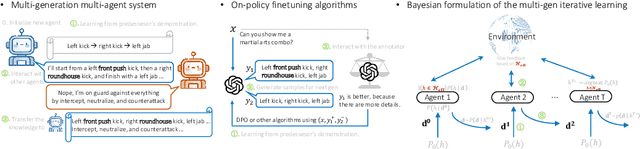


With the widespread adoption of Large Language Models (LLMs), the prevalence of iterative interactions among these models is anticipated to increase. Notably, recent advancements in multi-round self-improving methods allow LLMs to generate new examples for training subsequent models. At the same time, multi-agent LLM systems, involving automated interactions among agents, are also increasing in prominence. Thus, in both short and long terms, LLMs may actively engage in an evolutionary process. We draw parallels between the behavior of LLMs and the evolution of human culture, as the latter has been extensively studied by cognitive scientists for decades. Our approach involves leveraging Iterated Learning (IL), a Bayesian framework that elucidates how subtle biases are magnified during human cultural evolution, to explain some behaviors of LLMs. This paper outlines key characteristics of agents' behavior in the Bayesian-IL framework, including predictions that are supported by experimental verification with various LLMs. This theoretical framework could help to more effectively predict and guide the evolution of LLMs in desired directions.
Phenomenal Yet Puzzling: Testing Inductive Reasoning Capabilities of Language Models with Hypothesis Refinement
Oct 12, 2023The ability to derive underlying principles from a handful of observations and then generalize to novel situations -- known as inductive reasoning -- is central to human intelligence. Prior work suggests that language models (LMs) often fall short on inductive reasoning, despite achieving impressive success on research benchmarks. In this work, we conduct a systematic study of the inductive reasoning capabilities of LMs through iterative hypothesis refinement, a technique that more closely mirrors the human inductive process than standard input-output prompting. Iterative hypothesis refinement employs a three-step process: proposing, selecting, and refining hypotheses in the form of textual rules. By examining the intermediate rules, we observe that LMs are phenomenal hypothesis proposers (i.e., generating candidate rules), and when coupled with a (task-specific) symbolic interpreter that is able to systematically filter the proposed set of rules, this hybrid approach achieves strong results across inductive reasoning benchmarks that require inducing causal relations, language-like instructions, and symbolic concepts. However, they also behave as puzzling inductive reasoners, showing notable performance gaps in rule induction (i.e., identifying plausible rules) and rule application (i.e., applying proposed rules to instances), suggesting that LMs are proposing hypotheses without being able to actually apply the rules. Through empirical and human analyses, we further reveal several discrepancies between the inductive reasoning processes of LMs and humans, shedding light on both the potentials and limitations of using LMs in inductive reasoning tasks.