 Add to Chrome
 Add to Firefox
 Add to Edge
SciFigPlag-Bench: A Benchmark for Provenance-Aware Scientific Figure Plagiarism Detection
Jul 31, 2026
Scientific figures often encode the visual evidence behind scientific findings, yet figure plagiarism remains underexplored as a benchmarked multimodal evaluation problem. We present SciFigPlag-Bench, a benchmark for provenance-aware reasoning over scientific figures in scholarly documents. Unlike general image-similarity or image-forensics benchmarks, SciFigPlag-Bench evaluates whether a suspicious figure reuses evidence from a specific source figure, how the reused content has been transformed, and where the reused evidence appears. We introduce a factorized taxonomy that separates what is reused from how it is transformed, covering material-preserving reuse, such as full-figure and subfigure reuse, as well as abstract-content reuse, such as data re-expression and structural redraw. Guided by this taxonomy, we construct a hybrid benchmark with 2,582 positive pairs and 2,541 negative pairs, combining documented real-world cases, taxonomy-guided synthetic examples, and visually similar negatives. The benchmark supports four diagnostic tasks: pairwise detection, source attribution, hierarchical reuse-type classification, and reuse correspondence localization. Experiments with diverse vision-language models establish initial baselines and reveal persistent challenges in fine-grained provenance reasoning, reuse-type understanding, and spatial evidence grounding.

Decay Pruning Method: Smooth Pruning With a Self-Rectifying Procedure
Jun 06, 2024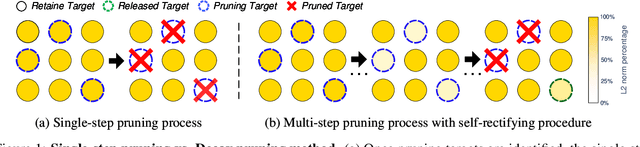
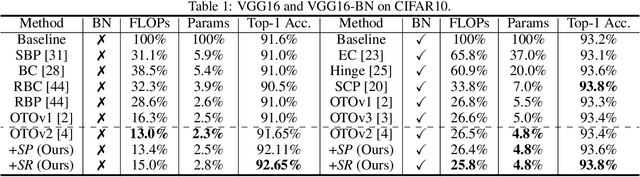
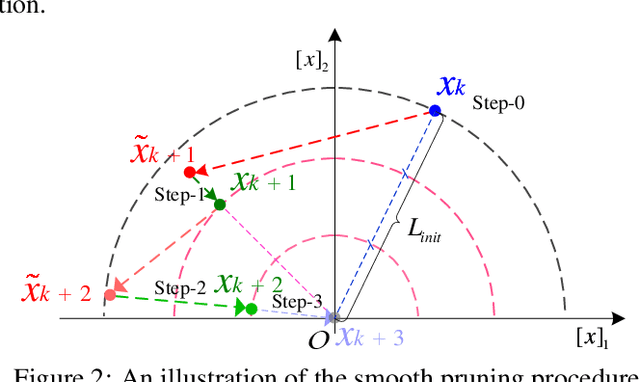
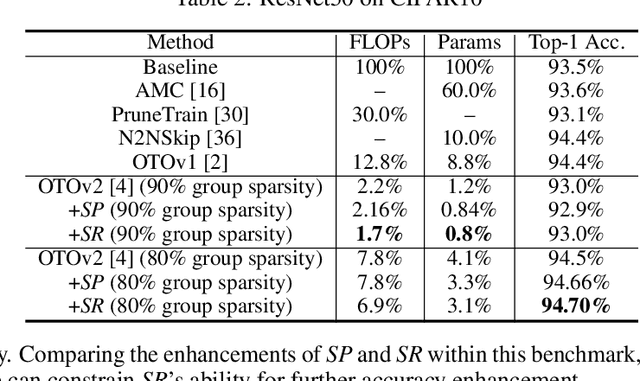
Current structured pruning methods often result in considerable accuracy drops due to abrupt network changes and loss of information from pruned structures. To address these issues, we introduce the Decay Pruning Method (DPM), a novel smooth pruning approach with a self-rectifying mechanism. DPM consists of two key components: (i) Smooth Pruning: It converts conventional single-step pruning into multi-step smooth pruning, gradually reducing redundant structures to zero over N steps with ongoing optimization. (ii) Self-Rectifying: This procedure further enhances the aforementioned process by rectifying sub-optimal pruning based on gradient information. Our approach demonstrates strong generalizability and can be easily integrated with various existing pruning methods. We validate the effectiveness of DPM by integrating it with three popular pruning methods: OTOv2, Depgraph, and Gate Decorator. Experimental results show consistent improvements in performance compared to the original pruning methods, along with further reductions of FLOPs in most scenarios.