 Add to Chrome
 Add to Firefox
 Add to Edge
Quantum Implicit Neural Representations
Jun 06, 2024
Implicit neural representations have emerged as a powerful paradigm to represent signals such as images and sounds. This approach aims to utilize neural networks to parameterize the implicit function of the signal. However, when representing implicit functions, traditional neural networks such as ReLU-based multilayer perceptrons face challenges in accurately modeling high-frequency components of signals. Recent research has begun to explore the use of Fourier Neural Networks (FNNs) to overcome this limitation. In this paper, we propose Quantum Implicit Representation Network (QIREN), a novel quantum generalization of FNNs. Furthermore, through theoretical analysis, we demonstrate that QIREN possesses a quantum advantage over classical FNNs. Lastly, we conducted experiments in signal representation, image superresolution, and image generation tasks to show the superior performance of QIREN compared to state-of-the-art (SOTA) models. Our work not only incorporates quantum advantages into implicit neural representations but also uncovers a promising application direction for Quantum Neural Networks.

Combinatorial Optimization with Automated Graph Neural Networks
Jun 05, 2024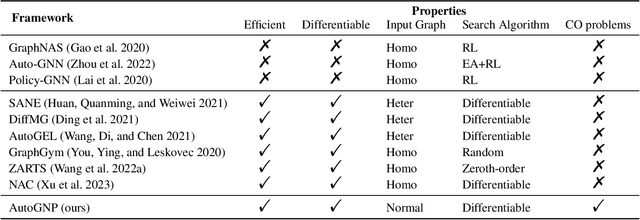


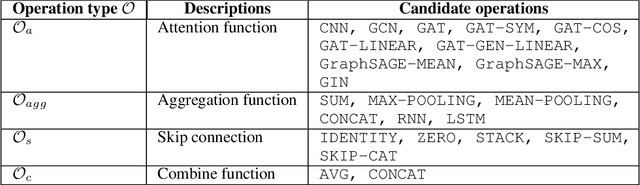
In recent years, graph neural networks (GNNs) have become increasingly popular for solving NP-hard combinatorial optimization (CO) problems, such as maximum cut and maximum independent set. The core idea behind these methods is to represent a CO problem as a graph and then use GNNs to learn the node/graph embedding with combinatorial information. Although these methods have achieved promising results, given a specific CO problem, the design of GNN architectures still requires heavy manual work with domain knowledge. Existing automated GNNs are mostly focused on traditional graph learning problems, which is inapplicable to solving NP-hard CO problems. To this end, we present a new class of \textbf{AUTO}mated \textbf{G}NNs for solving \textbf{NP}-hard problems, namely \textbf{AutoGNP}. We represent CO problems by GNNs and focus on two specific problems, i.e., mixed integer linear programming and quadratic unconstrained binary optimization. The idea of AutoGNP is to use graph neural architecture search algorithms to automatically find the best GNNs for a given NP-hard combinatorial optimization problem. Compared with existing graph neural architecture search algorithms, AutoGNP utilizes two-hop operators in the architecture search space. Moreover, AutoGNP utilizes simulated annealing and a strict early stopping policy to avoid local optimal solutions. Empirical results on benchmark combinatorial problems demonstrate the superiority of our proposed model.
Decision-focused Graph Neural Networks for Combinatorial Optimization
Jun 05, 2024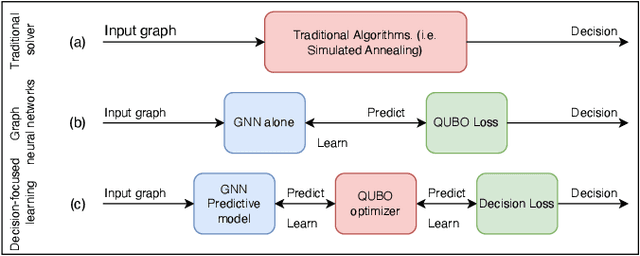
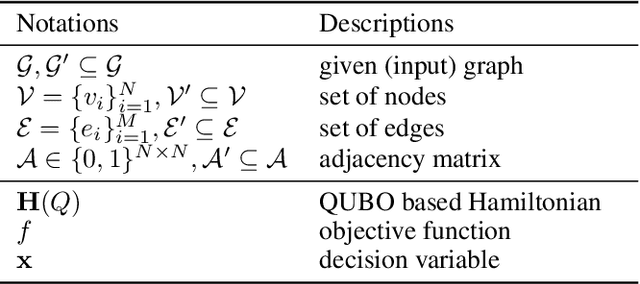
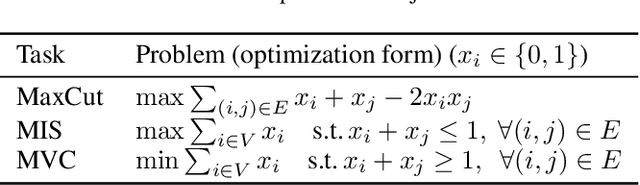
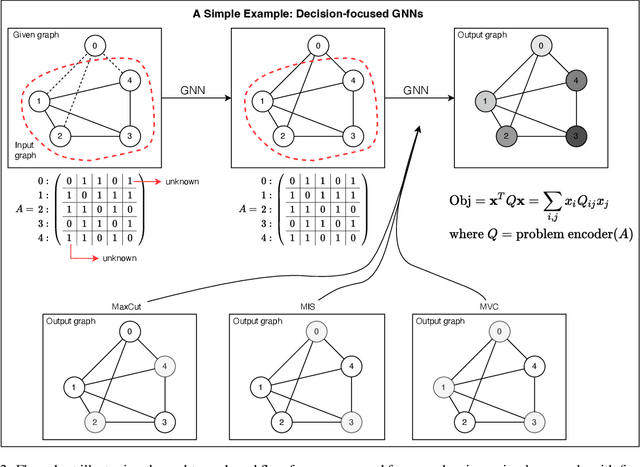
In recent years, there has been notable interest in investigating combinatorial optimization (CO) problems by neural-based framework. An emerging strategy to tackle these challenging problems involves the adoption of graph neural networks (GNNs) as an alternative to traditional algorithms, a subject that has attracted considerable attention. Despite the growing popularity of GNNs and traditional algorithm solvers in the realm of CO, there is limited research on their integrated use and the correlation between them within an end-to-end framework. The primary focus of our work is to formulate a more efficient and precise framework for CO by employing decision-focused learning on graphs. Additionally, we introduce a decision-focused framework that utilizes GNNs to address CO problems with auxiliary support. To realize an end-to-end approach, we have designed two cascaded modules: (a) an unsupervised trained graph predictive model, and (b) a solver for quadratic binary unconstrained optimization. Empirical evaluations are conducted on various classical tasks, including maximum cut, maximum independent set, and minimum vertex cover. The experimental results on classical CO problems (i.e. MaxCut, MIS, and MVC) demonstrate the superiority of our method over both the standalone GNN approach and classical methods.
On Hardware-efficient Inference in Probabilistic Circuits
May 22, 2024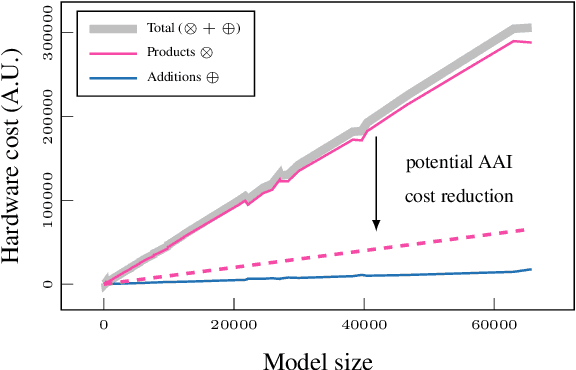
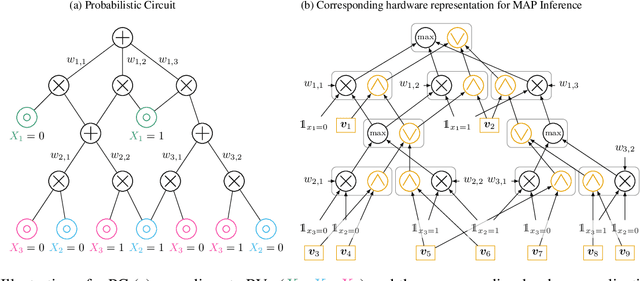
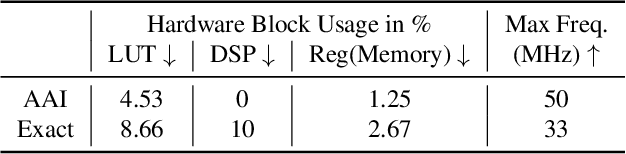
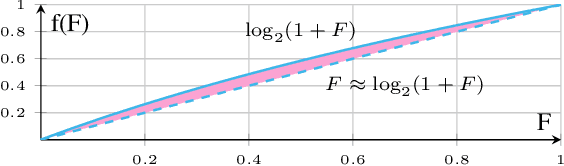
Probabilistic circuits (PCs) offer a promising avenue to perform embedded reasoning under uncertainty. They support efficient and exact computation of various probabilistic inference tasks by design. Hence, hardware-efficient computation of PCs is highly interesting for edge computing applications. As computations in PCs are based on arithmetic with probability values, they are typically performed in the log domain to avoid underflow. Unfortunately, performing the log operation on hardware is costly. Hence, prior work has focused on computations in the linear domain, resulting in high resolution and energy requirements. This work proposes the first dedicated approximate computing framework for PCs that allows for low-resolution logarithm computations. We leverage Addition As Int, resulting in linear PC computation with simple hardware elements. Further, we provide a theoretical approximation error analysis and present an error compensation mechanism. Empirically, our method obtains up to 357x and 649x energy reduction on custom hardware for evidence and MAP queries respectively with little or no computational error.
Joint Precoding for RIS-Assisted Wideband THz Cell-Free Massive MIMO Systems
May 13, 2024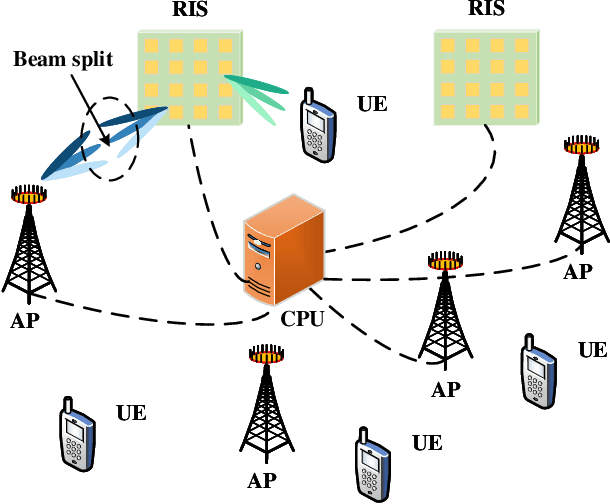
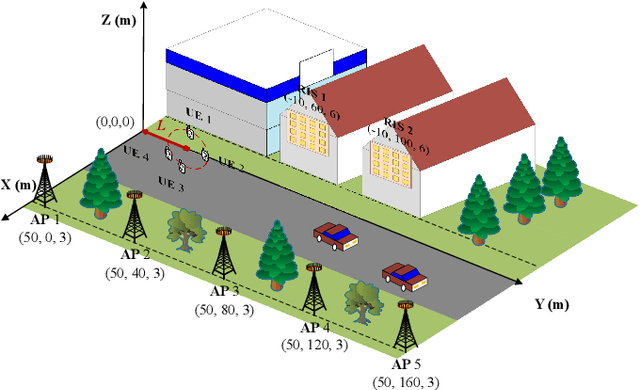
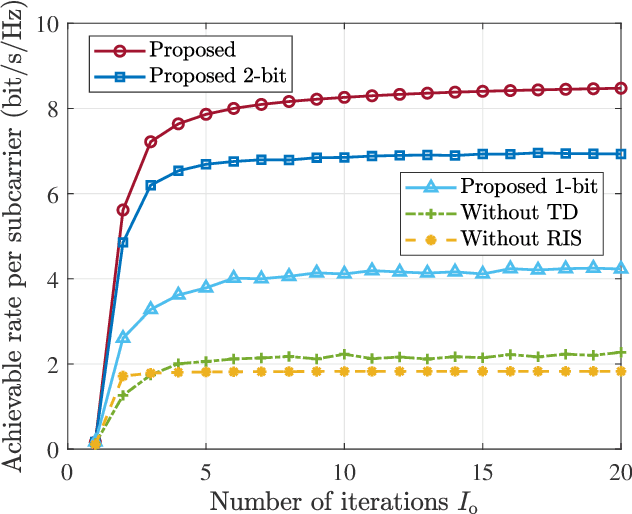
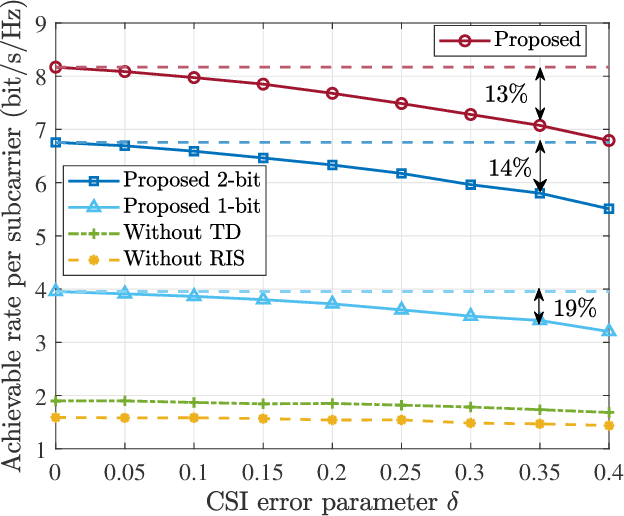
Terahertz (THz) cell-free massive multiple-input-multiple-output (mMIMO) networks have been envisioned as a prospective technology for achieving higher system capacity, improved performance, and ultra-high reliability in 6G networks. However, due to severe attenuation and limited scattering in THz transmission, as well as high power consumption for increased number of access points (APs), further improvement of network capacity becomes challenging. Reconfigurable intelligent surface (RIS) has been introduced as a low-cost solution to reduce AP deployment and assist in data transmission. However, due to the ultra-wide bandwidth and frequency-dependent characteristics of RISs, beam split effect has become an unavoidable obstacle. To compensate the severe performance degradation caused by beam split effect, we introduce additional time delay (TD) layers at both access points (APs) and RISs. Accordingly, we propose a joint precoding framework at APs and RISs to fully unleash the potential of the considered network. Specifically, we first formulate the joint precoding as a non-convex optimization problem. Then, given the location of unchanged RISs, we adjust the time delays (TDs) of APs to align the generated beams towards RISs. After that, with knowledge of the optimal TDs of APs, we decouple the optimization problem into three subproblems of optimizing the baseband beamformers, RISs and TDs of RISs, respectively. Exploiting multidimensional complex quadratic transform, we transform the subproblems into convex forms and solve them under alternate optimizing framework. Numerical results verify that the proposed method can effectively mitigate beam split effect and significantly improve the achievable rate compared with conventional cell-free mMIMO networks.
Dynamical Mode Recognition of Coupled Flame Oscillators by Supervised and Unsupervised Learning Approaches
Apr 27, 2024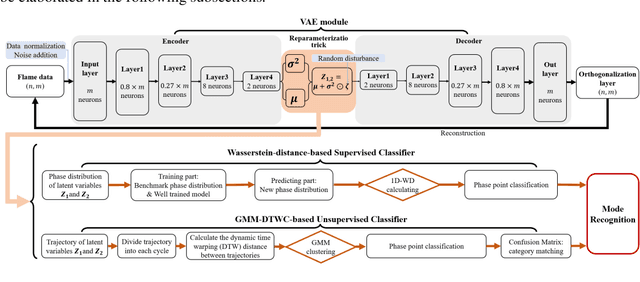
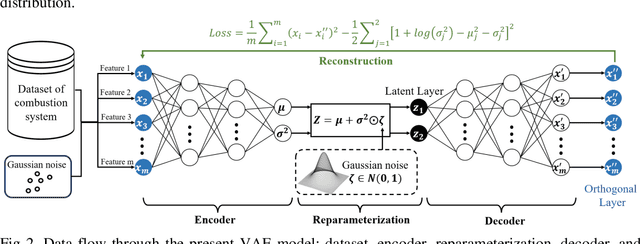
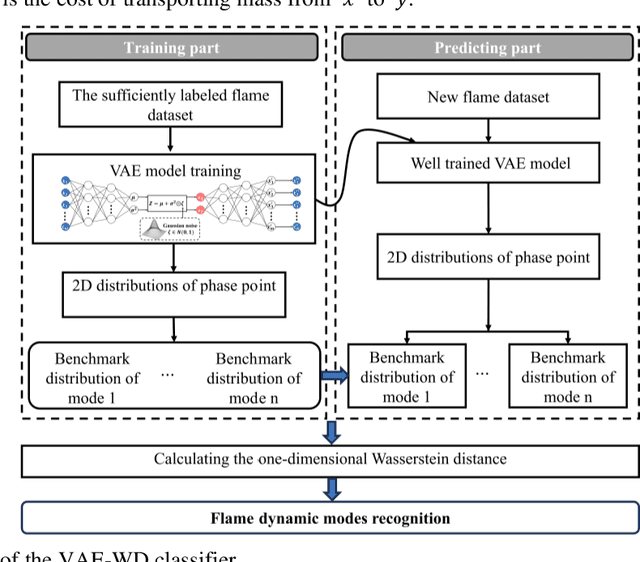
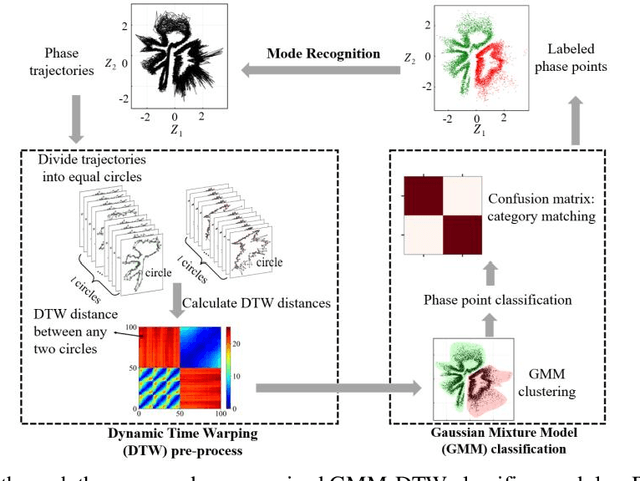
Combustion instability in gas turbines and rocket engines, as one of the most challenging problems in combustion research, arises from the complex interactions among flames, which are also influenced by chemical reactions, heat and mass transfer, and acoustics. Identifying and understanding combustion instability is essential to ensure the safe and reliable operation of many combustion systems, where exploring and classifying the dynamical behaviors of complex flame systems is a core take. To facilitate fundamental studies, the present work concerns dynamical mode recognition of coupled flame oscillators made of flickering buoyant diffusion flames, which have gained increasing attention in recent years but are not sufficiently understood. The time series data of flame oscillators are generated by fully validated reacting flow simulations. Due to limitations of expertise-based models, a data-driven approach is adopted. In this study, a nonlinear dimensional reduction model of variational autoencoder (VAE) is used to project the simulation data onto a 2-dimensional latent space. Based on the phase trajectories in latent space, both supervised and unsupervised classifiers are proposed for datasets with well known labeling and without, respectively. For labeled datasets, we establish the Wasserstein-distance-based classifier (WDC) for mode recognition; for unlabeled datasets, we develop a novel unsupervised classifier (GMM-DTWC) combining dynamic time warping (DTW) and Gaussian mixture model (GMM). Through comparing with conventional approaches for dimensionality reduction and classification, the proposed supervised and unsupervised VAE-based approaches exhibit a prominent performance for distinguishing dynamical modes, implying their potential extension to dynamical mode recognition of complex combustion problems.
MFORT-QA: Multi-hop Few-shot Open Rich Table Question Answering
Mar 28, 2024In today's fast-paced industry, professionals face the challenge of summarizing a large number of documents and extracting vital information from them on a daily basis. These metrics are frequently hidden away in tables and/or their nested hyperlinks. To address this challenge, the approach of Table Question Answering (QA) has been developed to extract the relevant information. However, traditional Table QA training tasks that provide a table and an answer(s) from a gold cell coordinate(s) for a question may not always ensure extracting the accurate answer(s). Recent advancements in Large Language Models (LLMs) have opened up new possibilities for extracting information from tabular data using prompts. In this paper, we introduce the Multi-hop Few-shot Open Rich Table QA (MFORT-QA) approach, which consists of two major steps. The first step involves Few-Shot Learning (FSL), where relevant tables and associated contexts of hyperlinks are retrieved based on a given question. The retrieved content is then used to construct few-shot prompts as inputs to an LLM, such as ChatGPT. To tackle the challenge of answering complex questions, the second step leverages Chain-of-thought (CoT) prompting to decompose the complex question into a sequential chain of questions and reasoning thoughts in a multi-hop manner. Retrieval-Augmented Generation (RAG) enhances this process by retrieving relevant tables and contexts of hyperlinks that are relevant to the resulting reasoning thoughts and questions. These additional contexts are then used to supplement the prompt used in the first step, resulting in more accurate answers from an LLM. Empirical results from OTT-QA demonstrate that our abstractive QA approach significantly improves the accuracy of extractive Table QA methods.
InternLM2 Technical Report
Mar 26, 2024


The evolution of Large Language Models (LLMs) like ChatGPT and GPT-4 has sparked discussions on the advent of Artificial General Intelligence (AGI). However, replicating such advancements in open-source models has been challenging. This paper introduces InternLM2, an open-source LLM that outperforms its predecessors in comprehensive evaluations across 6 dimensions and 30 benchmarks, long-context modeling, and open-ended subjective evaluations through innovative pre-training and optimization techniques. The pre-training process of InternLM2 is meticulously detailed, highlighting the preparation of diverse data types including text, code, and long-context data. InternLM2 efficiently captures long-term dependencies, initially trained on 4k tokens before advancing to 32k tokens in pre-training and fine-tuning stages, exhibiting remarkable performance on the 200k ``Needle-in-a-Haystack" test. InternLM2 is further aligned using Supervised Fine-Tuning (SFT) and a novel Conditional Online Reinforcement Learning from Human Feedback (COOL RLHF) strategy that addresses conflicting human preferences and reward hacking. By releasing InternLM2 models in different training stages and model sizes, we provide the community with insights into the model's evolution.
Refining Segmentation On-the-Fly: An Interactive Framework for Point Cloud Semantic Segmentation
Mar 11, 2024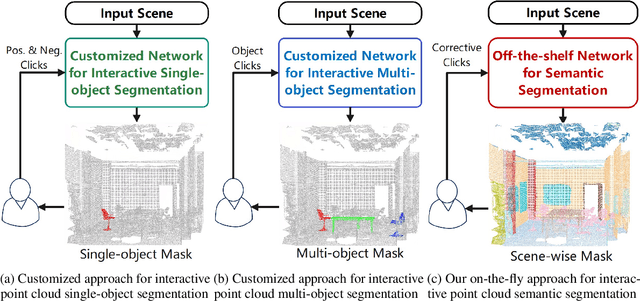
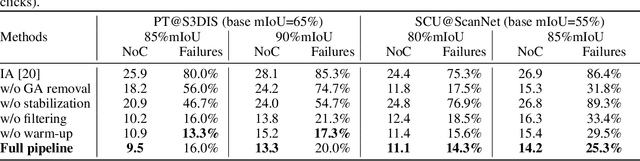
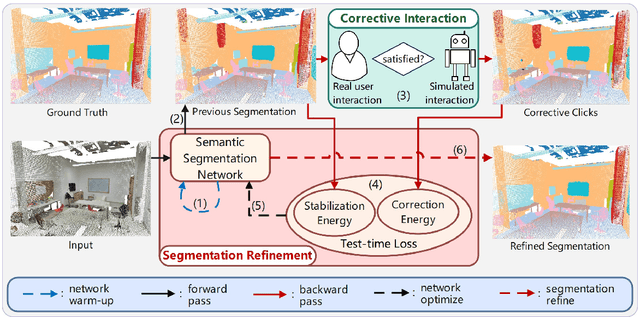
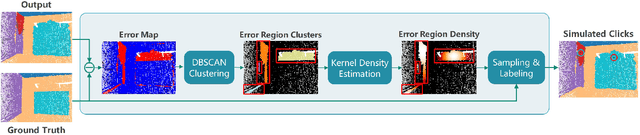
Existing interactive point cloud segmentation approaches primarily focus on the object segmentation, which aim to determine which points belong to the object of interest guided by user interactions. This paper concentrates on an unexplored yet meaningful task, i.e., interactive point cloud semantic segmentation, which assigns high-quality semantic labels to all points in a scene with user corrective clicks. Concretely, we presents the first interactive framework for point cloud semantic segmentation, named InterPCSeg, which seamlessly integrates with off-the-shelf semantic segmentation networks without offline re-training, enabling it to run in an on-the-fly manner. To achieve online refinement, we treat user interactions as sparse training examples during the test-time. To address the instability caused by the sparse supervision, we design a stabilization energy to regulate the test-time training process. For objective and reproducible evaluation, we develop an interaction simulation scheme tailored for the interactive point cloud semantic segmentation task. We evaluate our framework on the S3DIS and ScanNet datasets with off-the-shelf segmentation networks, incorporating interactions from both the proposed interaction simulator and real users. Quantitative and qualitative experimental results demonstrate the efficacy of our framework in refining the semantic segmentation results with user interactions. The source code will be publicly available.
Learning Expressive And Generalizable Motion Features For Face Forgery Detection
Mar 08, 2024Previous face forgery detection methods mainly focus on appearance features, which may be easily attacked by sophisticated manipulation. Considering the majority of current face manipulation methods generate fake faces based on a single frame, which do not take frame consistency and coordination into consideration, artifacts on frame sequences are more effective for face forgery detection. However, current sequence-based face forgery detection methods use general video classification networks directly, which discard the special and discriminative motion information for face manipulation detection. To this end, we propose an effective sequence-based forgery detection framework based on an existing video classification method. To make the motion features more expressive for manipulation detection, we propose an alternative motion consistency block instead of the original motion features module. To make the learned features more generalizable, we propose an auxiliary anomaly detection block. With these two specially designed improvements, we make a general video classification network achieve promising results on three popular face forgery datasets.