 Add to Chrome
 Add to Firefox
 Add to Edge
MG-RWKV: Multi-Grained Context-Aware RWKV for Temporal Forgery Localization
Jul 01, 2026
Driven by Artificial Intelligence-Generated Content (AIGC), the authenticity of audio-visual content is facing severe challenges. Temporal Forgery Localization (TFL) aims to precisely identify manipulated segments within untrimmed sequences. However, existing methods are limited by CNNs' local receptive fields or Transformers' quadratic complexity, while emerging linear models often struggle to balance global authentic context compression with local abrupt forgery perception. To address this, we propose MG-RWKV, a multi-granularity framework that leverages the data-dependent state evolution of RWKV to achieve efficient full-sequence processing with O(T) complexity. Our framework features three core innovations: (1) a Bidirectional RWKV architecture that captures bidirectional temporal contexts without quadratic overhead; (2) a Multi-Granularity Mixture of Experts (MG-MoE) that performs dynamic routing over explicit temporal receptive fields, adaptively selecting granularities based on forgery duration to significantly enhance decision interpretability; and (3) Cross-Granularity Consistency (CGC), which aligns adjacent feature pyramid levels through hierarchical scale-wise pairing and spatial boundary-aware weighting, effectively reducing false positives in authentic regions. Extensive experiments on Lav-DF, TVIL, and Psynd datasets demonstrate that MG-RWKV achieves state-of-the-art performance with low computational cost.

Beyond Chain-of-Thought: Rewrite as a Universal Interface for Generative Multimodal Embeddings
Apr 24, 2026Multimodal Large Language Models (MLLMs) have emerged as a promising foundation for universal multimodal embeddings. Recent studies have shown that reasoning-driven generative multimodal embeddings can outperform discriminative embeddings on several embedding tasks. However, Chain-of-Thought (CoT) reasoning tends to generate redundant thinking steps and introduce semantic ambiguity in the summarized answers in broader retrieval scenarios. To address this limitation, we propose Rewrite-driven Multimodal Embedding (RIME), a unified framework that jointly optimizes generation and embedding through a retrieval-friendly rewrite. Meanwhile, we present the Cross-Mode Alignment (CMA) to bridge the generative and discriminative embedding spaces, enabling flexible mutual retrieval to trade off efficiency and accuracy. Based on this, we also introduce Refine Reinforcement Learning (Refine-RL) that treats discriminative embeddings as stable semantic anchors to guide the rewrite optimization. Extensive experiments on MMEB-V2, MRMR and UVRB demonstrate that RIME substantially outperforms prior generative embedding models while significantly reducing the length of thinking.
RealChart2Code: Advancing Chart-to-Code Generation with Real Data and Multi-Task Evaluation
Mar 26, 2026Vision-Language Models (VLMs) have demonstrated impressive capabilities in code generation across various domains. However, their ability to replicate complex, multi-panel visualizations from real-world data remains largely unassessed. To address this gap, we introduce \textbf{\texttt{RealChart2Code}}, a new large-scale benchmark with over 2,800 instances grounded in authentic datasets and featuring tasks with clear analytical intent. Crucially, it is the first benchmark to systematically evaluate chart generation from large-scale raw data and assess iterative code refinement in a multi-turn conversational setting. Our comprehensive evaluation of 14 leading VLMs on \texttt{RealChart2Code} reveals significant performance degradation compared to simpler benchmarks, highlighting their struggles with complex plot structures and authentic data. Our analysis uncovers a substantial performance gap between proprietary and open-weight models and confirms that even state-of-the-art VLMs often fail to accurately replicate intricate, multi-panel charts. These findings provide valuable insights into the current limitations of VLMs and guide future research directions. We release the benchmark and code at \url{https://github.com/Speakn0w/RealChart2Code}.
AdaMem: Adaptive User-Centric Memory for Long-Horizon Dialogue Agents
Mar 17, 2026Large language model (LLM) agents increasingly rely on external memory to support long-horizon interaction, personalized assistance, and multi-step reasoning. However, existing memory systems still face three core challenges: they often rely too heavily on semantic similarity, which can miss evidence crucial for user-centric understanding; they frequently store related experiences as isolated fragments, weakening temporal and causal coherence; and they typically use static memory granularities that do not adapt well to the requirements of different questions. We propose AdaMem, an adaptive user-centric memory framework for long-horizon dialogue agents. AdaMem organizes dialogue history into working, episodic, persona, and graph memories, enabling the system to preserve recent context, structured long-term experiences, stable user traits, and relation-aware connections within a unified framework. At inference time, AdaMem first resolves the target participant, then builds a question-conditioned retrieval route that combines semantic retrieval with relation-aware graph expansion only when needed, and finally produces the answer through a role-specialized pipeline for evidence synthesis and response generation. We evaluate AdaMem on the LoCoMo and PERSONAMEM benchmarks for long-horizon reasoning and user modeling. Experimental results show that AdaMem achieves state-of-the-art performance on both benchmarks. The code will be released upon acceptance.
Learning Cross-View Object Correspondence via Cycle-Consistent Mask Prediction
Feb 22, 2026We study the task of establishing object-level visual correspondence across different viewpoints in videos, focusing on the challenging egocentric-to-exocentric and exocentric-to-egocentric scenarios. We propose a simple yet effective framework based on conditional binary segmentation, where an object query mask is encoded into a latent representation to guide the localization of the corresponding object in a target video. To encourage robust, view-invariant representations, we introduce a cycle-consistency training objective: the predicted mask in the target view is projected back to the source view to reconstruct the original query mask. This bidirectional constraint provides a strong self-supervisory signal without requiring ground-truth annotations and enables test-time training (TTT) at inference. Experiments on the Ego-Exo4D and HANDAL-X benchmarks demonstrate the effectiveness of our optimization objective and TTT strategy, achieving state-of-the-art performance. The code is available at https://github.com/shannany0606/CCMP.
What Makes Low-Bit Quantization-Aware Training Work for Reasoning LLMs? A Systematic Study
Jan 21, 2026Reasoning models excel at complex tasks such as coding and mathematics, yet their inference is often slow and token-inefficient. To improve the inference efficiency, post-training quantization (PTQ) usually comes with the cost of large accuracy drops, especially for reasoning tasks under low-bit settings. In this study, we present a systematic empirical study of quantization-aware training (QAT) for reasoning models. Our key findings include: (1) Knowledge distillation is a robust objective for reasoning models trained via either supervised fine-tuning or reinforcement learning; (2) PTQ provides a strong initialization for QAT, improving accuracy while reducing training cost; (3) Reinforcement learning remains feasible for quantized models given a viable cold start and yields additional gains; and (4) Aligning the PTQ calibration domain with the QAT training domain accelerates convergence and often improves the final accuracy. Finally, we consolidate these findings into an optimized workflow (Reasoning-QAT), and show that it consistently outperforms state-of-the-art PTQ methods across multiple LLM backbones and reasoning datasets. For instance, on Qwen3-0.6B, it surpasses GPTQ by 44.53% on MATH-500 and consistently recovers performance in the 2-bit regime.
What Should I Cite? A RAG Benchmark for Academic Citation Prediction
Jan 21, 2026With the rapid growth of Web-based academic publications, more and more papers are being published annually, making it increasingly difficult to find relevant prior work. Citation prediction aims to automatically suggest appropriate references, helping scholars navigate the expanding scientific literature. Here we present \textbf{CiteRAG}, the first comprehensive retrieval-augmented generation (RAG)-integrated benchmark for evaluating large language models on academic citation prediction, featuring a multi-level retrieval strategy, specialized retrievers, and generators. Our benchmark makes four core contributions: (1) We establish two instances of the citation prediction task with different granularity. Task 1 focuses on coarse-grained list-specific citation prediction, while Task 2 targets fine-grained position-specific citation prediction. To enhance these two tasks, we build a dataset containing 7,267 instances for Task 1 and 8,541 instances for Task 2, enabling comprehensive evaluation of both retrieval and generation. (2) We construct a three-level large-scale corpus with 554k papers spanning many major subfields, using an incremental pipeline. (3) We propose a multi-level hybrid RAG approach for citation prediction, fine-tuning embedding models with contrastive learning to capture complex citation relationships, paired with specialized generation models. (4) We conduct extensive experiments across state-of-the-art language models, including closed-source APIs, open-source models, and our fine-tuned generators, demonstrating the effectiveness of our framework. Our open-source toolkit enables reproducible evaluation and focuses on academic literature, providing the first comprehensive evaluation framework for citation prediction and serving as a methodological template for other scientific domains. Our source code and data are released at https://github.com/LQgdwind/CiteRAG.
HSSBench: Benchmarking Humanities and Social Sciences Ability for Multimodal Large Language Models
Jun 04, 2025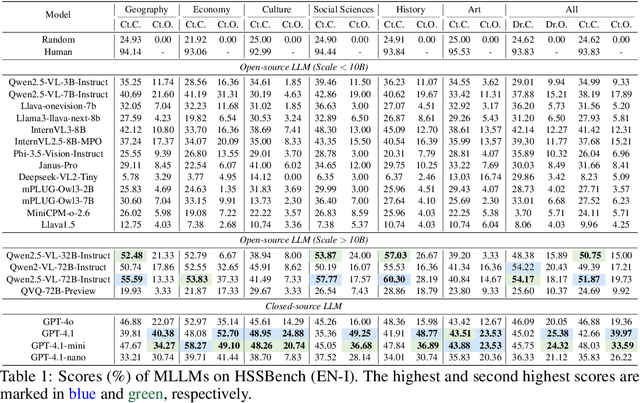
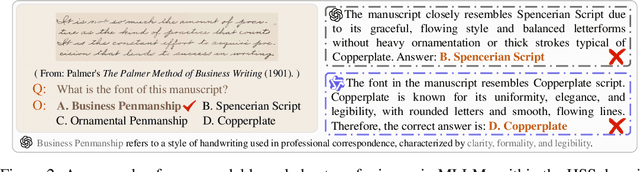
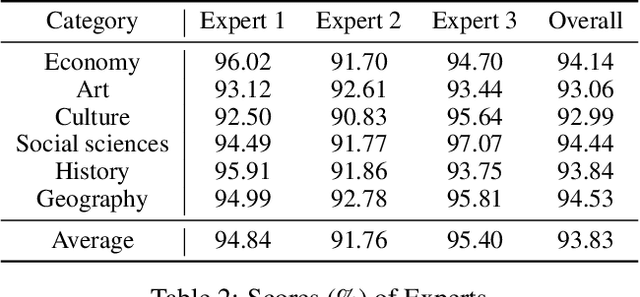
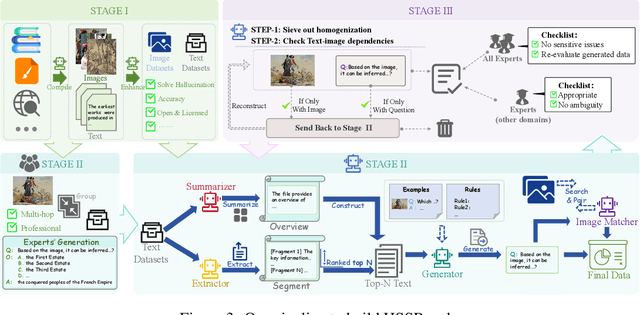
Multimodal Large Language Models (MLLMs) have demonstrated significant potential to advance a broad range of domains. However, current benchmarks for evaluating MLLMs primarily emphasize general knowledge and vertical step-by-step reasoning typical of STEM disciplines, while overlooking the distinct needs and potential of the Humanities and Social Sciences (HSS). Tasks in the HSS domain require more horizontal, interdisciplinary thinking and a deep integration of knowledge across related fields, which presents unique challenges for MLLMs, particularly in linking abstract concepts with corresponding visual representations. Addressing this gap, we present HSSBench, a dedicated benchmark designed to assess the capabilities of MLLMs on HSS tasks in multiple languages, including the six official languages of the United Nations. We also introduce a novel data generation pipeline tailored for HSS scenarios, in which multiple domain experts and automated agents collaborate to generate and iteratively refine each sample. HSSBench contains over 13,000 meticulously designed samples, covering six key categories. We benchmark more than 20 mainstream MLLMs on HSSBench and demonstrate that it poses significant challenges even for state-of-the-art models. We hope that this benchmark will inspire further research into enhancing the cross-disciplinary reasoning abilities of MLLMs, especially their capacity to internalize and connect knowledge across fields.