 Add to Chrome
 Add to Firefox
 Add to Edge
EvReflection: Event-Driven Micro-Dynamics for Reflection Removal
Aug 06, 2026
Despite remarkable progress in reflection removal, current methods primarily exploit static image priors from a single frame and still suffer from severe residual artifacts due to the inherent ambiguity between the reflection and transmission layers. In this paper, we propose leveraging event signals to break this ambiguity. By employing event cameras to capture micro-dynamics, we reveal the differential motion between these two layers. We thereby present a novel event-driven reflection removal network, EvReflection, that utilizes these dynamic cues for layer separation. Specifically, we design a Micro-Dynamics Decoupler to disentangle layer-specific motions from event streams as priors, which then guide a Parallax-Attention Rectifier to cleanly remove artifacts from the RGB image. Furthermore, to address data scarcity, we develop a parallax-aware simulation pipeline and construct the EVR$^2$ benchmark dataset, the first real-world dataset for this task. Extensive experiments demonstrate that EvReflection achieves state-of-the-art performance on both synthetic and real-world benchmarks, surpassing the best competing method by more than 1.6 dB and 1.2 dB in PSNR, respectively. The code, dataset, and pre-trained models are available at https://github.com/JiaxiaoWang/EvReflection.

Seeing the Unseen: Zooming in the Dark with Event Cameras
Jan 05, 2026This paper addresses low-light video super-resolution (LVSR), aiming to restore high-resolution videos from low-light, low-resolution (LR) inputs. Existing LVSR methods often struggle to recover fine details due to limited contrast and insufficient high-frequency information. To overcome these challenges, we present RetinexEVSR, the first event-driven LVSR framework that leverages high-contrast event signals and Retinex-inspired priors to enhance video quality under low-light scenarios. Unlike previous approaches that directly fuse degraded signals, RetinexEVSR introduces a novel bidirectional cross-modal fusion strategy to extract and integrate meaningful cues from noisy event data and degraded RGB frames. Specifically, an illumination-guided event enhancement module is designed to progressively refine event features using illumination maps derived from the Retinex model, thereby suppressing low-light artifacts while preserving high-contrast details. Furthermore, we propose an event-guided reflectance enhancement module that utilizes the enhanced event features to dynamically recover reflectance details via a multi-scale fusion mechanism. Experimental results show that our RetinexEVSR achieves state-of-the-art performance on three datasets. Notably, on the SDSD benchmark, our method can get up to 2.95 dB gain while reducing runtime by 65% compared to prior event-based methods. Code: https://github.com/DachunKai/RetinexEVSR.
Dome-DETR: DETR with Density-Oriented Feature-Query Manipulation for Efficient Tiny Object Detection
May 09, 2025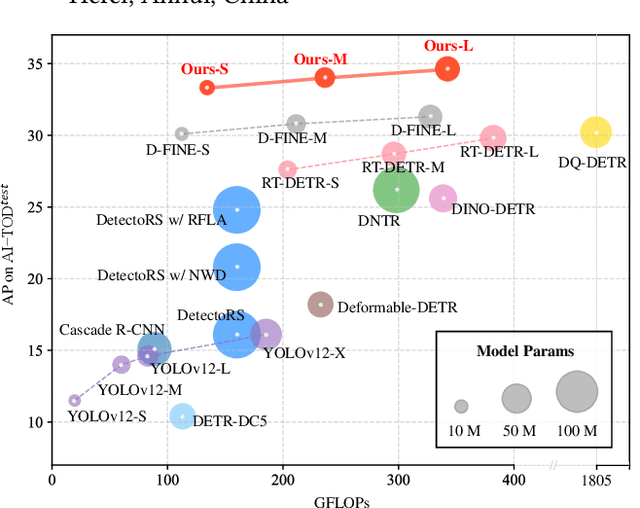
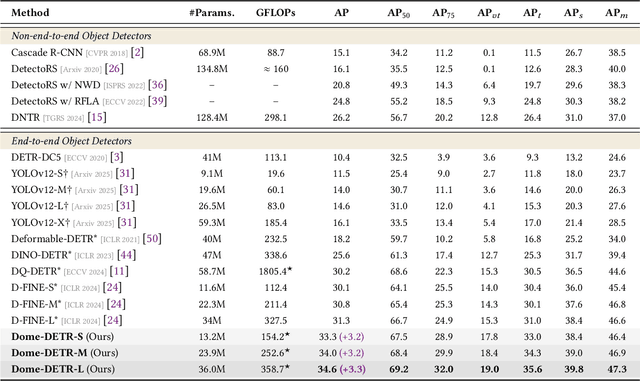
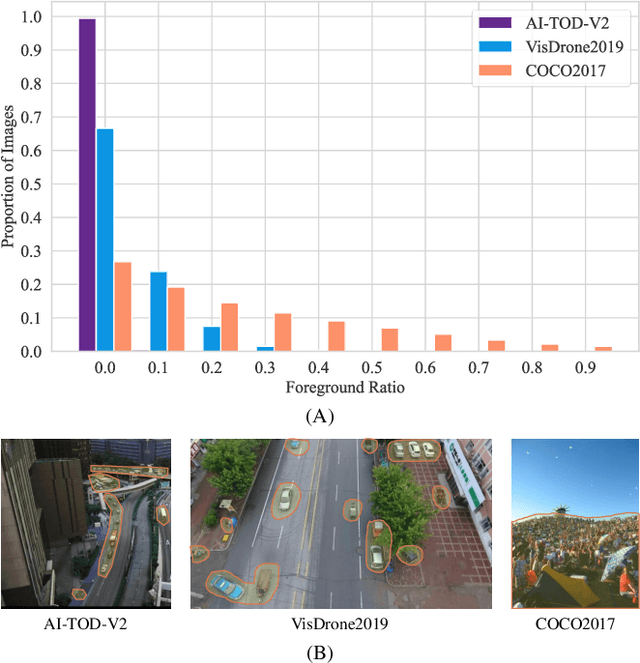
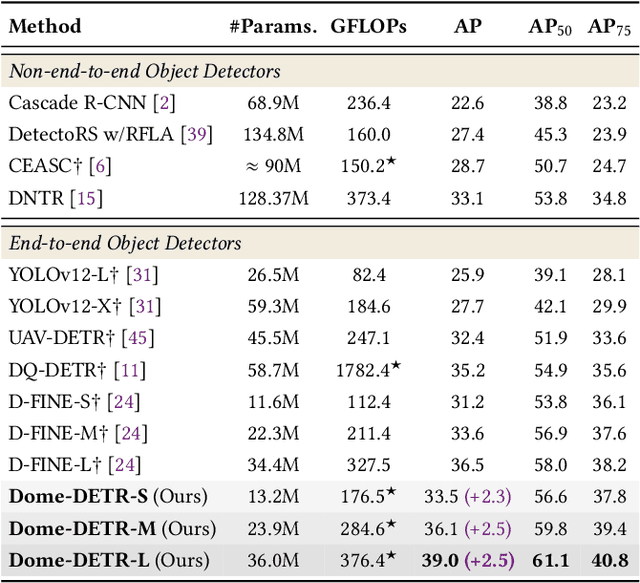
Tiny object detection plays a vital role in drone surveillance, remote sensing, and autonomous systems, enabling the identification of small targets across vast landscapes. However, existing methods suffer from inefficient feature leverage and high computational costs due to redundant feature processing and rigid query allocation. To address these challenges, we propose Dome-DETR, a novel framework with Density-Oriented Feature-Query Manipulation for Efficient Tiny Object Detection. To reduce feature redundancies, we introduce a lightweight Density-Focal Extractor (DeFE) to produce clustered compact foreground masks. Leveraging these masks, we incorporate Masked Window Attention Sparsification (MWAS) to focus computational resources on the most informative regions via sparse attention. Besides, we propose Progressive Adaptive Query Initialization (PAQI), which adaptively modulates query density across spatial areas for better query allocation. Extensive experiments demonstrate that Dome-DETR achieves state-of-the-art performance (+3.3 AP on AI-TOD-V2 and +2.5 AP on VisDrone) while maintaining low computational complexity and a compact model size. Code will be released upon acceptance.