 Add to Chrome
 Add to Firefox
 Add to Edge
Molmo and PixMo: Open Weights and Open Data for State-of-the-Art Multimodal Models
Sep 25, 2024


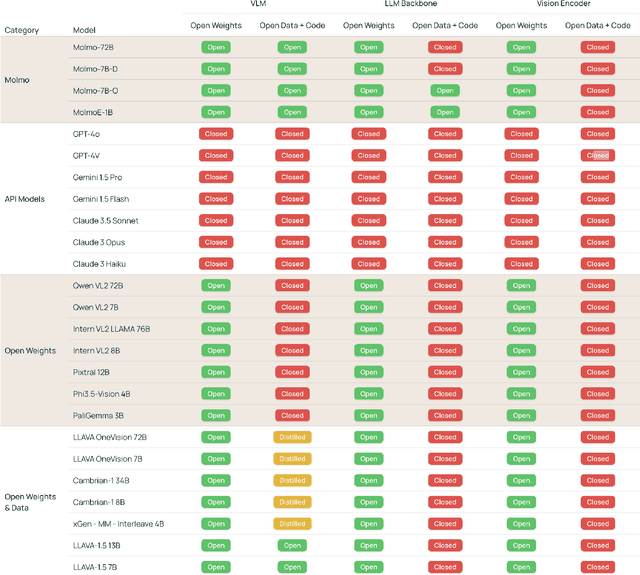
Today's most advanced multimodal models remain proprietary. The strongest open-weight models rely heavily on synthetic data from proprietary VLMs to achieve good performance, effectively distilling these closed models into open ones. As a result, the community is still missing foundational knowledge about how to build performant VLMs from scratch. We present Molmo, a new family of VLMs that are state-of-the-art in their class of openness. Our key innovation is a novel, highly detailed image caption dataset collected entirely from human annotators using speech-based descriptions. To enable a wide array of user interactions, we also introduce a diverse dataset mixture for fine-tuning that includes in-the-wild Q&A and innovative 2D pointing data. The success of our approach relies on careful choices for the model architecture details, a well-tuned training pipeline, and, most critically, the quality of our newly collected datasets, all of which will be released. The best-in-class 72B model within the Molmo family not only outperforms others in the class of open weight and data models but also compares favorably against proprietary systems like GPT-4o, Claude 3.5, and Gemini 1.5 on both academic benchmarks and human evaluation. We will be releasing all of our model weights, captioning and fine-tuning data, and source code in the near future. Select model weights, inference code, and demo are available at https://molmo.allenai.org.

OLMoE: Open Mixture-of-Experts Language Models
Sep 03, 2024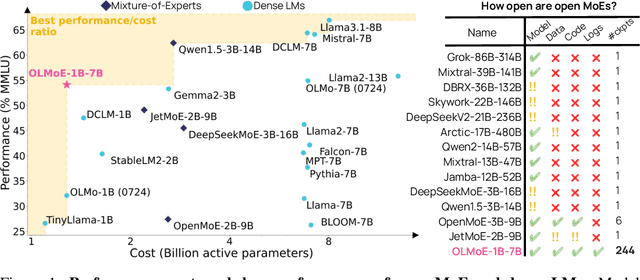
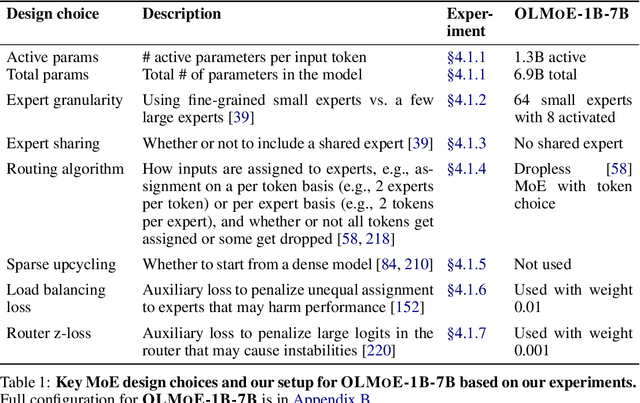
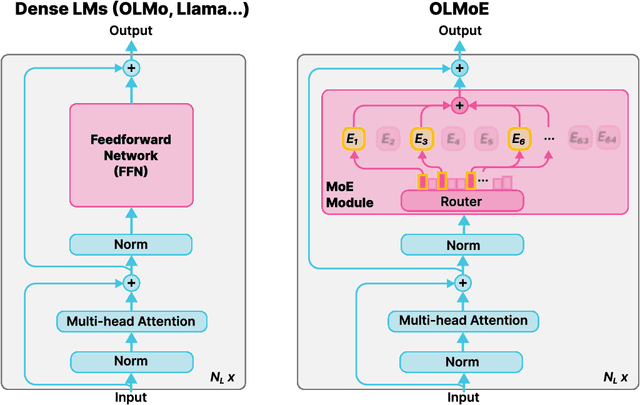
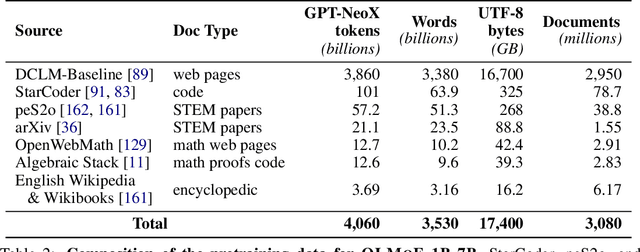
We introduce OLMoE, a fully open, state-of-the-art language model leveraging sparse Mixture-of-Experts (MoE). OLMoE-1B-7B has 7 billion (B) parameters but uses only 1B per input token. We pretrain it on 5 trillion tokens and further adapt it to create OLMoE-1B-7B-Instruct. Our models outperform all available models with similar active parameters, even surpassing larger ones like Llama2-13B-Chat and DeepSeekMoE-16B. We present various experiments on MoE training, analyze routing in our model showing high specialization, and open-source all aspects of our work: model weights, training data, code, and logs.
Toward a More Complete OMR Solution
Aug 31, 2024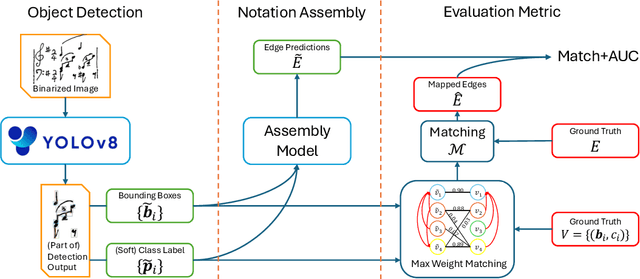
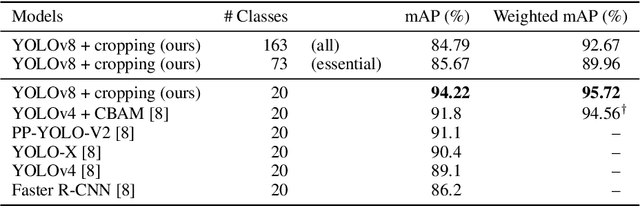
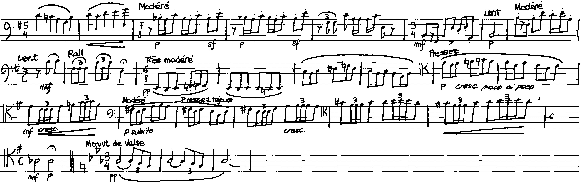
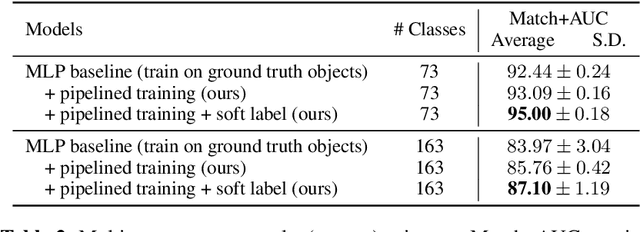
Optical music recognition (OMR) aims to convert music notation into digital formats. One approach to tackle OMR is through a multi-stage pipeline, where the system first detects visual music notation elements in the image (object detection) and then assembles them into a music notation (notation assembly). Most previous work on notation assembly unrealistically assumes perfect object detection. In this study, we focus on the MUSCIMA++ v2.0 dataset, which represents musical notation as a graph with pairwise relationships among detected music objects, and we consider both stages together. First, we introduce a music object detector based on YOLOv8, which improves detection performance. Second, we introduce a supervised training pipeline that completes the notation assembly stage based on detection output. We find that this model is able to outperform existing models trained on perfect detection output, showing the benefit of considering the detection and assembly stages in a more holistic way. These findings, together with our novel evaluation metric, are important steps toward a more complete OMR solution.
Risks and NLP Design: A Case Study on Procedural Document QA
Aug 16, 2024As NLP systems are increasingly deployed at scale, concerns about their potential negative impacts have attracted the attention of the research community, yet discussions of risk have mostly been at an abstract level and focused on generic AI or NLP applications. We argue that clearer assessments of risks and harms to users--and concrete strategies to mitigate them--will be possible when we specialize the analysis to more concrete applications and their plausible users. As an illustration, this paper is grounded in cooking recipe procedural document question answering (ProcDocQA), where there are well-defined risks to users such as injuries or allergic reactions. Our case study shows that an existing language model, applied in "zero-shot" mode, quantitatively answers real-world questions about recipes as well or better than the humans who have answered the questions on the web. Using a novel questionnaire informed by theoretical work on AI risk, we conduct a risk-oriented error analysis that could then inform the design of a future system to be deployed with lower risk of harm and better performance.
Does Liking Yellow Imply Driving a School Bus? Semantic Leakage in Language Models
Aug 12, 2024Despite their wide adoption, the biases and unintended behaviors of language models remain poorly understood. In this paper, we identify and characterize a phenomenon never discussed before, which we call semantic leakage, where models leak irrelevant information from the prompt into the generation in unexpected ways. We propose an evaluation setting to detect semantic leakage both by humans and automatically, curate a diverse test suite for diagnosing this behavior, and measure significant semantic leakage in 13 flagship models. We also show that models exhibit semantic leakage in languages besides English and across different settings and generation scenarios. This discovery highlights yet another type of bias in language models that affects their generation patterns and behavior.
Data Mixture Inference: What do BPE Tokenizers Reveal about their Training Data?
Jul 24, 2024

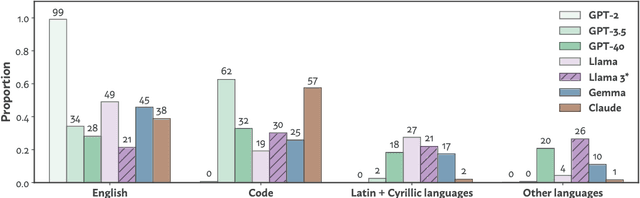

The pretraining data of today's strongest language models is opaque; in particular, little is known about the proportions of various domains or languages represented. In this work, we tackle a task which we call data mixture inference, which aims to uncover the distributional make-up of training data. We introduce a novel attack based on a previously overlooked source of information -- byte-pair encoding (BPE) tokenizers, used by the vast majority of modern language models. Our key insight is that the ordered list of merge rules learned by a BPE tokenizer naturally reveals information about the token frequencies in its training data: the first merge is the most common byte pair, the second is the most common pair after merging the first token, and so on. Given a tokenizer's merge list along with data samples for each category of interest, we formulate a linear program that solves for the proportion of each category in the tokenizer's training set. Importantly, to the extent to which tokenizer training data is representative of the pretraining data, we indirectly learn about pretraining data. In controlled experiments, we show that our attack recovers mixture ratios with high precision for tokenizers trained on known mixtures of natural languages, programming languages, and data sources. We then apply our approach to off-the-shelf tokenizers released with recent LMs. We confirm much publicly disclosed information about these models, and also make several new inferences: GPT-4o's tokenizer is much more multilingual than its predecessors, training on 39% non-English data; Llama3 extends GPT-3.5's tokenizer primarily for multilingual (48%) use; GPT-3.5's and Claude's tokenizers are trained on predominantly code (~60%). We hope our work sheds light on current design practices for pretraining data, and inspires continued research into data mixture inference for LMs.
MAGNET: Improving the Multilingual Fairness of Language Models with Adaptive Gradient-Based Tokenization
Jul 11, 2024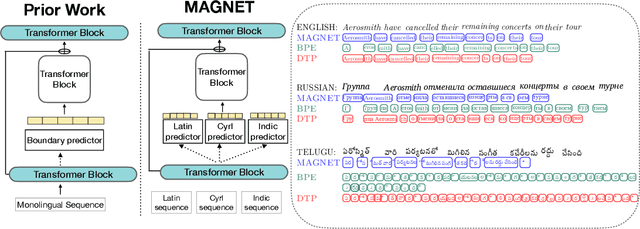

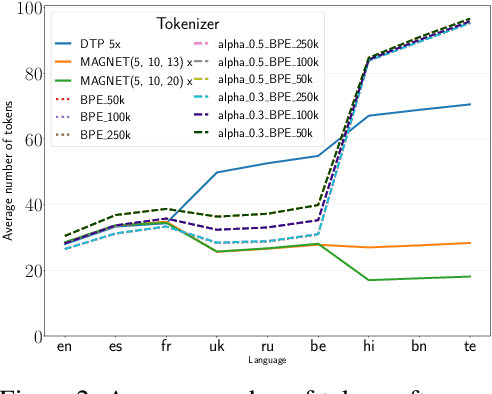

In multilingual settings, non-Latin scripts and low-resource languages are usually disadvantaged in terms of language models' utility, efficiency, and cost. Specifically, previous studies have reported multiple modeling biases that the current tokenization algorithms introduce to non-Latin script languages, the main one being over-segmentation. In this work, we propose MAGNET; multilingual adaptive gradient-based tokenization to reduce over-segmentation via adaptive gradient-based subword tokenization. MAGNET learns to predict segment boundaries between byte tokens in a sequence via sub-modules within the model, which act as internal boundary predictors (tokenizers). Previous gradient-based tokenization methods aimed for uniform compression across sequences by integrating a single boundary predictor during training and optimizing it end-to-end through stochastic reparameterization alongside the next token prediction objective. However, this approach still results in over-segmentation for non-Latin script languages in multilingual settings. In contrast, MAGNET offers a customizable architecture where byte-level sequences are routed through language-script-specific predictors, each optimized for its respective language script. This modularity enforces equitable segmentation granularity across different language scripts compared to previous methods. Through extensive experiments, we demonstrate that in addition to reducing segmentation disparities, MAGNET also enables faster language modelling and improves downstream utility.
MUSE: Machine Unlearning Six-Way Evaluation for Language Models
Jul 08, 2024Language models (LMs) are trained on vast amounts of text data, which may include private and copyrighted content. Data owners may request the removal of their data from a trained model due to privacy or copyright concerns. However, exactly unlearning only these datapoints (i.e., retraining with the data removed) is intractable in modern-day models. This has led to the development of many approximate unlearning algorithms. The evaluation of the efficacy of these algorithms has traditionally been narrow in scope, failing to precisely quantify the success and practicality of the algorithm from the perspectives of both the model deployers and the data owners. We address this issue by proposing MUSE, a comprehensive machine unlearning evaluation benchmark that enumerates six diverse desirable properties for unlearned models: (1) no verbatim memorization, (2) no knowledge memorization, (3) no privacy leakage, (4) utility preservation on data not intended for removal, (5) scalability with respect to the size of removal requests, and (6) sustainability over sequential unlearning requests. Using these criteria, we benchmark how effectively eight popular unlearning algorithms on 7B-parameter LMs can unlearn Harry Potter books and news articles. Our results demonstrate that most algorithms can prevent verbatim memorization and knowledge memorization to varying degrees, but only one algorithm does not lead to severe privacy leakage. Furthermore, existing algorithms fail to meet deployer's expectations because they often degrade general model utility and also cannot sustainably accommodate successive unlearning requests or large-scale content removal. Our findings identify key issues with the practicality of existing unlearning algorithms on language models, and we release our benchmark to facilitate further evaluations: muse-bench.github.io
Voices Unheard: NLP Resources and Models for Yorùbá Regional Dialects
Jun 27, 2024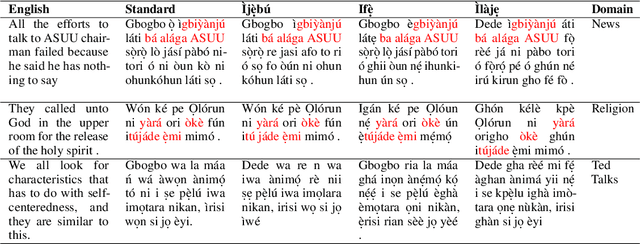
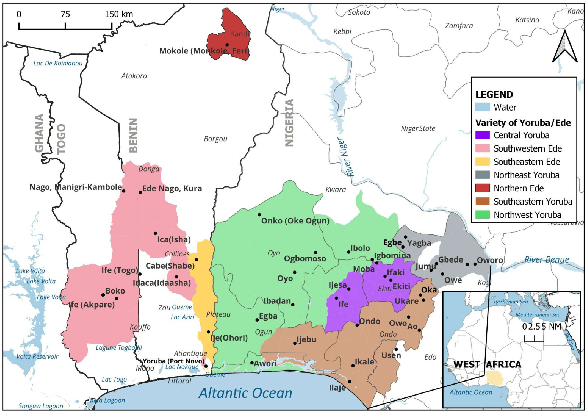
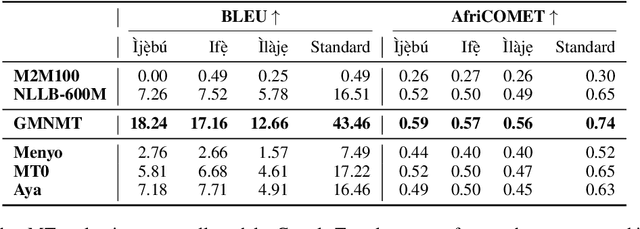
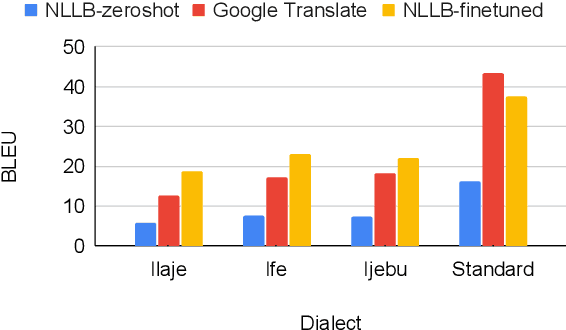
Yor\`ub\'a an African language with roughly 47 million speakers encompasses a continuum with several dialects. Recent efforts to develop NLP technologies for African languages have focused on their standard dialects, resulting in disparities for dialects and varieties for which there are little to no resources or tools. We take steps towards bridging this gap by introducing a new high-quality parallel text and speech corpus YOR\`ULECT across three domains and four regional Yor\`ub\'a dialects. To develop this corpus, we engaged native speakers, travelling to communities where these dialects are spoken, to collect text and speech data. Using our newly created corpus, we conducted extensive experiments on (text) machine translation, automatic speech recognition, and speech-to-text translation. Our results reveal substantial performance disparities between standard Yor\`ub\'a and the other dialects across all tasks. However, we also show that with dialect-adaptive finetuning, we are able to narrow this gap. We believe our dataset and experimental analysis will contribute greatly to developing NLP tools for Yor\`ub\'a and its dialects, and potentially for other African languages, by improving our understanding of existing challenges and offering a high-quality dataset for further development. We release YOR\`ULECT dataset and models publicly under an open license.
Evaluating Copyright Takedown Methods for Language Models
Jun 26, 2024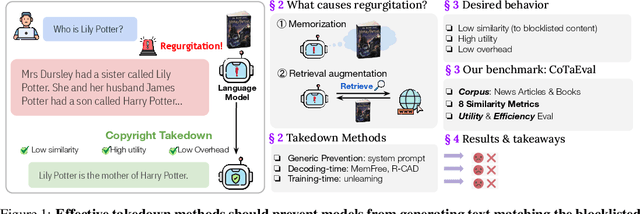


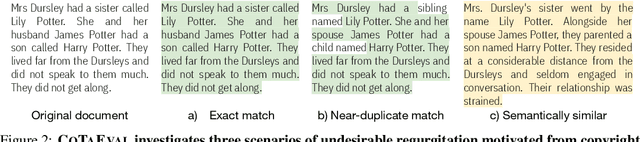
Language models (LMs) derive their capabilities from extensive training on diverse data, including potentially copyrighted material. These models can memorize and generate content similar to their training data, posing potential concerns. Therefore, model creators are motivated to develop mitigation methods that prevent generating protected content. We term this procedure as copyright takedowns for LMs, noting the conceptual similarity to (but legal distinction from) the DMCA takedown This paper introduces the first evaluation of the feasibility and side effects of copyright takedowns for LMs. We propose CoTaEval, an evaluation framework to assess the effectiveness of copyright takedown methods, the impact on the model's ability to retain uncopyrightable factual knowledge from the training data whose recitation is embargoed, and how well the model maintains its general utility and efficiency. We examine several strategies, including adding system prompts, decoding-time filtering interventions, and unlearning approaches. Our findings indicate that no tested method excels across all metrics, showing significant room for research in this unique problem setting and indicating potential unresolved challenges for live policy proposals.