 Add to Chrome
 Add to Firefox
 Add to Edge
Nemotron 3 Ultra: Open, Efficient Mixture-of-Experts Hybrid Mamba-Transformer Model for Agentic Reasoning
Jun 12, 2026
We introduce Nemotron 3 Ultra, a 550 billion total and 55 billion active parameter Mixture-of-Experts Hybrid Mamba-Attention language model. We pre-trained Nemotron 3 Ultra on 20 trillion text tokens, then extended the context length to 1M tokens, and post-trained using Supervised Fine Tuning (SFT), Reinforcement Learning (RL), and Multi-teacher On-Policy Distillation (MOPD). Nemotron 3 Ultra is our most capable model yet, employing multiple key technologies - LatentMoE, Multi Token Prediction (MTP), NVFP4 pre-training, multi-environment RLVR, MOPD, and reasoning budget control. Nemotron 3 Ultra achieves up to ~6x higher inference throughput as compared to state-of-the-art publicly available LLMs while attaining on-par accuracy. The state-of-the-art accuracy, high inference throughput, and 1M token context length make Nemotron 3 Ultra ideal for long-running autonomous agentic tasks. We open-source the base, post-trained, and quantized checkpoints, along with the training data and recipe on HuggingFace.

Nemotron 3 Super: Open, Efficient Mixture-of-Experts Hybrid Mamba-Transformer Model for Agentic Reasoning
Apr 14, 2026We describe the pre-training, post-training, and quantization of Nemotron 3 Super, a 120 billion (active 12 billion) parameter hybrid Mamba-Attention Mixture-of-Experts model. Nemotron 3 Super is the first model in the Nemotron 3 family to 1) be pre-trained in NVFP4, 2) leverage LatentMoE, a new Mixture-of-Experts architecture that optimizes for both accuracy per FLOP and accuracy per parameter, and 3) include MTP layers for inference acceleration through native speculative decoding. We pre-trained Nemotron 3 Super on 25 trillion tokens followed by post-training using supervised fine tuning (SFT) and reinforcement learning (RL). The final model supports up to 1M context length and achieves comparable accuracy on common benchmarks, while also achieving up to 2.2x and 7.5x higher inference throughput compared to GPT-OSS-120B and Qwen3.5-122B, respectively. Nemotron 3 Super datasets, along with the base, post-trained, and quantized checkpoints, are open-sourced on HuggingFace.
Are Language Models Sensitive to Morally Irrelevant Distractors?
Feb 10, 2026With the rapid development and uptake of large language models (LLMs) across high-stakes settings, it is increasingly important to ensure that LLMs behave in ways that align with human values. Existing moral benchmarks prompt LLMs with value statements, moral scenarios, or psychological questionnaires, with the implicit underlying assumption that LLMs report somewhat stable moral preferences. However, moral psychology research has shown that human moral judgements are sensitive to morally irrelevant situational factors, such as smelling cinnamon rolls or the level of ambient noise, thereby challenging moral theories that assume the stability of human moral judgements. Here, we draw inspiration from this "situationist" view of moral psychology to evaluate whether LLMs exhibit similar cognitive moral biases to humans. We curate a novel multimodal dataset of 60 "moral distractors" from existing psychological datasets of emotionally-valenced images and narratives which have no moral relevance to the situation presented. After injecting these distractors into existing moral benchmarks to measure their effects on LLM responses, we find that moral distractors can shift the moral judgements of LLMs by over 30% even in low-ambiguity scenarios, highlighting the need for more contextual moral evaluations and more nuanced cognitive moral modeling of LLMs.
Are you going to finish that? A Practical Study of the Tokenization Boundary Problem
Jan 30, 2026Language models (LMs) are trained over sequences of tokens, whereas users interact with LMs via text. This mismatch gives rise to the partial token problem, which occurs when a user ends their prompt in the middle of the expected next-token, leading to distorted next-token predictions. Although this issue has been studied using arbitrary character prefixes, its prevalence and severity in realistic prompts respecting word boundaries remains underexplored. In this work, we identify three domains where token and "word" boundaries often do not line up: languages that do not use whitespace, highly compounding languages, and code. In Chinese, for example, up to 25% of word boundaries do not line up with token boundaries, making even natural, word-complete prompts susceptible to this problem. We systematically construct semantically natural prompts ending with a partial tokens; in experiments, we find that they comprise a serious failure mode: frontier LMs consistently place three orders of magnitude less probability on the correct continuation compared to when the prompt is "backed-off" to be token-aligned. This degradation does not diminish with scale and often worsens for larger models. Finally, we evaluate inference-time mitigations to the partial token problem and validate the effectiveness of recent exact solutions. Overall, we demonstrate the scale and severity of probability distortion caused by tokenization in realistic use cases, and provide practical recommentions for model inference providers.
NVIDIA Nemotron 3: Efficient and Open Intelligence
Dec 24, 2025We introduce the Nemotron 3 family of models - Nano, Super, and Ultra. These models deliver strong agentic, reasoning, and conversational capabilities. The Nemotron 3 family uses a Mixture-of-Experts hybrid Mamba-Transformer architecture to provide best-in-class throughput and context lengths of up to 1M tokens. Super and Ultra models are trained with NVFP4 and incorporate LatentMoE, a novel approach that improves model quality. The two larger models also include MTP layers for faster text generation. All Nemotron 3 models are post-trained using multi-environment reinforcement learning enabling reasoning, multi-step tool use, and support granular reasoning budget control. Nano, the smallest model, outperforms comparable models in accuracy while remaining extremely cost-efficient for inference. Super is optimized for collaborative agents and high-volume workloads such as IT ticket automation. Ultra, the largest model, provides state-of-the-art accuracy and reasoning performance. Nano is released together with its technical report and this white paper, while Super and Ultra will follow in the coming months. We will openly release the model weights, pre- and post-training software, recipes, and all data for which we hold redistribution rights.
Nemotron 3 Nano: Open, Efficient Mixture-of-Experts Hybrid Mamba-Transformer Model for Agentic Reasoning
Dec 23, 2025We present Nemotron 3 Nano 30B-A3B, a Mixture-of-Experts hybrid Mamba-Transformer language model. Nemotron 3 Nano was pretrained on 25 trillion text tokens, including more than 3 trillion new unique tokens over Nemotron 2, followed by supervised fine tuning and large-scale RL on diverse environments. Nemotron 3 Nano achieves better accuracy than our previous generation Nemotron 2 Nano while activating less than half of the parameters per forward pass. It achieves up to 3.3x higher inference throughput than similarly-sized open models like GPT-OSS-20B and Qwen3-30B-A3B-Thinking-2507, while also being more accurate on popular benchmarks. Nemotron 3 Nano demonstrates enhanced agentic, reasoning, and chat abilities and supports context lengths up to 1M tokens. We release both our pretrained Nemotron 3 Nano 30B-A3B Base and post-trained Nemotron 3 Nano 30B-A3B checkpoints on Hugging Face.
Olmo 3
Dec 15, 2025We introduce Olmo 3, a family of state-of-the-art, fully-open language models at the 7B and 32B parameter scales. Olmo 3 model construction targets long-context reasoning, function calling, coding, instruction following, general chat, and knowledge recall. This release includes the entire model flow, i.e., the full lifecycle of the family of models, including every stage, checkpoint, data point, and dependency used to build it. Our flagship model, Olmo 3 Think 32B, is the strongest fully-open thinking model released to-date.
Broken Tokens? Your Language Model can Secretly Handle Non-Canonical Tokenizations
Jun 23, 2025Modern tokenizers employ deterministic algorithms to map text into a single "canonical" token sequence, yet the same string can be encoded as many non-canonical tokenizations using the tokenizer vocabulary. In this work, we investigate the robustness of LMs to text encoded with non-canonical tokenizations entirely unseen during training. Surprisingly, when evaluated across 20 benchmarks, we find that instruction-tuned models retain up to 93.4% of their original performance when given a randomly sampled tokenization, and 90.8% with character-level tokenization. We see that overall stronger models tend to be more robust, and robustness diminishes as the tokenization departs farther from the canonical form. Motivated by these results, we then identify settings where non-canonical tokenization schemes can *improve* performance, finding that character-level segmentation improves string manipulation and code understanding tasks by up to +14%, and right-aligned digit grouping enhances large-number arithmetic by +33%. Finally, we investigate the source of this robustness, finding that it arises in the instruction-tuning phase. We show that while both base and post-trained models grasp the semantics of non-canonical tokenizations (perceiving them as containing misspellings), base models try to mimic the imagined mistakes and degenerate into nonsensical output, while post-trained models are committed to fluent responses. Overall, our findings suggest that models are less tied to their tokenizer than previously believed, and demonstrate the promise of intervening on tokenization at inference time to boost performance.
Sampling from Your Language Model One Byte at a Time
Jun 17, 2025Tokenization is used almost universally by modern language models, enabling efficient text representation using multi-byte or multi-character tokens. However, prior work has shown that tokenization can introduce distortion into the model's generations. For example, users are often advised not to end their prompts with a space because it prevents the model from including the space as part of the next token. This Prompt Boundary Problem (PBP) also arises in languages such as Chinese and in code generation, where tokens often do not line up with syntactic boundaries. Additionally mismatching tokenizers often hinder model composition and interoperability. For example, it is not possible to directly ensemble models with different tokenizers due to their mismatching vocabularies. To address these issues, we present an inference-time method to convert any autoregressive LM with a BPE tokenizer into a character-level or byte-level LM, without changing its generative distribution at the text level. Our method efficient solves the PBP and is also able to unify the vocabularies of language models with different tokenizers, allowing one to ensemble LMs with different tokenizers at inference time as well as transfer the post-training from one model to another using proxy-tuning. We demonstrate in experiments that the ensemble and proxy-tuned models outperform their constituents on downstream evals.
LLAMAPIE: Proactive In-Ear Conversation Assistants
May 07, 2025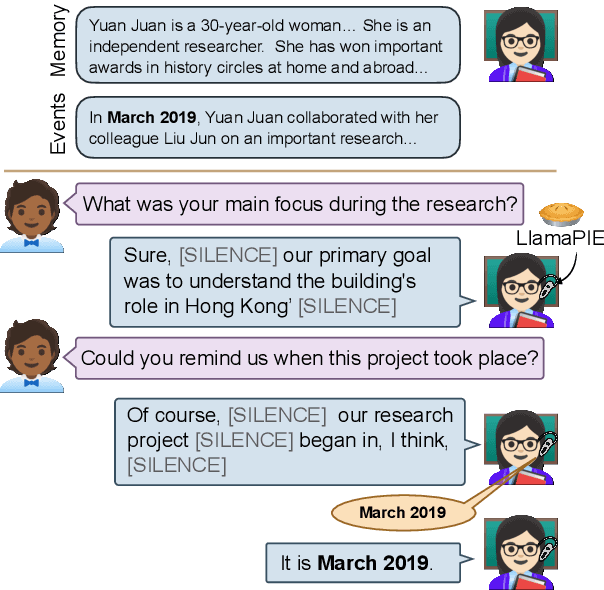
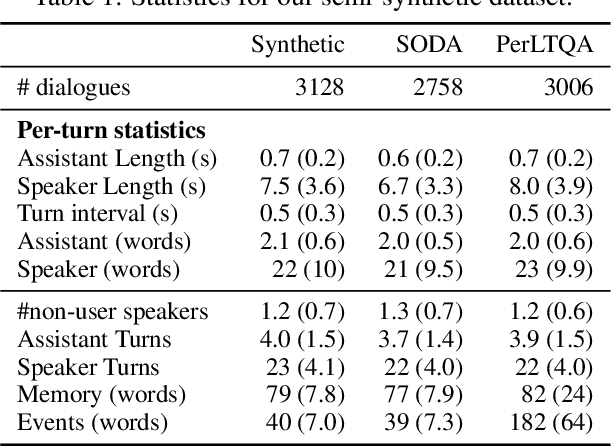
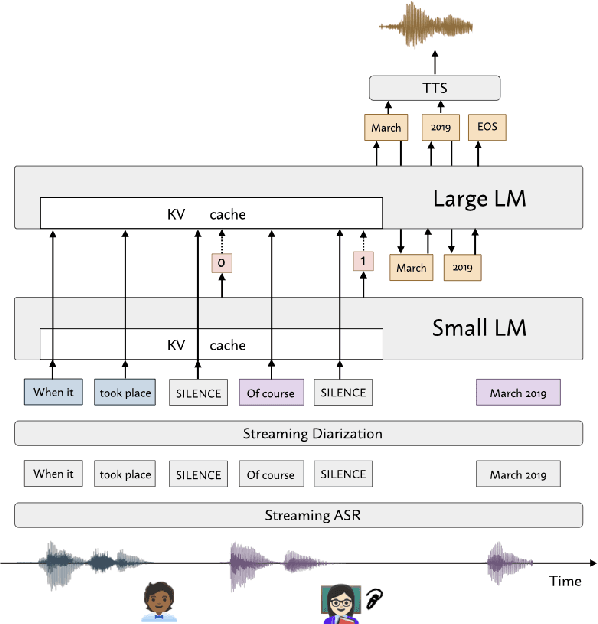
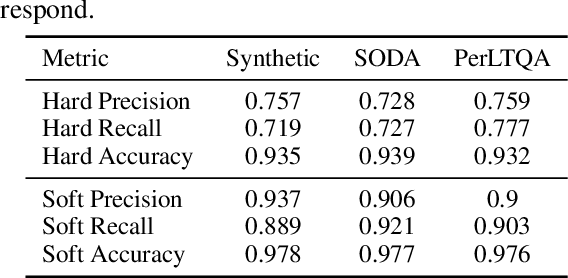
We introduce LlamaPIE, the first real-time proactive assistant designed to enhance human conversations through discreet, concise guidance delivered via hearable devices. Unlike traditional language models that require explicit user invocation, this assistant operates in the background, anticipating user needs without interrupting conversations. We address several challenges, including determining when to respond, crafting concise responses that enhance conversations, leveraging knowledge of the user for context-aware assistance, and real-time, on-device processing. To achieve this, we construct a semi-synthetic dialogue dataset and propose a two-model pipeline: a small model that decides when to respond and a larger model that generates the response. We evaluate our approach on real-world datasets, demonstrating its effectiveness in providing helpful, unobtrusive assistance. User studies with our assistant, implemented on Apple Silicon M2 hardware, show a strong preference for the proactive assistant over both a baseline with no assistance and a reactive model, highlighting the potential of LlamaPie to enhance live conversations.