 Add to Chrome
 Add to Firefox
 Add to Edge
BOOKMARKS: Efficient Active Storyline Memory for Role-playing
May 13, 2026
Memory systems are critical for role-playing agents (RPAs) to maintain long-horizon consistency. However, existing RPA memory methods (e.g., profiling) mainly rely on recurrent summarization, whose compression inevitably discards important details. To address this issue, we propose a search-based memory framework called BOOKMARKS, which actively initializes, maintains, and updates task-relevant pieces of bookmarks for the current task (e.g., character acting). A bookmark is structured as the answer to a question at a specific point in the storyline. For each current task, BOOKMARKS selects reusable existing bookmarks or initializes new ones (at storyline beginning) with useful questions. These bookmarks are then synchronized to the current story point, with their answers updated accordingly, so they can be efficiently reused in future grounding rounds. Compared with recurrent summarization, BOOKMARKS offers (1) active grounding for capturing task-specific details and (2) passive updating to avoid unnecessary computation. In implementation, BOOKMARKS supports concept, behavior, and state searches, each powered by an efficient synchronization method. BOOKMARKS significantly outperforms RPA memory baselines on 85 characters from 16 artifacts, demonstrating the effectiveness of search-based memory for RPAs.

Simulating Organized Group Behavior: New Framework, Benchmark, and Analysis
Apr 10, 2026Simulating how organized groups (e.g., corporations) make decisions (e.g., responding to a competitor's move) is essential for understanding real-world dynamics and could benefit relevant applications (e.g., market prediction). In this paper, we formalize this problem as a concrete research platform for group behavior understanding, providing: (1) a task definition with benchmark and evaluation criteria, (2) a structured analytical framework with a corresponding algorithm, and (3) detailed temporal and cross-group analysis. Specifically, we propose Organized Group Behavior Simulation, a task that models organized groups as collective entities from a practical perspective: given a group facing a particular situation (e.g., AI Boom), predict the decision it would take. To support this task, we present GROVE (GRoup Organizational BehaVior Evaluation), a benchmark covering 44 entities with 8,052 real-world context-decision pairs collected from Wikipedia and TechCrunch across 9 domains, with an end-to-end evaluation protocol assessing consistency, initiative, scope, magnitude, and horizon. Beyond straightforward prompting pipelines, we propose a structured analytical framework that converts collective decision-making events into an interpretable, adaptive, and traceable behavioral model, achieving stronger performance than summarization- and retrieval-based baselines. It further introduces an adapter mechanism for time-aware evolution and group-aware transfer, and traceable evidence nodes grounding each decision rule in originating historical events. Our analysis reveals temporal behavioral drift within individual groups, which the time-aware adapter effectively captures for stronger prediction, and structured cross-group similarity that enables knowledge transfer for data-scarce organizations.
How Well Does Generative Recommendation Generalize?
Mar 20, 2026A widely held hypothesis for why generative recommendation (GR) models outperform conventional item ID-based models is that they generalize better. However, there is few systematic way to verify this hypothesis beyond a superficial comparison of overall performance. To address this gap, we categorize each data instance based on the specific capability required for a correct prediction: either memorization (reusing item transition patterns observed during training) or generalization (composing known patterns to predict unseen item transitions). Extensive experiments show that GR models perform better on instances that require generalization, whereas item ID-based models perform better when memorization is more important. To explain this divergence, we shift the analysis from the item level to the token level and show that what appears to be item-level generalization often reduces to token-level memorization for GR models. Finally, we show that the two paradigms are complementary. We propose a simple memorization-aware indicator that adaptively combines them on a per-instance basis, leading to improved overall recommendation performance.
Codified Finite-state Machines for Role-playing
Feb 05, 2026Modeling latent character states is crucial for consistent and engaging role-playing (RP) with large language models (LLMs). Yet, existing prompting-based approaches mainly capture surface actions, often failing to track the latent states that drive interaction. We revisit finite-state machines (FSMs), long used in game design to model state transitions. While effective in small, well-specified state spaces, traditional hand-crafted, rule-based FSMs struggle to adapt to the open-ended semantic space of RP. To address this, we introduce Codified Finite-State Machines (CFSMs), a framework that automatically codifies textual character profiles into FSMs using LLM-based coding. CFSMs extract key states and transitions directly from the profile, producing interpretable structures that enforce character consistency. To further capture uncertainty and variability, we extend CFSMs into Codified Probabilistic Finite-State Machines (CPFSMs), where transitions are modeled as probability distributions over states. Through both synthetic evaluations and real-world RP scenarios in established artifacts, we demonstrate that CFSM and CPFSM outperform generally applied baselines, verifying effectiveness not only in structured tasks but also in open-ended stochastic state exploration.
Deriving Character Logic from Storyline as Codified Decision Trees
Jan 15, 2026Role-playing (RP) agents rely on behavioral profiles to act consistently across diverse narrative contexts, yet existing profiles are largely unstructured, non-executable, and weakly validated, leading to brittle agent behavior. We propose Codified Decision Trees (CDT), a data-driven framework that induces an executable and interpretable decision structure from large-scale narrative data. CDT represents behavioral profiles as a tree of conditional rules, where internal nodes correspond to validated scene conditions and leaves encode grounded behavioral statements, enabling deterministic retrieval of context-appropriate rules at execution time. The tree is learned by iteratively inducing candidate scene-action rules, validating them against data, and refining them through hierarchical specialization, yielding profiles that support transparent inspection and principled updates. Across multiple benchmarks, CDT substantially outperforms human-written profiles and prior profile induction methods on $85$ characters across $16$ artifacts, indicating that codified and validated behavioral representations lead to more reliable agent grounding.
Codified Foreshadowing-Payoff Text Generation
Jan 11, 2026Foreshadowing and payoff are ubiquitous narrative devices through which authors introduce commitments early in a story and resolve them through concrete, observable outcomes. However, despite advances in story generation, large language models (LLMs) frequently fail to bridge these long-range narrative dependencies, often leaving "Chekhov's guns" unfired even when the necessary context is present. Existing evaluations largely overlook this structural failure, focusing on surface-level coherence rather than the logical fulfillment of narrative setups. In this paper, we introduce Codified Foreshadowing-Payoff Generation (CFPG), a novel framework that reframes narrative quality through the lens of payoff realization. Recognizing that LLMs struggle to intuitively grasp the "triggering mechanism" of a foreshadowed event, CFPG transforms narrative continuity into a set of executable causal predicates. By mining and encoding Foreshadow-Trigger-Payoff triples from the BookSum corpus, we provide structured supervision that ensures foreshadowed commitments are not only mentioned but also temporally and logically fulfilled. Experiments demonstrate that CFPG significantly outperforms standard prompting baselines in payoff accuracy and narrative alignment. Our findings suggest that explicitly codifying narrative mechanics is essential for moving LLMs from surface-level fluency to genuine narrative competence.
ToolGym: an Open-world Tool-using Environment for Scalable Agent Testing and Data Curation
Jan 09, 2026Tool-using LLM agents still struggle in open-world settings with large tool pools, long-horizon objectives, wild constraints, and unreliable tool states. For scalable and realistic training and testing, we introduce an open-world tool-using environment, built on 5,571 format unified tools across 204 commonly used apps. It includes a task creation engine that synthesizes long-horizon, multi-tool workflows with wild constraints, and a state controller that injects interruptions and failures to stress-test robustness. On top of this environment, we develop a tool select-then-execute agent framework with a planner-actor decomposition to separate deliberate reasoning and self-correction from step-wise execution. Comprehensive evaluation of state-of-the-art LLMs reveals the misalignment between tool planning and execution abilities, the constraint following weakness of existing LLMs, and DeepSeek-v3.2's strongest robustness. Finally, we collect 1,170 trajectories from our environment to fine-tune LLMs, achieving superior performance to baselines using 119k samples, indicating the environment's value as both a realistic benchmark and a data engine for tool-using agents. Our code and data will be publicly released.
A Tale of LLMs and Induced Small Proxies: Scalable Agents for Knowledge Mining
Oct 01, 2025At the core of Deep Research is knowledge mining, the task of extracting structured information from massive unstructured text in response to user instructions. Large language models (LLMs) excel at interpreting such instructions but are prohibitively expensive to deploy at scale, while traditional pipelines of classifiers and extractors remain efficient yet brittle and unable to generalize to new tasks. We introduce Falconer, a collaborative framework that combines the agentic reasoning of LLMs with lightweight proxy models for scalable knowledge mining. In Falconer, LLMs act as planners, decomposing user instructions into executable pipelines, and as annotators, generating supervision to train small proxies. The framework unifies classification and extraction into two atomic operations, get label and get span, enabling a single instruction-following model to replace multiple task-specific components. To evaluate the consistency between proxy models incubated by Falconer and annotations provided by humans and large models, we construct new benchmarks covering both planning and end-to-end execution. Experiments show that Falconer closely matches state-of-the-art LLMs in instruction-following accuracy while reducing inference cost by up to 90% and accelerating large-scale knowledge mining by more than 20x, offering an efficient and scalable foundation for Deep Research.
The Price of Format: Diversity Collapse in LLMs
May 25, 2025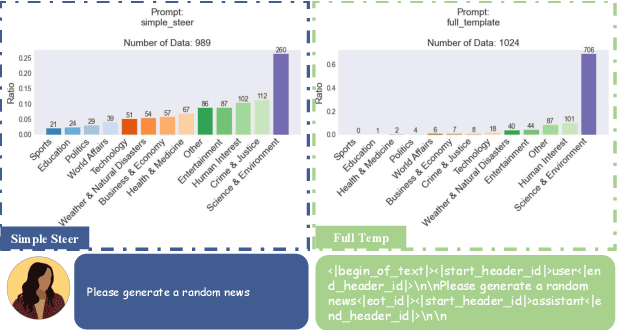
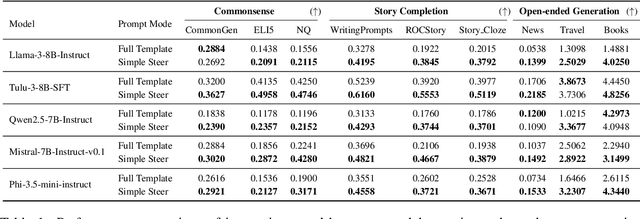
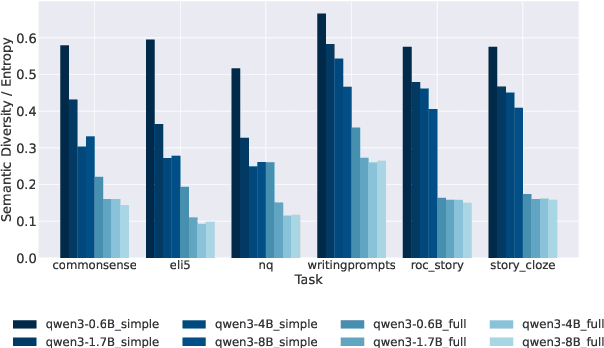
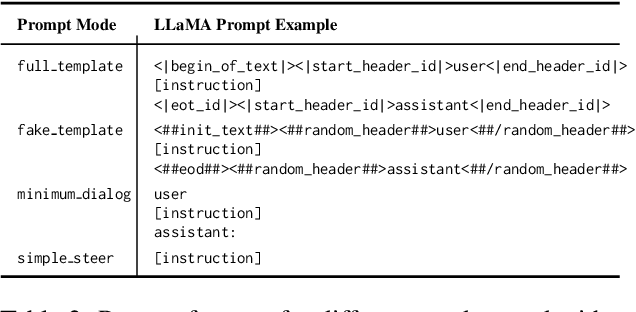
Instruction-tuned large language models (LLMs) employ structured templates, such as role markers and special tokens, to enforce format consistency during inference. However, we identify a critical limitation of such formatting: it induces a phenomenon we term diversity collapse, where the model generates semantically similar outputs for open-ended inputs, undermining creativity and variability. We systematically evaluate this effect across tasks like story completion and free-form generation, finding that (1) diversity collapse persists even under high-temperature sampling, and (2) structural tokens in templates significantly constrain the model's output space. To contextualize these findings, we fine-tune the same model using a range of structured prompts and then evaluate them across three axes: downstream task performance, alignment behavior, and output diversity. Our analysis shows that format consistency between fine-tuning and inference is crucial for structure-sensitive tasks (e.g., GSM8K, IFEval), but has marginal influence on knowledge-heavy tasks (e.g., MMLU, WebQuestions). In contrast, output diversity is primarily governed by the presence or absence of structural tokens, with minimal formatting yielding the most diverse outputs. These findings reveal that current prompting conventions, while beneficial for alignment, may inadvertently suppress output diversity, underscoring the need for diversity-aware prompt design and instruction tuning.
Bidirectional LMs are Better Knowledge Memorizers? A Benchmark for Real-world Knowledge Injection
May 18, 2025Despite significant advances in large language models (LLMs), their knowledge memorization capabilities remain underexplored, due to the lack of standardized and high-quality test ground. In this paper, we introduce a novel, real-world and large-scale knowledge injection benchmark that evolves continuously over time without requiring human intervention. Specifically, we propose WikiDYK, which leverages recently-added and human-written facts from Wikipedia's "Did You Know..." entries. These entries are carefully selected by expert Wikipedia editors based on criteria such as verifiability and clarity. Each entry is converted into multiple question-answer pairs spanning diverse task formats from easy cloze prompts to complex multi-hop questions. WikiDYK contains 12,290 facts and 77,180 questions, which is also seamlessly extensible with future updates from Wikipedia editors. Extensive experiments using continued pre-training reveal a surprising insight: despite their prevalence in modern LLMs, Causal Language Models (CLMs) demonstrate significantly weaker knowledge memorization capabilities compared to Bidirectional Language Models (BiLMs), exhibiting a 23% lower accuracy in terms of reliability. To compensate for the smaller scales of current BiLMs, we introduce a modular collaborative framework utilizing ensembles of BiLMs as external knowledge repositories to integrate with LLMs. Experiment shows that our framework further improves the reliability accuracy by up to 29.1%.