 Add to Chrome
 Add to Firefox
 Add to Edge
EvoLen: Evolution-Guided Tokenization for DNA Language Model
Apr 09, 2026
Tokens serve as the basic units of representation in DNA language models (DNALMs), yet their design remains underexplored. Unlike natural language, DNA lacks inherent token boundaries or predefined compositional rules, making tokenization a fundamental modeling decision rather than a naturally specified one. While existing approaches like byte-pair encoding (BPE) excel at capturing token structures that reflect human-generated linguistic regularities, DNA is organized by biological function and evolutionary constraint rather than linguistic convention. We argue that DNA tokenization should prioritize functional sequence patterns like regulatory motifs-short, recurring segments under evolutionary constraint and typically preserved across species. We incorporate evolutionary information directly into the tokenization process through EvoLen, a tokenizer that combines evolutionary stratification with length-aware decoding to better preserve motif-scale functional sequence units. EvoLen uses cross-species evolutionary signals to group DNA sequences, trains separate BPE tokenizers on each group, merges the resulting vocabularies via a rule prioritizing preserved patterns, and applies length-aware decoding with dynamic programming. Through controlled experiments, EvoLen improves the preservation of functional sequence patterns, differentiation across genomic contexts, and alignment with evolutionary constraint, while matching or outperforming standard BPE across diverse DNALM benchmarks. These results demonstrate that tokenization introduces a critical inductive bias and that incorporating evolutionary information yields more biologically meaningful and interpretable sequence representations.

KRNET: Image Denoising with Kernel Regulation Network
Oct 20, 2019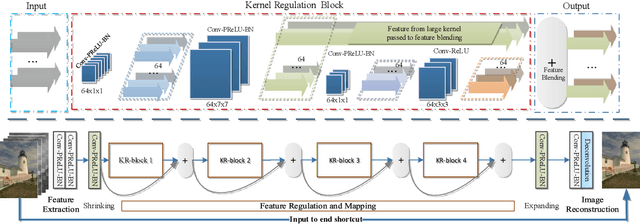



One popular strategy for image denoising is to design a generalized regularization term that is capable of exploring the implicit prior underlying data observation. Convolutional neural networks (CNN) have shown the powerful capability to learn image prior information through a stack of layers defined by a combination of kernels (filters) on the input. However, existing CNN-based methods mainly focus on synthetic gray-scale images. These methods still exhibit low performance when tackling multi-channel color image denoising. In this paper, we optimize CNN regularization capability by developing a kernel regulation module. In particular, we propose a kernel regulation network-block, referred to as KR-block, by integrating the merits of both large and small kernels, that can effectively estimate features in solving image denoising. We build a deep CNN-based denoiser, referred to as KRNET, via concatenating multiple KR-blocks. We evaluate KRNET on additive white Gaussian noise (AWGN), multi-channel (MC) noise, and realistic noise, where KRNET obtains significant performance gains over state-of-the-art methods across a wide spectrum of noise levels.
Image Restoration Using Deep Regulated Convolutional Networks
Oct 19, 2019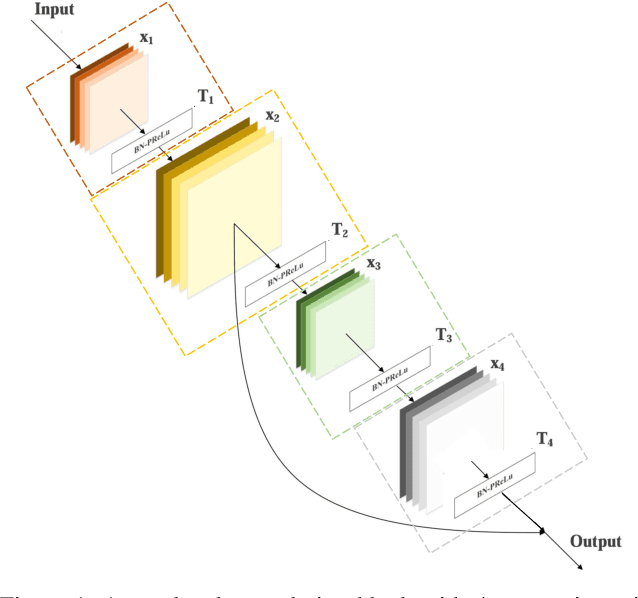
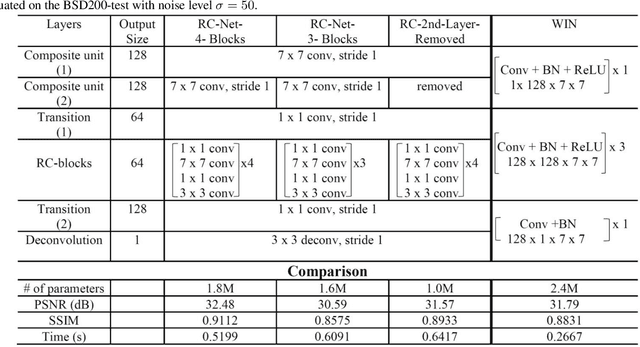
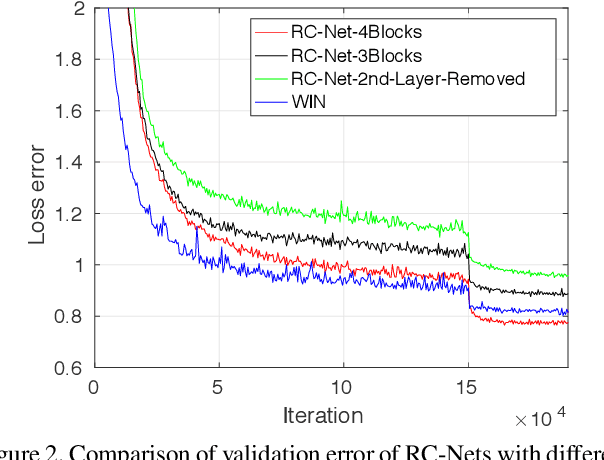

While the depth of convolutional neural networks has attracted substantial attention in the deep learning research, the width of these networks has recently received greater interest. The width of networks, defined as the size of the receptive fields and the density of the channels, has demonstrated crucial importance in low-level vision tasks such as image denoising and restoration. However, the limited generalization ability, due to the increased width of networks, creates a bottleneck in designing wider networks. In this paper, we propose the Deep Regulated Convolutional Network (RC-Net), a deep network composed of regulated sub-network blocks cascaded by skip-connections, to overcome this bottleneck. Specifically, the Regulated Convolution block (RC-block), featured by a combination of large and small convolution filters, balances the effectiveness of prominent feature extraction and the generalization ability of the network. RC-Nets have several compelling advantages: they embrace diversified features through large-small filter combinations, alleviate the hazy boundary and blurred details in image denoising and super-resolution problems, and stabilize the learning process. Our proposed RC-Nets outperform state-of-the-art approaches with significant performance gains in various image restoration tasks while demonstrating promising generalization ability. The code is available at https://github.com/cswin/RC-Nets.