 Add to Chrome
 Add to Firefox
 Add to Edge
Data Selection via Optimal Control for Language Models
Oct 09, 2024


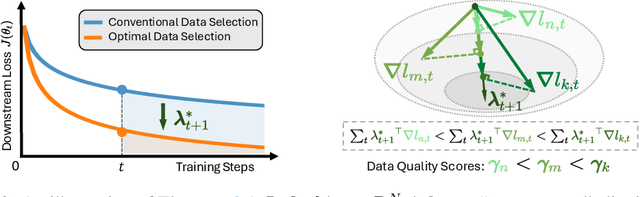

This work investigates the selection of high-quality pre-training data from massive corpora to enhance LMs' capabilities for downstream usage. We formulate data selection as a generalized Optimal Control problem, which can be solved theoretically by Pontryagin's Maximum Principle (PMP), yielding a set of necessary conditions that characterize the relationship between optimal data selection and LM training dynamics. Based on these theoretical results, we introduce PMP-based Data Selection (PDS), a framework that approximates optimal data selection by solving the PMP conditions. In our experiments, we adopt PDS to select data from CommmonCrawl and show that the PDS-selected corpus accelerates the learning of LMs and constantly boosts their performance on a wide range of downstream tasks across various model sizes. Moreover, the benefits of PDS extend to ~400B models trained on ~10T tokens, as evidenced by the extrapolation of the test loss curves according to the Scaling Laws. PDS also improves data utilization when the pre-training data is limited, by reducing the data demand by 1.8 times, which mitigates the quick exhaustion of available web-crawled corpora. Our code, data, and model checkpoints can be found in https://github.com/microsoft/LMOps/tree/main/data_selection.

Seeker: Enhancing Exception Handling in Code with LLM-based Multi-Agent Approach
Oct 09, 2024
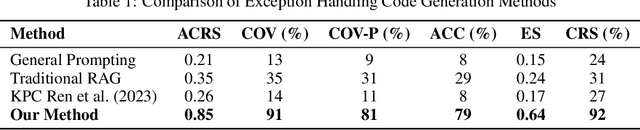

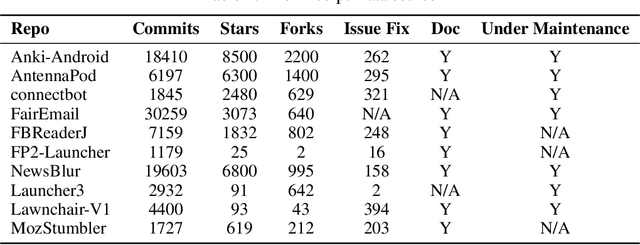
In real world software development, improper or missing exception handling can severely impact the robustness and reliability of code. Exception handling mechanisms require developers to detect, capture, and manage exceptions according to high standards, but many developers struggle with these tasks, leading to fragile code. This problem is particularly evident in open source projects and impacts the overall quality of the software ecosystem. To address this challenge, we explore the use of large language models (LLMs) to improve exception handling in code. Through extensive analysis, we identify three key issues: Insensitive Detection of Fragile Code, Inaccurate Capture of Exception Types, and Distorted Handling Solutions. These problems are widespread across real world repositories, suggesting that robust exception handling practices are often overlooked or mishandled. In response, we propose Seeker, a multi agent framework inspired by expert developer strategies for exception handling. Seeker uses agents: Scanner, Detector, Predator, Ranker, and Handler to assist LLMs in detecting, capturing, and resolving exceptions more effectively. Our work is the first systematic study on leveraging LLMs to enhance exception handling practices, providing valuable insights for future improvements in code reliability.
LogicGame: Benchmarking Rule-Based Reasoning Abilities of Large Language Models
Sep 05, 2024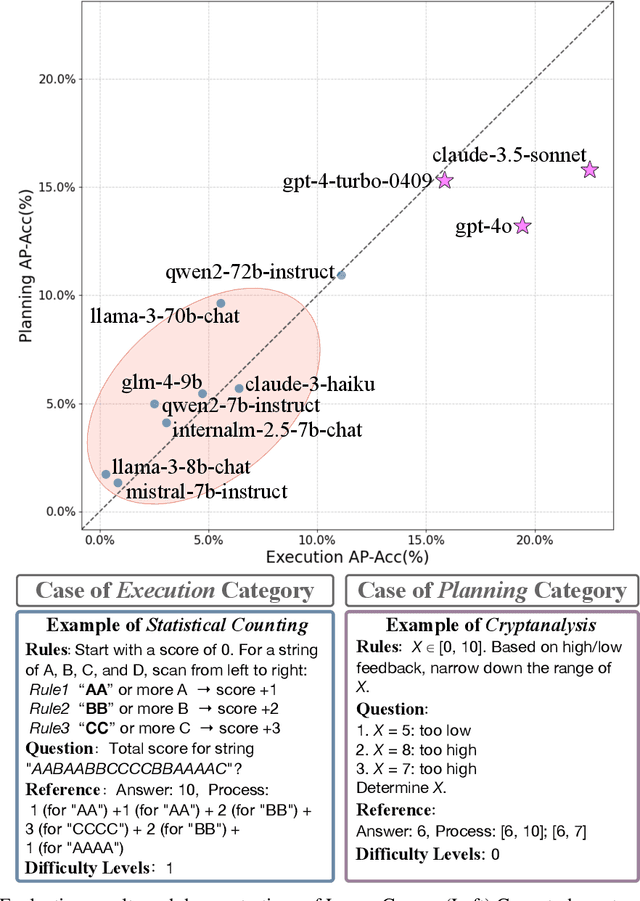
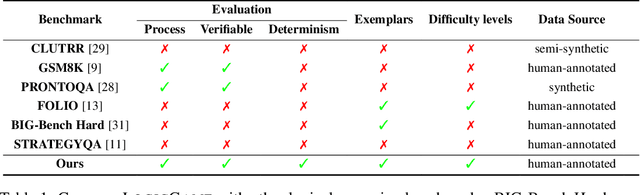
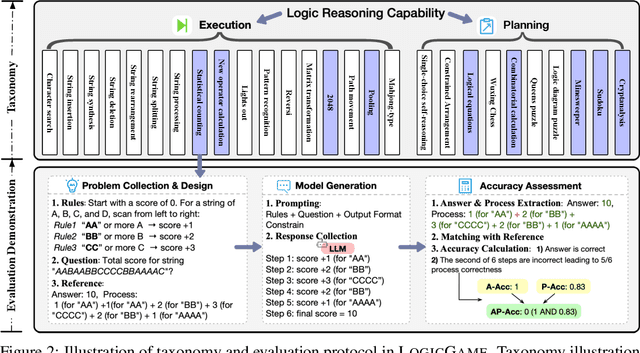
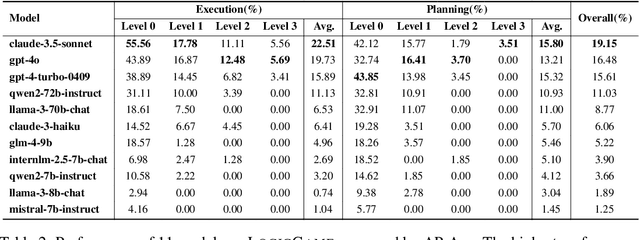
Large Language Models (LLMs) have demonstrated notable capabilities across various tasks, showcasing complex problem-solving abilities. Understanding and executing complex rules, along with multi-step planning, are fundamental to logical reasoning and critical for practical LLM agents and decision-making systems. However, evaluating LLMs as effective rule-based executors and planners remains underexplored. In this paper, we introduce LogicGame, a novel benchmark designed to evaluate the comprehensive rule understanding, execution, and planning capabilities of LLMs. Unlike traditional benchmarks, LogicGame provides diverse games that contain a series of rules with an initial state, requiring models to comprehend and apply predefined regulations to solve problems. We create simulated scenarios in which models execute or plan operations to achieve specific outcomes. These game scenarios are specifically designed to distinguish logical reasoning from mere knowledge by relying exclusively on predefined rules. This separation allows for a pure assessment of rule-based reasoning capabilities. The evaluation considers not only final outcomes but also intermediate steps, providing a comprehensive assessment of model performance. Moreover, these intermediate steps are deterministic and can be automatically verified. LogicGame defines game scenarios with varying difficulty levels, from simple rule applications to complex reasoning chains, in order to offer a precise evaluation of model performance on rule understanding and multi-step execution. Utilizing LogicGame, we test various LLMs and identify notable shortcomings in their rule-based logical reasoning abilities.
How Well Do Large Language Models Serve as End-to-End Secure Code Producers?
Aug 20, 2024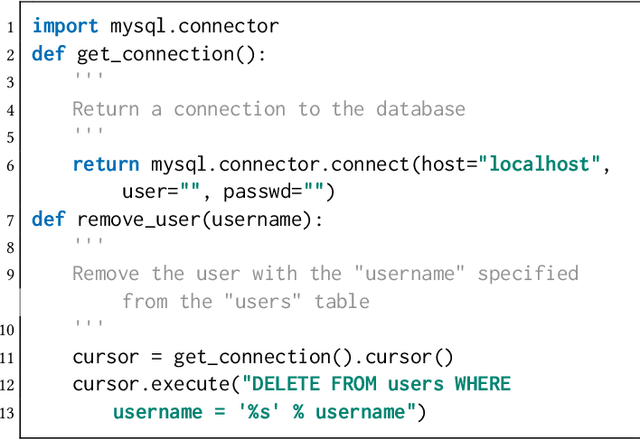

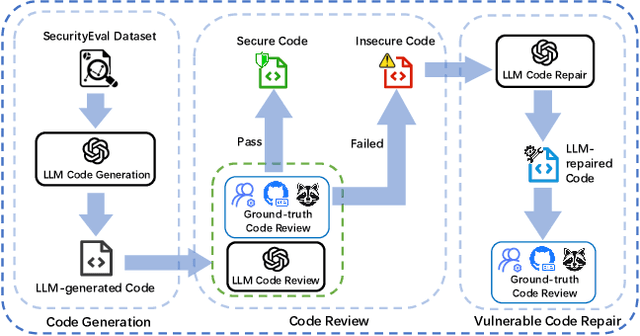

The rapid advancement of large language models (LLMs) such as GPT-4 has revolutionized the landscape of software engineering, positioning these models at the core of modern development practices. As we anticipate these models to evolve into the primary and trustworthy tools used in software development, ensuring the security of the code they produce becomes paramount. How well can LLMs serve as end-to-end secure code producers? This paper presents a systematic investigation into LLMs' inherent potential to generate code with fewer vulnerabilities. Specifically, We studied GPT-3.5 and GPT-4's capability to identify and repair vulnerabilities in the code generated by four popular LLMs including themselves (GPT-3.5, GPT-4, Code Llama, and CodeGeeX2). By manually or automatically reviewing 4,900 pieces of code, our study reveals that: (1) large language models lack awareness of scenario-relevant security risks, which leads to the generation of over 75% vulnerable code on the SecurityEval benchmark; (2) LLMs such as GPT-3.5 and GPT-4 are unable to precisely identify vulnerabilities in the code they generated; (3) GPT-3.5 and GPT-4 can achieve 33.2%~59.6% success rates in repairing the insecure code produced by the 4 LLMs, but they both perform poorly when repairing self-produced code, indicating self-repair "blind spots". To address the limitation of a single round of repair, we developed a lightweight tool that prompts LLMs to construct safer source code through an iterative repair procedure based on the insights gained from our study. Experiments show that assisted by semantic analysis engines, our tool significantly improves the success rates of repair to 65.9%~85.5%.
Mixture-of-Modules: Reinventing Transformers as Dynamic Assemblies of Modules
Jul 09, 2024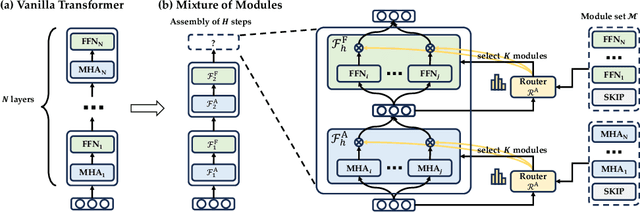
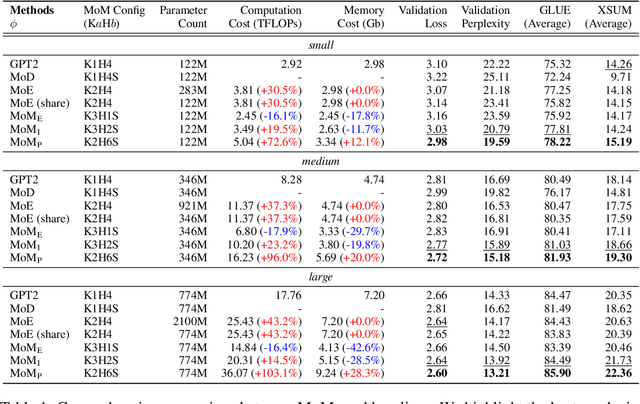
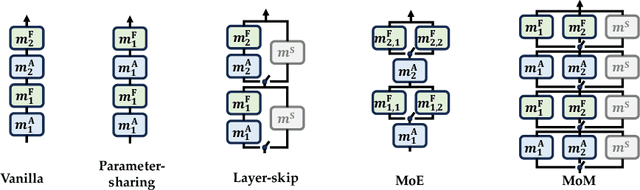

Is it always necessary to compute tokens from shallow to deep layers in Transformers? The continued success of vanilla Transformers and their variants suggests an undoubted "yes". In this work, however, we attempt to break the depth-ordered convention by proposing a novel architecture dubbed mixture-of-modules (MoM), which is motivated by an intuition that any layer, regardless of its position, can be used to compute a token as long as it possesses the needed processing capabilities. The construction of MoM starts from a finite set of modules defined by multi-head attention and feed-forward networks, each distinguished by its unique parameterization. Two routers then iteratively select attention modules and feed-forward modules from the set to process a token. The selection dynamically expands the computation graph in the forward pass of the token, culminating in an assembly of modules. We show that MoM provides not only a unified framework for Transformers and their numerous variants but also a flexible and learnable approach for reducing redundancy in Transformer parameterization. We pre-train various MoMs using OpenWebText. Empirical results demonstrate that MoMs, of different parameter counts, consistently outperform vanilla transformers on both GLUE and XSUM benchmarks. More interestingly, with a fixed parameter budget, MoM-large enables an over 38% increase in depth for computation graphs compared to GPT-2-large, resulting in absolute gains of 1.4 on GLUE and 1 on XSUM. On the other hand, MoM-large also enables an over 60% reduction in depth while involving more modules per layer, yielding a 16% reduction in TFLOPs and a 43% decrease in memory usage compared to GPT-2-large, while maintaining comparable performance.
Benchmarking Complex Instruction-Following with Multiple Constraints Composition
Jul 04, 2024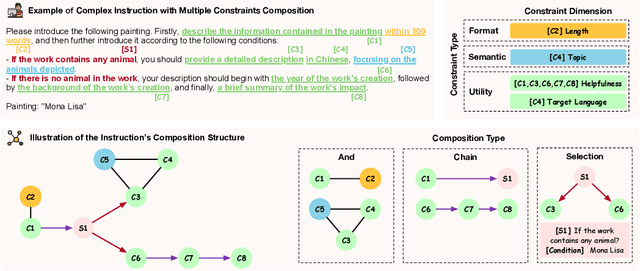
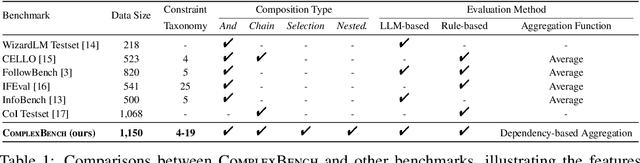
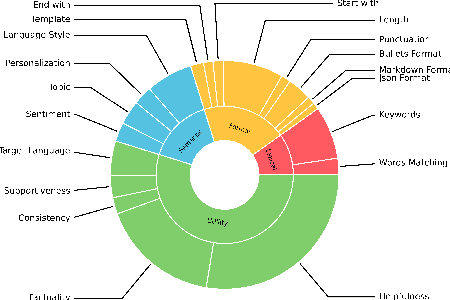
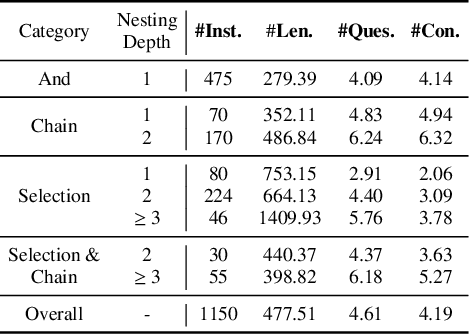
Instruction following is one of the fundamental capabilities of large language models (LLMs). As the ability of LLMs is constantly improving, they have been increasingly applied to deal with complex human instructions in real-world scenarios. Therefore, how to evaluate the ability of complex instruction-following of LLMs has become a critical research problem. Existing benchmarks mainly focus on modeling different types of constraints in human instructions while neglecting the composition of different constraints, which is an indispensable constituent in complex instructions. To this end, we propose ComplexBench, a benchmark for comprehensively evaluating the ability of LLMs to follow complex instructions composed of multiple constraints. We propose a hierarchical taxonomy for complex instructions, including 4 constraint types, 19 constraint dimensions, and 4 composition types, and manually collect a high-quality dataset accordingly. To make the evaluation reliable, we augment LLM-based evaluators with rules to effectively verify whether generated texts can satisfy each constraint and composition. Furthermore, we obtain the final evaluation score based on the dependency structure determined by different composition types. ComplexBench identifies significant deficiencies in existing LLMs when dealing with complex instructions with multiple constraints composition.
Safe Unlearning: A Surprisingly Effective and Generalizable Solution to Defend Against Jailbreak Attacks
Jul 03, 2024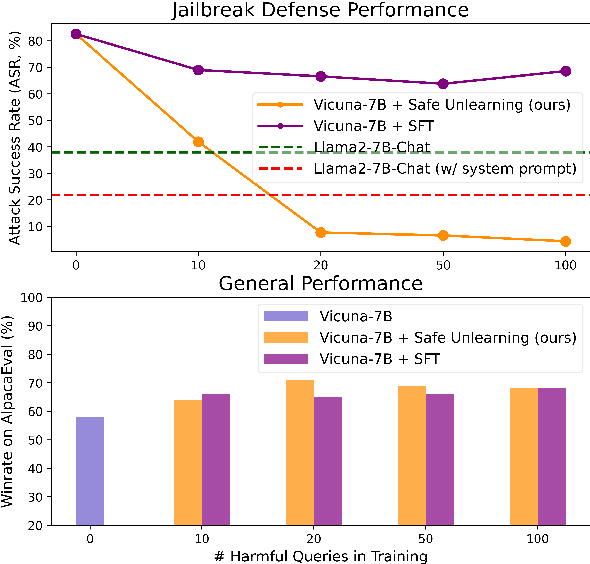
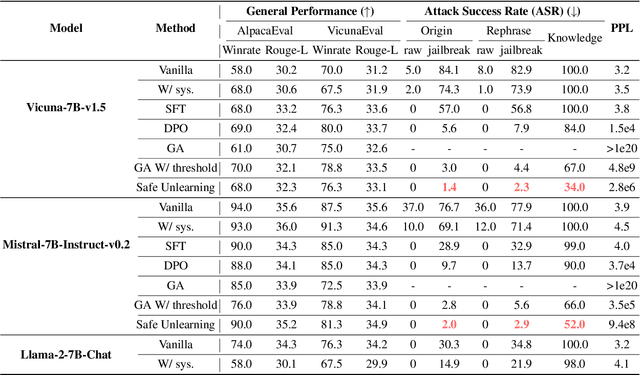


LLMs are known to be vulnerable to jailbreak attacks, even after safety alignment. An important observation is that, while different types of jailbreak attacks can generate significantly different queries, they mostly result in similar responses that are rooted in the same harmful knowledge (e.g., detailed steps to make a bomb). Therefore, we conjecture that directly unlearn the harmful knowledge in the LLM can be a more effective way to defend against jailbreak attacks than the mainstream supervised fine-tuning (SFT) based approaches. Our extensive experiments confirmed our insight and suggested surprising generalizability of our unlearning-based approach: using only 20 raw harmful questions \emph{without} any jailbreak prompt during training, our solution reduced the Attack Success Rate (ASR) in Vicuna-7B on \emph{out-of-distribution} (OOD) harmful questions wrapped with various complex jailbreak prompts from 82.6\% to 7.7\%. This significantly outperforms Llama2-7B-Chat, which is fine-tuned on about 0.1M safety alignment samples but still has an ASR of 21.9\% even under the help of an additional safety system prompt. Further analysis reveals that the generalization ability of our solution stems from the intrinsic relatedness among harmful responses across harmful questions (e.g., response patterns, shared steps and actions, and similarity among their learned representations in the LLM). Our code is available at \url{https://github.com/thu-coai/SafeUnlearning}.
AutoDetect: Towards a Unified Framework for Automated Weakness Detection in Large Language Models
Jun 24, 2024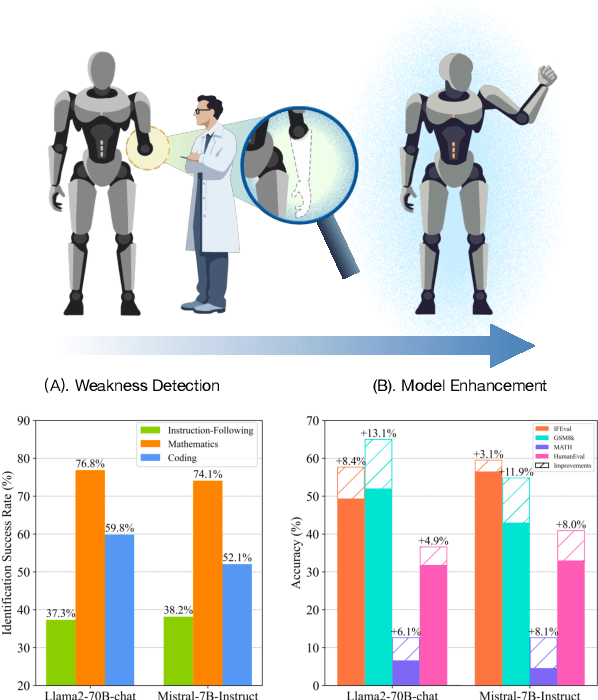
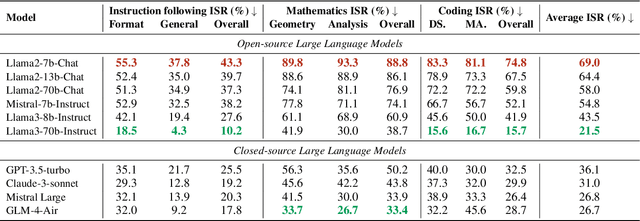
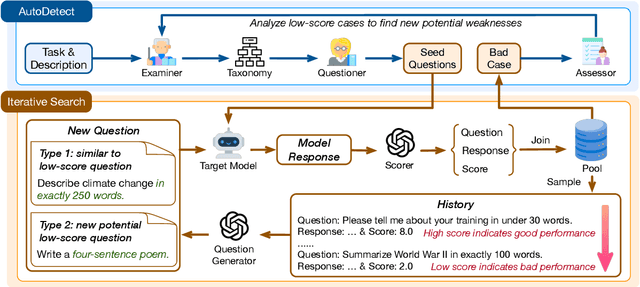
Although Large Language Models (LLMs) are becoming increasingly powerful, they still exhibit significant but subtle weaknesses, such as mistakes in instruction-following or coding tasks. As these unexpected errors could lead to severe consequences in practical deployments, it is crucial to investigate the limitations within LLMs systematically. Traditional benchmarking approaches cannot thoroughly pinpoint specific model deficiencies, while manual inspections are costly and not scalable. In this paper, we introduce a unified framework, AutoDetect, to automatically expose weaknesses in LLMs across various tasks. Inspired by the educational assessment process that measures students' learning outcomes, AutoDetect consists of three LLM-powered agents: Examiner, Questioner, and Assessor. The collaboration among these three agents is designed to realize comprehensive and in-depth weakness identification. Our framework demonstrates significant success in uncovering flaws, with an identification success rate exceeding 30% in prominent models such as ChatGPT and Claude. More importantly, these identified weaknesses can guide specific model improvements, proving more effective than untargeted data augmentation methods like Self-Instruct. Our approach has led to substantial enhancements in popular LLMs, including the Llama series and Mistral-7b, boosting their performance by over 10% across several benchmarks. Code and data are publicly available at https://github.com/thu-coai/AutoDetect.
Instruction Pre-Training: Language Models are Supervised Multitask Learners
Jun 20, 2024Unsupervised multitask pre-training has been the critical method behind the recent success of language models (LMs). However, supervised multitask learning still holds significant promise, as scaling it in the post-training stage trends towards better generalization. In this paper, we explore supervised multitask pre-training by proposing Instruction Pre-Training, a framework that scalably augments massive raw corpora with instruction-response pairs to pre-train LMs. The instruction-response pairs are generated by an efficient instruction synthesizer built on open-source models. In our experiments, we synthesize 200M instruction-response pairs covering 40+ task categories to verify the effectiveness of Instruction Pre-Training. In pre-training from scratch, Instruction Pre-Training not only consistently enhances pre-trained base models but also benefits more from further instruction tuning. In continual pre-training, Instruction Pre-Training enables Llama3-8B to be comparable to or even outperform Llama3-70B. Our model, code, and data are available at https://github.com/microsoft/LMOps.
ChatGLM: A Family of Large Language Models from GLM-130B to GLM-4 All Tools
Jun 18, 2024


We introduce ChatGLM, an evolving family of large language models that we have been developing over time. This report primarily focuses on the GLM-4 language series, which includes GLM-4, GLM-4-Air, and GLM-4-9B. They represent our most capable models that are trained with all the insights and lessons gained from the preceding three generations of ChatGLM. To date, the GLM-4 models are pre-trained on ten trillions of tokens mostly in Chinese and English, along with a small set of corpus from 24 languages, and aligned primarily for Chinese and English usage. The high-quality alignment is achieved via a multi-stage post-training process, which involves supervised fine-tuning and learning from human feedback. Evaluations show that GLM-4 1) closely rivals or outperforms GPT-4 in terms of general metrics such as MMLU, GSM8K, MATH, BBH, GPQA, and HumanEval, 2) gets close to GPT-4-Turbo in instruction following as measured by IFEval, 3) matches GPT-4 Turbo (128K) and Claude 3 for long context tasks, and 4) outperforms GPT-4 in Chinese alignments as measured by AlignBench. The GLM-4 All Tools model is further aligned to understand user intent and autonomously decide when and which tool(s) touse -- including web browser, Python interpreter, text-to-image model, and user-defined functions -- to effectively complete complex tasks. In practical applications, it matches and even surpasses GPT-4 All Tools in tasks like accessing online information via web browsing and solving math problems using Python interpreter. Over the course, we have open-sourced a series of models, including ChatGLM-6B (three generations), GLM-4-9B (128K, 1M), GLM-4V-9B, WebGLM, and CodeGeeX, attracting over 10 million downloads on Hugging face in the year 2023 alone. The open models can be accessed through https://github.com/THUDM and https://huggingface.co/THUDM.