 Add to Chrome
 Add to Firefox
 Add to Edge
Progressive Video Condensation with MLLM Agent for Long-form Video Understanding
Apr 03, 2026
Understanding long videos requires extracting query-relevant information from long sequences under tight compute budgets. Existing text-then-LLM pipelines lose fine-grained visual cues, while video-based multimodal large language models (MLLMs) can keep visual details but are too frame-hungry and computationally expensive. In this work, we aim to harness MLLMs for efficient video understanding. We propose ProVCA, a progressive video condensation agent that iteratively locates key video frames at multiple granularities. ProVCA first adopts a segment localization module to identify the video segment relevant to the query, then a snippet selection module to select important snippets based on similarity, and finally a keyframe refinement module to pinpoint specific keyframes in those snippets. By progressively narrowing the scope from coarse segments to fine frames, ProVCA identifies a small set of keyframes for MLLM-based reasoning. ProVCA achieves state-of-the-art zero-shot accuracies of 69.3\% on EgoSchema, 80.5\% on NExT-QA, and 77.7\% on IntentQA, while using fewer frames than previous training-free methods.

VideoARM: Agentic Reasoning over Hierarchical Memory for Long-Form Video Understanding
Dec 13, 2025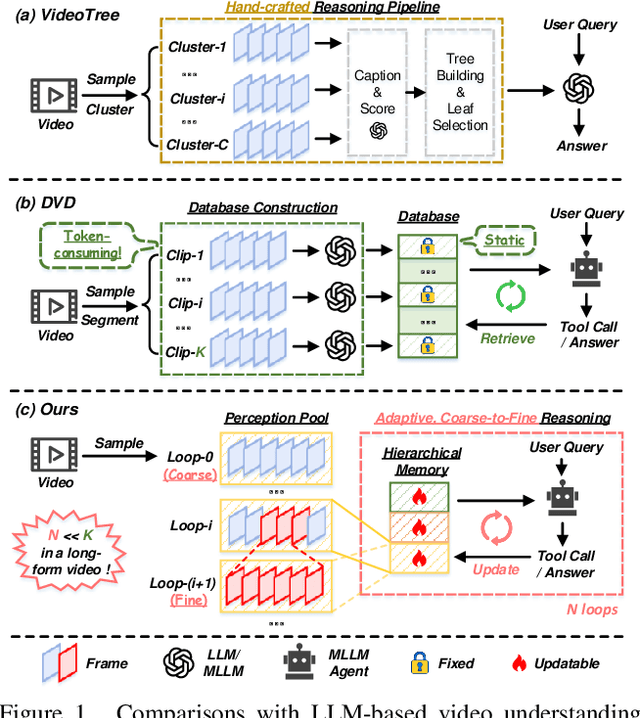
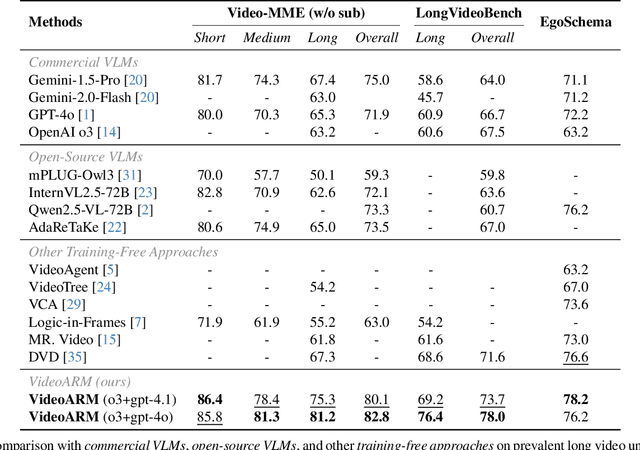
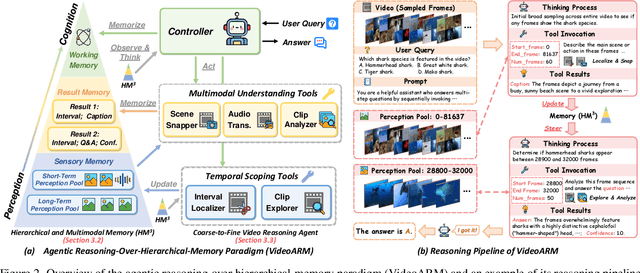
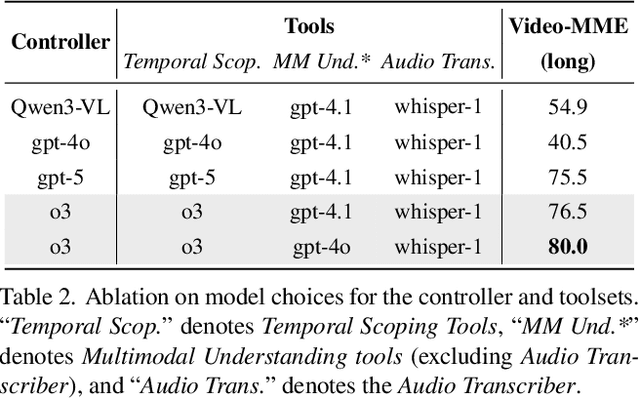
Long-form video understanding remains challenging due to the extended temporal structure and dense multimodal cues. Despite recent progress, many existing approaches still rely on hand-crafted reasoning pipelines or employ token-consuming video preprocessing to guide MLLMs in autonomous reasoning. To overcome these limitations, we introduce VideoARM, an Agentic Reasoning-over-hierarchical-Memory paradigm for long-form video understanding. Instead of static, exhaustive preprocessing, VideoARM performs adaptive, on-the-fly agentic reasoning and memory construction. Specifically, VideoARM performs an adaptive and continuous loop of observing, thinking, acting, and memorizing, where a controller autonomously invokes tools to interpret the video in a coarse-to-fine manner, thereby substantially reducing token consumption. In parallel, a hierarchical multimodal memory continuously captures and updates multi-level clues throughout the operation of the agent, providing precise contextual information to support the controller in decision-making. Experiments on prevalent benchmarks demonstrate that VideoARM outperforms the state-of-the-art method, DVD, while significantly reducing token consumption for long-form videos.