 Add to Chrome
 Add to Firefox
 Add to Edge
DerainSplat: Feed-Forward Clean 3D Gaussian Splatting from Sparse Rainy Views
Aug 03, 2026
Although image deraining has advanced substantially, existing methods mainly focus on 2D image restoration. As spatial intelligence applications such as embodied AI and autonomous driving continue to emerge, reconstructing clean 3D scenes from sparse rainy views in a feed-forward manner becomes increasingly important. Existing feed-forward 3D Gaussian Splatting (3DGS) methods often assume clean inputs and collapse under rainy conditions. To this end, we present \textbf{\textit{DerainSplat}}, a feed-forward framework that reconstructs clean 3D scenes from only a few rainy views. To support this task, we build a large-scale multi-view derain dataset through a four-stage synthesis pipeline that sequentially models overcast illumination, depth-dependent haze, rain streaks, and lens raindrops, producing privileged weather factors. We introduce a weather net that predicts the weather factors from rainy context and yields two support maps. Scene support modulates cross-view cost-volume matching, while radiance support drives depth-aligned appearance fusion to fill corrupted pixels. The derived geometry evidence further attenuates Gaussian opacity to reduce spurious structures. A rainy cycle consistency re-renders clean views using the predicted factors and aligns them with rainy inputs. Extensive experiments show that \textbf{\textit{DerainSplat}} outperforms existing methods on various datasets, including RealEstate10K, ACID, Mip-NeRF360, and real-world rainy scenes, with strong cross-dataset generalization.

SRSplat: Feed-Forward Super-Resolution Gaussian Splatting from Sparse Multi-View Images
Nov 15, 2025Feed-forward 3D reconstruction from sparse, low-resolution (LR) images is a crucial capability for real-world applications, such as autonomous driving and embodied AI. However, existing methods often fail to recover fine texture details. This limitation stems from the inherent lack of high-frequency information in LR inputs. To address this, we propose \textbf{SRSplat}, a feed-forward framework that reconstructs high-resolution 3D scenes from only a few LR views. Our main insight is to compensate for the deficiency of texture information by jointly leveraging external high-quality reference images and internal texture cues. We first construct a scene-specific reference gallery, generated for each scene using Multimodal Large Language Models (MLLMs) and diffusion models. To integrate this external information, we introduce the \textit{Reference-Guided Feature Enhancement (RGFE)} module, which aligns and fuses features from the LR input images and their reference twin image. Subsequently, we train a decoder to predict the Gaussian primitives using the multi-view fused feature obtained from \textit{RGFE}. To further refine predicted Gaussian primitives, we introduce \textit{Texture-Aware Density Control (TADC)}, which adaptively adjusts Gaussian density based on the internal texture richness of the LR inputs. Extensive experiments demonstrate that our SRSplat outperforms existing methods on various datasets, including RealEstate10K, ACID, and DTU, and exhibits strong cross-dataset and cross-resolution generalization capabilities.
Sparse4DGS: 4D Gaussian Splatting for Sparse-Frame Dynamic Scene Reconstruction
Nov 10, 2025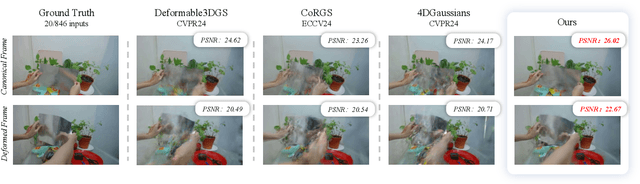

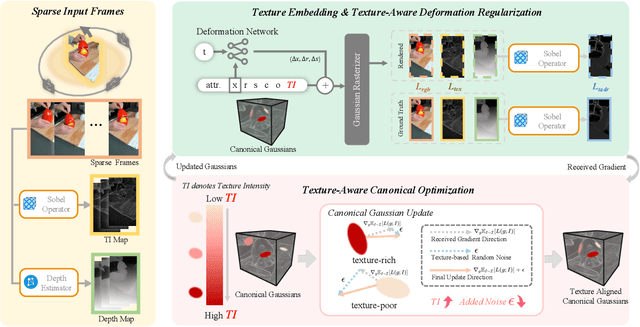
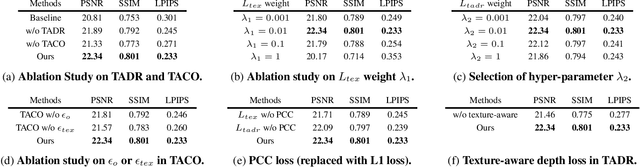
Dynamic Gaussian Splatting approaches have achieved remarkable performance for 4D scene reconstruction. However, these approaches rely on dense-frame video sequences for photorealistic reconstruction. In real-world scenarios, due to equipment constraints, sometimes only sparse frames are accessible. In this paper, we propose Sparse4DGS, the first method for sparse-frame dynamic scene reconstruction. We observe that dynamic reconstruction methods fail in both canonical and deformed spaces under sparse-frame settings, especially in areas with high texture richness. Sparse4DGS tackles this challenge by focusing on texture-rich areas. For the deformation network, we propose Texture-Aware Deformation Regularization, which introduces a texture-based depth alignment loss to regulate Gaussian deformation. For the canonical Gaussian field, we introduce Texture-Aware Canonical Optimization, which incorporates texture-based noise into the gradient descent process of canonical Gaussians. Extensive experiments show that when taking sparse frames as inputs, our method outperforms existing dynamic or few-shot techniques on NeRF-Synthetic, HyperNeRF, NeRF-DS, and our iPhone-4D datasets.