 Add to Chrome
 Add to Firefox
 Add to Edge
Enhanced Direction-Sensing Methods and Performance Analysis in Low-Altitude Wireless Network via a Rotation Antenna Array
Mar 21, 2026
Due to the directive property of each antenna element, the received signal power can be severely attenuated when the emitter deviates from the array boresight, which will lead to a severe degradation in sensing performance along the corresponding direction. Although existing rotatable array sensing methods such as recursive rotation (RR-Root-MUSIC) can mitigate this issue by iteratively rotating and sensing, several mechanical rotations and repeated eigendecomposition operations are required to yield a high computational complexity and low time-efficiency. To address this problem, a pre-rotation initialization with recieve power as a rule is proposed to signifcantly reduce the computational complexity and improve the time-efficiency. Using this idea, a low-complexity enhanced direction-sensing framework with pre-rotation initialization and iterative greedy spatial-spectrum search (PRI-IGSS) is develped with three stages: (1) the normal vector of array is rotated to a set of candidates to find the opimal direction with the maximum sensing energy with the corresponding DOA value computed by the Root-MUSIC algorithm; (2) the array is mechanically rotated to the initial estimated direction and kept fixed; (3) an iterative greedy spatial-spectrum search or recieving beamforming method, moviated by reinforcement learning, is designed with a reduced search range and making a summation of all previous sampling variance matrices and the current one is adopted to provide an increasiong performance gain as the iteration process continues. To assess the performance of the proposed method, the corresponding CRLB is derived with a simplified rotation model. Simulation results demonstrate that the proposed PRI-IGSS method performs much better than RR-Root-MUSIC and achieves the CRLB in term of mean squared error due to the fact there is no sample accumulation for the latter.

DoF Analysis and Beamforming Design for Active IRS-aided Multi-user MIMO Wireless Communication in Rank-deficient Channels
Nov 13, 2024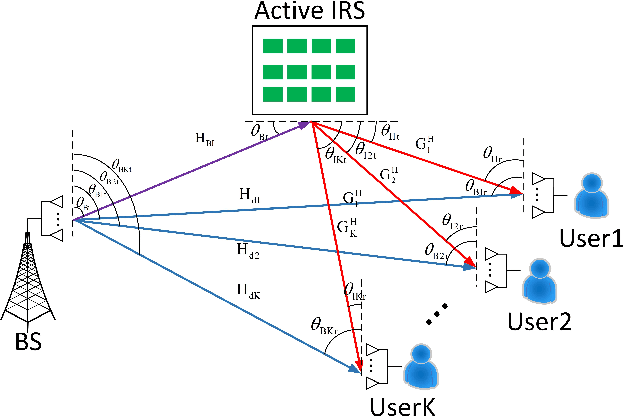
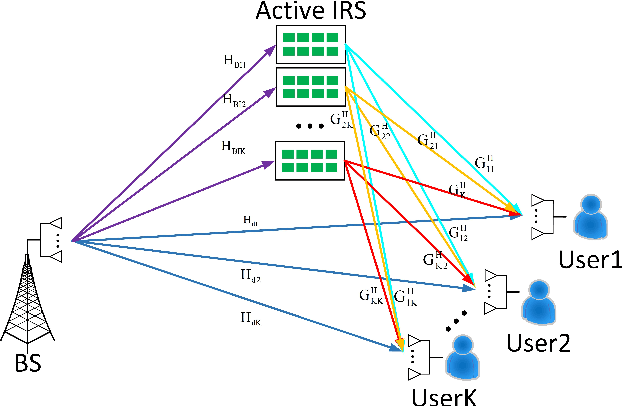
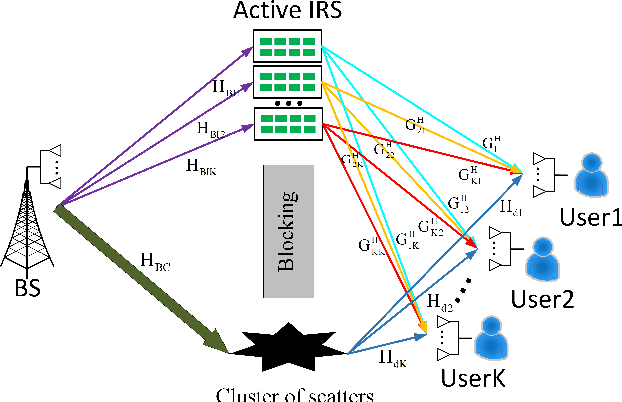
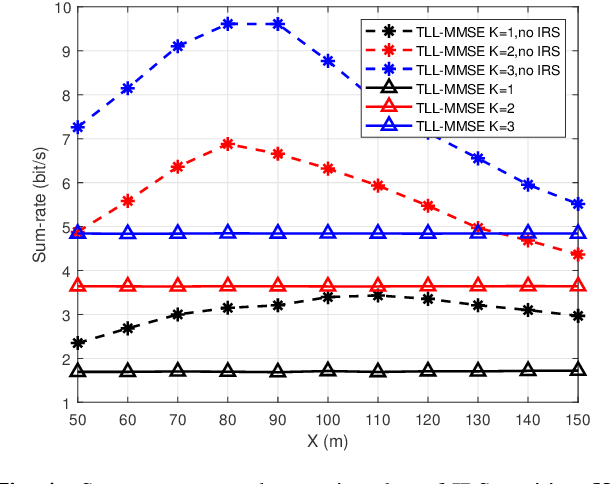
Due to its ability of significantly improving data rate, intelligent reflecting surface (IRS) will be a potential crucial technique for the future generation wireless networks like 6G. In this paper, we will focus on the analysis of degree of freedom (DoF) in IRS-aided multi-user MIMO network. Firstly, the DoF upper bound of IRS-aided single-user MIMO network, i.e., the achievable maximum DoF of such a system, is derived, and the corresponding results are extended to the case of IRS-aided multiuser MIMO by using the matrix rank inequalities. In particular, in serious rank-deficient, also called low-rank, channels like line-of-sight (LoS), the network DoF may doubles over no-IRS with the help of IRS. To verify the rate performance gain from augmented DoF, three closed-form beamforming methods, null-space projection plus maximize transmit power and maximize receive power (NSP-MTP-MRP), Schmidt orthogonalization plus minimum mean square error (SO-MMSE) and two-layer leakage plus MMSE (TLL-MMSE) are proposed to achieve the maximum DoF. Simulation results shows that IRS does make a dramatic rate enhancement. For example, in a serious deficient channel, the sum-rate of the proposed TLL-MMSE aided by IRS is about twice that of no IRS. This means that IRS may achieve a significant DoF improvement in such a channel.