 Add to Chrome
 Add to Firefox
 Add to Edge
Generative Reasoning Re-ranker
Feb 08, 2026
Recent studies increasingly explore Large Language Models (LLMs) as a new paradigm for recommendation systems due to their scalability and world knowledge. However, existing work has three key limitations: (1) most efforts focus on retrieval and ranking, while the reranking phase, critical for refining final recommendations, is largely overlooked; (2) LLMs are typically used in zero-shot or supervised fine-tuning settings, leaving their reasoning abilities, especially those enhanced through reinforcement learning (RL) and high-quality reasoning data, underexploited; (3) items are commonly represented by non-semantic IDs, creating major scalability challenges in industrial systems with billions of identifiers. To address these gaps, we propose the Generative Reasoning Reranker (GR2), an end-to-end framework with a three-stage training pipeline tailored for reranking. First, a pretrained LLM is mid-trained on semantic IDs encoded from non-semantic IDs via a tokenizer achieving $\ge$99% uniqueness. Next, a stronger larger-scale LLM generates high-quality reasoning traces through carefully designed prompting and rejection sampling, which are used for supervised fine-tuning to impart foundational reasoning skills. Finally, we apply Decoupled Clip and Dynamic sAmpling Policy Optimization (DAPO), enabling scalable RL supervision with verifiable rewards designed specifically for reranking. Experiments on two real-world datasets demonstrate GR2's effectiveness: it surpasses the state-of-the-art OneRec-Think by 2.4% in Recall@5 and 1.3% in NDCG@5. Ablations confirm that advanced reasoning traces yield substantial gains across metrics. We further find that RL reward design is crucial in reranking: LLMs tend to exploit reward hacking by preserving item order, motivating conditional verifiable rewards to mitigate this behavior and optimize reranking performance.

AutoScape: Geometry-Consistent Long-Horizon Scene Generation
Oct 23, 2025This paper proposes AutoScape, a long-horizon driving scene generation framework. At its core is a novel RGB-D diffusion model that iteratively generates sparse, geometrically consistent keyframes, serving as reliable anchors for the scene's appearance and geometry. To maintain long-range geometric consistency, the model 1) jointly handles image and depth in a shared latent space, 2) explicitly conditions on the existing scene geometry (i.e., rendered point clouds) from previously generated keyframes, and 3) steers the sampling process with a warp-consistent guidance. Given high-quality RGB-D keyframes, a video diffusion model then interpolates between them to produce dense and coherent video frames. AutoScape generates realistic and geometrically consistent driving videos of over 20 seconds, improving the long-horizon FID and FVD scores over the prior state-of-the-art by 48.6\% and 43.0\%, respectively.
AssoCiAm: A Benchmark for Evaluating Association Thinking while Circumventing Ambiguity
Sep 18, 2025Recent advancements in multimodal large language models (MLLMs) have garnered significant attention, offering a promising pathway toward artificial general intelligence (AGI). Among the essential capabilities required for AGI, creativity has emerged as a critical trait for MLLMs, with association serving as its foundation. Association reflects a model' s ability to think creatively, making it vital to evaluate and understand. While several frameworks have been proposed to assess associative ability, they often overlook the inherent ambiguity in association tasks, which arises from the divergent nature of associations and undermines the reliability of evaluations. To address this issue, we decompose ambiguity into two types-internal ambiguity and external ambiguity-and introduce AssoCiAm, a benchmark designed to evaluate associative ability while circumventing the ambiguity through a hybrid computational method. We then conduct extensive experiments on MLLMs, revealing a strong positive correlation between cognition and association. Additionally, we observe that the presence of ambiguity in the evaluation process causes MLLMs' behavior to become more random-like. Finally, we validate the effectiveness of our method in ensuring more accurate and reliable evaluations. See Project Page for the data and codes.
Incremental Object Keypoint Learning
Mar 26, 2025Existing progress in object keypoint estimation primarily benefits from the conventional supervised learning paradigm based on numerous data labeled with pre-defined keypoints. However, these well-trained models can hardly detect the undefined new keypoints in test time, which largely hinders their feasibility for diverse downstream tasks. To handle this, various solutions are explored but still suffer from either limited generalizability or transferability. Therefore, in this paper, we explore a novel keypoint learning paradigm in that we only annotate new keypoints in the new data and incrementally train the model, without retaining any old data, called Incremental object Keypoint Learning (IKL). A two-stage learning scheme as a novel baseline tailored to IKL is developed. In the first Knowledge Association stage, given the data labeled with only new keypoints, an auxiliary KA-Net is trained to automatically associate the old keypoints to these new ones based on their spatial and intrinsic anatomical relations. In the second Mutual Promotion stage, based on a keypoint-oriented spatial distillation loss, we jointly leverage the auxiliary KA-Net and the old model for knowledge consolidation to mutually promote the estimation of all old and new keypoints. Owing to the investigation of the correlations between new and old keypoints, our proposed method can not just effectively mitigate the catastrophic forgetting of old keypoints, but may even further improve the estimation of the old ones and achieve a positive transfer beyond anti-forgetting. Such an observation has been solidly verified by extensive experiments on different keypoint datasets, where our method exhibits superiority in alleviating the forgetting issue and boosting performance while enjoying labeling efficiency even under the low-shot data regime.
External Large Foundation Model: How to Efficiently Serve Trillions of Parameters for Online Ads Recommendation
Feb 26, 2025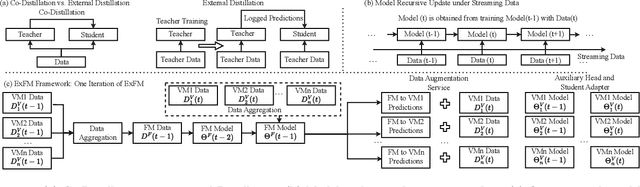
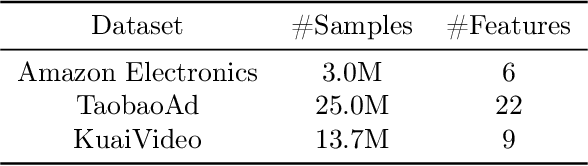
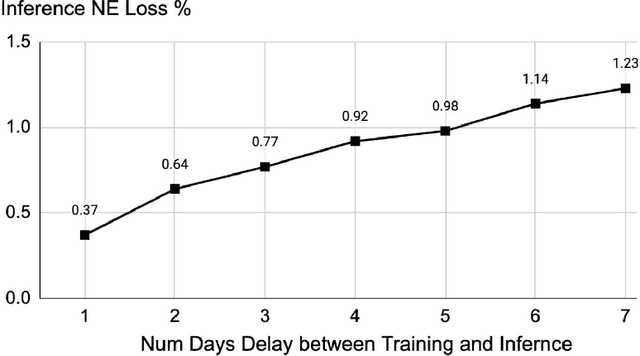
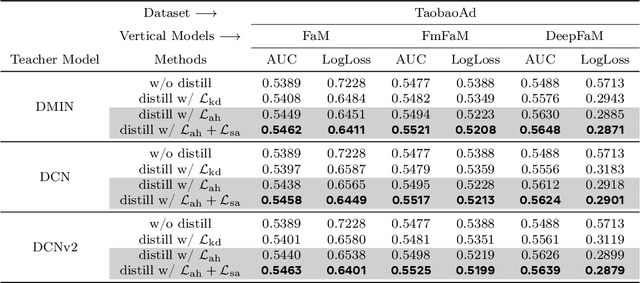
Ads recommendation is a prominent service of online advertising systems and has been actively studied. Recent studies indicate that scaling-up and advanced design of the recommendation model can bring significant performance improvement. However, with a larger model scale, such prior studies have a significantly increasing gap from industry as they often neglect two fundamental challenges in industrial-scale applications. First, training and inference budgets are restricted for the model to be served, exceeding which may incur latency and impair user experience. Second, large-volume data arrive in a streaming mode with data distributions dynamically shifting, as new users/ads join and existing users/ads leave the system. We propose the External Large Foundation Model (ExFM) framework to address the overlooked challenges. Specifically, we develop external distillation and a data augmentation system (DAS) to control the computational cost of training/inference while maintaining high performance. We design the teacher in a way like a foundation model (FM) that can serve multiple students as vertical models (VMs) to amortize its building cost. We propose Auxiliary Head and Student Adapter to mitigate the data distribution gap between FM and VMs caused by the streaming data issue. Comprehensive experiments on internal industrial-scale applications and public datasets demonstrate significant performance gain by ExFM.
The Efficiency vs. Accuracy Trade-off: Optimizing RAG-Enhanced LLM Recommender Systems Using Multi-Head Early Exit
Jan 04, 2025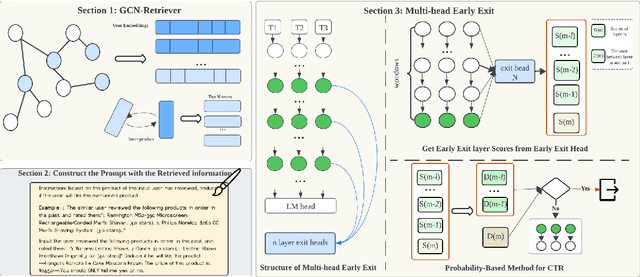
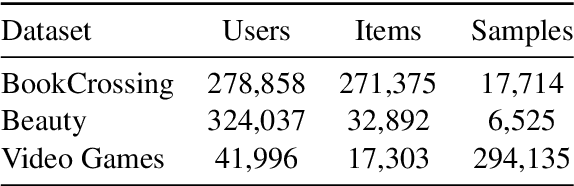
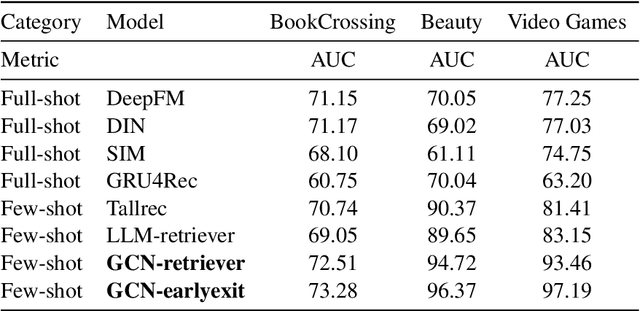
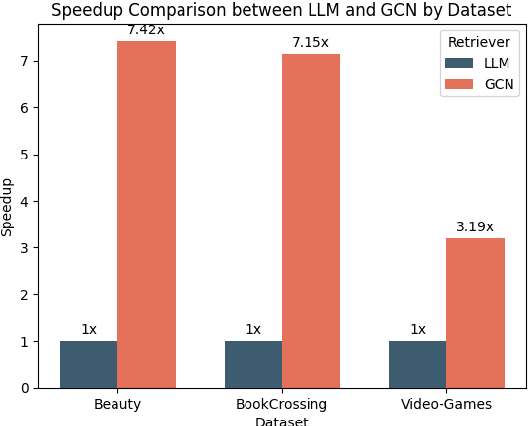
The deployment of Large Language Models (LLMs) in recommender systems for predicting Click-Through Rates (CTR) necessitates a delicate balance between computational efficiency and predictive accuracy. This paper presents an optimization framework that combines Retrieval-Augmented Generation (RAG) with an innovative multi-head early exit architecture to concurrently enhance both aspects. By integrating Graph Convolutional Networks (GCNs) as efficient retrieval mechanisms, we are able to significantly reduce data retrieval times while maintaining high model performance. The early exit strategy employed allows for dynamic termination of model inference, utilizing real-time predictive confidence assessments across multiple heads. This not only quickens the responsiveness of LLMs but also upholds or improves their accuracy, making it ideal for real-time application scenarios. Our experiments demonstrate how this architecture effectively decreases computation time without sacrificing the accuracy needed for reliable recommendation delivery, establishing a new standard for efficient, real-time LLM deployment in commercial systems.
Accelerating Multimodel Large Language Models by Searching Optimal Vision Token Reduction
Nov 30, 2024


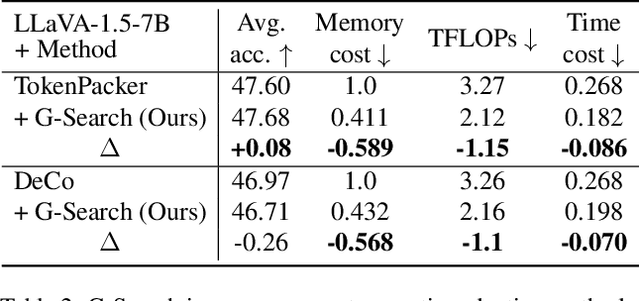
Prevailing Multimodal Large Language Models (MLLMs) encode the input image(s) as vision tokens and feed them into the language backbone, similar to how Large Language Models (LLMs) process the text tokens. However, the number of vision tokens increases quadratically as the image resolutions, leading to huge computational costs. In this paper, we consider improving MLLM's efficiency from two scenarios, (I) Reducing computational cost without degrading the performance. (II) Improving the performance with given budgets. We start with our main finding that the ranking of each vision token sorted by attention scores is similar in each layer except the first layer. Based on it, we assume that the number of essential top vision tokens does not increase along layers. Accordingly, for Scenario I, we propose a greedy search algorithm (G-Search) to find the least number of vision tokens to keep at each layer from the shallow to the deep. Interestingly, G-Search is able to reach the optimal reduction strategy based on our assumption. For Scenario II, based on the reduction strategy from G-Search, we design a parametric sigmoid function (P-Sigmoid) to guide the reduction at each layer of the MLLM, whose parameters are optimized by Bayesian Optimization. Extensive experiments demonstrate that our approach can significantly accelerate those popular MLLMs, e.g. LLaVA, and InternVL2 models, by more than $2 \times$ without performance drops. Our approach also far outperforms other token reduction methods when budgets are limited, achieving a better trade-off between efficiency and effectiveness.
AIDE: An Automatic Data Engine for Object Detection in Autonomous Driving
Mar 26, 2024


Autonomous vehicle (AV) systems rely on robust perception models as a cornerstone of safety assurance. However, objects encountered on the road exhibit a long-tailed distribution, with rare or unseen categories posing challenges to a deployed perception model. This necessitates an expensive process of continuously curating and annotating data with significant human effort. We propose to leverage recent advances in vision-language and large language models to design an Automatic Data Engine (AIDE) that automatically identifies issues, efficiently curates data, improves the model through auto-labeling, and verifies the model through generation of diverse scenarios. This process operates iteratively, allowing for continuous self-improvement of the model. We further establish a benchmark for open-world detection on AV datasets to comprehensively evaluate various learning paradigms, demonstrating our method's superior performance at a reduced cost.
Evidential Active Recognition: Intelligent and Prudent Open-World Embodied Perception
Nov 23, 2023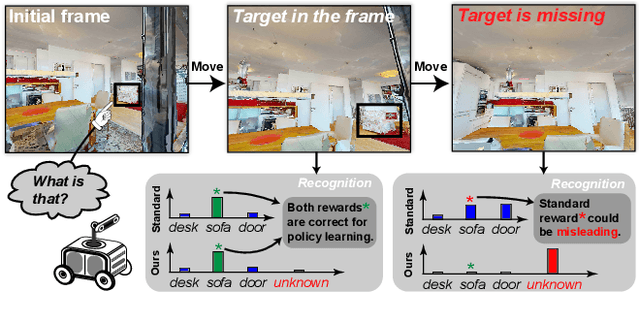
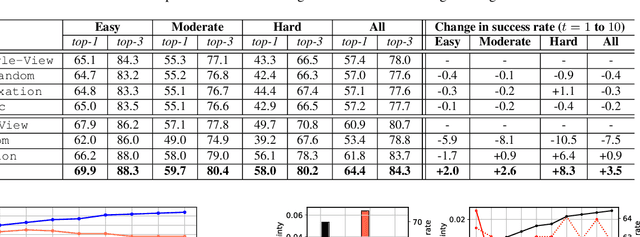
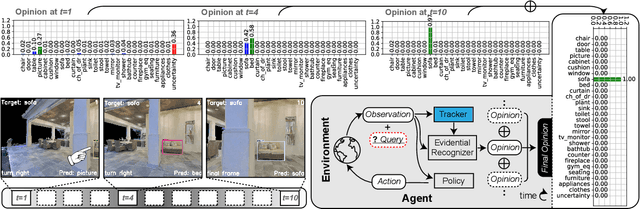
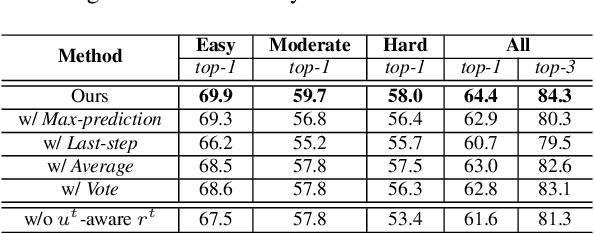
Active recognition enables robots to intelligently explore novel observations, thereby acquiring more information while circumventing undesired viewing conditions. Recent approaches favor learning policies from simulated or collected data, wherein appropriate actions are more frequently selected when the recognition is accurate. However, most recognition modules are developed under the closed-world assumption, which makes them ill-equipped to handle unexpected inputs, such as the absence of the target object in the current observation. To address this issue, we propose treating active recognition as a sequential evidence-gathering process, providing by-step uncertainty quantification and reliable prediction under the evidence combination theory. Additionally, the reward function developed in this paper effectively characterizes the merit of actions when operating in open-world environments. To evaluate the performance, we collect a dataset from an indoor simulator, encompassing various recognition challenges such as distance, occlusion levels, and visibility. Through a series of experiments on recognition and robustness analysis, we demonstrate the necessity of introducing uncertainties to active recognition and the superior performance of the proposed method.
Understanding Self-attention Mechanism via Dynamical System Perspective
Aug 19, 2023The self-attention mechanism (SAM) is widely used in various fields of artificial intelligence and has successfully boosted the performance of different models. However, current explanations of this mechanism are mainly based on intuitions and experiences, while there still lacks direct modeling for how the SAM helps performance. To mitigate this issue, in this paper, based on the dynamical system perspective of the residual neural network, we first show that the intrinsic stiffness phenomenon (SP) in the high-precision solution of ordinary differential equations (ODEs) also widely exists in high-performance neural networks (NN). Thus the ability of NN to measure SP at the feature level is necessary to obtain high performance and is an important factor in the difficulty of training NN. Similar to the adaptive step-size method which is effective in solving stiff ODEs, we show that the SAM is also a stiffness-aware step size adaptor that can enhance the model's representational ability to measure intrinsic SP by refining the estimation of stiffness information and generating adaptive attention values, which provides a new understanding about why and how the SAM can benefit the model performance. This novel perspective can also explain the lottery ticket hypothesis in SAM, design new quantitative metrics of representational ability, and inspire a new theoretic-inspired approach, StepNet. Extensive experiments on several popular benchmarks demonstrate that StepNet can extract fine-grained stiffness information and measure SP accurately, leading to significant improvements in various visual tasks.