 Add to Chrome
 Add to Firefox
 Add to Edge
Making Long-Context Language Models Better Multi-Hop Reasoners
Aug 06, 2024
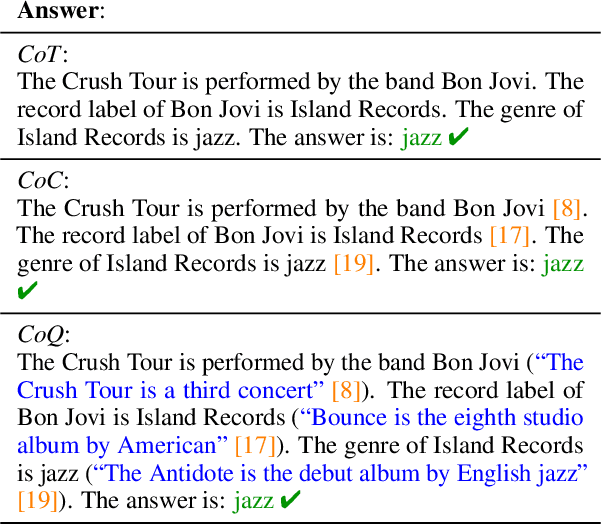
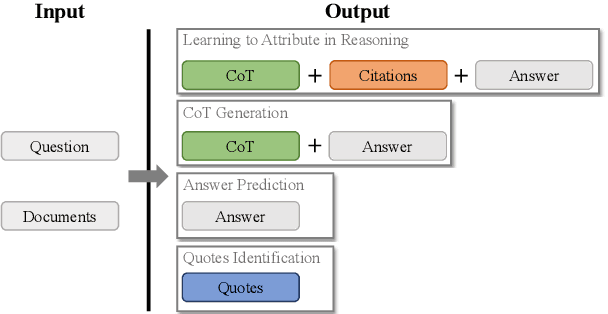
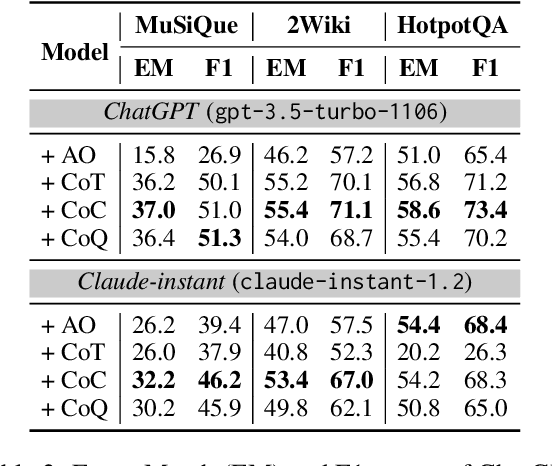
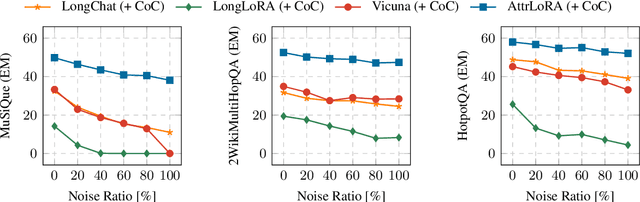
Recent advancements in long-context modeling have enhanced language models (LMs) for complex tasks across multiple NLP applications. Despite this progress, we find that these models struggle with multi-hop reasoning and exhibit decreased performance in the presence of noisy contexts. In this paper, we introduce Reasoning with Attributions, a novel approach that prompts LMs to supply attributions for each assertion during their reasoning. We validate our approach through experiments on three multi-hop datasets, employing both proprietary and open-source models, and demonstrate its efficacy and resilience. Furthermore, we explore methods to augment reasoning capabilities via fine-tuning and offer an attribution-annotated dataset and a specialized training strategy. Our fine-tuned model achieves competitive performance on multi-hop reasoning benchmarks, closely paralleling proprietary LMs such as ChatGPT and Claude-instant.

On the Resilience of Multi-Agent Systems with Malicious Agents
Aug 02, 2024Multi-agent systems, powered by large language models, have shown great abilities across various tasks due to the collaboration of expert agents, each focusing on a specific domain. However, when agents are deployed separately, there is a risk that malicious users may introduce malicious agents who generate incorrect or irrelevant results that are too stealthy to be identified by other non-specialized agents. Therefore, this paper investigates two essential questions: (1) What is the resilience of various multi-agent system structures (e.g., A$\rightarrow$B$\rightarrow$C, A$\leftrightarrow$B$\leftrightarrow$C) under malicious agents, on different downstream tasks? (2) How can we increase system resilience to defend against malicious agents? To simulate malicious agents, we devise two methods, AutoTransform and AutoInject, to transform any agent into a malicious one while preserving its functional integrity. We run comprehensive experiments on four downstream multi-agent systems tasks, namely code generation, math problems, translation, and text evaluation. Results suggest that the "hierarchical" multi-agent structure, i.e., A$\rightarrow$(B$\leftrightarrow$C), exhibits superior resilience with the lowest performance drop of $23.6\%$, compared to $46.4\%$ and $49.8\%$ of other two structures. Additionally, we show the promise of improving multi-agent system resilience by demonstrating that two defense methods, introducing an additional agent to review and correct messages or mechanisms for each agent to challenge others' outputs, can enhance system resilience. Our code and data are available at https://github.com/CUHK-ARISE/MAS-Resilience.
Automatically Generating UI Code from Screenshot: A Divide-and-Conquer-Based Approach
Jun 24, 2024
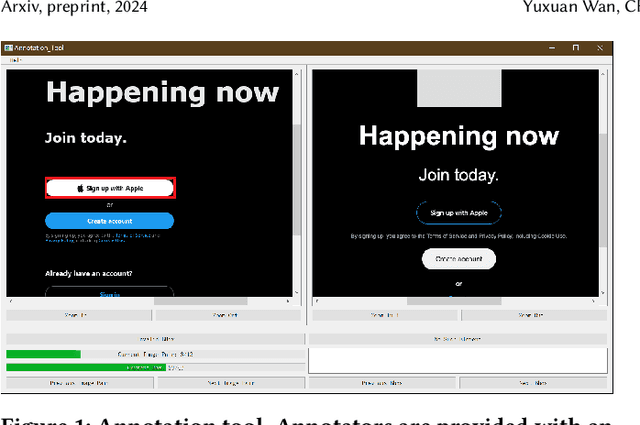


Websites are critical in today's digital world, with over 1.11 billion currently active and approximately 252,000 new sites launched daily. Converting website layout design into functional UI code is a time-consuming yet indispensable step of website development. Manual methods of converting visual designs into functional code present significant challenges, especially for non-experts. To explore automatic design-to-code solutions, we first conduct a motivating study on GPT-4o and identify three types of issues in generating UI code: element omission, element distortion, and element misarrangement. We further reveal that a focus on smaller visual segments can help multimodal large language models (MLLMs) mitigate these failures in the generation process. In this paper, we propose DCGen, a divide-and-conquer-based approach to automate the translation of webpage design to UI code. DCGen starts by dividing screenshots into manageable segments, generating descriptions for each segment, and then reassembling them into complete UI code for the entire screenshot. We conduct extensive testing with a dataset comprised of real-world websites and various MLLMs and demonstrate that DCGen achieves up to a 14% improvement in visual similarity over competing methods. To the best of our knowledge, DCGen is the first segment-aware prompt-based approach for generating UI code directly from screenshots.
Automatic Programming: Large Language Models and Beyond
May 03, 2024
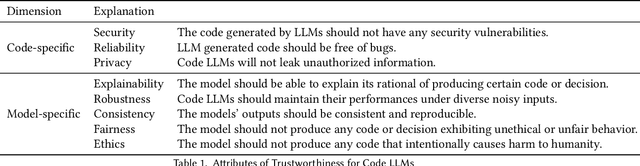
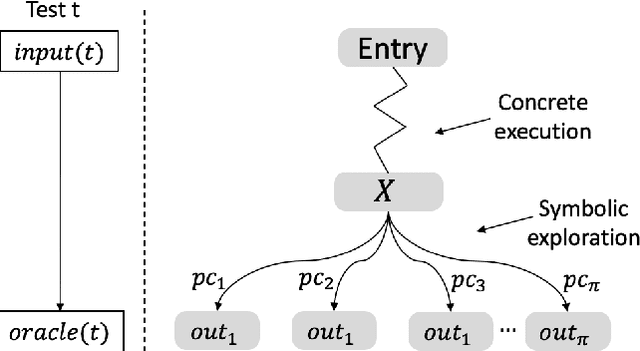

Automatic programming has seen increasing popularity due to the emergence of tools like GitHub Copilot which rely on Large Language Models (LLMs). At the same time, automatically generated code faces challenges during deployment due to concerns around quality and trust. In this article, we study automated coding in a general sense and study the concerns around code quality, security and related issues of programmer responsibility. These are key issues for organizations while deciding on the usage of automatically generated code. We discuss how advances in software engineering such as program repair and analysis can enable automatic programming. We conclude with a forward looking view, focusing on the programming environment of the near future, where programmers may need to switch to different roles to fully utilize the power of automatic programming. Automated repair of automatically generated programs from LLMs, can help produce higher assurance code from LLMs, along with evidence of assurance
How Well Can LLMs Echo Us? Evaluating AI Chatbots' Role-Play Ability with ECHO
Apr 22, 2024The role-play ability of Large Language Models (LLMs) has emerged as a popular research direction. However, existing studies focus on imitating well-known public figures or fictional characters, overlooking the potential for simulating ordinary individuals. Such an oversight limits the potential for advancements in digital human clones and non-player characters in video games. To bridge this gap, we introduce ECHO, an evaluative framework inspired by the Turing test. This framework engages the acquaintances of the target individuals to distinguish between human and machine-generated responses. Notably, our framework focuses on emulating average individuals rather than historical or fictional figures, presenting a unique advantage to apply the Turing Test. We evaluated three role-playing LLMs using ECHO, with GPT-3.5 and GPT-4 serving as foundational models, alongside the online application GPTs from OpenAI. Our results demonstrate that GPT-4 more effectively deceives human evaluators, and GPTs achieves a leading success rate of 48.3%. Furthermore, we investigated whether LLMs could discern between human-generated and machine-generated texts. While GPT-4 can identify differences, it could not determine which texts were human-produced. Our code and results of reproducing the role-playing LLMs are made publicly available via https://github.com/CUHK-ARISE/ECHO.
Beyond Embeddings: The Promise of Visual Table in Multi-Modal Models
Mar 27, 2024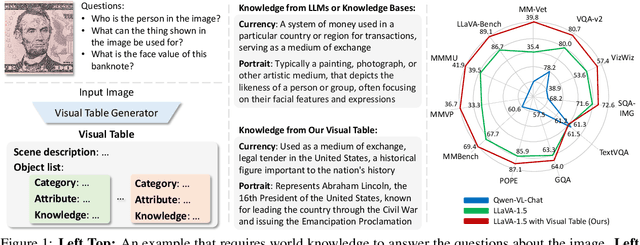
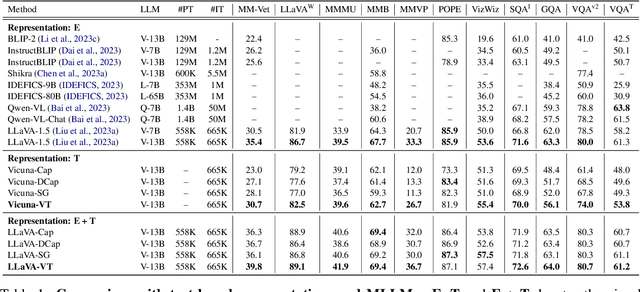
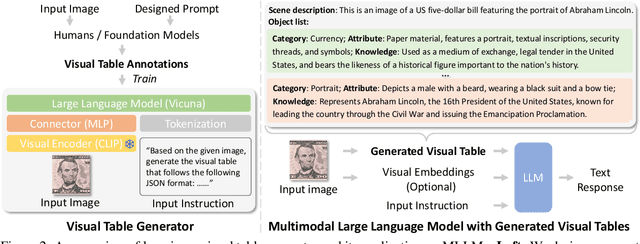
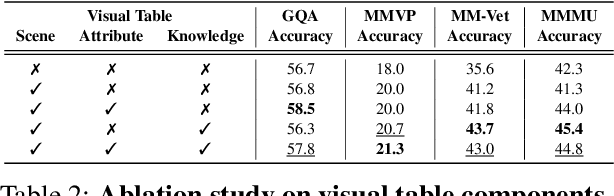
Visual representation learning has been a cornerstone in computer vision, evolving from supervised learning with human-annotated labels to aligning image-text pairs from the Internet. Despite recent advancements in multi-modal large language models (MLLMs), the visual representations they rely on, such as CLIP embeddings, often lack access to external world knowledge critical for real-world visual reasoning. In this work, we propose Visual Table, a novel visual representation tailored for MLLMs. It provides hierarchical text descriptions of holistic visual scenes, consisting of a scene description and multiple object-centric descriptions that encompass categories, attributes, and knowledge at instance level. We further develop a scalable generator for visual table generation and train it on small-scale annotations from GPT4V. Extensive evaluations demonstrate that, with generated visual tables as additional visual representations, our model can consistently outperform the state-of-the-art (SOTA) MLLMs across diverse benchmarks. When visual tables serve as standalone visual representations, our model can closely match or even beat the SOTA MLLMs that are built on CLIP visual embeddings. Our code is available at https://github.com/LaVi-Lab/Visual-Table.
How Far Are We on the Decision-Making of LLMs? Evaluating LLMs' Gaming Ability in Multi-Agent Environments
Mar 18, 2024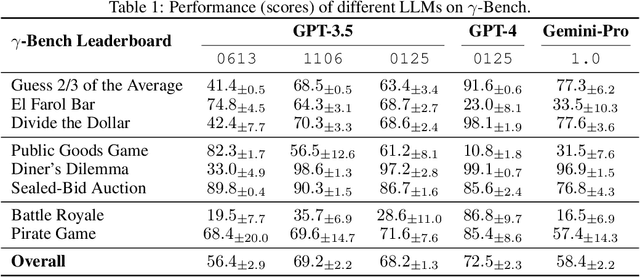
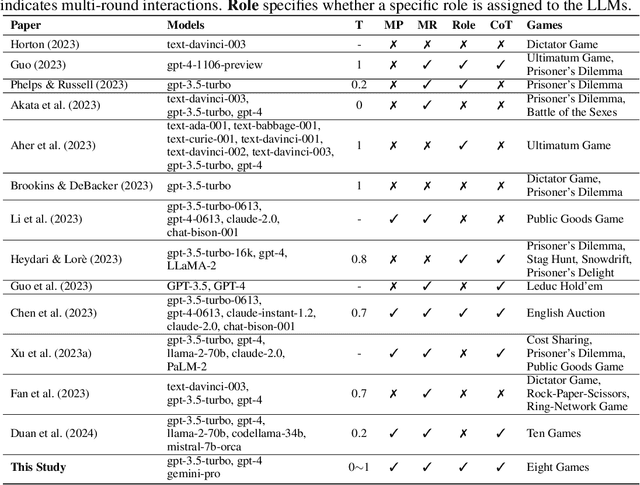
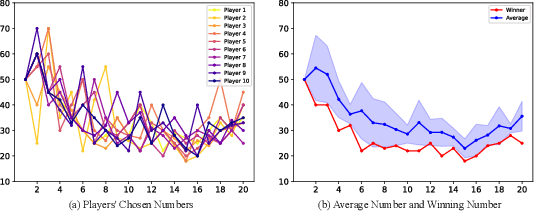

Decision-making, a complicated task requiring various types of abilities, presents an excellent framework for assessing Large Language Models (LLMs). Our research investigates LLMs' decision-making capabilities through the lens of a well-established field, Game Theory. We focus specifically on games that support the participation of more than two agents simultaneously. Subsequently, we introduce our framework, GAMA-Bench, including eight classical multi-agent games. We design a scoring scheme to assess a model's performance in these games quantitatively. Through GAMA-Bench, we investigate LLMs' robustness, generalizability, and enhancement strategies. Results reveal that while GPT-3.5 shows satisfying robustness, its generalizability is relatively limited. However, its performance can be improved through approaches such as Chain-of-Thought. Additionally, we conduct evaluations across various LLMs and find that GPT-4 outperforms other models on GAMA-Bench, achieving a score of 72.5. Moreover, the increasingly higher scores across the three iterations of GPT-3.5 (0613, 1106, 0125) demonstrate marked advancements in the model's intelligence with each update. The code and experimental results are made publicly available via https://github.com/CUHK-ARISE/GAMABench.
Knowledge-aware Alert Aggregation in Large-scale Cloud Systems: a Hybrid Approach
Mar 11, 2024Due to the scale and complexity of cloud systems, a system failure would trigger an "alert storm", i.e., massive correlated alerts. Although these alerts can be traced back to a few root causes, the overwhelming number makes it infeasible for manual handling. Alert aggregation is thus critical to help engineers concentrate on the root cause and facilitate failure resolution. Existing methods typically utilize semantic similarity-based methods or statistical methods to aggregate alerts. However, semantic similarity-based methods overlook the causal rationale of alerts, while statistical methods can hardly handle infrequent alerts. To tackle these limitations, we introduce leveraging external knowledge, i.e., Standard Operation Procedure (SOP) of alerts as a supplement. We propose COLA, a novel hybrid approach based on correlation mining and LLM (Large Language Model) reasoning for online alert aggregation. The correlation mining module effectively captures the temporal and spatial relations between alerts, measuring their correlations in an efficient manner. Subsequently, only uncertain pairs with low confidence are forwarded to the LLM reasoning module for detailed analysis. This hybrid design harnesses both statistical evidence for frequent alerts and the reasoning capabilities of computationally intensive LLMs, ensuring the overall efficiency of COLA in handling large volumes of alerts in practical scenarios. We evaluate COLA on three datasets collected from the production environment of a large-scale cloud platform. The experimental results show COLA achieves F1-scores from 0.901 to 0.930, outperforming state-of-the-art methods and achieving comparable efficiency. We also share our experience in deploying COLA in our real-world cloud system, Cloud X.
FaultProfIT: Hierarchical Fault Profiling of Incident Tickets in Large-scale Cloud Systems
Feb 27, 2024Postmortem analysis is essential in the management of incidents within cloud systems, which provides valuable insights to improve system's reliability and robustness. At CloudA, fault pattern profiling is performed during the postmortem phase, which involves the classification of incidents' faults into unique categories, referred to as fault pattern. By aggregating and analyzing these fault patterns, engineers can discern common faults, vulnerable components and emerging fault trends. However, this process is currently conducted by manual labeling, which has inherent drawbacks. On the one hand, the sheer volume of incidents means only the most severe ones are analyzed, causing a skewed overview of fault patterns. On the other hand, the complexity of the task demands extensive domain knowledge, which leads to errors and inconsistencies. To address these limitations, we propose an automated approach, named FaultProfIT, for Fault pattern Profiling of Incident Tickets. It leverages hierarchy-guided contrastive learning to train a hierarchy-aware incident encoder and predicts fault patterns with enhanced incident representations. We evaluate FaultProfIT using the production incidents from CloudA. The results demonstrate that FaultProfIT outperforms state-of-the-art methods. Our ablation study and analysis also verify the effectiveness of hierarchy-guided contrastive learning. Additionally, we have deployed FaultProfIT at CloudA for six months. To date, FaultProfIT has analyzed 10,000+ incidents from 30+ cloud services, successfully revealing several fault trends that have informed system improvements.
Asclepius: A Spectrum Evaluation Benchmark for Medical Multi-Modal Large Language Models
Feb 17, 2024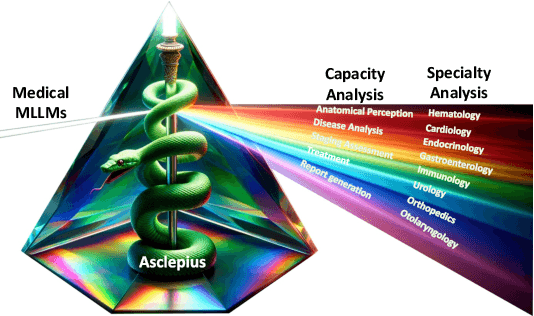
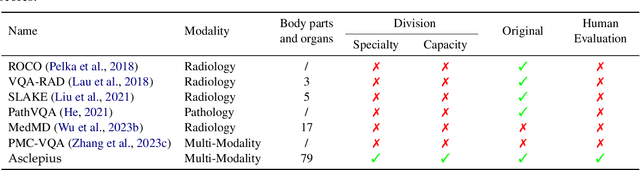
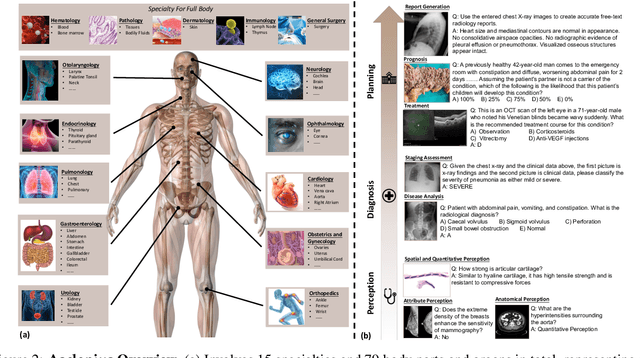
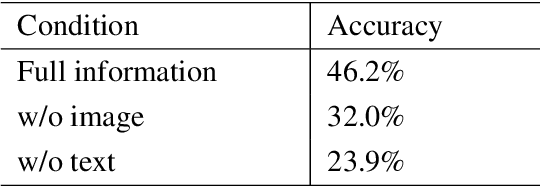
The significant breakthroughs of Medical Multi-Modal Large Language Models (Med-MLLMs) renovate modern healthcare with robust information synthesis and medical decision support. However, these models are often evaluated on benchmarks that are unsuitable for the Med-MLLMs due to the intricate nature of the real-world diagnostic frameworks, which encompass diverse medical specialties and involve complex clinical decisions. Moreover, these benchmarks are susceptible to data leakage, since Med-MLLMs are trained on large assemblies of publicly available data. Thus, an isolated and clinically representative benchmark is highly desirable for credible Med-MLLMs evaluation. To this end, we introduce Asclepius, a novel Med-MLLM benchmark that rigorously and comprehensively assesses model capability in terms of: distinct medical specialties (cardiovascular, gastroenterology, etc.) and different diagnostic capacities (perception, disease analysis, etc.). Grounded in 3 proposed core principles, Asclepius ensures a comprehensive evaluation by encompassing 15 medical specialties, stratifying into 3 main categories and 8 sub-categories of clinical tasks, and exempting from train-validate contamination. We further provide an in-depth analysis of 6 Med-MLLMs and compare them with 5 human specialists, providing insights into their competencies and limitations in various medical contexts. Our work not only advances the understanding of Med-MLLMs' capabilities but also sets a precedent for future evaluations and the safe deployment of these models in clinical environments. We launch and maintain a leaderboard for community assessment of Med-MLLM capabilities (https://asclepius-med.github.io/).