 Add to Chrome
 Add to Firefox
 Add to Edge
A Unified Issue Resolution Benchmark for Requirement Clarification, Planning, and Code Generation for Coding Agents
Aug 10, 2026
Large language model-powered coding agents are increasingly used to modify existing code repositories, for example, by adding features or fixing bugs. Yet existing repository-level benchmarks typically evaluate only whether the final patch passes tests. Satisfying a user request requires a long chain of interdependent reasoning and decisions: an agent must recover explicit and implicit requirements, formulate a repository-grounded implementation plan, and translate it into correct code. A pass/fail outcome cannot characterize how an unsuccessful trajectory diverges from the requirements and implementation process needed for a correct patch. To address this gap, we introduce SWE-RPG, a repository-level benchmark that combines executable patch evaluation with validated ground-truth references (GTs) for (1) Requirement Clarification and (2) Implementation Planning. These intermediate GTs support retrospective, GT-aligned diagnosis of complete coding-agent trajectories across clarification, planning, code generation, and artifact submission. SWE-RPG comprises 163 tasks from 31 Python and Java repositories, including 113 bug fixes and 50 feature additions. We evaluate 3 coding agents, including Claude Code, Codex, and OpenCode, with 6 large language model backends, including Claude-Sonnet-5 and GPT-5.6-Terra. Results show that the evaluated popular coding agents still struggle to implement user requests in existing repositories, achieving an average resolved rate of only 31.5% on SWE-RPG. Intermediate-GT diagnosis further identifies implicit requirement recovery as the main bottleneck, accounting for 24.5%--46.0% of agent runs. This result suggests implicit-requirement recovery as a key candidate direction for improving coding agents. The benchmark data and evaluation code are available at https://github.com/Xin-Zhou-smu/SWE-RPG-Bench.

GEB-Bench: Abstract Structures Told in Many Voices
Aug 07, 2026Can a model look at a river delta and a lightning bolt and see that they share a structure? We introduce GEB-Bench, a benchmark whose unit is an abstract structural motif--self-reference, a strange loop, a Mobius twist--in the spirit of Godel, Escher, Bach. Each motif is told in several voices: a natural scene whose composition is the structure, a folk story whose telling enacts it through a mechanically checkable form device, a mathematical theorem, and a programmatic skeleton; surface parameters are declared nuisance variables and never scored. Motifs, voices, and the structural changes between them form a small cross-modal category, and GEB-Bench's tasks are its questions. Evaluating twelve open and proprietary models, we find that abstraction failure is lawful. The central finding is a gap between recognition and cross-voice mapping: models identify a structure within one voice far better than they carry it across voices; every model pays this tax, and mapping strong enough to narrow it appears only at the frontier tier. Two patterns support it. Errors align more strongly with the designed formal geometry than with measured perceptual geometries, and frontier models from different vendors converge on the same wrong answers; and surface complexity taxes every model that reads structure, with capacity buying headroom rather than immunity. GEB-Bench is fully generative and released with its pipeline.
H2AL: Hyperbolic Hierarchy-aware Aggregative Learning for Registration-based Few-shot Medical Image Segmentation
Aug 07, 2026Registration-based Few-shot medical image segmentation (RFMIS) aims to generate pseudo-labels for unlabeled images by warping a labeled image through registration. However, existing methods primarily perform pixel-level optimization and inference in Euclidean space, treating anatomical structures as flat and disjoint. This neglect of inherent hierarchies degrades pseudo-label quality and weakens the discrimination of ambiguous regions, limiting the segmentation performance. To overcome this challenge, we propose a Hyperbolic Hierarchy-aware Aggregative Learning framework for RFMIS, termed H2AL, that enhances both deformation plausibility and anatomical discrimination for dual-task learning. Specifically, we introduce a Hyperbolic Hierarchy-aware Infusion (H2I) module, which leverages the hierarchical modeling capability of hyperbolic space to learn precise hierarchy-aware representations via transformation-guided supervised hyperbolic contrastive learning, and injects such hierarchical priors into Euclidean space through a gated infusion block while preserving semantic richness. Furthermore, we propose an end-to-end joint optimization algorithm by gradient aggregation, where the gradients from the registration and segmentation decoders, embedding semantic and hierarchical cues, are aggregated to update the shared encoder to promote collaborative learning across tasks. Extensive experiments on two anatomical regions, with five experimental settings, demonstrate the effectiveness and efficiency of our method in both registration and segmentation. The code is publicly available at https://github.com/JiamingCai469/H2AL.
When LLM Defenses Backfire: Characterizing Safety, Performance, and Cost Trade-offs
Jul 27, 2026Jailbreak defenses are essential for protecting large language models (LLMs), but they can also introduce secondary costs that weaken model utility. We present a systematic study of these defense trade-offs along three dimensions: performance impact, over-refusal on benign inputs, and inference cost. Rather than treating defenses as a single class, we organize them by operational strategy and examine how different strategies correlate with different side-effect profiles. Across state-of-the-art defense methods, widely used benchmark datasets, and representative open-source LLMs, we find that defenses rarely improve downstream capability, but instead vary in how they trade safety gains against usability and efficiency. In particular, rule-based defenses best preserve task performance, highly conservative self-reflective defenses often increase over-refusal, and multi-round defenses incur the largest runtime overhead. These results provide both a benchmark for evaluating defense side effects and practical guidance for selecting defenses under deployment constraints.
When Does Recurrence Become an Algorithm? Convergence Selection in Weight-Tied Looped Transformers
Jul 22, 2026When does a weight-tied looped transformer -- one block applied T times -- implement an actual algorithm? We answer with four findings from controlled populations on group word problems. (1) The budget law: free training installs a linear computation frontier, a mechanism that solves v positions per loop, whose speed is priced by the training contract: v ~ n_train/T_train (exponent 0.98 +/- 0.04, R^2=0.99), exactly unity under T=n training. SGD selects a frontier matching the minimum the contract demands; granting more test-time loops than ever trained rescues late positions at fixed input length, yielding a principled halting rule T* = ceil(n / v-hat). (2) Architecture prior, not expressivity, picks the algorithm: standard-depth transformers learn parallel scans on this family; weight tying flips the selection to the serial frontier, even when positional addressing for a log-depth scan is supplied. At matched depth and parameters, untied models extrapolate worst and fail to learn A5 at all. (3) The walls are not where circuit complexity says: NC1-completeness costs nothing (A5 generalizes fully), while group order does (S5's 120x120 operator deadlocks joint learning) -- and an operator-first curriculum dissolves the wall in every seed. (4) Mechanisms are portable, not mandatable: warm-starting across budget contracts transfers the algorithm in every seed, re-pricing its speed, while imposing seriality through the input schedule fails where free training succeeds. These results are invisible to standard instruments, which provably saturate at the fixed points trained loops converge to. We introduce a head instrument, the convergence-time scaling tau(n,i), validate it causally via damage cones whose slope reproduces v, and show in-distribution head measurements predict out-of-distribution fate where tail metrics do not. Results replicate on the public easy-to-hard benchmark.
MemPose: Category-level Object Pose Estimation with Memory
Jul 06, 2026In the pursuit of robust and generalizable category-level object pose estimation, most existing methods adopt parametric formulations that learn effective representations from data, yet they primarily encode category-level patterns into fixed shape priors or static parameter weights, which limits their scalability to highly diverse instances. In this paper, we rethink category-level pose estimation from a memory-centric perspective and present MemPose, a memory-augmented framework that explicitly incorporates category-level geometric memory into the pose estimation pipeline. We introduce an external memory buffer that stores and dynamically updates structural representations from previously observed instances, enabling the model to leverage accumulated experience to support current perception. Extensive experiments on four challenging benchmarks (REAL275, CAMERA25, Housecat6D and Wild6D) demonstrate the superiority of our proposed method over previous state-of-the-art approaches.
CodePivot: Bootstrapping Multilingual Transpilation in LLMs via Reinforcement Learning without Parallel Corpora
Apr 20, 2026Transpilation, or code translation, aims to convert source code from one programming language (PL) to another. It is beneficial for many downstream applications, from modernizing large legacy codebases to augmenting data for low-resource PLs. Recent large language model (LLM)-based approaches have demonstrated immense potential for code translation. Among these approaches, training-based methods are particularly important because LLMs currently do not effectively adapt to domain-specific settings that suffer from a lack of knowledge without targeted training. This limitation is evident in transpilation tasks involving low-resource PLs. However, existing training-based approaches rely on a pairwise transpilation paradigm, making it impractical to support a diverse range of PLs. This limitation is particularly prominent for low-resource PLs due to a scarcity of training data. Furthermore, these methods suffer from suboptimal reinforcement learning (RL) reward formulations. To address these limitations, we propose CodePivot, a training framework that leverages Python as an intermediate representation (IR), augmented by a novel RL reward mechanism, Aggressive-Partial-Functional reward, to bootstrap the model's multilingual transpilation ability without requiring parallel corpora. Experiments involving 10 PLs show that the resulting 7B model, trained on Python-to-Others tasks, consistently improves performance across both general and low-resource PL-related transpilation tasks. It outperforms substantially larger mainstream models with hundreds of billions more parameters, such as Deepseek-R1 and Qwen3-235B-A22B-Instruct-2507, on Python-to-Others tasks and Others-to-All tasks, respectively. In addition, it outperforms its counterpart trained directly on Any-to-Any tasks on general transpilation tasks. The code and data are available at https://github.com/lishangyu-hkust/CodePivot.
MulVul: Retrieval-augmented Multi-Agent Code Vulnerability Detection via Cross-Model Prompt Evolution
Jan 26, 2026Large Language Models (LLMs) struggle to automate real-world vulnerability detection due to two key limitations: the heterogeneity of vulnerability patterns undermines the effectiveness of a single unified model, and manual prompt engineering for massive weakness categories is unscalable. To address these challenges, we propose \textbf{MulVul}, a retrieval-augmented multi-agent framework designed for precise and broad-coverage vulnerability detection. MulVul adopts a coarse-to-fine strategy: a \emph{Router} agent first predicts the top-$k$ coarse categories and then forwards the input to specialized \emph{Detector} agents, which identify the exact vulnerability types. Both agents are equipped with retrieval tools to actively source evidence from vulnerability knowledge bases to mitigate hallucinations. Crucially, to automate the generation of specialized prompts, we design \emph{Cross-Model Prompt Evolution}, a prompt optimization mechanism where a generator LLM iteratively refines candidate prompts while a distinct executor LLM validates their effectiveness. This decoupling mitigates the self-correction bias inherent in single-model optimization. Evaluated on 130 CWE types, MulVul achieves 34.79\% Macro-F1, outperforming the best baseline by 41.5\%. Ablation studies validate cross-model prompt evolution, which boosts performance by 51.6\% over manual prompts by effectively handling diverse vulnerability patterns.
3D Software Synthesis Guided by Constraint-Expressive Intermediate Representation
Jul 24, 2025Graphical user interface (UI) software has undergone a fundamental transformation from traditional two-dimensional (2D) desktop/web/mobile interfaces to spatial three-dimensional (3D) environments. While existing work has made remarkable success in automated 2D software generation, such as HTML/CSS and mobile app interface code synthesis, the generation of 3D software still remains under-explored. Current methods for 3D software generation usually generate the 3D environments as a whole and cannot modify or control specific elements in the software. Furthermore, these methods struggle to handle the complex spatial and semantic constraints inherent in the real world. To address the challenges, we present Scenethesis, a novel requirement-sensitive 3D software synthesis approach that maintains formal traceability between user specifications and generated 3D software. Scenethesis is built upon ScenethesisLang, a domain-specific language that serves as a granular constraint-aware intermediate representation (IR) to bridge natural language requirements and executable 3D software. It serves both as a comprehensive scene description language enabling fine-grained modification of 3D software elements and as a formal constraint-expressive specification language capable of expressing complex spatial constraints. By decomposing 3D software synthesis into stages operating on ScenethesisLang, Scenethesis enables independent verification, targeted modification, and systematic constraint satisfaction. Our evaluation demonstrates that Scenethesis accurately captures over 80% of user requirements and satisfies more than 90% of hard constraints while handling over 100 constraints simultaneously. Furthermore, Scenethesis achieves a 42.8% improvement in BLIP-2 visual evaluation scores compared to the state-of-the-art method.
CleanPose: Category-Level Object Pose Estimation via Causal Learning and Knowledge Distillation
Feb 03, 2025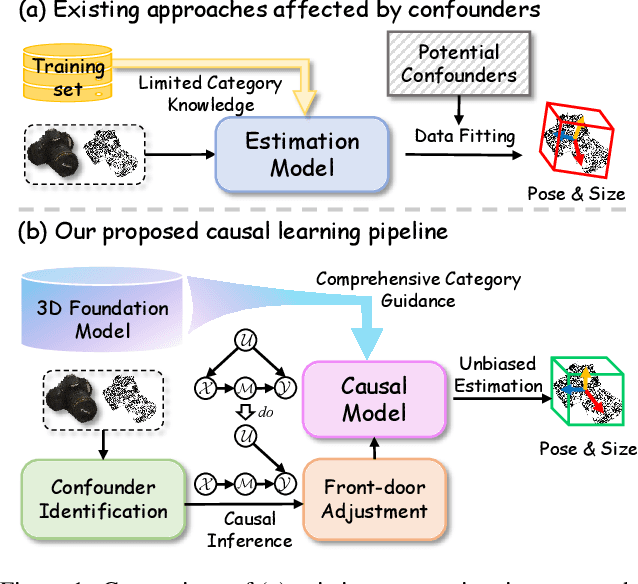
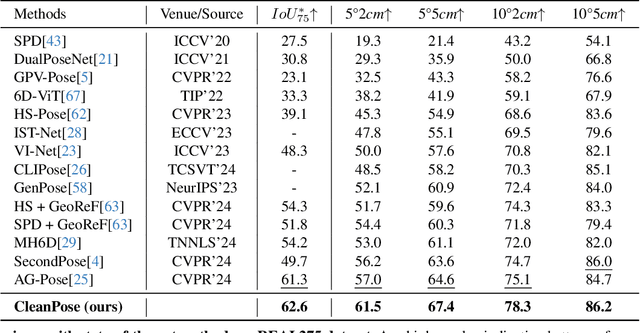
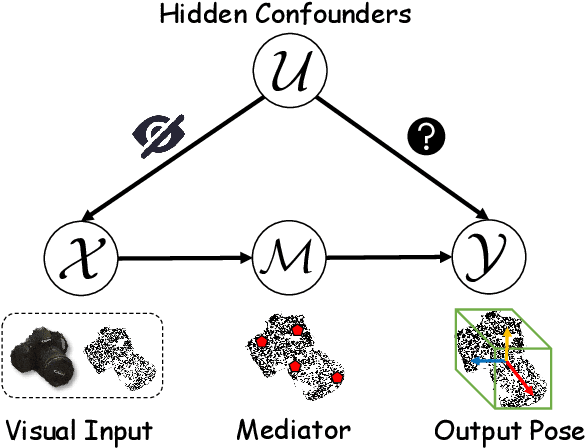
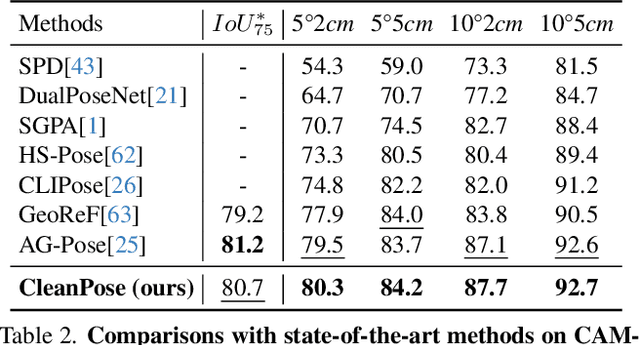
Category-level object pose estimation aims to recover the rotation, translation and size of unseen instances within predefined categories. In this task, deep neural network-based methods have demonstrated remarkable performance. However, previous studies show they suffer from spurious correlations raised by "unclean" confounders in models, hindering their performance on novel instances with significant variations. To address this issue, we propose CleanPose, a novel approach integrating causal learning and knowledge distillation to enhance category-level pose estimation. To mitigate the negative effect of unobserved confounders, we develop a causal inference module based on front-door adjustment, which promotes unbiased estimation by reducing potential spurious correlations. Additionally, to further improve generalization ability, we devise a residual-based knowledge distillation method that has proven effective in providing comprehensive category information guidance. Extensive experiments across multiple benchmarks (REAL275, CAMERA25 and HouseCat6D) hightlight the superiority of proposed CleanPose over state-of-the-art methods. Code will be released.