 Add to Chrome
 Add to Firefox
 Add to Edge
Categorize Early, Integrate Late: Divergent Processing Strategies in Automatic Speech Recognition
Jan 11, 2026
In speech language modeling, two architectures dominate the frontier: the Transformer and the Conformer. However, it remains unknown whether their comparable performance stems from convergent processing strategies or distinct architectural inductive biases. We introduce Architectural Fingerprinting, a probing framework that isolates the effect of architecture on representation, and apply it to a controlled suite of 24 pre-trained encoders (39M-3.3B parameters). Our analysis reveals divergent hierarchies: Conformers implement a "Categorize Early" strategy, resolving phoneme categories 29% earlier in depth and speaker gender by 16% depth. In contrast, Transformers "Integrate Late," deferring phoneme, accent, and duration encoding to deep layers (49-57%). These fingerprints suggest design heuristics: Conformers' front-loaded categorization may benefit low-latency streaming, while Transformers' deep integration may favor tasks requiring rich context and cross-utterance normalization.

In-Context Learning Boosts Speech Recognition via Human-like Adaptation to Speakers and Language Varieties
May 20, 2025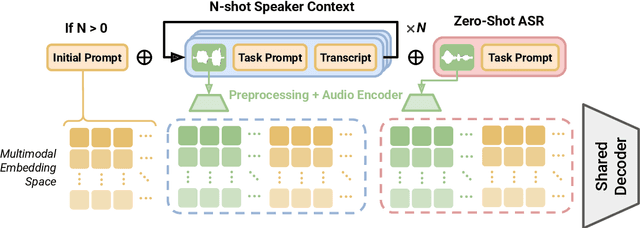
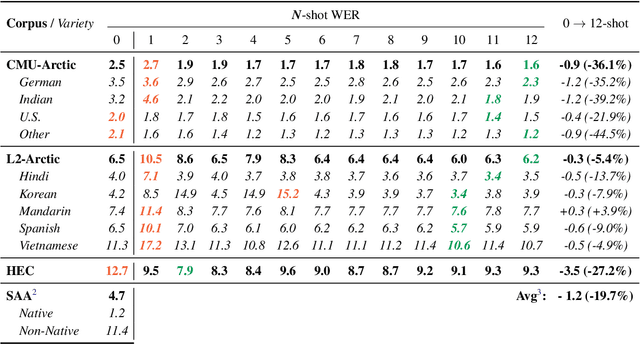
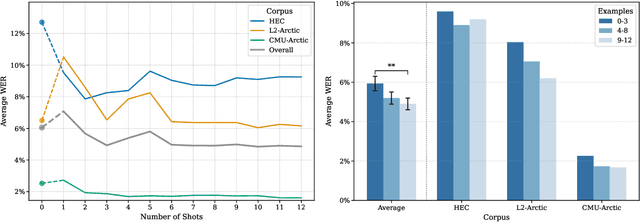
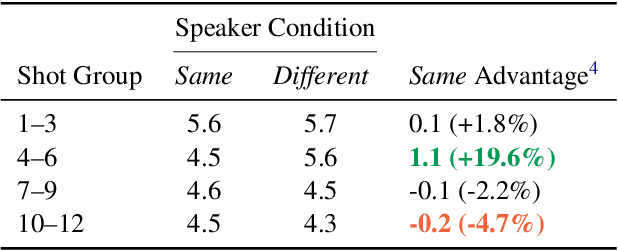
Human listeners readily adjust to unfamiliar speakers and language varieties through exposure, but do these adaptation benefits extend to state-of-the-art spoken language models? We introduce a scalable framework that allows for in-context learning (ICL) in Phi-4 Multimodal using interleaved task prompts and audio-text pairs, and find that as few as 12 example utterances (~50 seconds) at inference time reduce word error rates by a relative 19.7% (1.2 pp.) on average across diverse English corpora. These improvements are most pronounced in low-resource varieties, when the context and target speaker match, and when more examples are provided--though scaling our procedure yields diminishing marginal returns to context length. Overall, we find that our novel ICL adaptation scheme (1) reveals a similar performance profile to human listeners, and (2) demonstrates consistent improvements to automatic speech recognition (ASR) robustness across diverse speakers and language backgrounds. While adaptation succeeds broadly, significant gaps remain for certain varieties, revealing where current models still fall short of human flexibility. We release our prompts and code on GitHub.