 Add to Chrome
 Add to Firefox
 Add to Edge
DistortBench: Benchmarking Vision Language Models on Image Distortion Identification
Apr 21, 2026
Vision-language models (VLMs) are increasingly used in settings where sensitivity to low-level image degradations matters, including content moderation, image restoration, and quality monitoring. Yet their ability to recognize distortion type and severity remains poorly understood. We present DistortBench, a diagnostic benchmark for no-reference distortion perception in VLMs. DistortBench contains 13,500 four-choice questions covering 27 distortion types, six perceptual categories, and five severity levels: 25 distortions inherit KADID-10k calibrations, while two added rotation distortions use monotonic angle-based levels. We evaluate 18 VLMs, including 17 open-weight models from five families and one proprietary model. Despite strong performance on high-level vision-language tasks, the best model reaches only 61.9% accuracy, just below the human majority-vote baseline of 65.7% (average individual: 60.2%), indicating that low-level perceptual understanding remains a major weakness of current VLMs. Our analysis further reveals weak and non-monotonic scaling with model size, performance drops in most base--thinking pairs, and distinct severity-response patterns across model families. We hope DistortBench will serve as a useful benchmark for measuring and improving low-level visual perception in VLMs.

ML-SUPERB 2.0: Benchmarking Multilingual Speech Models Across Modeling Constraints, Languages, and Datasets
Jun 12, 2024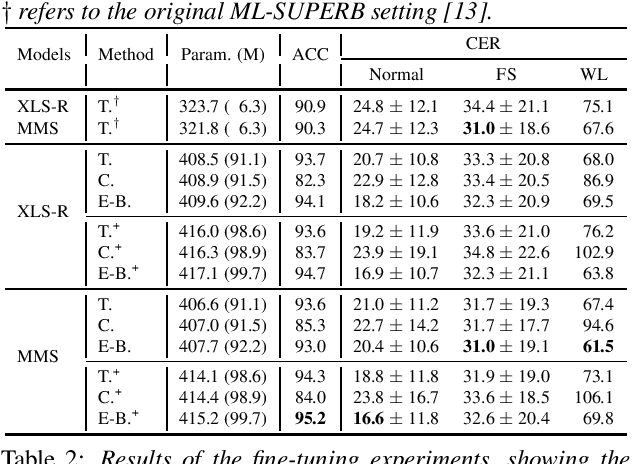
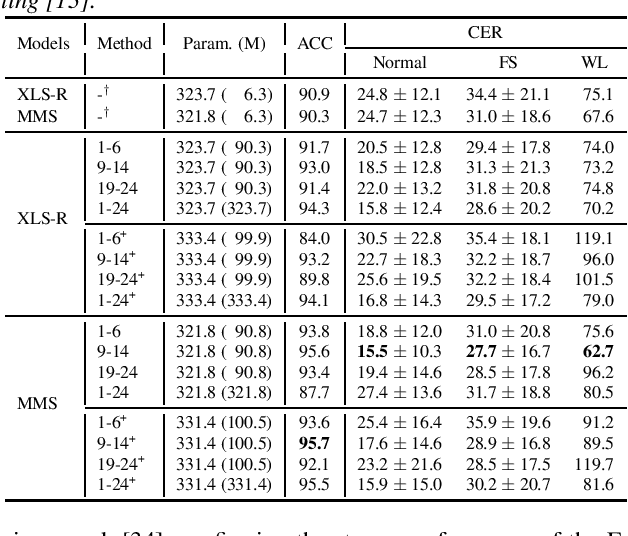
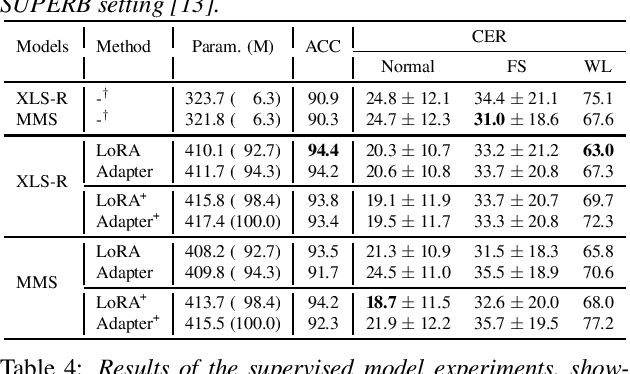
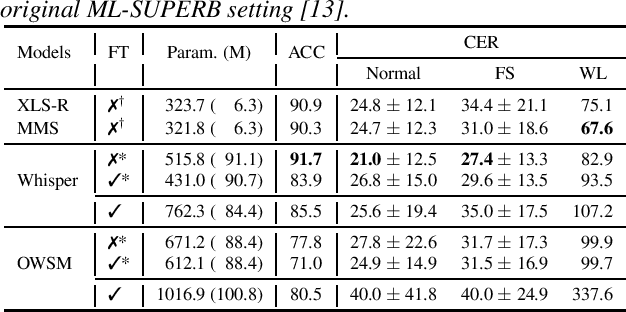
ML-SUPERB evaluates self-supervised learning (SSL) models on the tasks of language identification and automatic speech recognition (ASR). This benchmark treats the models as feature extractors and uses a single shallow downstream model, which can be fine-tuned for a downstream task. However, real-world use cases may require different configurations. This paper presents ML-SUPERB~2.0, which is a new benchmark for evaluating pre-trained SSL and supervised speech models across downstream models, fine-tuning setups, and efficient model adaptation approaches. We find performance improvements over the setup of ML-SUPERB. However, performance depends on the downstream model design. Also, we find large performance differences between languages and datasets, suggesting the need for more targeted approaches to improve multilingual ASR performance.
Visual Information Matters for ASR Error Correction
Mar 16, 2023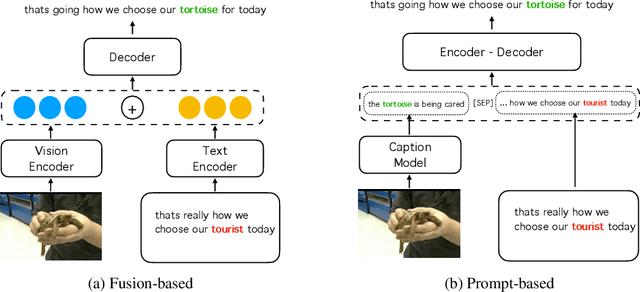
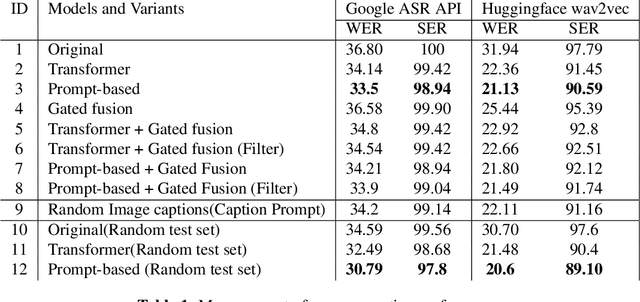
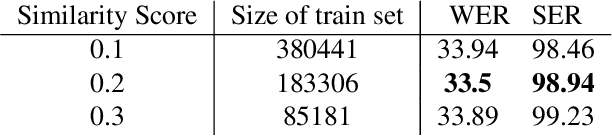
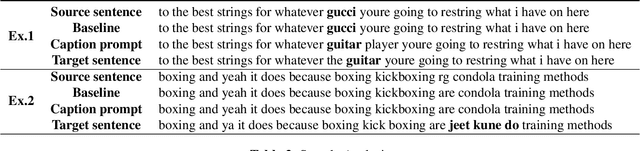
Aiming to improve the Automatic Speech Recognition (ASR) outputs with a post-processing step, ASR error correction (EC) techniques have been widely developed due to their efficiency in using parallel text data. Previous works mainly focus on using text or/ and speech data, which hinders the performance gain when not only text and speech information, but other modalities, such as visual information are critical for EC. The challenges are mainly two folds: one is that previous work fails to emphasize visual information, thus rare exploration has been studied. The other is that the community lacks a high-quality benchmark where visual information matters for the EC models. Therefore, this paper provides 1) simple yet effective methods, namely gated fusion and image captions as prompts to incorporate visual information to help EC; 2) large-scale benchmark datasets, namely Visual-ASR-EC, where each item in the training data consists of visual, speech, and text information, and the test data are carefully selected by human annotators to ensure that even humans could make mistakes when visual information is missing. Experimental results show that using captions as prompts could effectively use the visual information and surpass state-of-the-art methods by upto 1.2% in Word Error Rate(WER), which also indicates that visual information is critical in our proposed Visual-ASR-EC dataset
Evaluation of large-scale synthetic data for Grammar Error Correction
Oct 31, 2022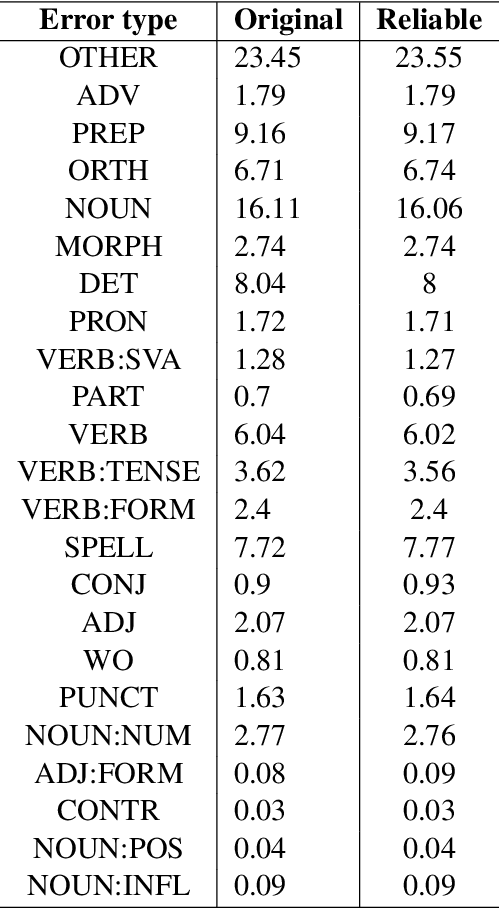
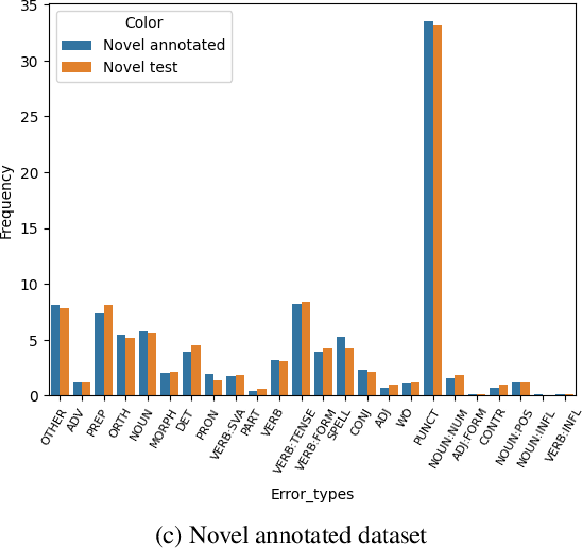
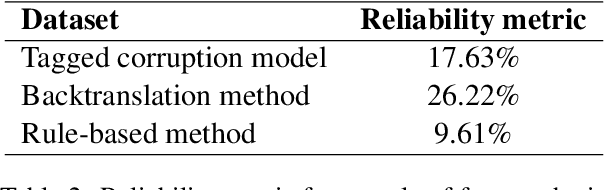
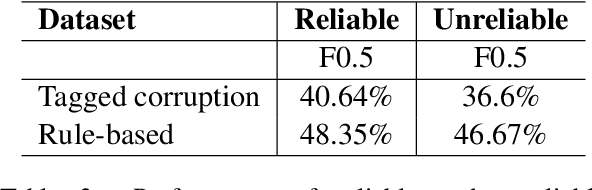
Grammar Error Correction(GEC) mainly relies on the availability of high quality of large amount of synthetic parallel data of grammatically correct and erroneous sentence pairs. The quality of the synthetic data is evaluated on how well the GEC system performs when pre-trained using it. But this does not provide much insight into what are the necessary factors which define the quality of these data. So this work aims to introduce 3 metrics - reliability, diversity and distribution match to provide more insight into the quality of large-scale synthetic data generated for the GEC task, as well as automatically evaluate them. Evaluating these three metrics automatically can also help in providing feedback to the data generation systems and thereby improve the quality of the synthetic data generated dynamically