 Add to Chrome
 Add to Firefox
 Add to Edge
Scaling Open Discrete Audio Foundation Models with Interleaved Semantic, Acoustic, and Text Tokens
Feb 18, 2026
Current audio language models are predominantly text-first, either extending pre-trained text LLM backbones or relying on semantic-only audio tokens, limiting general audio modeling. This paper presents a systematic empirical study of native audio foundation models that apply next-token prediction to audio at scale, jointly modeling semantic content, acoustic details, and text to support both general audio generation and cross-modal capabilities. We provide comprehensive empirical insights for building such models: (1) We systematically investigate design choices -- data sources, text mixture ratios, and token composition -- establishing a validated training recipe. (2) We conduct the first scaling law study for discrete audio models via IsoFLOP analysis on 64 models spanning $3{\times}10^{18}$ to $3{\times}10^{20}$ FLOPs, finding that optimal data grows 1.6$\times$ faster than optimal model size. (3) We apply these lessons to train SODA (Scaling Open Discrete Audio), a suite of models from 135M to 4B parameters on 500B tokens, comparing against our scaling predictions and existing models. SODA serves as a flexible backbone for diverse audio/text tasks -- we demonstrate this by fine-tuning for voice-preserving speech-to-speech translation, using the same unified architecture.

Textual Steering Vectors Can Improve Visual Understanding in Multimodal Large Language Models
May 20, 2025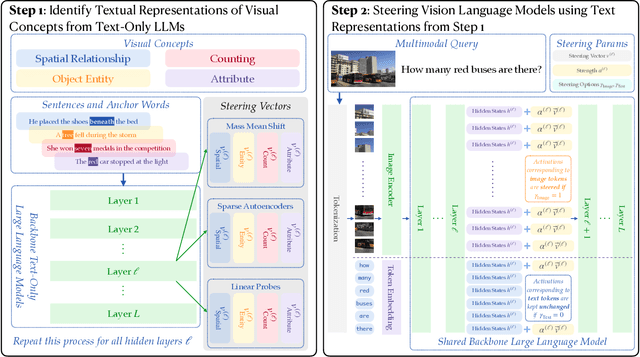
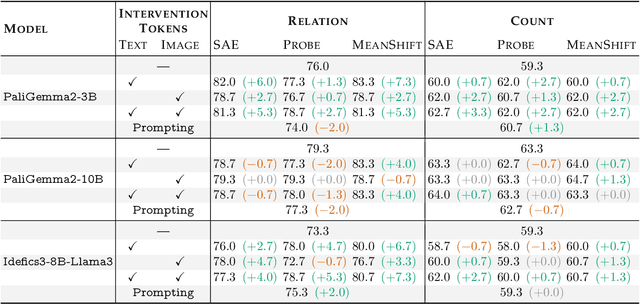
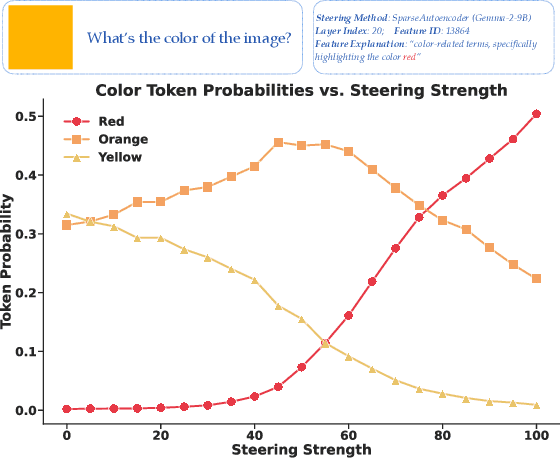
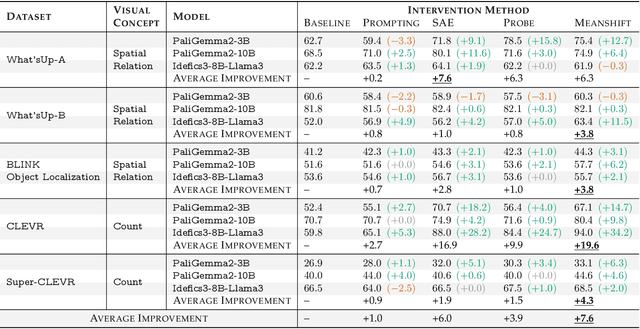
Steering methods have emerged as effective and targeted tools for guiding large language models' (LLMs) behavior without modifying their parameters. Multimodal large language models (MLLMs), however, do not currently enjoy the same suite of techniques, due in part to their recency and architectural diversity. Inspired by this gap, we investigate whether MLLMs can be steered using vectors derived from their text-only LLM backbone, via sparse autoencoders (SAEs), mean shift, and linear probing. We find that text-derived steering consistently enhances multimodal accuracy across diverse MLLM architectures and visual tasks. In particular, mean shift boosts spatial relationship accuracy on CV-Bench by up to +7.3% and counting accuracy by up to +3.3%, outperforming prompting and exhibiting strong generalization to out-of-distribution datasets. These results highlight textual steering vectors as a powerful, efficient mechanism for enhancing grounding in MLLMs with minimal additional data collection and computational overhead.