 Add to Chrome
 Add to Firefox
 Add to Edge
Active Perception for Embodied Disambiguation
Aug 11, 2026
Natural language provides robots with a flexible task interface, but target ambiguity in embodied environments arises not only from user intent; it can also result from missing taskrelevant physical evidence in the current observation. Existing interactive disambiguation methods primarily obtain additional information by asking the user, whereas occlusion, restricted viewpoints, unreadable text, and unobserved targets require the robot to actively change its observation. We propose an active-perception framework for embodied target disambiguation that uses active observation as the backbone for information acquisition and uses a vision-language model to decide, on the basis of accumulated visual evidence and interaction information, whether to continue observing, request clarification, or complete target selection. Active observation can both directly recover missing discriminative evidence and reveal object names, labels, and semantic attributes, thereby improving user clarification when it remains necessary. Real-robot experiments show that the framework combines physical information acquisition and userintent clarification within a unified embodied disambiguation process.

Radar4D-VLM: Proposal-Grounded Temporal 4D Radar Reasoning Across Frozen Language Models
Aug 04, 2026Vision-language models for autonomous driving primarily rely on cameras and LiDAR, leaving 4D radar largely unexplored as a standalone perceptual modality despite its robustness to adverse visibility and direct measurement of radial velocity. We introduce Radar4D-VLM, a radar-only temporal vision-language model that reasons from ten consecutive 4D-radar point-cloud sweeps without camera or LiDAR input. Radar4D-VLM extracts geometrically grounded object proposals and organizes radar evidence into a compact hierarchy of object, scene, and kinematic tokens. A parameter-efficient projector maps these tokens into frozen language backbones, while auditable prediction heads jointly model object count, spatial distribution, motion state, collision risk, semantic category, and radial velocity. Radar4D-VLM combines proposal-grounded temporal object tokenization, global scene context, and explicit kinematic tokens within a unified frozen-backbone interface. On sequence-isolated K-Radar development validation, its Top-64 proposal recall reaches 98.13% at 4 m, exceeding fixed-lattice and uniform-random controls by 6.40 and 22.83 percentage points, respectively. We further evaluate 24 matched runs spanning eight frozen Qwen, Phi, Mistral, Llama, and Gemma backbones under an identical adaptation budget. The radar-token interface remains compatible across all five language-model families, while matched aligned, permuted, and no-language controls show sensor dependence but no stable direct-head gain from aligned language supervision. These results establish a reproducible foundation for radar-only multimodal scene and motion reasoning while separating interface compatibility from the benefit of language supervision.
MonoIR-RS: Infrared Remote Sensing Vision-Language Learning with CLIP and VLM Adaptation
Jul 07, 2026Infrared remote-sensing imagery captures intensity structure, object-background contrast, and illumination-invariant cues often invisible in RGB imagery. Yet, most remote-sensing vision-language resources and models focus on visible-band semantics, leaving infrared vision-language understanding underexplored. We introduce MonoIR-RS, a large-scale infrared remote-sensing vision-language dataset and benchmark that couples IR-aware data construction with CLIP-style contrastive adaptation and VLM instruction tuning. Built from the same source pool and split as FusionRS, MonoIR-RS retains the infrared image as the model-facing modality, yielding 600,000 synthesized infrared images and 59,032 retained IR-aware caption records. The model experiments use this retained language-supervision subset, whose captions rewrite supervision around grayscale structure and infrared-style contrast instead of RGB appearance. We show that the synthesized infrared imagery is markedly closer to real thermal imagery than a grayscale conversion on the AVIID benchmark. We fine-tune five CLIP backbones and six VLM backbones, and calibrate them against zero-shot behavior: IR-aware adaptation lifts CLIP mean recall by up to 12.8 points and drives VLM captioning IR-cue coverage to 100% while reducing residual RGB-color leakage to near zero. By isolating the infrared modality from RGB-IR dual-modal learning, MonoIR-RS offers a controlled, reproducible testbed for aligning infrared remote-sensing evidence with language.
GURecon: Learning Detailed 3D Geometric Uncertainties for Neural Surface Reconstruction
Dec 19, 2024Neural surface representation has demonstrated remarkable success in the areas of novel view synthesis and 3D reconstruction. However, assessing the geometric quality of 3D reconstructions in the absence of ground truth mesh remains a significant challenge, due to its rendering-based optimization process and entangled learning of appearance and geometry with photometric losses. In this paper, we present a novel framework, i.e, GURecon, which establishes a geometric uncertainty field for the neural surface based on geometric consistency. Different from existing methods that rely on rendering-based measurement, GURecon models a continuous 3D uncertainty field for the reconstructed surface, and is learned by an online distillation approach without introducing real geometric information for supervision. Moreover, in order to mitigate the interference of illumination on geometric consistency, a decoupled field is learned and exploited to finetune the uncertainty field. Experiments on various datasets demonstrate the superiority of GURecon in modeling 3D geometric uncertainty, as well as its plug-and-play extension to various neural surface representations and improvement on downstream tasks such as incremental reconstruction. The code and supplementary material are available on the project website: https://zju3dv.github.io/GURecon/.
MLoRA: Multi-Domain Low-Rank Adaptive Network for CTR Prediction
Aug 14, 2024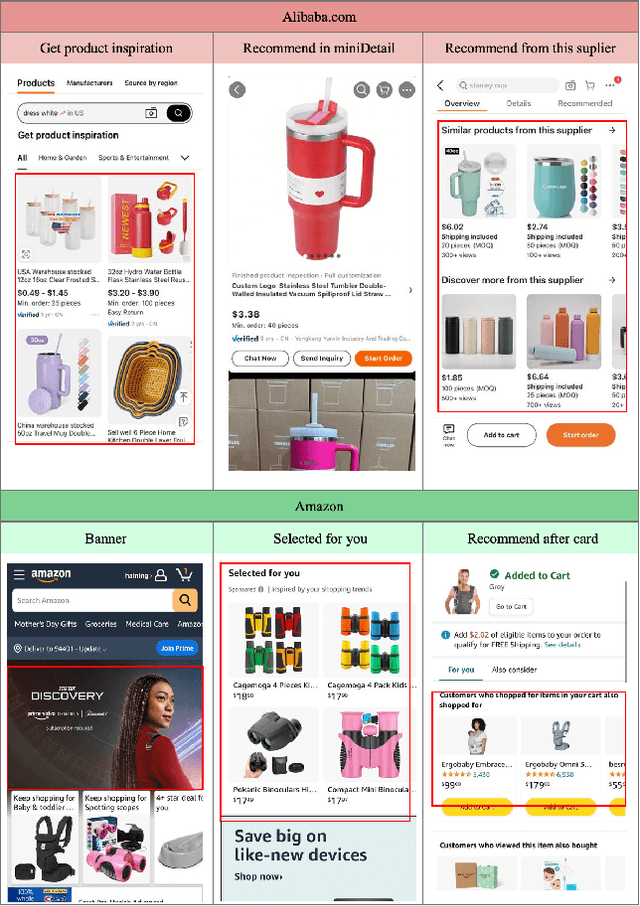
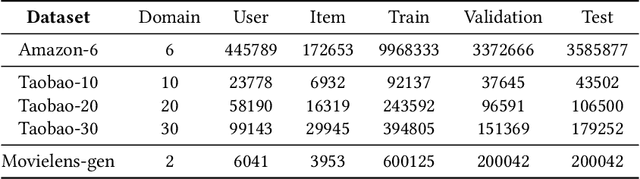
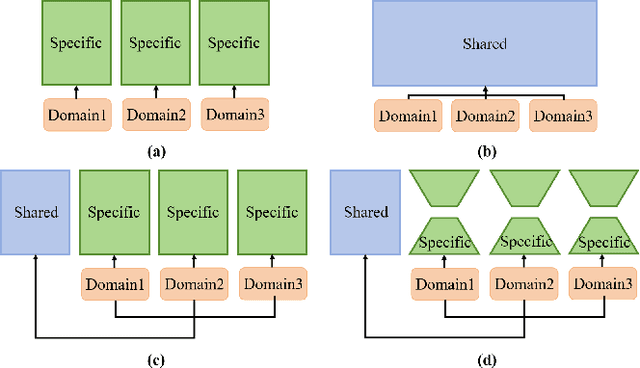
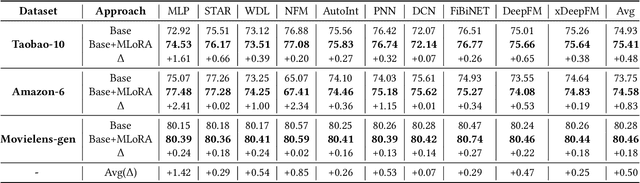
Click-through rate (CTR) prediction is one of the fundamental tasks in the industry, especially in e-commerce, social media, and streaming media. It directly impacts website revenues, user satisfaction, and user retention. However, real-world production platforms often encompass various domains to cater for diverse customer needs. Traditional CTR prediction models struggle in multi-domain recommendation scenarios, facing challenges of data sparsity and disparate data distributions across domains. Existing multi-domain recommendation approaches introduce specific-domain modules for each domain, which partially address these issues but often significantly increase model parameters and lead to insufficient training. In this paper, we propose a Multi-domain Low-Rank Adaptive network (MLoRA) for CTR prediction, where we introduce a specialized LoRA module for each domain. This approach enhances the model's performance in multi-domain CTR prediction tasks and is able to be applied to various deep-learning models. We evaluate the proposed method on several multi-domain datasets. Experimental results demonstrate our MLoRA approach achieves a significant improvement compared with state-of-the-art baselines. Furthermore, we deploy it in the production environment of the Alibaba.COM. The online A/B testing results indicate the superiority and flexibility in real-world production environments. The code of our MLoRA is publicly available.
Modeling User Intent Beyond Trigger: Incorporating Uncertainty for Trigger-Induced Recommendation
Aug 07, 2024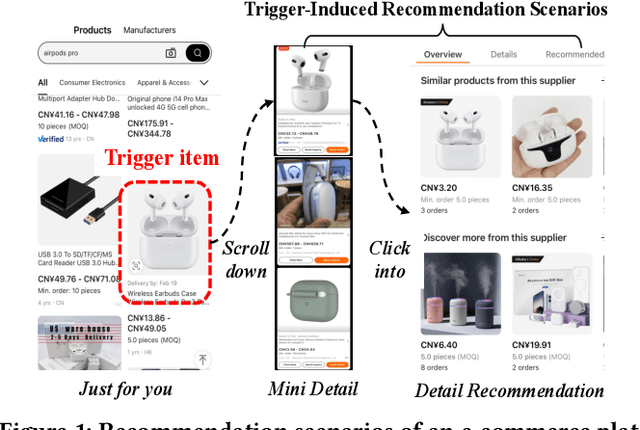


To cater to users' desire for an immersive browsing experience, numerous e-commerce platforms provide various recommendation scenarios, with a focus on Trigger-Induced Recommendation (TIR) tasks. However, the majority of current TIR methods heavily rely on the trigger item to understand user intent, lacking a higher-level exploration and exploitation of user intent (e.g., popular items and complementary items), which may result in an overly convergent understanding of users' short-term intent and can be detrimental to users' long-term purchasing experiences. Moreover, users' short-term intent shows uncertainty and is affected by various factors such as browsing context and historical behaviors, which poses challenges to user intent modeling. To address these challenges, we propose a novel model called Deep Uncertainty Intent Network (DUIN), comprising three essential modules: i) Explicit Intent Exploit Module extracting explicit user intent using the contrastive learning paradigm; ii) Latent Intent Explore Module exploring latent user intent by leveraging the multi-view relationships between items; iii) Intent Uncertainty Measurement Module offering a distributional estimation and capturing the uncertainty associated with user intent. Experiments on three real-world datasets demonstrate the superior performance of DUIN compared to existing baselines. Notably, DUIN has been deployed across all TIR scenarios in our e-commerce platform, with online A/B testing results conclusively validating its superiority.
On Practical Diversified Recommendation with Controllable Category Diversity Framework
Feb 06, 2024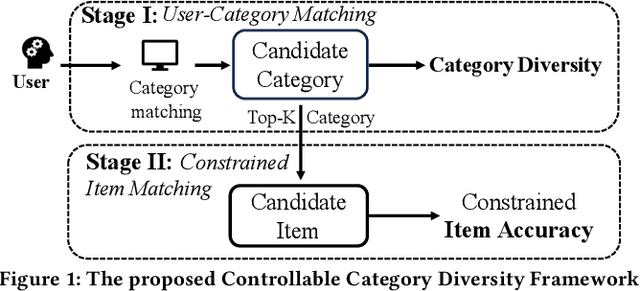
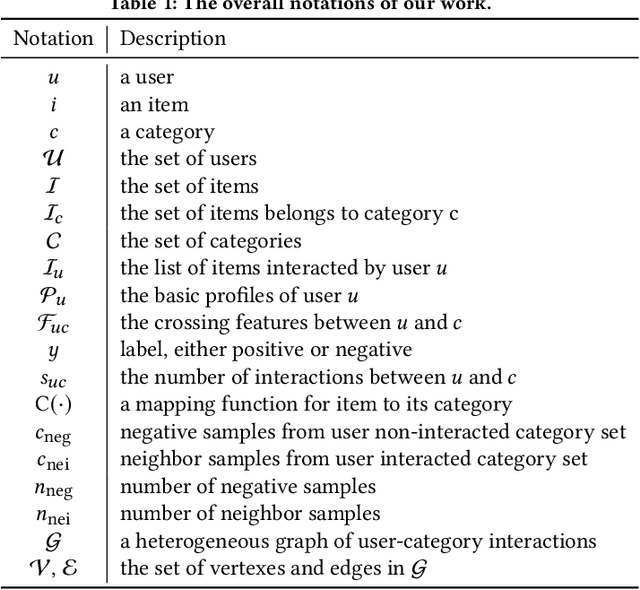
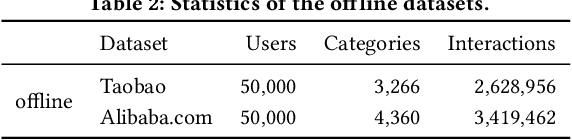
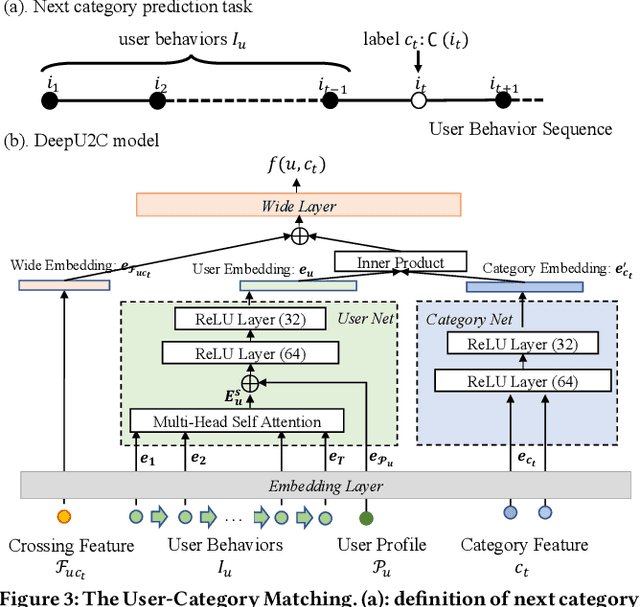
Recommender systems have made significant strides in various industries, primarily driven by extensive efforts to enhance recommendation accuracy. However, this pursuit of accuracy has inadvertently given rise to echo chamber/filter bubble effects. Especially in industry, it could impair user's experiences and prevent user from accessing a wider range of items. One of the solutions is to take diversity into account. However, most of existing works focus on user's explicit preferences, while rarely exploring user's non-interaction preferences. These neglected non-interaction preferences are especially important for broadening user's interests in alleviating echo chamber/filter bubble effects.Therefore, in this paper, we first define diversity as two distinct definitions, i.e., user-explicit diversity (U-diversity) and user-item non-interaction diversity (N-diversity) based on user historical behaviors. Then, we propose a succinct and effective method, named as Controllable Category Diversity Framework (CCDF) to achieve both high U-diversity and N-diversity simultaneously.Specifically, CCDF consists of two stages, User-Category Matching and Constrained Item Matching. The User-Category Matching utilizes the DeepU2C model and a combined loss to capture user's preferences in categories, and then selects the top-$K$ categories with a controllable parameter $K$.These top-$K$ categories will be used as trigger information in Constrained Item Matching. Offline experimental results show that our proposed DeepU2C outperforms state-of-the-art diversity-oriented methods, especially on N-diversity task. The whole framework is validated in a real-world production environment by conducting online A/B testing.
* A Two-stage Controllable Category Diversity Framework for Recommendation
Deep Evolutional Instant Interest Network for CTR Prediction in Trigger-Induced Recommendation
Jan 17, 2024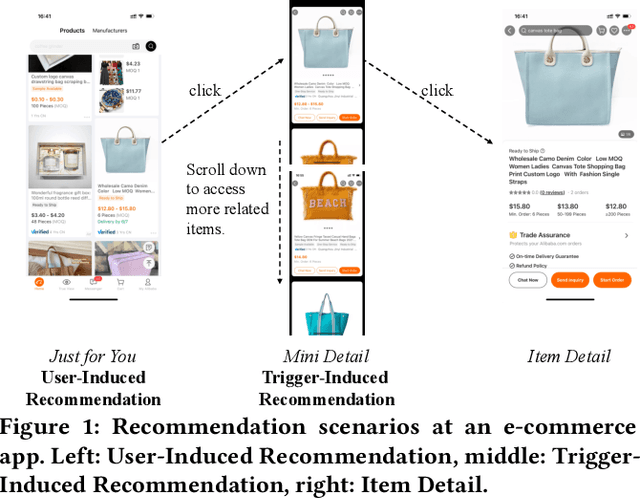
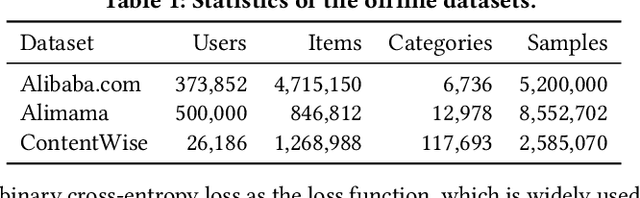
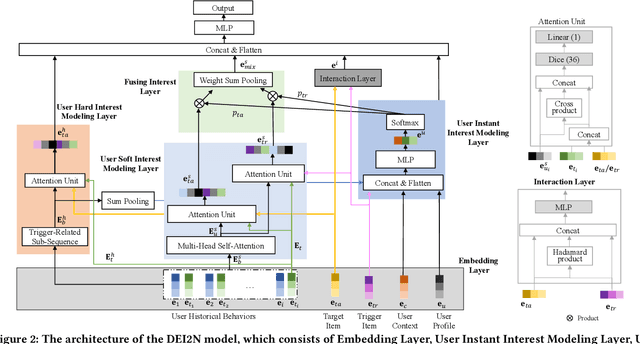
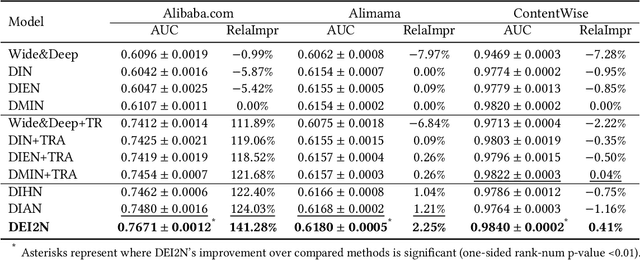
The recommendation has been playing a key role in many industries, e.g., e-commerce, streaming media, social media, etc. Recently, a new recommendation scenario, called Trigger-Induced Recommendation (TIR), where users are able to explicitly express their instant interests via trigger items, is emerging as an essential role in many e-commerce platforms, e.g., Alibaba.com and Amazon. Without explicitly modeling the user's instant interest, traditional recommendation methods usually obtain sub-optimal results in TIR. Even though there are a few methods considering the trigger and target items simultaneously to solve this problem, they still haven't taken into account temporal information of user behaviors, the dynamic change of user instant interest when the user scrolls down and the interactions between the trigger and target items. To tackle these problems, we propose a novel method -- Deep Evolutional Instant Interest Network (DEI2N), for click-through rate prediction in TIR scenarios. Specifically, we design a User Instant Interest Modeling Layer to predict the dynamic change of the intensity of instant interest when the user scrolls down. Temporal information is utilized in user behavior modeling. Moreover, an Interaction Layer is introduced to learn better interactions between the trigger and target items. We evaluate our method on several offline and real-world industrial datasets. Experimental results show that our proposed DEI2N outperforms state-of-the-art baselines. In addition, online A/B testing demonstrates the superiority over the existing baseline in real-world production environments.
PNeRFLoc: Visual Localization with Point-based Neural Radiance Fields
Dec 17, 2023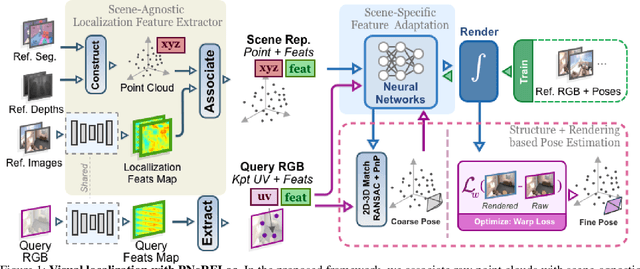
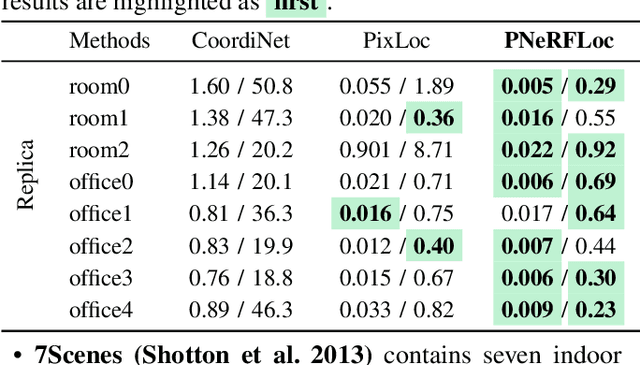
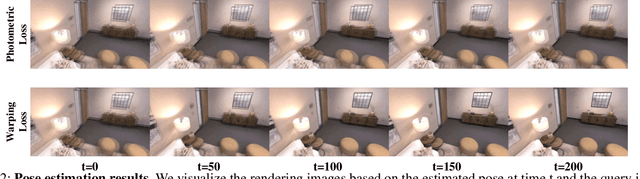

Due to the ability to synthesize high-quality novel views, Neural Radiance Fields (NeRF) have been recently exploited to improve visual localization in a known environment. However, the existing methods mostly utilize NeRFs for data augmentation to improve the regression model training, and the performance on novel viewpoints and appearances is still limited due to the lack of geometric constraints. In this paper, we propose a novel visual localization framework, \ie, PNeRFLoc, based on a unified point-based representation. On the one hand, PNeRFLoc supports the initial pose estimation by matching 2D and 3D feature points as traditional structure-based methods; on the other hand, it also enables pose refinement with novel view synthesis using rendering-based optimization. Specifically, we propose a novel feature adaption module to close the gaps between the features for visual localization and neural rendering. To improve the efficacy and efficiency of neural rendering-based optimization, we also develop an efficient rendering-based framework with a warping loss function. Furthermore, several robustness techniques are developed to handle illumination changes and dynamic objects for outdoor scenarios. Experiments demonstrate that PNeRFLoc performs the best on synthetic data when the NeRF model can be well learned and performs on par with the SOTA method on the visual localization benchmark datasets.
Dense RGB SLAM with Neural Implicit Maps
Jan 21, 2023There is an emerging trend of using neural implicit functions for map representation in Simultaneous Localization and Mapping (SLAM). Some pioneer works have achieved encouraging results on RGB-D SLAM. In this paper, we present a dense RGB SLAM method with neural implicit map representation. To reach this challenging goal without depth input, we introduce a hierarchical feature volume to facilitate the implicit map decoder. This design effectively fuses shape cues across different scales to facilitate map reconstruction. Our method simultaneously solves the camera motion and the neural implicit map by matching the rendered and input video frames. To facilitate optimization, we further propose a photometric warping loss in the spirit of multi-view stereo to better constrain the camera pose and scene geometry. We evaluate our method on commonly used benchmarks and compare it with modern RGB and RGB-D SLAM systems. Our method achieves favorable results than previous methods and even surpasses some recent RGB-D SLAM methods. Our source code will be publicly available.