 Add to Chrome
 Add to Firefox
 Add to Edge
From Generation to Matching: A Development Report on Personalized Chinese Handwriting
Aug 16, 2026
This paper documents a frozen engineering project on personalized Chinese handwriting. The project started from approximately 200 real handwriting images from one user, covering 197 unique Chinese characters, and was initially formulated as few-shot generation of unseen characters. A sequence of canonical-centered personalization routes repeatedly exposed the same conflict: increasing structural pressure made outputs more canonical, while increasing personalization could damage identity-defining strokes. The project was therefore reset around real-human character equivalence classes. A multi-writer CASIA candidate pool showed that a USER-compatible realization often already existed among valid human samples. The task consequently changed from synthesis to character-wise matching, followed by cross-writer composition into a virtual writer. The frozen system uses real-ink features, character-specific human population percentiles, top-20 candidate pruning, and greedy hardest-first whole-row selection. On the covered target set, all 197 USER characters had real-human candidates, and the 100-character evaluation subset was covered 100/100. Knowncharacter held-out comparisons included a row judged visually almost indistinguishable from genuine USER handwriting. A 60- episode stability audit placed every episode in a predefined A-like machine-proxy region, but these were not independent human A-level judgments. The final evidence supports stable practical B-level quality, with many outputs approaching A-level under the USER-defined criterion. The report records why generation became unnecessary for this case without claiming unrestricted or universal handwriting synthesis.

Active Perception for Embodied Disambiguation
Aug 11, 2026Natural language provides robots with a flexible task interface, but target ambiguity in embodied environments arises not only from user intent; it can also result from missing taskrelevant physical evidence in the current observation. Existing interactive disambiguation methods primarily obtain additional information by asking the user, whereas occlusion, restricted viewpoints, unreadable text, and unobserved targets require the robot to actively change its observation. We propose an active-perception framework for embodied target disambiguation that uses active observation as the backbone for information acquisition and uses a vision-language model to decide, on the basis of accumulated visual evidence and interaction information, whether to continue observing, request clarification, or complete target selection. Active observation can both directly recover missing discriminative evidence and reveal object names, labels, and semantic attributes, thereby improving user clarification when it remains necessary. Real-robot experiments show that the framework combines physical information acquisition and userintent clarification within a unified embodied disambiguation process.
DRIFT: Difficulty Routing Self-DIstillation with Rhythm-Gated Exploration and Success BuFfer Training
Jun 29, 2026Enabling large language models to achieve stable self-improvement without external expert supervision remains a central challenge in complex reasoning tasks. Existing self-distillation and reinforcement learning methods lack explicit mechanisms for tracking problem-level learning progress and adapting optimization strategies accordingly. Consequently, training may over-optimize easy problems, receive weak supervision from hard problems, and fail to sufficiently explore borderline cases. To resolve these issues, we propose DRIFT, an online self-evolution policy optimization framework for large language models. DRIFT regulates the model's self-improvement process through the joint use of Difficulty Routing and Rhythm Gating. The former identifies the model's learning state at the problem level and dynamically allocates self-distillation and reinforcement learning signals, while the latter refines policy updates at the token level, concentrating exploration on critical reasoning positions. By further incorporating a success buffer and a two-stage curriculum learning strategy, DRIFT preserves high-quality historical experience while progressively guiding the model from reliable behavior acquisition toward stable policy evolution. Evaluated across five benchmarks and three model scales, DRIFT surpasses the peak performance of both GRPO and SDPO across all evaluated metrics. On the average score over the five benchmarks, DRIFT achieves 79.5$\%$, outperforming GRPO by 9.5$\%$ and SDPO by 7.5$\%$, establishing a new state-of-the-art result. Notably, on ToolUse, DRIFT reaches an accuracy of 79.2$\%$, improving over GRPO by 13.5$\%$ and SDPO by 10.7$\%$, setting a new state-of-the-art and substantially outperforming all concurrent methods.
Workflow-GYM: Towards Long-Horizon Evaluation of Computer-use Agentic tasks in Real-World Professional Fields
Jun 09, 2026Recent years have witnessed the rapid evolution of AI agents toward handling increasingly complex, real-world tasks. However, existing benchmarks rarely evaluate whether agents can operate graphical user interfaces to complete long-horizon, high-value professional workflows across diverse domains. Current GUI benchmarks still predominantly focus on general-purpose software, relatively simple applications, and short-horizon tasks, leaving it largely unknown whether modern agents can follow user instructions to autonomously operate domain-specific professional software and accomplish economically valuable work in an end-to-end manner. To bridge this gap, we introduce Workflow-GYM, a benchmark for long-horizon GUI tasks centered on professional domains and specialized software environments. Through extensive experiments on state-of-the-art models, we find that even the strongest models achieve only slightly above 30% success rates, highlighting that professional long-horizon GUI workflows remain highly challenging for current GUI agents. Further analysis reveals that current agents struggle to maintain long-horizon workflow consistency, frequently exhibiting workflow stage omission, error propagation, objective drift, and insufficient understanding of professional software environments. Our findings provide important insights into the limitations of current agent systems and suggest key directions for the next generation of GUI-agent research.
Bi-Adapt: Few-shot Bimanual Adaptation for Novel Categories of 3D Objects via Semantic Correspondence
Feb 09, 2026Bimanual manipulation is imperative yet challenging for robots to execute complex tasks, requiring coordinated collaboration between two arms. However, existing methods for bimanual manipulation often rely on costly data collection and training, struggling to generalize to unseen objects in novel categories efficiently. In this paper, we present Bi-Adapt, a novel framework designed for efficient generalization for bimanual manipulation via semantic correspondence. Bi-Adapt achieves cross-category affordance mapping by leveraging the strong capability of vision foundation models. Fine-tuning with restricted data on novel categories, Bi-Adapt exhibits notable generalization to out-of-category objects in a zero-shot manner. Extensive experiments conducted in both simulation and real-world environments validate the effectiveness of our approach and demonstrate its high efficiency, achieving a high success rate on different benchmark tasks across novel categories with limited data. Project website: https://biadapt-project.github.io/
GUI-ReWalk: Massive Data Generation for GUI Agent via Stochastic Exploration and Intent-Aware Reasoning
Sep 19, 2025Graphical User Interface (GUI) Agents, powered by large language and vision-language models, hold promise for enabling end-to-end automation in digital environments. However, their progress is fundamentally constrained by the scarcity of scalable, high-quality trajectory data. Existing data collection strategies either rely on costly and inconsistent manual annotations or on synthetic generation methods that trade off between diversity and meaningful task coverage. To bridge this gap, we present GUI-ReWalk: a reasoning-enhanced, multi-stage framework for synthesizing realistic and diverse GUI trajectories. GUI-ReWalk begins with a stochastic exploration phase that emulates human trial-and-error behaviors, and progressively transitions into a reasoning-guided phase where inferred goals drive coherent and purposeful interactions. Moreover, it supports multi-stride task generation, enabling the construction of long-horizon workflows across multiple applications. By combining randomness for diversity with goal-aware reasoning for structure, GUI-ReWalk produces data that better reflects the intent-aware, adaptive nature of human-computer interaction. We further train Qwen2.5-VL-7B on the GUI-ReWalk dataset and evaluate it across multiple benchmarks, including Screenspot-Pro, OSWorld-G, UI-Vision, AndroidControl, and GUI-Odyssey. Results demonstrate that GUI-ReWalk enables superior coverage of diverse interaction flows, higher trajectory entropy, and more realistic user intent. These findings establish GUI-ReWalk as a scalable and data-efficient framework for advancing GUI agent research and enabling robust real-world automation.
MetaFold: Language-Guided Multi-Category Garment Folding Framework via Trajectory Generation and Foundation Model
Mar 11, 2025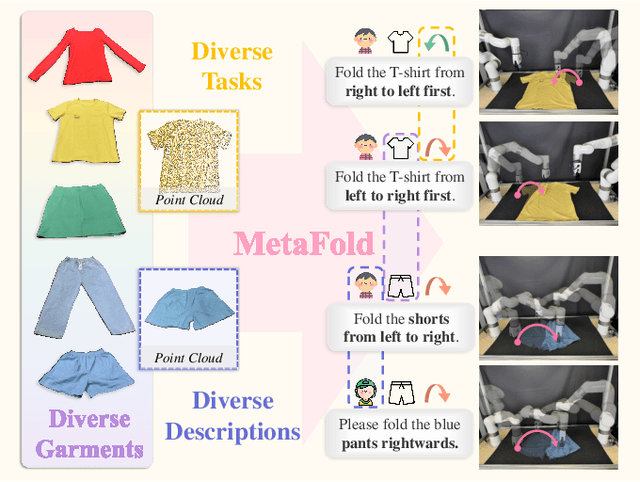
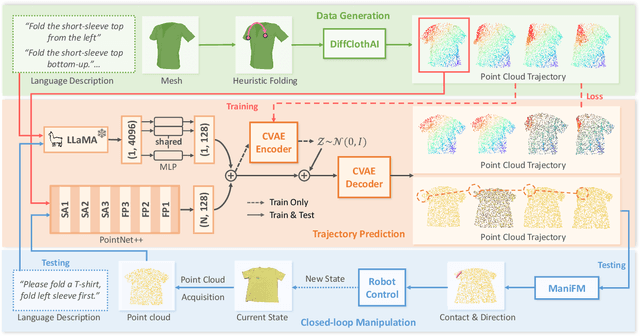
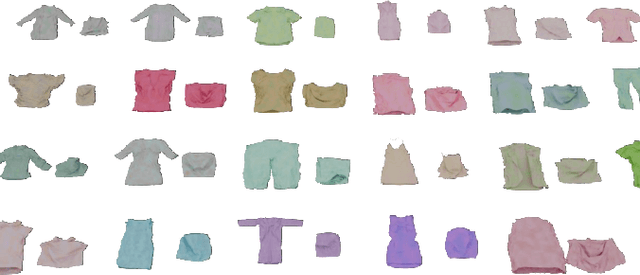
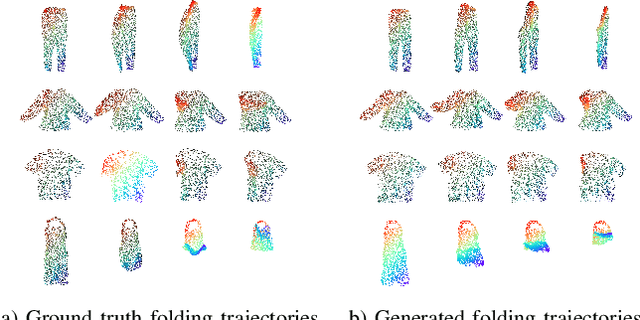
Garment folding is a common yet challenging task in robotic manipulation. The deformability of garments leads to a vast state space and complex dynamics, which complicates precise and fine-grained manipulation. Previous approaches often rely on predefined key points or demonstrations, limiting their generalization across diverse garment categories. This paper presents a framework, MetaFold, that disentangles task planning from action prediction, learning each independently to enhance model generalization. It employs language-guided point cloud trajectory generation for task planning and a low-level foundation model for action prediction. This structure facilitates multi-category learning, enabling the model to adapt flexibly to various user instructions and folding tasks. Experimental results demonstrate the superiority of our proposed framework. Supplementary materials are available on our website: https://meta-fold.github.io/.
Memory-based Ensemble Learning in CMR Semantic Segmentation
Feb 13, 2025Existing models typically segment either the entire 3D frame or 2D slices independently to derive clinical functional metrics from ventricular segmentation in cardiac cine sequences. While performing well overall, they struggle at the end slices. To address this, we leverage spatial continuity to extract global uncertainty from segmentation variance and use it as memory in our ensemble learning method, Streaming, for classifier weighting, balancing overall and end-slice performance. Additionally, we introduce the End Coefficient (EC) to quantify end-slice accuracy. Experiments on ACDC and M\&Ms datasets show that our framework achieves near-state-of-the-art Dice Similarity Coefficient (DSC) and outperforms all models on end-slice performance, improving patient-specific segmentation accuracy.
Ethereum Fraud Detection via Joint Transaction Language Model and Graph Representation Learning
Sep 09, 2024Ethereum faces growing fraud threats. Current fraud detection methods, whether employing graph neural networks or sequence models, fail to consider the semantic information and similarity patterns within transactions. Moreover, these approaches do not leverage the potential synergistic benefits of combining both types of models. To address these challenges, we propose TLMG4Eth that combines a transaction language model with graph-based methods to capture semantic, similarity, and structural features of transaction data in Ethereum. We first propose a transaction language model that converts numerical transaction data into meaningful transaction sentences, enabling the model to learn explicit transaction semantics. Then, we propose a transaction attribute similarity graph to learn transaction similarity information, enabling us to capture intuitive insights into transaction anomalies. Additionally, we construct an account interaction graph to capture the structural information of the account transaction network. We employ a deep multi-head attention network to fuse transaction semantic and similarity embeddings, and ultimately propose a joint training approach for the multi-head attention network and the account interaction graph to obtain the synergistic benefits of both.
The Role of Transformer Models in Advancing Blockchain Technology: A Systematic Review
Sep 02, 2024As blockchain technology rapidly evolves, the demand for enhanced efficiency, security, and scalability grows.Transformer models, as powerful deep learning architectures,have shown unprecedented potential in addressing various blockchain challenges. However, a systematic review of Transformer applications in blockchain is lacking. This paper aims to fill this research gap by surveying over 200 relevant papers, comprehensively reviewing practical cases and research progress of Transformers in blockchain applications. Our survey covers key areas including anomaly detection, smart contract security analysis, cryptocurrency prediction and trend analysis, and code summary generation. To clearly articulate the advancements of Transformers across various blockchain domains, we adopt a domain-oriented classification system, organizing and introducing representative methods based on major challenges in current blockchain research. For each research domain,we first introduce its background and objectives, then review previous representative methods and analyze their limitations,and finally introduce the advancements brought by Transformer models. Furthermore, we explore the challenges of utilizing Transformer, such as data privacy, model complexity, and real-time processing requirements. Finally, this article proposes future research directions, emphasizing the importance of exploring the Transformer architecture in depth to adapt it to specific blockchain applications, and discusses its potential role in promoting the development of blockchain technology. This review aims to provide new perspectives and a research foundation for the integrated development of blockchain technology and machine learning, supporting further innovation and application expansion of blockchain technology.