 Add to Chrome
 Add to Firefox
 Add to Edge
OmniOpt: Taxonomy, Geometry, and Benchmarking of Modern Optimizers
Jul 04, 2026
Optimizer selection for large-scale model training has become a system-level design decision constrained jointly by compute, memory, tuning budget, and task diversity, yet the landscape of over one hundred methods remains fragmented. We therefore present OmniOpt, a unified survey and benchmark cookbook of optimizers for the research community. OmniOpt rests on four coupled components. First, we treat every optimizer update as a structured transformation through a five-stage meta-pipeline, and show that most methods engage only one or two of these stages. Second, we use norm-constrained linear minimization oracles (LMOs) to unify different optimizers. Third, these two views ground a dual-dimension taxonomy, one dimension assigning each method to a mechanism family and the other recording the measurable training objectives it aims to improve. Fourth, and at the core of this paper, we instantiate the full taxonomy in a unified cross-domain benchmark spanning representative optimizers, model scales, and training regimes from language model pretraining to image classification, systematically analyzing each method family across multiple effect objectives and laying out their trade-offs. OmniOpt thus supplies the research community with an operational coordinate system for selecting optimizers under explicit mechanism and objective assumptions, and charts a direction for the future development of the optimizer community.

Bridging Modal Isolation in Interleaved Thinking: Supervising Modality Transitions via Stepwise Reinforcement
Jun 11, 2026Interleaved thinking, where a unified multimodal model alternates between textual reasoning and visual generation, has shown promise on spatial and physical tasks. However, in complex long-chain scenarios, we identify a fundamental failure mode: generated images diverge from the textual context while subsequent text ignores the visual evidence, causing the two modalities to alternate without genuinely informing each other. We term this Modal Isolation and attribute it to compounding information loss at modality boundaries. We decompose each reasoning cycle into atomic operations and define modality transition loss, quantifying cross-modal hallucination (text-to-image) and visual utilization deficit (image-to-text) at each boundary. We propose MoTiF (Modality Tiransition Fidelity), a two-stage training framework that directly optimizes these transitions: Reflective SFT trains the model to detect and recover from erroneous visual outputs; Flow-GRPO improves image generation fidelity via reinforcement learning. All training signals in MoTiF derive from transition-level fidelity rather than end-task accuracy. Across four visual puzzle benchmarks, this transition-level supervision substantially improves both cross-modal coherence and final task accuracy. The results demonstrate that effective interleaved reasoning requires explicit structural supervision at modality boundaries, not merely scaling or end-task optimization.
PaperFlow: Profiling, Recommending, and Adapting Across Daily Paper Streams
Jun 05, 2026Scientific paper recommendation is typically evaluated as static ranking over a fixed candidate set, yet real scientific reading unfolds as a daily, longitudinal process in which interests shift and feedback accumulates. We introduce PaperFlow, a framework that organizes it into three coupled stages: Profiling, which constructs and maintains a structured, inspectable scholarly profile from heterogeneous cold-start evidence; Recommending, which ranks each date-specific paper stream through multi-signal aggregation under a fixed display budget; and Adapting, which updates user state from semantically distinct feedback signals and models interest drift across days. We further define a longitudinal user-day benchmark that fixes users, dates, candidate pools, visible inputs, and hidden simulated relevance labels under a shared temporal information boundary. The benchmark contains 24 simulated research users, 50 daily paper streams, 1,200 user-day episodes, 20,727 unique papers, and 497,448 episode-paper records. We additionally specify a blind human-evaluation protocol to validate alignment between automatic metrics and expert judgments. Experiments against five scientific recommendation baselines show that PaperFlow achieves the strongest oracle-based ranking, the highest behavioral alignment with simulated reading selections, and the best blind human-evaluation score.
PaperFit: Vision-in-the-Loop Typesetting Optimization for Scientific Documents
May 11, 2026A LaTeX manuscript that compiles without error is not necessarily publication-ready. The resulting PDFs frequently suffer from misplaced floats, overflowing equations, inconsistent table scaling, widow and orphan lines, and poor page balance, forcing authors into repetitive compile-inspect-edit cycles. Rule-based tools are blind to rendered visuals, operating only on source code and log files. Text-only LLMs perform open-loop text editing, unable to predict or verify the two-dimensional layout consequences of their changes. Reliable typesetting optimization therefore requires a visual closed loop with verification after every edit. We formalize this problem as Visual Typesetting Optimization (VTO), the task of transforming a compilable LaTeX paper into a visually polished, page-budget-compliant PDF through iterative visual verification and source-level revision, and introduce a five-category taxonomy of typesetting defects to guide diagnosis. We present PaperFit, a vision-in-the-loop agent that iteratively renders pages, diagnoses defects, and applies constrained repairs. To benchmark VTO, we construct PaperFit-Bench with 200 papers across 10 venue templates and 13 defect types at different difficulty. Extensive experiments show that PaperFit outperforms all baselines by a large margin, establishing that bridging the gap from compilable source to publication-ready PDF requires vision-in-the-loop optimization and that VTO constitutes a critical missing stage in the document automation pipeline.
Programming with Data: Test-Driven Data Engineering for Self-Improving LLMs from Raw Corpora
Apr 27, 2026Reliably transferring specialized human knowledge from text into large language models remains a fundamental challenge in artificial intelligence. Fine-tuning on domain corpora has enabled substantial capability gains, but the process operates without feedback: when a model fails on a domain task, there is no method to diagnose what is deficient in the training data, and the only recourse is to add more data indiscriminately. Here we show that when a structured knowledge representation extracted from the source corpus serves as the shared foundation for both training data and evaluation, the complete data-engineering lifecycle maps onto the software development lifecycle in a precise and operative way: training data becomes source code specifying what the model should learn, model training becomes compilation, benchmarking becomes unit testing, and failure-driven data repair becomes debugging. Under this correspondence, model failures decompose into concept-level gaps and reasoning-chain breaks that can be traced back to specific deficiencies in the data and repaired through targeted patches, with each repair cycle producing consistent improvements across model scales and architectures without degrading general capabilities. We formalize this principle as Programming with Data and instantiate it across sixteen disciplines spanning the natural sciences, engineering, biomedicine, and the social sciences, releasing a structured knowledge base, benchmark suite, and training corpus as open resources. By demonstrating that the relationship between training data and model behaviour is structurally traceable and systematically repairable, this work establishes a principled foundation for the reliable engineering of human expertise into language models.
The Trinity of Consistency as a Defining Principle for General World Models
Feb 26, 2026The construction of World Models capable of learning, simulating, and reasoning about objective physical laws constitutes a foundational challenge in the pursuit of Artificial General Intelligence. Recent advancements represented by video generation models like Sora have demonstrated the potential of data-driven scaling laws to approximate physical dynamics, while the emerging Unified Multimodal Model (UMM) offers a promising architectural paradigm for integrating perception, language, and reasoning. Despite these advances, the field still lacks a principled theoretical framework that defines the essential properties requisite for a General World Model. In this paper, we propose that a World Model must be grounded in the Trinity of Consistency: Modal Consistency as the semantic interface, Spatial Consistency as the geometric basis, and Temporal Consistency as the causal engine. Through this tripartite lens, we systematically review the evolution of multimodal learning, revealing a trajectory from loosely coupled specialized modules toward unified architectures that enable the synergistic emergence of internal world simulators. To complement this conceptual framework, we introduce CoW-Bench, a benchmark centered on multi-frame reasoning and generation scenarios. CoW-Bench evaluates both video generation models and UMMs under a unified evaluation protocol. Our work establishes a principled pathway toward general world models, clarifying both the limitations of current systems and the architectural requirements for future progress.
GGBench: A Geometric Generative Reasoning Benchmark for Unified Multimodal Models
Nov 14, 2025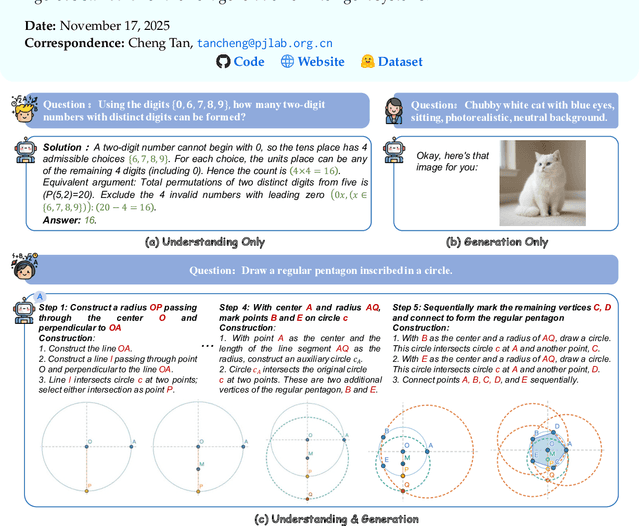
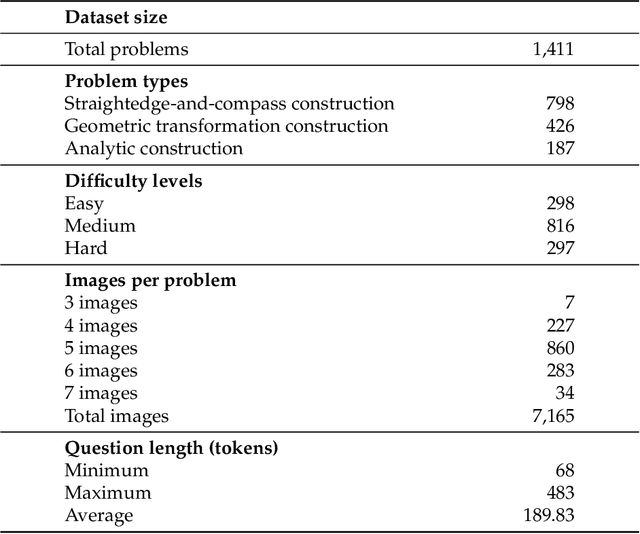
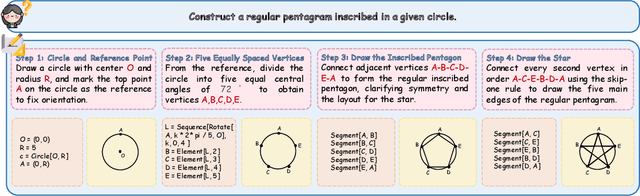
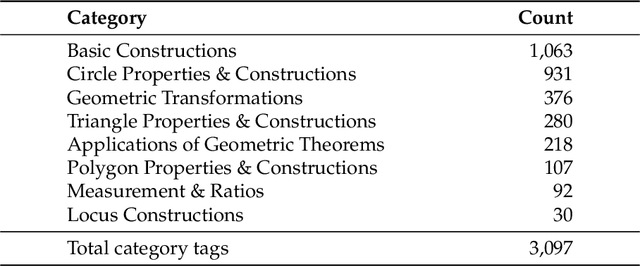
The advent of Unified Multimodal Models (UMMs) signals a paradigm shift in artificial intelligence, moving from passive perception to active, cross-modal generation. Despite their unprecedented ability to synthesize information, a critical gap persists in evaluation: existing benchmarks primarily assess discriminative understanding or unconstrained image generation separately, failing to measure the integrated cognitive process of generative reasoning. To bridge this gap, we propose that geometric construction provides an ideal testbed as it inherently demands a fusion of language comprehension and precise visual generation. We introduce GGBench, a benchmark designed specifically to evaluate geometric generative reasoning. It provides a comprehensive framework for systematically diagnosing a model's ability to not only understand and reason but to actively construct a solution, thereby setting a more rigorous standard for the next generation of intelligent systems. Project website: https://opendatalab-raiser.github.io/GGBench/.