 Add to Chrome
 Add to Firefox
 Add to Edge
Shape Your Feed: An LLM-based Agentic System for Conversational Recommendation
Aug 06, 2026
Industrial recommendation systems predominantly adopt a passive ranking paradigm that infers user preferences from implicit behavioral signals (e.g., clicks, dwell time) rather than explicit, natural language inputs. As a result, users experience a persistent discrepancy between their explicit interests and what passive behavioral algorithms deliver, limiting their ability to express nuanced preferences or steer their feed in real time. To address this growing gap between how recommendations are optimized and how users wish to articulate their interests, we present Shape Your Feed (SYF), an LLM-based agentic recommendation framework that enables real-time, multimodal co-curation of content. SYF employs a three-tier architecture: (i) a Perception Flow that captures fine-grained user intent from text prompts, voice commands, and UI interactions; (ii) a Serving Flow that performs real-time agentic re-ranking and pruning of candidate items, grounded in a persistent Semantic Profile encoding evolving user preferences; and (iii) a Self-Evolution Flow that aligns system behavior with human judgments via Direct Preference Optimization (DPO) and an LLM-as-a-Judge ensemble. Offline evaluations show that SYF's alignment scoring module achieves 98.85% accuracy, substantially improving over strong few-shot baselines. Large-scale online A/B experiments on production traffic further demonstrate that SYF improves feed relevance and user sentiment, indicating a practical and scalable path toward interactive, user-steerable recommendation in industrial settings.

A General Framework for Multimodal LLM-Based Multimedia Understanding in Large-Scale Recommendation Systems
May 10, 2026Conventional recommendation systems frequently fail to fully exploit the high-dimensional semantic signals inherent in multimedia content, thereby limiting the fidelity of user preference modeling. While Multimodal Large Language Models (MM-LLMs) offer robust mechanisms for interpreting such complex data, their integration into latency-constrained, industrial-scale architectures remains a significant challenge. To address this, we propose a generalized framework for MM-LLM-driven multimedia understanding. Our methodology employs a tripartite architecture encompassing content interpretation, representation extraction, and systematic pipeline integration, instantiated via a LLaMA2-based model that generates descriptive captions subsequently ingested as tokenized categorical features. Empirical evaluation demonstrates the efficacy of this approach, yielding a $0.35\%$ increase in offline AUC and a $0.02\%$ improvement in online metrics at scale, substantiating the practical viability of leveraging MM-LLMs to enhance large-scale recommendation performance.
Objective Shaping with Hard Negatives: Windowed Partial AUC Optimization for RL-based LLM Recommenders
Apr 24, 2026Reinforcement learning (RL) effectively optimizes Large Language Model (LLM)-based recommenders by contrasting positive and negative items. Empirically, training with beam-search negatives consistently outperforms random negatives, yet the mechanism is not well understood. We address this gap by analyzing the induced optimization objective and show that: (i) Under binary reward feedback, optimizing LLM recommenders with Group Relative Policy Optimization (GRPO) is theoretically equivalent to maximizing the Area Under the ROC Curve (AUC), which is often misaligned with Top-$K$ recommendation; and (ii) Replacing random negatives with beam-search negatives reshapes the objective toward partial AUC, improving alignment with Top-$K$ metrics. Motivated by this perspective, we introduce Windowed Partial AUC (WPAUC), which constrains the false positive rate (FPR) to a window [$α,α+d$] to more directly align with Top-$K$ metrics. We further propose an efficient Threshold-Adjusted Windowed reweighting (TAWin) RL method for its optimization, enabling explicit control over the targeted Top-$K$ performance. Experiments on four real-world datasets validate the theory and deliver consistent state-of-the-art performance.
Deep Reinforcement Learning for Personalized Search Story Recommendation
Jul 26, 2019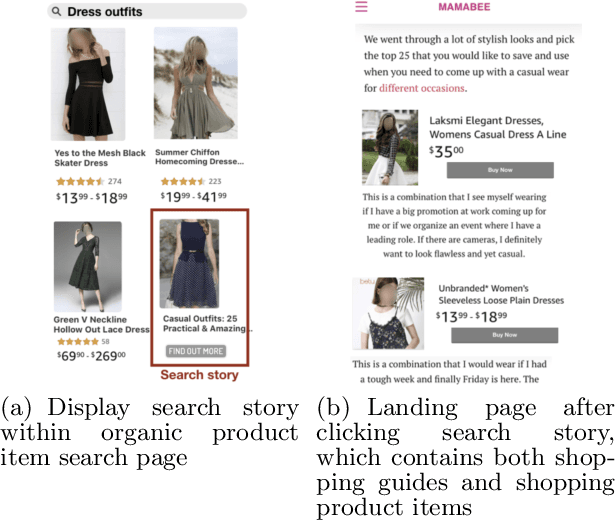
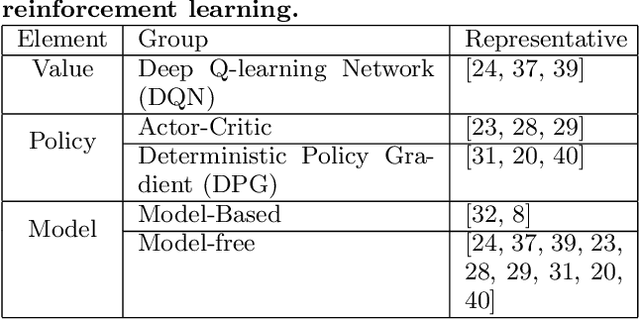
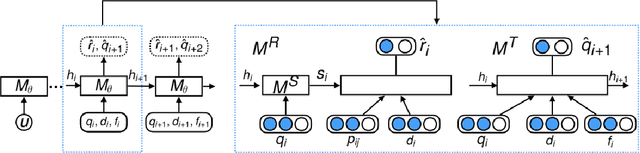
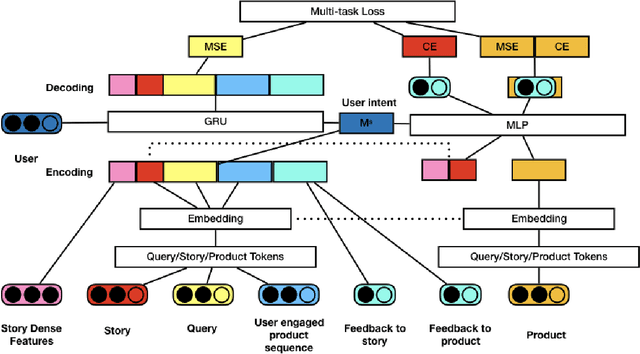
In recent years, \emph{search story}, a combined display with other organic channels, has become a major source of user traffic on platforms such as e-commerce search platforms, news feed platforms and web and image search platforms. The recommended search story guides a user to identify her own preference and personal intent, which subsequently influences the user's real-time and long-term search behavior. %With such an increased importance of search stories, As search stories become increasingly important, in this work, we study the problem of personalized search story recommendation within a search engine, which aims to suggest a search story relevant to both a search keyword and an individual user's interest. To address the challenge of modeling both immediate and future values of recommended search stories (i.e., cross-channel effect), for which conventional supervised learning framework is not applicable, we resort to a Markov decision process and propose a deep reinforcement learning architecture trained by both imitation learning and reinforcement learning. We empirically demonstrate the effectiveness of our proposed approach through extensive experiments on real-world data sets from JD.com.
Label Propagation on K-partite Graphs with Heterophily
Jan 21, 2017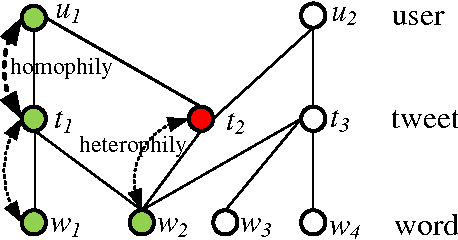
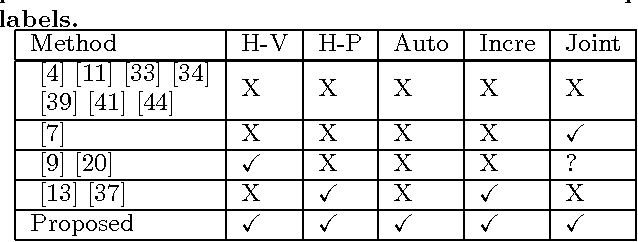
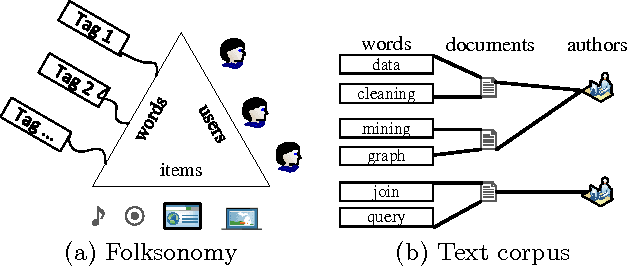
In this paper, for the first time, we study label propagation in heterogeneous graphs under heterophily assumption. Homophily label propagation (i.e., two connected nodes share similar labels) in homogeneous graph (with same types of vertices and relations) has been extensively studied before. Unfortunately, real-life networks are heterogeneous, they contain different types of vertices (e.g., users, images, texts) and relations (e.g., friendships, co-tagging) and allow for each node to propagate both the same and opposite copy of labels to its neighbors. We propose a $\mathcal{K}$-partite label propagation model to handle the mystifying combination of heterogeneous nodes/relations and heterophily propagation. With this model, we develop a novel label inference algorithm framework with update rules in near-linear time complexity. Since real networks change over time, we devise an incremental approach, which supports fast updates for both new data and evidence (e.g., ground truth labels) with guaranteed efficiency. We further provide a utility function to automatically determine whether an incremental or a re-modeling approach is favored. Extensive experiments on real datasets have verified the effectiveness and efficiency of our approach, and its superiority over the state-of-the-art label propagation methods.
Temporal Learning and Sequence Modeling for a Job Recommender System
Aug 11, 2016
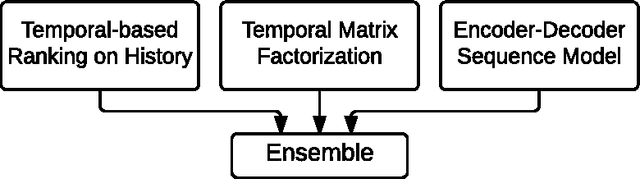
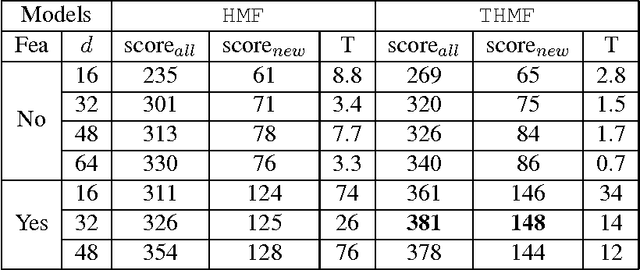
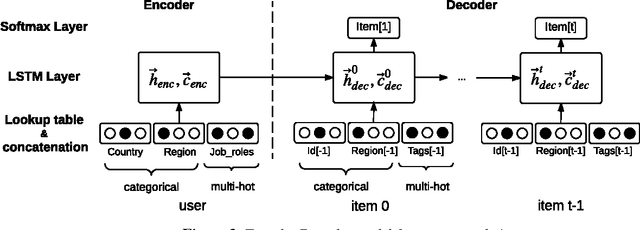
We present our solution to the job recommendation task for RecSys Challenge 2016. The main contribution of our work is to combine temporal learning with sequence modeling to capture complex user-item activity patterns to improve job recommendations. First, we propose a time-based ranking model applied to historical observations and a hybrid matrix factorization over time re-weighted interactions. Second, we exploit sequence properties in user-items activities and develop a RNN-based recommendation model. Our solution achieved 5$^{th}$ place in the challenge among more than 100 participants. Notably, the strong performance of our RNN approach shows a promising new direction in employing sequence modeling for recommendation systems.
Scalable Link Prediction in Dynamic Networks via Non-Negative Matrix Factorization
Jul 23, 2016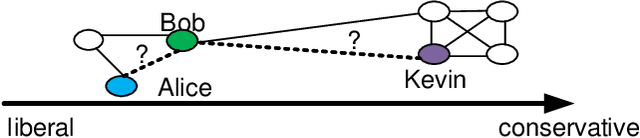
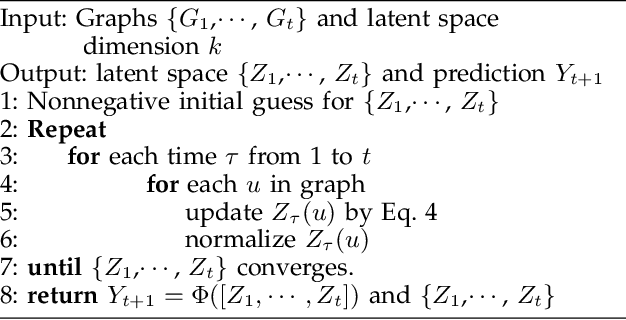
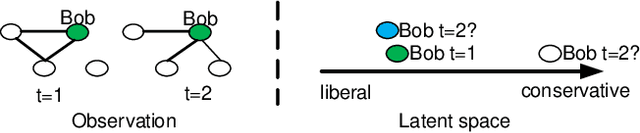
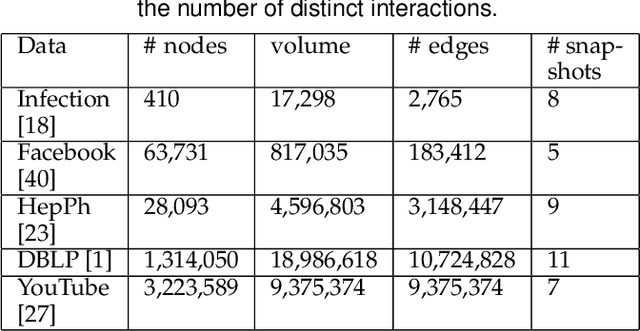
We propose a scalable temporal latent space model for link prediction in dynamic social networks, where the goal is to predict links over time based on a sequence of previous graph snapshots. The model assumes that each user lies in an unobserved latent space and interactions are more likely to form between similar users in the latent space representation. In addition, the model allows each user to gradually move its position in the latent space as the network structure evolves over time. We present a global optimization algorithm to effectively infer the temporal latent space, with a quadratic convergence rate. Two alternative optimization algorithms with local and incremental updates are also proposed, allowing the model to scale to larger networks without compromising prediction accuracy. Empirically, we demonstrate that our model, when evaluated on a number of real-world dynamic networks, significantly outperforms existing approaches for temporal link prediction in terms of both scalability and predictive power.
The DARPA Twitter Bot Challenge
Apr 21, 2016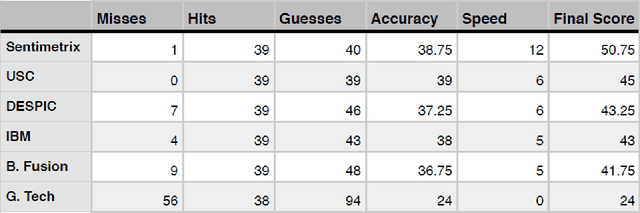
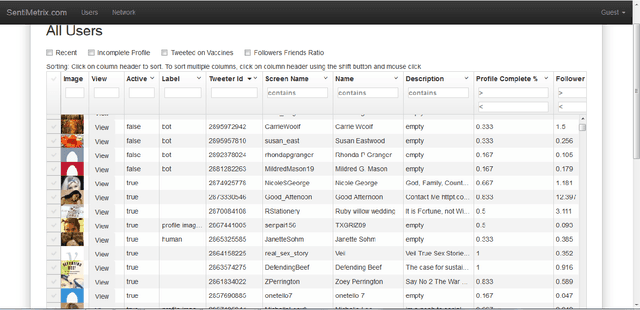
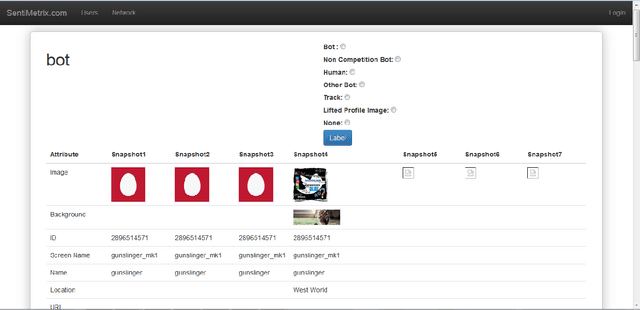
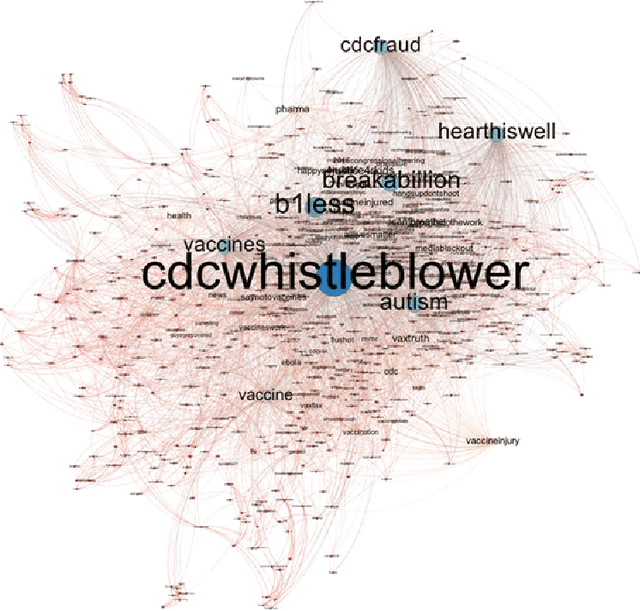
A number of organizations ranging from terrorist groups such as ISIS to politicians and nation states reportedly conduct explicit campaigns to influence opinion on social media, posing a risk to democratic processes. There is thus a growing need to identify and eliminate "influence bots" - realistic, automated identities that illicitly shape discussion on sites like Twitter and Facebook - before they get too influential. Spurred by such events, DARPA held a 4-week competition in February/March 2015 in which multiple teams supported by the DARPA Social Media in Strategic Communications program competed to identify a set of previously identified "influence bots" serving as ground truth on a specific topic within Twitter. Past work regarding influence bots often has difficulty supporting claims about accuracy, since there is limited ground truth (though some exceptions do exist [3,7]). However, with the exception of [3], no past work has looked specifically at identifying influence bots on a specific topic. This paper describes the DARPA Challenge and describes the methods used by the three top-ranked teams.
* IEEE Computer Magazine, in press
Tripartite Graph Clustering for Dynamic Sentiment Analysis on Social Media
Jun 12, 2014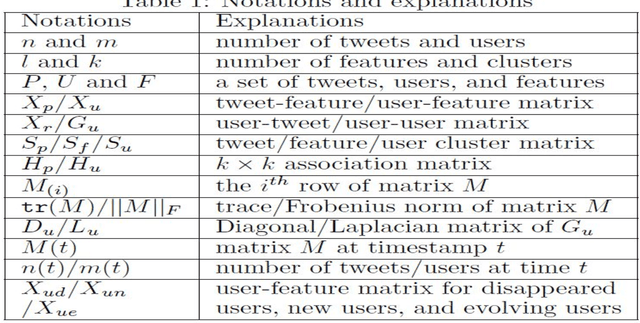
The growing popularity of social media (e.g, Twitter) allows users to easily share information with each other and influence others by expressing their own sentiments on various subjects. In this work, we propose an unsupervised \emph{tri-clustering} framework, which analyzes both user-level and tweet-level sentiments through co-clustering of a tripartite graph. A compelling feature of the proposed framework is that the quality of sentiment clustering of tweets, users, and features can be mutually improved by joint clustering. We further investigate the evolution of user-level sentiments and latent feature vectors in an online framework and devise an efficient online algorithm to sequentially update the clustering of tweets, users and features with newly arrived data. The online framework not only provides better quality of both dynamic user-level and tweet-level sentiment analysis, but also improves the computational and storage efficiency. We verified the effectiveness and efficiency of the proposed approaches on the November 2012 California ballot Twitter data.