 Add to Chrome
 Add to Firefox
 Add to Edge
Spectral Regularization for Diffusion Models
Mar 02, 2026
Diffusion models are typically trained using pointwise reconstruction objectives that are agnostic to the spectral and multi-scale structure of natural signals. We propose a loss-level spectral regularization framework that augments standard diffusion training with differentiable Fourier- and wavelet-domain losses, without modifying the diffusion process, model architecture, or sampling procedure. The proposed regularizers act as soft inductive biases that encourage appropriate frequency balance and coherent multi-scale structure in generated samples. Our approach is compatible with DDPM, DDIM, and EDM formulations and introduces negligible computational overhead. Experiments on image and audio generation demonstrate consistent improvements in sample quality, with the largest gains observed on higher-resolution, unconditional datasets where fine-scale structure is most challenging to model.

Is Your Diffusion Sampler Actually Correct? A Sampler-Centric Evaluation of Discrete Diffusion Language Models
Feb 23, 2026Discrete diffusion language models (dLLMs) provide a fast and flexible alternative to autoregressive models (ARMs) via iterative denoising with parallel updates. However, their evaluation is challenging: existing metrics conflate denoiser approximation error with sampler-induced error from the sampling dynamics, a problem that does not arise for ARMs whose autoregressive sampling exactly reflects the learned probability model. We introduce a sampler-centric oracle framework that replaces learned denoisers with an exact Hidden Markov Model posterior derived from a ground-truth Markov chain, isolating sampler-induced error in a controlled setting. We show that few-step discrete diffusion samplers are not distributionally correct even under an oracle denoiser, with transition-level mismatch that vanishes only as the number of steps approaches the sequence length. Moreover, improvements in negative log-likelihood, generative perplexity, or MAUVE do not imply correct sampling. Code is available at https://luhantang.github.io/dllm_sampler
Discrete Stochastic Localization for Non-autoregressive Generation
Feb 18, 2026Non-autoregressive (NAR) generation reduces decoding latency by predicting many tokens in parallel, but iterative refinement often suffers from error accumulation and distribution shift under self-generated drafts. Masked diffusion language models (MDLMs) and their remasking samplers (e.g., ReMDM) can be viewed as modern NAR iterative refinement, where generation repeatedly revises a partially observed draft. In this work we show that \emph{training alone} can substantially improve the step-efficiency of MDLM/ReMDM sampling. We propose \textsc{DSL} (Discrete Stochastic Localization), which trains a single SNR-invariant denoiser across a continuum of corruption levels, bridging intermediate draft noise and mask-style endpoint corruption within one Diffusion Transformer. On OpenWebText, \textsc{DSL} fine-tuning yields large MAUVE gains at low step budgets, surpassing the MDLM+ReMDM baseline with \(\sim\)4$\times$ fewer denoiser evaluations, and matches autoregressive quality at high budgets. Analyses show improved self-correction and uncertainty calibration, making remasking markedly more compute-efficient.
Generation Order and Parallel Decoding in Masked Diffusion Models: An Information-Theoretic Perspective
Jan 30, 2026Masked Diffusion Models (MDMs) significantly accelerate inference by trading off sequential determinism. However, the theoretical mechanisms governing generation order and the risks inherent in parallelization remain under-explored. In this work, we provide a unified information-theoretic framework to decouple and analyze two fundamental sources of failure: order sensitivity and parallelization bias. Our analysis yields three key insights: (1) The benefits of Easy-First decoding (prioritizing low-entropy tokens) are magnified as model error increases; (2) factorized parallel decoding introduces intrinsic sampling errors that can lead to arbitrary large Reverse KL divergence, capturing "incoherence" failures that standard Forward KL metrics overlook; and (3) while verification can eliminate sampling error, it incurs an exponential cost governed by the total correlation within a block. Conversely, heuristics like remasking, though computationally efficient, cannot guarantee distributional correctness. Experiments on a controlled Block-HMM and large-scale MDMs (LLaDA) for arithmetic reasoning validate our theoretical framework.
Thinking Out of Order: When Output Order Stops Reflecting Reasoning Order in Diffusion Language Models
Jan 29, 2026Autoregressive (AR) language models enforce a fixed left-to-right generation order, creating a fundamental limitation when the required output structure conflicts with natural reasoning (e.g., producing answers before explanations due to presentation or schema constraints). In such cases, AR models must commit to answers before generating intermediate reasoning, and this rigid constraint forces premature commitment. Masked diffusion language models (MDLMs), which iteratively refine all tokens in parallel, offer a way to decouple computation order from output structure. We validate this capability on GSM8K, Math500, and ReasonOrderQA, a benchmark we introduce with controlled difficulty and order-level evaluation. When prompts request answers before reasoning, AR models exhibit large accuracy gaps compared to standard chain-of-thought ordering (up to 67% relative drop), while MDLMs remain stable ($\leq$14% relative drop), a property we term "order robustness". Using ReasonOrderQA, we present evidence that MDLMs achieve order robustness by stabilizing simpler tokens (e.g., reasoning steps) earlier in the diffusion process than complex ones (e.g., final answers), enabling reasoning tokens to stabilize before answer commitment. Finally, we identify failure conditions where this advantage weakens, outlining the limits required for order robustness.
Multi-modal Imputation for Alzheimer's Disease Classification
Jan 28, 2026Deep learning has been successful in predicting neurodegenerative disorders, such as Alzheimer's disease, from magnetic resonance imaging (MRI). Combining multiple imaging modalities, such as T1-weighted (T1) and diffusion-weighted imaging (DWI) scans, can increase diagnostic performance. However, complete multimodal datasets are not always available. We use a conditional denoising diffusion probabilistic model to impute missing DWI scans from T1 scans. We perform extensive experiments to evaluate whether such imputation improves the accuracy of uni-modal and bi-modal deep learning models for 3-way Alzheimer's disease classification-cognitively normal, mild cognitive impairment, and Alzheimer's disease. We observe improvements in several metrics, particularly those sensitive to minority classes, for several imputation configurations.
Measurement-aligned Flow for Inverse Problem
Jun 13, 2025Diffusion models provide a powerful way to incorporate complex prior information for solving inverse problems. However, existing methods struggle to correctly incorporate guidance from conflicting signals in the prior and measurement, especially in the challenging setting of non-Gaussian or unknown noise. To bridge these gaps, we propose Measurement-Aligned Sampling (MAS), a novel framework for linear inverse problem solving that can more flexibly balance prior and measurement information. MAS unifies and extends existing approaches like DDNM and DAPS, and offers a new optimization perspective. MAS can generalize to handle known Gaussian noise, unknown or non-Gaussian noise types. Extensive experiments show that MAS consistently outperforms state-of-the-art methods across a range of tasks.
AbFlowNet: Optimizing Antibody-Antigen Binding Energy via Diffusion-GFlowNet Fusion
May 18, 2025Complementarity Determining Regions (CDRs) are critical segments of an antibody that facilitate binding to specific antigens. Current computational methods for CDR design utilize reconstruction losses and do not jointly optimize binding energy, a crucial metric for antibody efficacy. Rather, binding energy optimization is done through computationally expensive Online Reinforcement Learning (RL) pipelines rely heavily on unreliable binding energy estimators. In this paper, we propose AbFlowNet, a novel generative framework that integrates GFlowNet with Diffusion models. By framing each diffusion step as a state in the GFlowNet framework, AbFlowNet jointly optimizes standard diffusion losses and binding energy by directly incorporating energy signals into the training process, thereby unifying diffusion and reward optimization in a single procedure. Experimental results show that AbFlowNet outperforms the base diffusion model by 3.06% in amino acid recovery, 20.40% in geometric reconstruction (RMSD), and 3.60% in binding energy improvement ratio. ABFlowNet also decreases Top-1 total energy and binding energy errors by 24.8% and 38.1% without pseudo-labeling the test dataset or using computationally expensive online RL regimes.
Diffusion Bridge Models for 3D Medical Image Translation
Apr 21, 2025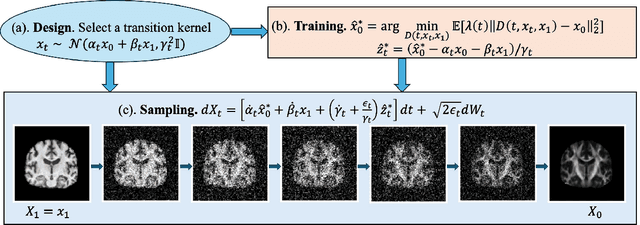
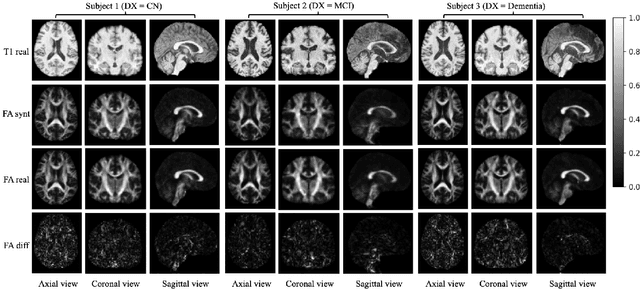


Diffusion tensor imaging (DTI) provides crucial insights into the microstructure of the human brain, but it can be time-consuming to acquire compared to more readily available T1-weighted (T1w) magnetic resonance imaging (MRI). To address this challenge, we propose a diffusion bridge model for 3D brain image translation between T1w MRI and DTI modalities. Our model learns to generate high-quality DTI fractional anisotropy (FA) images from T1w images and vice versa, enabling cross-modality data augmentation and reducing the need for extensive DTI acquisition. We evaluate our approach using perceptual similarity, pixel-level agreement, and distributional consistency metrics, demonstrating strong performance in capturing anatomical structures and preserving information on white matter integrity. The practical utility of the synthetic data is validated through sex classification and Alzheimer's disease classification tasks, where the generated images achieve comparable performance to real data. Our diffusion bridge model offers a promising solution for improving neuroimaging datasets and supporting clinical decision-making, with the potential to significantly impact neuroimaging research and clinical practice.
KG-LLM-Bench: A Scalable Benchmark for Evaluating LLM Reasoning on Textualized Knowledge Graphs
Apr 09, 2025Knowledge graphs have emerged as a popular method for injecting up-to-date, factual knowledge into large language models (LLMs). This is typically achieved by converting the knowledge graph into text that the LLM can process in context. While multiple methods of encoding knowledge graphs have been proposed, the impact of this textualization process on LLM performance remains under-explored. We introduce KG-LLM-Bench, a comprehensive and extensible benchmark spanning five knowledge graph understanding tasks, and evaluate how different encoding strategies affect performance across various base models. Our extensive experiments with seven language models and five textualization strategies provide insights for optimizing LLM performance on KG reasoning tasks.