 Add to Chrome
 Add to Firefox
 Add to Edge
Shape Your Feed: An LLM-based Agentic System for Conversational Recommendation
Aug 06, 2026
Industrial recommendation systems predominantly adopt a passive ranking paradigm that infers user preferences from implicit behavioral signals (e.g., clicks, dwell time) rather than explicit, natural language inputs. As a result, users experience a persistent discrepancy between their explicit interests and what passive behavioral algorithms deliver, limiting their ability to express nuanced preferences or steer their feed in real time. To address this growing gap between how recommendations are optimized and how users wish to articulate their interests, we present Shape Your Feed (SYF), an LLM-based agentic recommendation framework that enables real-time, multimodal co-curation of content. SYF employs a three-tier architecture: (i) a Perception Flow that captures fine-grained user intent from text prompts, voice commands, and UI interactions; (ii) a Serving Flow that performs real-time agentic re-ranking and pruning of candidate items, grounded in a persistent Semantic Profile encoding evolving user preferences; and (iii) a Self-Evolution Flow that aligns system behavior with human judgments via Direct Preference Optimization (DPO) and an LLM-as-a-Judge ensemble. Offline evaluations show that SYF's alignment scoring module achieves 98.85% accuracy, substantially improving over strong few-shot baselines. Large-scale online A/B experiments on production traffic further demonstrate that SYF improves feed relevance and user sentiment, indicating a practical and scalable path toward interactive, user-steerable recommendation in industrial settings.

A General Framework for Multimodal LLM-Based Multimedia Understanding in Large-Scale Recommendation Systems
May 10, 2026Conventional recommendation systems frequently fail to fully exploit the high-dimensional semantic signals inherent in multimedia content, thereby limiting the fidelity of user preference modeling. While Multimodal Large Language Models (MM-LLMs) offer robust mechanisms for interpreting such complex data, their integration into latency-constrained, industrial-scale architectures remains a significant challenge. To address this, we propose a generalized framework for MM-LLM-driven multimedia understanding. Our methodology employs a tripartite architecture encompassing content interpretation, representation extraction, and systematic pipeline integration, instantiated via a LLaMA2-based model that generates descriptive captions subsequently ingested as tokenized categorical features. Empirical evaluation demonstrates the efficacy of this approach, yielding a $0.35\%$ increase in offline AUC and a $0.02\%$ improvement in online metrics at scale, substantiating the practical viability of leveraging MM-LLMs to enhance large-scale recommendation performance.
Making Pre-trained Language Models End-to-end Few-shot Learners with Contrastive Prompt Tuning
Apr 01, 2022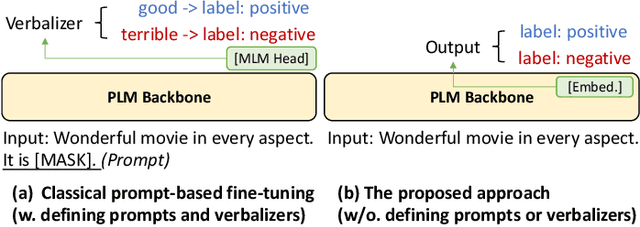

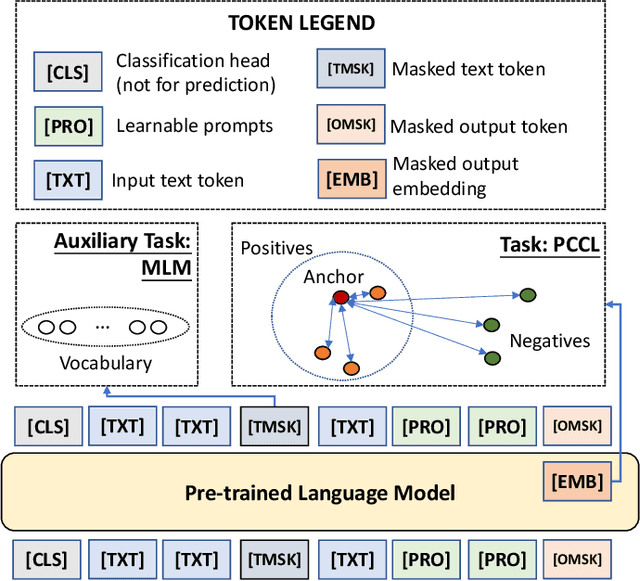
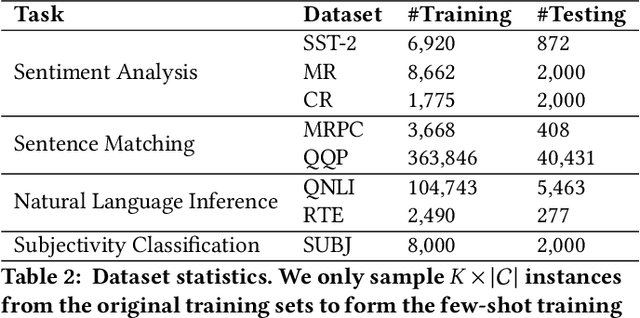
Pre-trained Language Models (PLMs) have achieved remarkable performance for various language understanding tasks in IR systems, which require the fine-tuning process based on labeled training data. For low-resource scenarios, prompt-based learning for PLMs exploits prompts as task guidance and turns downstream tasks into masked language problems for effective few-shot fine-tuning. In most existing approaches, the high performance of prompt-based learning heavily relies on handcrafted prompts and verbalizers, which may limit the application of such approaches in real-world scenarios. To solve this issue, we present CP-Tuning, the first end-to-end Contrastive Prompt Tuning framework for fine-tuning PLMs without any manual engineering of task-specific prompts and verbalizers. It is integrated with the task-invariant continuous prompt encoding technique with fully trainable prompt parameters. We further propose the pair-wise cost-sensitive contrastive learning procedure to optimize the model in order to achieve verbalizer-free class mapping and enhance the task-invariance of prompts. It explicitly learns to distinguish different classes and makes the decision boundary smoother by assigning different costs to easy and hard cases. Experiments over a variety of language understanding tasks used in IR systems and different PLMs show that CP-Tuning outperforms state-of-the-art methods.