 Add to Chrome
 Add to Firefox
 Add to Edge
MM-TTS: Multi-modal Prompt based Style Transfer for Expressive Text-to-Speech Synthesis
Dec 28, 2023
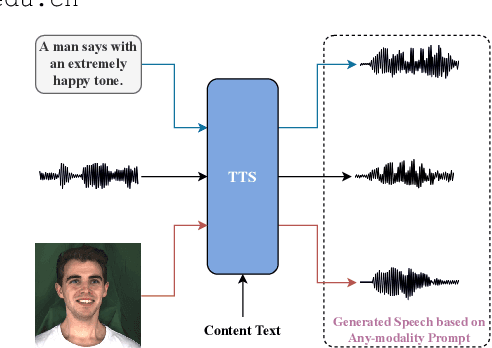
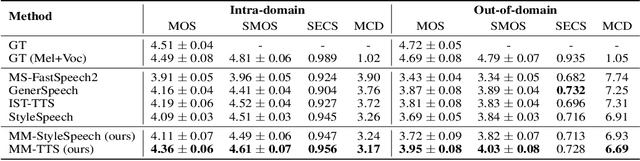
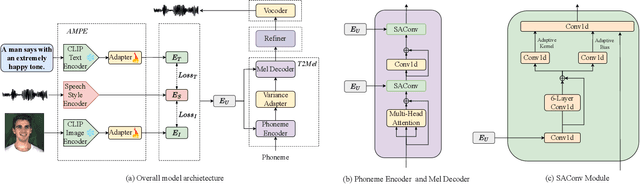
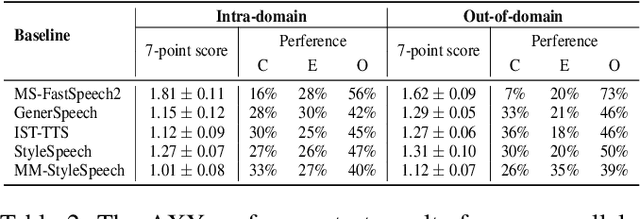
The style transfer task in Text-to-Speech refers to the process of transferring style information into text content to generate corresponding speech with a specific style. However, most existing style transfer approaches are either based on fixed emotional labels or reference speech clips, which cannot achieve flexible style transfer. Recently, some methods have adopted text descriptions to guide style transfer. In this paper, we propose a more flexible multi-modal and style controllable TTS framework named MM-TTS. It can utilize any modality as the prompt in unified multi-modal prompt space, including reference speech, emotional facial images, and text descriptions, to control the style of the generated speech in a system. The challenges of modeling such a multi-modal style controllable TTS mainly lie in two aspects:1)aligning the multi-modal information into a unified style space to enable the input of arbitrary modality as the style prompt in a single system, and 2)efficiently transferring the unified style representation into the given text content, thereby empowering the ability to generate prompt style-related voice. To address these problems, we propose an aligned multi-modal prompt encoder that embeds different modalities into a unified style space, supporting style transfer for different modalities. Additionally, we present a new adaptive style transfer method named Style Adaptive Convolutions to achieve a better style representation. Furthermore, we design a Rectified Flow based Refiner to solve the problem of over-smoothing Mel-spectrogram and generate audio of higher fidelity. Since there is no public dataset for multi-modal TTS, we construct a dataset named MEAD-TTS, which is related to the field of expressive talking head. Our experiments on the MEAD-TTS dataset and out-of-domain datasets demonstrate that MM-TTS can achieve satisfactory results based on multi-modal prompts.

Higher-Order Equivariant Neural Networks for Charge Density Prediction in Materials
Dec 08, 2023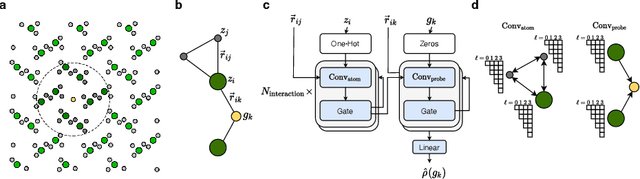
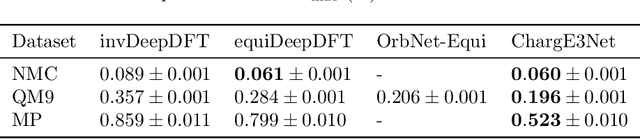
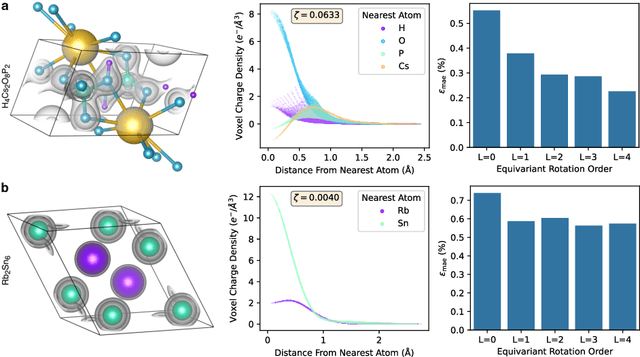
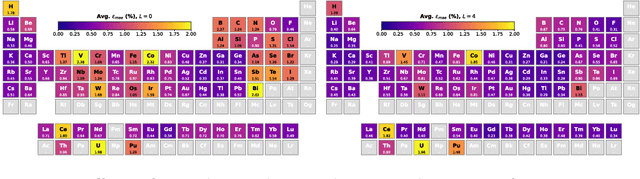
The calculation of electron density distribution using density functional theory (DFT) in materials and molecules is central to the study of their quantum and macro-scale properties, yet accurate and efficient calculation remains a long-standing challenge in the field of material science. This work introduces ChargE3Net, an E(3)-equivariant graph neural network for predicting electron density in atomic systems. ChargE3Net achieves equivariance through the use of higher-order tensor representations, and directly predicts the charge density at any arbitrary point in the system. We show that our method achieves greater performance than prior work on large and diverse sets of molecules and materials, and scales to larger systems than what is feasible to compute with DFT. Using predicted electron densities as an initialization, we show that fewer self-consistent iterations are required to converge DFT over the default initialization. In addition, we show that non-self-consistent calculations using the predicted electron densities can predict electronic and thermodynamic properties of materials at near-DFT accuracy.
Exploring Causal Learning through Graph Neural Networks: An In-depth Review
Nov 25, 2023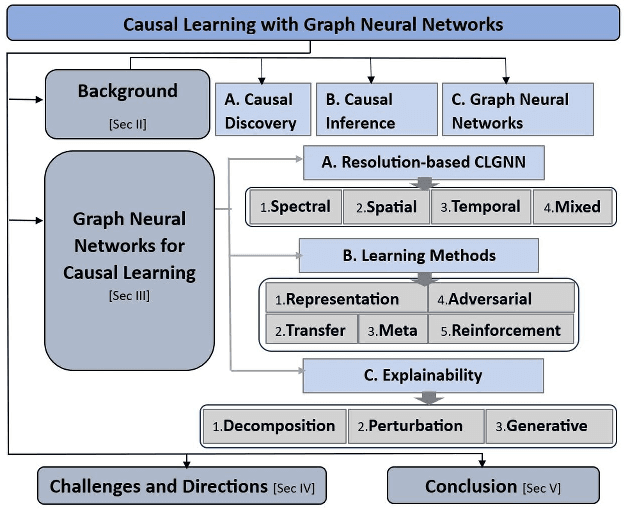
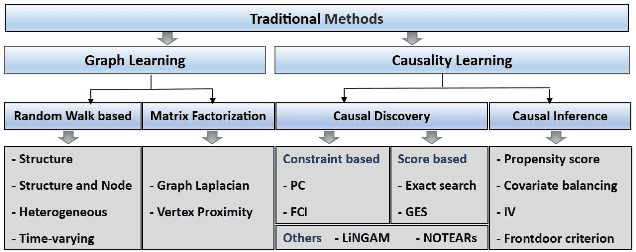
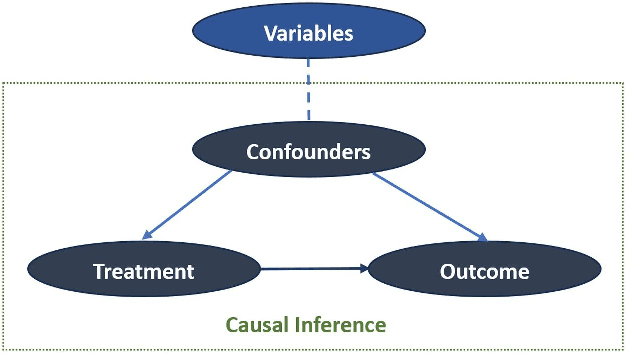
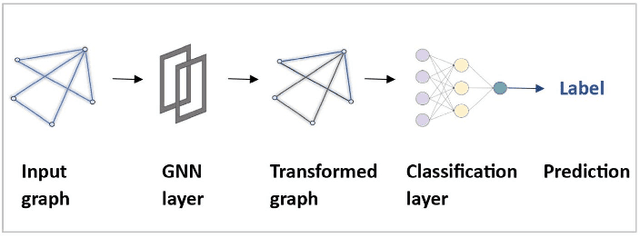
In machine learning, exploring data correlations to predict outcomes is a fundamental task. Recognizing causal relationships embedded within data is pivotal for a comprehensive understanding of system dynamics, the significance of which is paramount in data-driven decision-making processes. Beyond traditional methods, there has been a surge in the use of graph neural networks (GNNs) for causal learning, given their capabilities as universal data approximators. Thus, a thorough review of the advancements in causal learning using GNNs is both relevant and timely. To structure this review, we introduce a novel taxonomy that encompasses various state-of-the-art GNN methods employed in studying causality. GNNs are further categorized based on their applications in the causality domain. We further provide an exhaustive compilation of datasets integral to causal learning with GNNs to serve as a resource for practical study. This review also touches upon the application of causal learning across diverse sectors. We conclude the review with insights into potential challenges and promising avenues for future exploration in this rapidly evolving field of machine learning.
Compositional Zero-shot Learning via Progressive Language-based Observations
Nov 23, 2023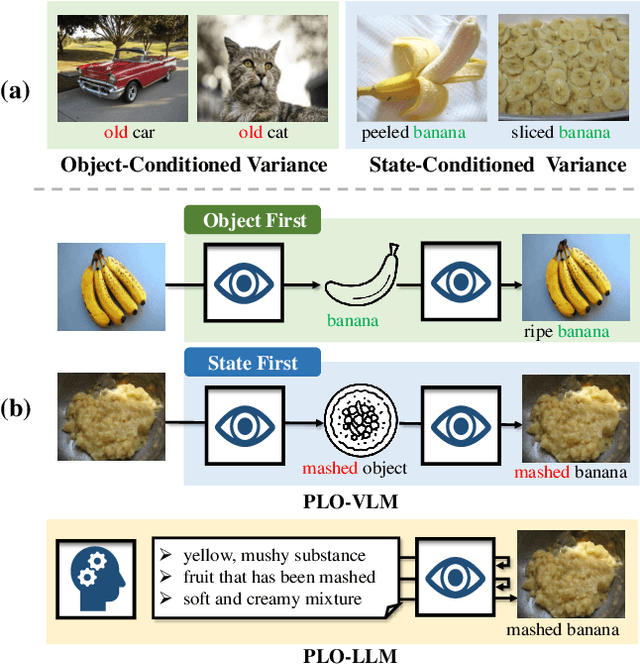
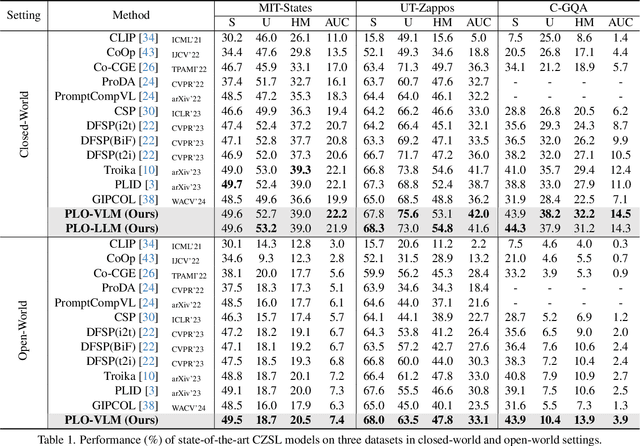
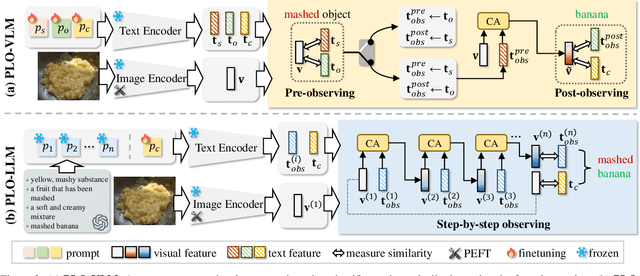
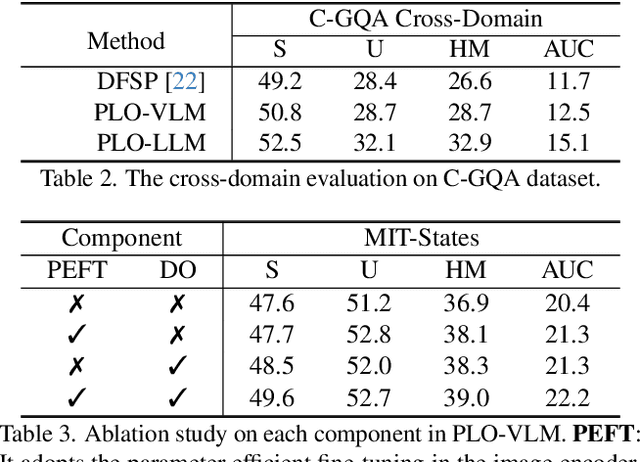
Compositional zero-shot learning aims to recognize unseen state-object compositions by leveraging known primitives (state and object) during training. However, effectively modeling interactions between primitives and generalizing knowledge to novel compositions remains a perennial challenge. There are two key factors: object-conditioned and state-conditioned variance, i.e., the appearance of states (or objects) can vary significantly when combined with different objects (or states). For instance, the state "old" can signify a vintage design for a "car" or an advanced age for a "cat". In this paper, we argue that these variances can be mitigated by predicting composition categories based on pre-observed primitive. To this end, we propose Progressive Language-based Observations (PLO), which can dynamically determine a better observation order of primitives. These observations comprise a series of concepts or languages that allow the model to understand image content in a step-by-step manner. Specifically, PLO adopts pre-trained vision-language models (VLMs) to empower the model with observation capabilities. We further devise two variants: 1) PLO-VLM: a two-step method, where a pre-observing classifier dynamically determines the observation order of two primitives. 2) PLO-LLM: a multi-step scheme, which utilizes large language models (LLMs) to craft composition-specific prompts for step-by-step observing. Extensive ablations on three challenging datasets demonstrate the superiority of PLO compared with state-of-the-art methods, affirming its abilities in compositional recognition.
Interpretable Geoscience Artificial Intelligence (XGeoS-AI): Application to Demystify Image Recognition
Nov 08, 2023


As Earth science enters the era of big data, artificial intelligence (AI) not only offers great potential for solving geoscience problems, but also plays a critical role in accelerating the understanding of the complex, interactive, and multiscale processes of Earth's behavior. As geoscience AI models are progressively utilized for significant predictions in crucial situations, geoscience researchers are increasingly demanding their interpretability and versatility. This study proposes an interpretable geoscience artificial intelligence (XGeoS-AI) framework to unravel the mystery of image recognition in the Earth sciences, and its effectiveness and versatility is demonstrated by taking computed tomography (CT) image recognition as an example. Inspired by the mechanism of human vision, the proposed XGeoS-AI framework generates a threshold value from a local region within the whole image to complete the recognition. Different kinds of artificial intelligence (AI) methods, such as Support Vector Regression (SVR), Multilayer Perceptron (MLP), Convolutional Neural Network (CNN), can be adopted as the AI engines of the proposed XGeoS-AI framework to efficiently complete geoscience image recognition tasks. Experimental results demonstrate that the effectiveness, versatility, and heuristics of the proposed framework have great potential in solving geoscience image recognition problems. Interpretable AI should receive more and more attention in the field of the Earth sciences, which is the key to promoting more rational and wider applications of AI in the field of Earth sciences. In addition, the proposed interpretable framework may be the forerunner of technological innovation in the Earth sciences.
TRIGO: Benchmarking Formal Mathematical Proof Reduction for Generative Language Models
Oct 24, 2023Automated theorem proving (ATP) has become an appealing domain for exploring the reasoning ability of the recent successful generative language models. However, current ATP benchmarks mainly focus on symbolic inference, but rarely involve the understanding of complex number combination reasoning. In this work, we propose TRIGO, an ATP benchmark that not only requires a model to reduce a trigonometric expression with step-by-step proofs but also evaluates a generative LM's reasoning ability on formulas and its capability to manipulate, group, and factor number terms. We gather trigonometric expressions and their reduced forms from the web, annotate the simplification process manually, and translate it into the Lean formal language system. We then automatically generate additional examples from the annotated samples to expand the dataset. Furthermore, we develop an automatic generator based on Lean-Gym to create dataset splits of varying difficulties and distributions in order to thoroughly analyze the model's generalization ability. Our extensive experiments show our proposed TRIGO poses a new challenge for advanced generative LM's including GPT-4 which is pre-trained on a considerable amount of open-source formal theorem-proving language data, and provide a new tool to study the generative LM's ability on both formal and mathematical reasoning.
OODRobustBench: benchmarking and analyzing adversarial robustness under distribution shift
Oct 19, 2023Existing works have made great progress in improving adversarial robustness, but typically test their method only on data from the same distribution as the training data, i.e. in-distribution (ID) testing. As a result, it is unclear how such robustness generalizes under input distribution shifts, i.e. out-of-distribution (OOD) testing. This is a concerning omission as such distribution shifts are unavoidable when methods are deployed in the wild. To address this issue we propose a benchmark named OODRobustBench to comprehensively assess OOD adversarial robustness using 23 dataset-wise shifts (i.e. naturalistic shifts in input distribution) and 6 threat-wise shifts (i.e., unforeseen adversarial threat models). OODRobustBench is used to assess 706 robust models using 60.7K adversarial evaluations. This large-scale analysis shows that: 1) adversarial robustness suffers from a severe OOD generalization issue; 2) ID robustness correlates strongly with OOD robustness, in a positive linear way, under many distribution shifts. The latter enables the prediction of OOD robustness from ID robustness. Based on this, we are able to predict the upper limit of OOD robustness for existing robust training schemes. The results suggest that achieving OOD robustness requires designing novel methods beyond the conventional ones. Last, we discover that extra data, data augmentation, advanced model architectures and particular regularization approaches can improve OOD robustness. Noticeably, the discovered training schemes, compared to the baseline, exhibit dramatically higher robustness under threat shift while keeping high ID robustness, demonstrating new promising solutions for robustness against both multi-attack and unforeseen attacks.
LEGO-Prover: Neural Theorem Proving with Growing Libraries
Oct 12, 2023


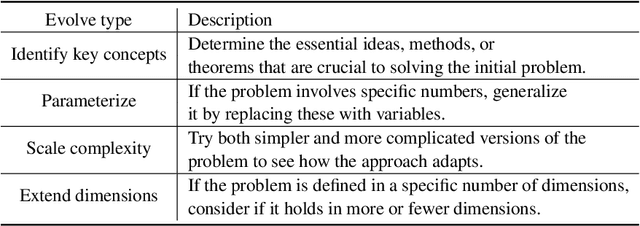
Despite the success of large language models (LLMs), the task of theorem proving still remains one of the hardest reasoning tasks that is far from being fully solved. Prior methods using language models have demonstrated promising results, but they still struggle to prove even middle school level theorems. One common limitation of these methods is that they assume a fixed theorem library during the whole theorem proving process. However, as we all know, creating new useful theorems or even new theories is not only helpful but crucial and necessary for advancing mathematics and proving harder and deeper results. In this work, we present LEGO-Prover, which employs a growing skill library containing verified lemmas as skills to augment the capability of LLMs used in theorem proving. By constructing the proof modularly, LEGO-Prover enables LLMs to utilize existing skills retrieved from the library and to create new skills during the proving process. These skills are further evolved (by prompting an LLM) to enrich the library on another scale. Modular and reusable skills are constantly added to the library to enable tackling increasingly intricate mathematical problems. Moreover, the learned library further bridges the gap between human proofs and formal proofs by making it easier to impute missing steps. LEGO-Prover advances the state-of-the-art pass rate on miniF2F-valid (48.0% to 57.0%) and miniF2F-test (45.5% to 47.1%). During the proving process, LEGO-Prover also manages to generate over 20,000 skills (theorems/lemmas) and adds them to the growing library. Our ablation study indicates that these newly added skills are indeed helpful for proving theorems, resulting in an improvement from a success rate of 47.1% to 50.4%. We also release our code and all the generated skills.
VisionFM: a Multi-Modal Multi-Task Vision Foundation Model for Generalist Ophthalmic Artificial Intelligence
Oct 08, 2023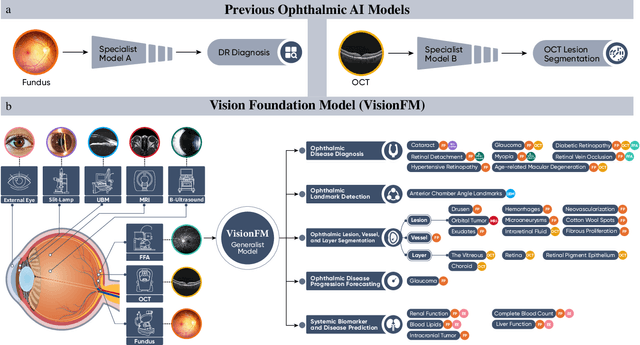
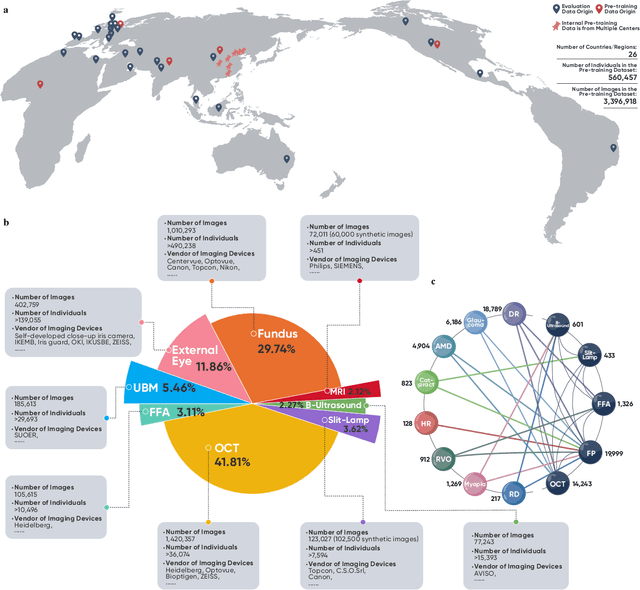
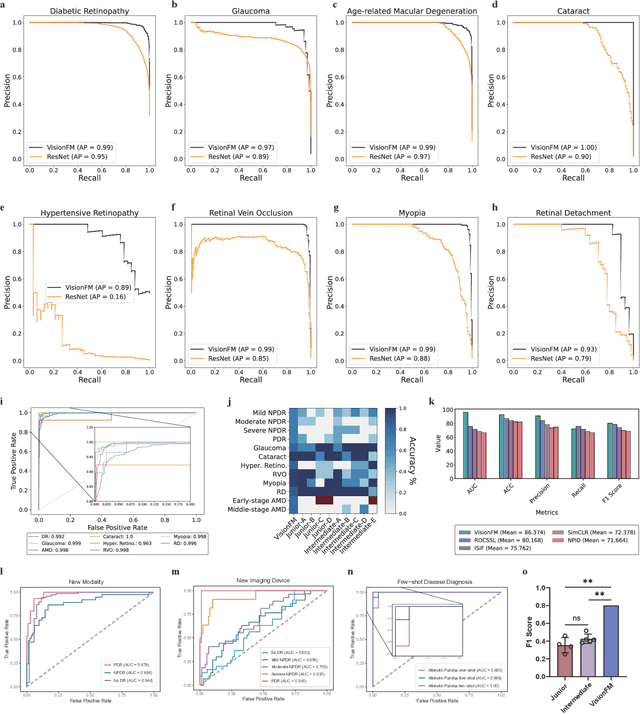
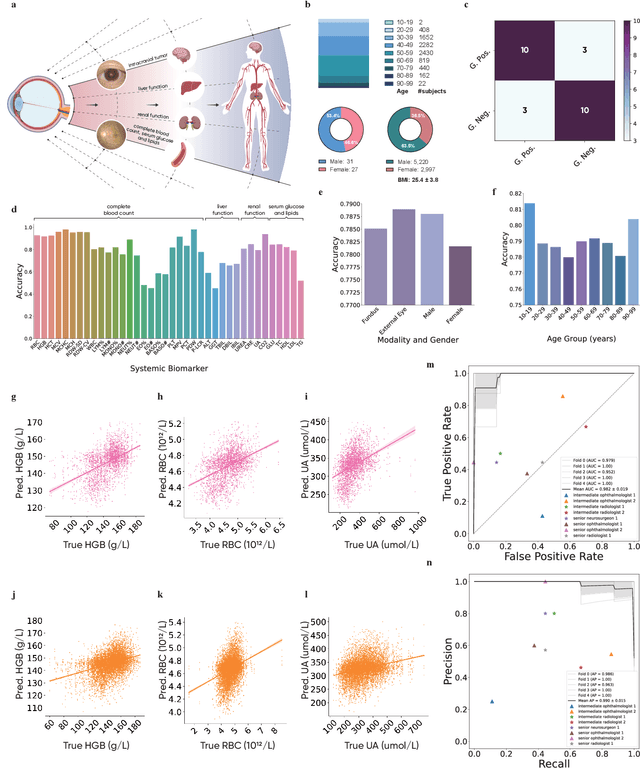
We present VisionFM, a foundation model pre-trained with 3.4 million ophthalmic images from 560,457 individuals, covering a broad range of ophthalmic diseases, modalities, imaging devices, and demography. After pre-training, VisionFM provides a foundation to foster multiple ophthalmic artificial intelligence (AI) applications, such as disease screening and diagnosis, disease prognosis, subclassification of disease phenotype, and systemic biomarker and disease prediction, with each application enhanced with expert-level intelligence and accuracy. The generalist intelligence of VisionFM outperformed ophthalmologists with basic and intermediate levels in jointly diagnosing 12 common ophthalmic diseases. Evaluated on a new large-scale ophthalmic disease diagnosis benchmark database, as well as a new large-scale segmentation and detection benchmark database, VisionFM outperformed strong baseline deep neural networks. The ophthalmic image representations learned by VisionFM exhibited noteworthy explainability, and demonstrated strong generalizability to new ophthalmic modalities, disease spectrum, and imaging devices. As a foundation model, VisionFM has a large capacity to learn from diverse ophthalmic imaging data and disparate datasets. To be commensurate with this capacity, in addition to the real data used for pre-training, we also generated and leveraged synthetic ophthalmic imaging data. Experimental results revealed that synthetic data that passed visual Turing tests, can also enhance the representation learning capability of VisionFM, leading to substantial performance gains on downstream ophthalmic AI tasks. Beyond the ophthalmic AI applications developed, validated, and demonstrated in this work, substantial further applications can be achieved in an efficient and cost-effective manner using VisionFM as the foundation.
Cross-domain Robust Deepfake Bias Expansion Network for Face Forgery Detection
Oct 08, 2023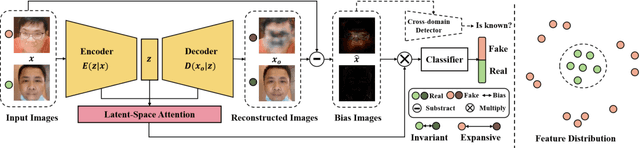
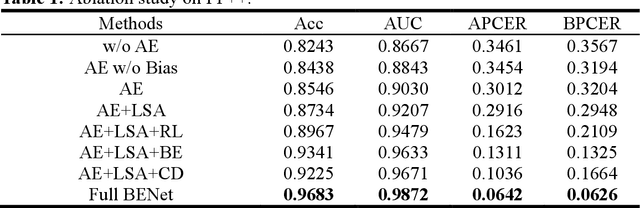
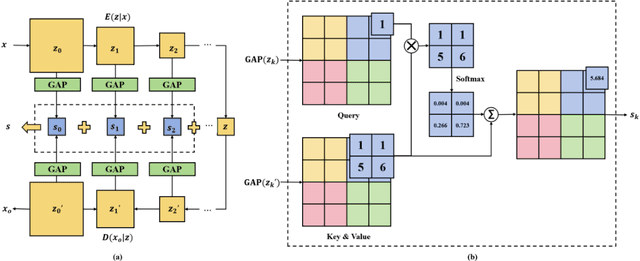
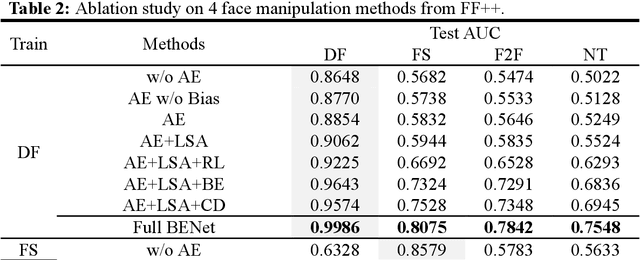
The rapid advancement of deepfake technologies raises significant concerns about the security of face recognition systems. While existing methods leverage the clues left by deepfake techniques for face forgery detection, malicious users may intentionally manipulate forged faces to obscure the traces of deepfake clues and thereby deceive detection tools. Meanwhile, attaining cross-domain robustness for data-based methods poses a challenge due to potential gaps in the training data, which may not encompass samples from all relevant domains. Therefore, in this paper, we introduce a solution - a Cross-Domain Robust Bias Expansion Network (BENet) - designed to enhance face forgery detection. BENet employs an auto-encoder to reconstruct input faces, maintaining the invariance of real faces while selectively enhancing the difference between reconstructed fake faces and their original counterparts. This enhanced bias forms a robust foundation upon which dependable forgery detection can be built. To optimize the reconstruction results in BENet, we employ a bias expansion loss infused with contrastive concepts to attain the aforementioned objective. In addition, to further heighten the amplification of forged clues, BENet incorporates a Latent-Space Attention (LSA) module. This LSA module effectively captures variances in latent features between the auto-encoder's encoder and decoder, placing emphasis on inconsistent forgery-related information. Furthermore, BENet incorporates a cross-domain detector with a threshold to determine whether the sample belongs to a known distribution. The correction of classification results through the cross-domain detector enables BENet to defend against unknown deepfake attacks from cross-domain. Extensive experiments demonstrate the superiority of BENet compared with state-of-the-art methods in intra-database and cross-database evaluations.