 Add to Chrome
 Add to Firefox
 Add to Edge
Full-Body Motion Reconstruction with Sparse Sensing from Graph Perspective
Jan 22, 2024
Estimating 3D full-body pose from sparse sensor data is a pivotal technique employed for the reconstruction of realistic human motions in Augmented Reality and Virtual Reality. However, translating sparse sensor signals into comprehensive human motion remains a challenge since the sparsely distributed sensors in common VR systems fail to capture the motion of full human body. In this paper, we use well-designed Body Pose Graph (BPG) to represent the human body and translate the challenge into a prediction problem of graph missing nodes. Then, we propose a novel full-body motion reconstruction framework based on BPG. To establish BPG, nodes are initially endowed with features extracted from sparse sensor signals. Features from identifiable joint nodes across diverse sensors are amalgamated and processed from both temporal and spatial perspectives. Temporal dynamics are captured using the Temporal Pyramid Structure, while spatial relations in joint movements inform the spatial attributes. The resultant features serve as the foundational elements of the BPG nodes. To further refine the BPG, node features are updated through a graph neural network that incorporates edge reflecting varying joint relations. Our method's effectiveness is evidenced by the attained state-of-the-art performance, particularly in lower body motion, outperforming other baseline methods. Additionally, an ablation study validates the efficacy of each module in our proposed framework.

CrossVideo: Self-supervised Cross-modal Contrastive Learning for Point Cloud Video Understanding
Jan 17, 2024This paper introduces a novel approach named CrossVideo, which aims to enhance self-supervised cross-modal contrastive learning in the field of point cloud video understanding. Traditional supervised learning methods encounter limitations due to data scarcity and challenges in label acquisition. To address these issues, we propose a self-supervised learning method that leverages the cross-modal relationship between point cloud videos and image videos to acquire meaningful feature representations. Intra-modal and cross-modal contrastive learning techniques are employed to facilitate effective comprehension of point cloud video. We also propose a multi-level contrastive approach for both modalities. Through extensive experiments, we demonstrate that our method significantly surpasses previous state-of-the-art approaches, and we conduct comprehensive ablation studies to validate the effectiveness of our proposed designs.
TACO: Benchmarking Generalizable Bimanual Tool-ACtion-Object Understanding
Jan 16, 2024Humans commonly work with multiple objects in daily life and can intuitively transfer manipulation skills to novel objects by understanding object functional regularities. However, existing technical approaches for analyzing and synthesizing hand-object manipulation are mostly limited to handling a single hand and object due to the lack of data support. To address this, we construct TACO, an extensive bimanual hand-object-interaction dataset spanning a large variety of tool-action-object compositions for daily human activities. TACO contains 2.5K motion sequences paired with third-person and egocentric views, precise hand-object 3D meshes, and action labels. To rapidly expand the data scale, we present a fully-automatic data acquisition pipeline combining multi-view sensing with an optical motion capture system. With the vast research fields provided by TACO, we benchmark three generalizable hand-object-interaction tasks: compositional action recognition, generalizable hand-object motion forecasting, and cooperative grasp synthesis. Extensive experiments reveal new insights, challenges, and opportunities for advancing the studies of generalizable hand-object motion analysis and synthesis. Our data and code are available at https://taco2024.github.io.
GenH2R: Learning Generalizable Human-to-Robot Handover via Scalable Simulation, Demonstration, and Imitation
Jan 01, 2024This paper presents GenH2R, a framework for learning generalizable vision-based human-to-robot (H2R) handover skills. The goal is to equip robots with the ability to reliably receive objects with unseen geometry handed over by humans in various complex trajectories. We acquire such generalizability by learning H2R handover at scale with a comprehensive solution including procedural simulation assets creation, automated demonstration generation, and effective imitation learning. We leverage large-scale 3D model repositories, dexterous grasp generation methods, and curve-based 3D animation to create an H2R handover simulation environment named \simabbns, surpassing the number of scenes in existing simulators by three orders of magnitude. We further introduce a distillation-friendly demonstration generation method that automatically generates a million high-quality demonstrations suitable for learning. Finally, we present a 4D imitation learning method augmented by a future forecasting objective to distill demonstrations into a visuo-motor handover policy. Experimental evaluations in both simulators and the real world demonstrate significant improvements (at least +10\% success rate) over baselines in all cases. The project page is https://GenH2R.github.io/.
Interactive Humanoid: Online Full-Body Motion Reaction Synthesis with Social Affordance Canonicalization and Forecasting
Dec 30, 2023We focus on the human-humanoid interaction task optionally with an object. We propose a new task named online full-body motion reaction synthesis, which generates humanoid reactions based on the human actor's motions. The previous work only focuses on human interaction without objects and generates body reactions without hand. Besides, they also do not consider the task as an online setting, which means the inability to observe information beyond the current moment in practical situations. To support this task, we construct two datasets named HHI and CoChair and propose a unified method. Specifically, we propose to construct a social affordance representation. We first select a social affordance carrier and use SE(3)-Equivariant Neural Networks to learn the local frame for the carrier, then we canonicalize the social affordance. Besides, we propose a social affordance forecasting scheme to enable the reactor to predict based on the imagined future. Experiments demonstrate that our approach can effectively generate high-quality reactions on HHI and CoChair. Furthermore, we also validate our method on existing human interaction datasets Interhuman and Chi3D.
Semantic Complete Scene Forecasting from a 4D Dynamic Point Cloud Sequence
Dec 15, 2023


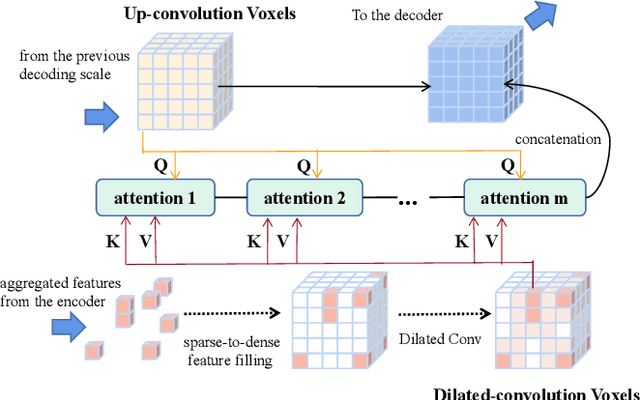
We study a new problem of semantic complete scene forecasting (SCSF) in this work. Given a 4D dynamic point cloud sequence, our goal is to forecast the complete scene corresponding to the future next frame along with its semantic labels. To tackle this challenging problem, we properly model the synergetic relationship between future forecasting and semantic scene completion through a novel network named SCSFNet. SCSFNet leverages a hybrid geometric representation for high-resolution complete scene forecasting. To leverage multi-frame observation as well as the understanding of scene dynamics to ease the completion task, SCSFNet introduces an attention-based skip connection scheme. To ease the need to model occlusion variations and to better focus on the occluded part, SCSFNet utilizes auxiliary visibility grids to guide the forecasting task. To evaluate the effectiveness of SCSFNet, we conduct experiments on various benchmarks including two large-scale indoor benchmarks we contributed and the outdoor SemanticKITTI benchmark. Extensive experiments show SCSFNet outperforms baseline methods on multiple metrics by a large margin, and also prove the synergy between future forecasting and semantic scene completion.
Look Before You Leap: Unveiling the Power of GPT-4V in Robotic Vision-Language Planning
Nov 29, 2023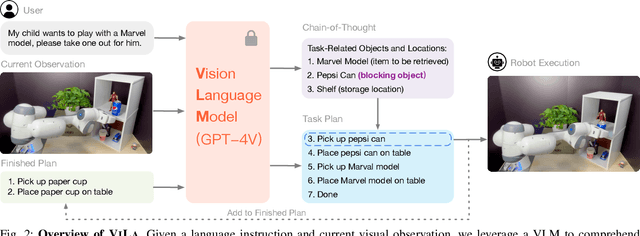
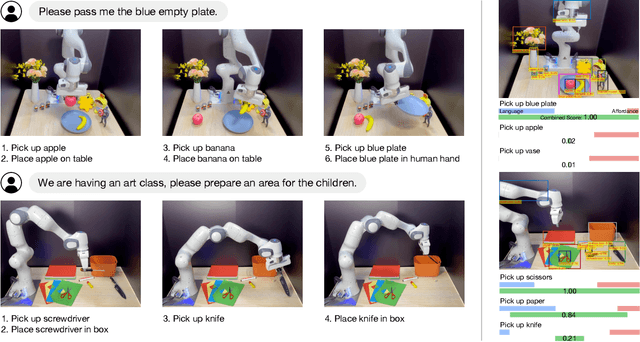
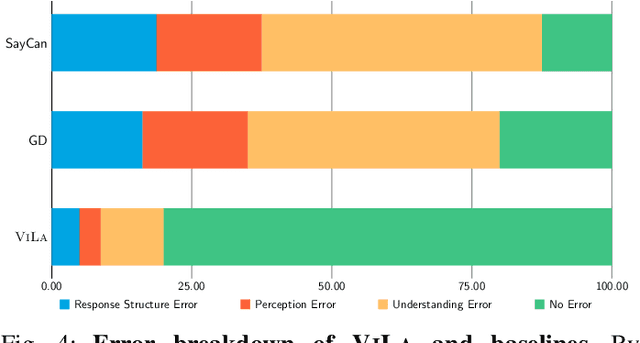
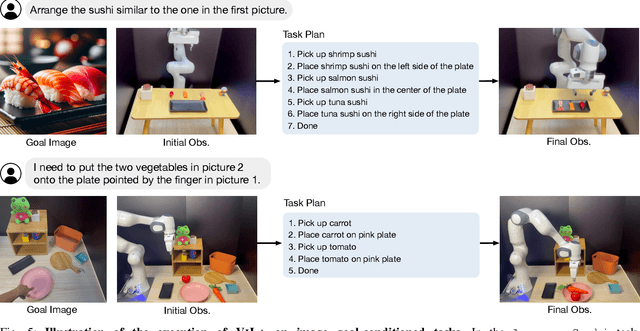
In this study, we are interested in imbuing robots with the capability of physically-grounded task planning. Recent advancements have shown that large language models (LLMs) possess extensive knowledge useful in robotic tasks, especially in reasoning and planning. However, LLMs are constrained by their lack of world grounding and dependence on external affordance models to perceive environmental information, which cannot jointly reason with LLMs. We argue that a task planner should be an inherently grounded, unified multimodal system. To this end, we introduce Robotic Vision-Language Planning (ViLa), a novel approach for long-horizon robotic planning that leverages vision-language models (VLMs) to generate a sequence of actionable steps. ViLa directly integrates perceptual data into its reasoning and planning process, enabling a profound understanding of commonsense knowledge in the visual world, including spatial layouts and object attributes. It also supports flexible multimodal goal specification and naturally incorporates visual feedback. Our extensive evaluation, conducted in both real-robot and simulated environments, demonstrates ViLa's superiority over existing LLM-based planners, highlighting its effectiveness in a wide array of open-world manipulation tasks.
NSM4D: Neural Scene Model Based Online 4D Point Cloud Sequence Understanding
Oct 12, 2023Understanding 4D point cloud sequences online is of significant practical value in various scenarios such as VR/AR, robotics, and autonomous driving. The key goal is to continuously analyze the geometry and dynamics of a 3D scene as unstructured and redundant point cloud sequences arrive. And the main challenge is to effectively model the long-term history while keeping computational costs manageable. To tackle these challenges, we introduce a generic online 4D perception paradigm called NSM4D. NSM4D serves as a plug-and-play strategy that can be adapted to existing 4D backbones, significantly enhancing their online perception capabilities for both indoor and outdoor scenarios. To efficiently capture the redundant 4D history, we propose a neural scene model that factorizes geometry and motion information by constructing geometry tokens separately storing geometry and motion features. Exploiting the history becomes as straightforward as querying the neural scene model. As the sequence progresses, the neural scene model dynamically deforms to align with new observations, effectively providing the historical context and updating itself with the new observations. By employing token representation, NSM4D also exhibits robustness to low-level sensor noise and maintains a compact size through a geometric sampling scheme. We integrate NSM4D with state-of-the-art 4D perception backbones, demonstrating significant improvements on various online perception benchmarks in indoor and outdoor settings. Notably, we achieve a 9.6% accuracy improvement for HOI4D online action segmentation and a 3.4% mIoU improvement for SemanticKITTI online semantic segmentation. Furthermore, we show that NSM4D inherently offers excellent scalability to longer sequences beyond the training set, which is crucial for real-world applications.
DreamLLM: Synergistic Multimodal Comprehension and Creation
Sep 20, 2023This paper presents DreamLLM, a learning framework that first achieves versatile Multimodal Large Language Models (MLLMs) empowered with frequently overlooked synergy between multimodal comprehension and creation. DreamLLM operates on two fundamental principles. The first focuses on the generative modeling of both language and image posteriors by direct sampling in the raw multimodal space. This approach circumvents the limitations and information loss inherent to external feature extractors like CLIP, and a more thorough multimodal understanding is obtained. Second, DreamLLM fosters the generation of raw, interleaved documents, modeling both text and image contents, along with unstructured layouts. This allows DreamLLM to learn all conditional, marginal, and joint multimodal distributions effectively. As a result, DreamLLM is the first MLLM capable of generating free-form interleaved content. Comprehensive experiments highlight DreamLLM's superior performance as a zero-shot multimodal generalist, reaping from the enhanced learning synergy.
TransTouch: Learning Transparent Objects Depth Sensing Through Sparse Touches
Sep 18, 2023Transparent objects are common in daily life. However, depth sensing for transparent objects remains a challenging problem. While learning-based methods can leverage shape priors to improve the sensing quality, the labor-intensive data collection in the real world and the sim-to-real domain gap restrict these methods' scalability. In this paper, we propose a method to finetune a stereo network with sparse depth labels automatically collected using a probing system with tactile feedback. We present a novel utility function to evaluate the benefit of touches. By approximating and optimizing the utility function, we can optimize the probing locations given a fixed touching budget to better improve the network's performance on real objects. We further combine tactile depth supervision with a confidence-based regularization to prevent over-fitting during finetuning. To evaluate the effectiveness of our method, we construct a real-world dataset including both diffuse and transparent objects. Experimental results on this dataset show that our method can significantly improve real-world depth sensing accuracy, especially for transparent objects.