 Add to Chrome
 Add to Firefox
 Add to Edge
XPolicyLab: A Unified Standard and Open Ecosystem for Robot Policy Evaluation and Deployment
Aug 11, 2026
Robot policy evaluation and deployment remain fragmented by model-specific software dependencies, data representations, and runtime interfaces, so that connecting N policies to M evaluation environments requires O(NM) separate integrations. We present XPolicyLab, a unified standard and open ecosystem that reduces this cost to O(N+M). XPolicyLab specifies common observation, action, and trajectory schemas together with a minimal adapter interface for observation updates, action prediction, batched execution, and episode reset, while a dependency-isolated client/server architecture separates policy inference from environment execution, so that each side retains its native software stack and may run locally or remotely. The ecosystem integrates 42 robot policies and standardizes their installation, debugging, serving, and evaluation workflows. Across these adapters, model-specific code varies by an order of magnitude while the environment-facing loop stays within a few lines of a fixed reference, confirming that the contract confines heterogeneity to the policy side. In a controlled study, conforming to the standard reduces the integration effort of a representative policy from over five hours to two hours, and packaged agent skills reduce it further to thirty minutes. The same adapters serve RoboTwin, RoboDojo simulation, and standardized real-robot evaluation through one interface. XPolicyLab is released as shared infrastructure for reproducible policy comparison and standardized deployment across simulation and physical platforms. Project website: https://xpolicylab.github.io/.

RoboDojo: A Unified Sim-and-Real Benchmark for Comprehensive Evaluation of Generalist Robot Manipulation Policies
Jul 05, 2026Generalist robot manipulation policies have advanced rapidly, yet existing benchmarks remain limited in systematically evaluating their capabilities. Many rely on simple, short-horizon, or skill-narrow tasks with limited capability coverage, and are often conducted only in simulation or only in the real world. Simulation enables scalable feedback but misses physical deployment challenges, while real-world evaluation is costly, time-consuming, and difficult to reproduce. We introduce RoboDojo, a unified sim-and-real benchmark for comprehensive evaluation of generalist robot manipulation policies. RoboDojo includes 42 simulation tasks and 18 real-world tasks covering diverse and complementary manipulation capabilities. The simulation benchmark evaluates five dimensions: generalization, memory, precision, long-horizon execution, and open-vocabulary instruction following, while the real-world benchmark exposes policies to challenging physical-world deployment conditions. RoboDojo supports scalable evaluation through heterogeneous parallel simulation in Isaac Sim and provides RoboDojo-RealEval, a reproducible real-world evaluation system with remote cloud access, standardized hardware, scene reset, evaluation protocol, and deployment interface. Together with XPolicyLab, policies can be integrated once and evaluated across simulation and real-world settings with minimal adaptation. We integrate 30 policies into XPolicyLab and evaluate them on RoboDojo, establishing a public leaderboard and systematic analysis of current policy performance. The website is available at http://robodojo-benchmark.com/.
OmniRetriever: Any-to-Any Audio-Video-Text Retrieval via Fusion-as-Teacher Distillation
May 26, 2026Unified multimodal embedding spaces have become the standard interface for cross-modal retrieval and multimodal RAG, and recent audio-video-text (AVT) encoders extend this setting to three modalities. Such encoders can produce a joint (T,V,A) embedding whenever all three modalities are available, but standard pairwise InfoNCE objectives leave this signal unused during training. We close this gap with fusion-as-teacher distillation, which treats a stop-gradient copy of the fused embedding as a teacher signal for the single-modal embeddings, paired with a Tuple-InfoNCE term that supervises the fused embedding directly. We instantiate this objective as OmniRetriever-7B. Across six zero-shot retrieval benchmarks, OmniRetriever-7B surpasses the closed-source Gemini Embedding 2 by 13.3-18.0 R@1 on Clotho and SoundDescs, and reaches the contemporary zero-shot specialist band of open video-text encoders on MSR-VTT and MSVD. To stress-test joint representations, we further release OmniRetriever-Bench, a 12-direction AVT retrieval benchmark totaling 3782 triples; on it OmniRetriever-7B attains AVG-all 34.84, improving over Gemini Embedding 2 by 1.72 and over the best prior open-source AVT method by 8.03.
O-MARC: Omni Memory-Augmented Compression Distillation for Efficient Video Understanding
May 26, 2026Omnimodal large language models enable unified audio video understanding, but long joint token sequences make inference costly, and existing benchmarks do not fully isolate audio visual association in noisy user generated videos. We introduce UGC-AVQA, a public UGC benchmark with 1,000 videos and 4,816 QA pairs, where an audio removal test ensures that benchmark questions require both acoustic and visual evidence. To reduce inference cost, we propose OMAC, a training free plug in compression method that preserves salient visual memory and temporally grounded audio anchors. To further make compact models robust to compressed inputs, we introduce O-MARC, a compression distillation framework for learning with memory compressed multimodal contexts. On Qwen2.5-Omni-3B, O-MARC improves the average score across four benchmarks to 45.8, outperforming full token inference at 44.1 and OmniZip at 41.0. OMAC also keeps inference efficient, reducing latency by 34.6\% (1.53$\times$ speedup) and memory by 34.7\% compared with full token inference.
NTIRE 2026 The 3rd Restore Any Image Model (RAIM) Challenge: Professional Image Quality Assessment (Track 1)
Apr 14, 2026In this paper, we present an overview of the NTIRE 2026 challenge on the 3rd Restore Any Image Model in the Wild, specifically focusing on Track 1: Professional Image Quality Assessment. Conventional Image Quality Assessment (IQA) typically relies on scalar scores. By compressing complex visual characteristics into a single number, these methods fundamentally struggle to distinguish subtle differences among uniformly high-quality images. Furthermore, they fail to articulate why one image is superior, lacking the reasoning capabilities required to provide guidance for vision tasks. To bridge this gap, recent advancements in Multimodal Large Language Models (MLLMs) offer a promising paradigm. Inspired by this potential, our challenge establishes a novel benchmark exploring the ability of MLLMs to mimic human expert cognition in evaluating high-quality image pairs. Participants were tasked with overcoming critical bottlenecks in professional scenarios, centering on two primary objectives: (1) Comparative Quality Selection: reliably identifying the visually superior image within a high-quality pair; and (2) Interpretative Reasoning: generating grounded, expert-level explanations that detail the rationale behind the selection. In total, the challenge attracted nearly 200 registrations and over 2,500 submissions. The top-performing methods significantly advanced the state of the art in professional IQA. The challenge dataset is available at https://github.com/narthchin/RAIM-PIQA, and the official homepage is accessible at https://www.codabench.org/competitions/12789/.
SpatialMem: Unified 3D Memory with Metric Anchoring and Fast Retrieval
Jan 21, 2026We present SpatialMem, a memory-centric system that unifies 3D geometry, semantics, and language into a single, queryable representation. Starting from casually captured egocentric RGB video, SpatialMem reconstructs metrically scaled indoor environments, detects structural 3D anchors (walls, doors, windows) as the first-layer scaffold, and populates a hierarchical memory with open-vocabulary object nodes -- linking evidence patches, visual embeddings, and two-layer textual descriptions to 3D coordinates -- for compact storage and fast retrieval. This design enables interpretable reasoning over spatial relations (e.g., distance, direction, visibility) and supports downstream tasks such as language-guided navigation and object retrieval without specialized sensors. Experiments across three real-life indoor scenes demonstrate that SpatialMem maintains strong anchor-description-level navigation completion and hierarchical retrieval accuracy under increasing clutter and occlusion, offering an efficient and extensible framework for embodied spatial intelligence.
MARC: Memory-Augmented RL Token Compression for Efficient Video Understanding
Oct 09, 2025The rapid progress of large language models (LLMs) has laid the foundation for multimodal models. However, visual language models (VLMs) still face heavy computational costs when extended from images to videos due to high frame rates and long durations. Token compression is a promising solution, yet most existing training-free methods cause information loss and performance degradation. To overcome this, we propose \textbf{Memory-Augmented Reinforcement Learning-based Token Compression (MARC)}, which integrates structured retrieval and RL-based distillation. MARC adopts a \textit{retrieve-then-compress} strategy using a \textbf{Visual Memory Retriever (VMR)} to select key clips and a \textbf{Compression Group Relative Policy Optimization (C-GRPO)} framework to distil reasoning ability from a teacher to a student model. Experiments on six video benchmarks show that MARC achieves near-baseline accuracy using only one frame's tokens -- reducing visual tokens by \textbf{95\%}, GPU memory by \textbf{72\%}, and latency by \textbf{23.9\%}. This demonstrates its potential for efficient, real-time video understanding in resource-constrained settings such as video QA, surveillance, and autonomous driving.
MutualNeRF: Improve the Performance of NeRF under Limited Samples with Mutual Information Theory
May 16, 2025This paper introduces MutualNeRF, a framework enhancing Neural Radiance Field (NeRF) performance under limited samples using Mutual Information Theory. While NeRF excels in 3D scene synthesis, challenges arise with limited data and existing methods that aim to introduce prior knowledge lack theoretical support in a unified framework. We introduce a simple but theoretically robust concept, Mutual Information, as a metric to uniformly measure the correlation between images, considering both macro (semantic) and micro (pixel) levels. For sparse view sampling, we strategically select additional viewpoints containing more non-overlapping scene information by minimizing mutual information without knowing ground truth images beforehand. Our framework employs a greedy algorithm, offering a near-optimal solution. For few-shot view synthesis, we maximize the mutual information between inferred images and ground truth, expecting inferred images to gain more relevant information from known images. This is achieved by incorporating efficient, plug-and-play regularization terms. Experiments under limited samples show consistent improvement over state-of-the-art baselines in different settings, affirming the efficacy of our framework.
Ring Artifacts Correction Based on Global-Local Features Interaction Guidance in the Projection Domain
Apr 15, 2025Ring artifacts are common artifacts in CT imaging, typically caused by inconsistent responses of detector units to X-rays, resulting in stripe artifacts in the projection data. Under circular scanning mode, such artifacts manifest as concentric rings radiating from the center of rotation, severely degrading image quality. In the Radon transform domain, even if the object's density function is piecewise discontinuous in certain regions, the projection images remain nearly continuous in the angular direction, making the ideal projections exhibit a smooth global low-frequency characteristic. In practical scanning, the local disturbances of the same detector unit at different scanning angles lead to a prominent high-frequency locality of stripe artifacts. Existing studies generally model ring artifacts disturbances as fixed additive errors, which overlooks the dynamic variation of detector responses during practical scanning. However, the degree of detector response inconsistency is a function of the projection values, as revealed in our experiments, thereby requiring consideration of the interaction between global and local features in the process of stripe artifacts extraction and correction. Therefore, we propose a CT ring artifacts correction method based on global and local features in the projection domain. We employ the VSS block and Dense block to respectively correct the low-frequency sub-band, which capture the global correlations of the projection, and the high-frequency sub-band, which contain local stripe artifacts after wavelet decomposition. Specifically, the accuracy of artifacts correction is enhanced by the interaction guidance between global and local features. Extensive experiments demonstrate that our method achieves superior performance in both quantitative metrics and visual quality, verifying its robustness and practical applicability.
ST-Think: How Multimodal Large Language Models Reason About 4D Worlds from Ego-Centric Videos
Mar 16, 2025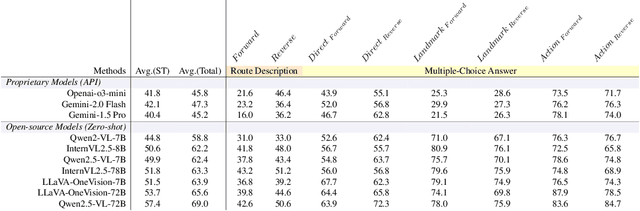
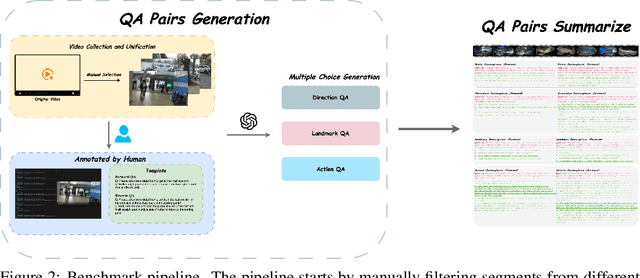
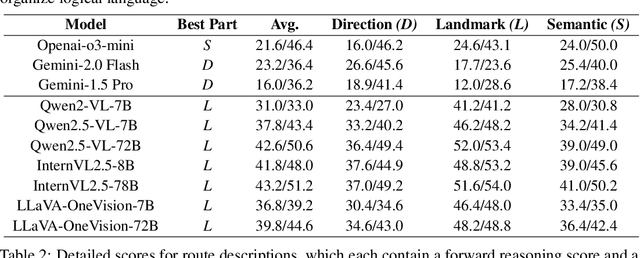
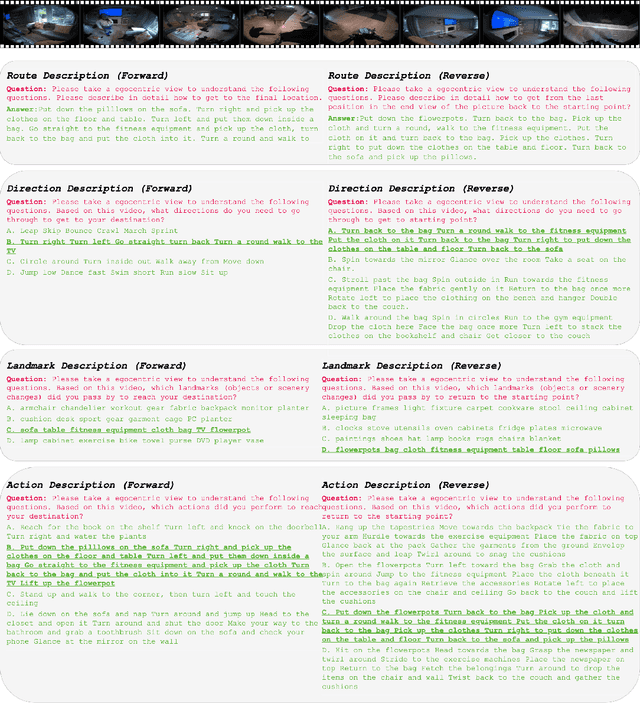
Humans excel at spatio-temporal reasoning, effortlessly interpreting dynamic visual events from an egocentric viewpoint. However, whether multimodal large language models (MLLMs) can similarly comprehend the 4D world remains uncertain. This paper explores multimodal spatio-temporal reasoning from an egocentric perspective, aiming to equip MLLMs with human-like reasoning capabilities. To support this objective, we introduce Ego-ST Bench, a novel benchmark containing over 5,000 question-answer pairs across four categories, systematically evaluating spatial, temporal, and integrated spatio-temporal reasoning. Additionally, we propose the ST-R1 Video model, a video-based reasoning model that incorporates reverse thinking into its reinforcement learning process, significantly enhancing performance. We combine long-chain-of-thought (long-CoT) supervised fine-tuning with Group Relative Policy Optimization (GRPO) reinforcement learning, achieving notable improvements with limited high-quality data. Ego-ST Bench and ST-R1 provide valuable insights and resources for advancing video-based spatio-temporal reasoning research.